Category: Media

Journalism, radio and stuff like that

  • Same boss, same bullshit

    The Sunday Times isn’t the only supposedly respectable newspaper to mislead its readers in order to parrot the homophobic and transphobic views of its owner, Rupert Murdoch. The Wall Street Journal does it too.

    The WSJ appears to have started the new year the way it means to continue, with an op-ed warning readers about the entirely invented syndrome of “rapid onset gender dysphoria”. Regular readers will recall that ROGD is a conservative, anti-trans invention and that the only supposedly scientific paper about it, a study based solely on interviews with parents who refused to believe their kids are trans, was torn to pieces by peers due to its shoddy premise and even shoddier methodology.

    In short, ROGD is a right-wing attempt to rebrand conversion therapy, the same “pray the gay away” bullying that’s so awful it’s being made illegal in much of the world.

    If you’d like more detail, the inimitable Julia Serano has an excellent round-up here.

    I’m not going to link to the WSJ: outrage-clicks are the whole point of this bullshit. Instead, here’s Jennifer Finney Boylan in the New York Times.

    An abundance of scientific research makes clear that gender variance is a fundamental truth of human biology, not some wacky dance craze.

    Transgender people have not come up with the entirety of our existence solely to hurt Tucker Carlson’s feelings. We do not embark upon transition because it’s groovy. We are here because our hearts demand it.

  • Don’t get your legal opinions from randoms on Twitter

    Former first minister Alex Salmond has won his legal case against the Scottish Government over its investigation of sexual harassment allegations against him. The government admits it didn’t follow the correct procedures and as a result, its investigation is invalid.

    The verdict has nothing whatsoever do to with the truth of whether Salmond actually harassed two women, but that isn’t stopping social media: already on Twitter we’re seeing a few Yes groups portray this as proof that the allegations were groundless (and blocking anyone who tries to explain otherwise). It’s already becoming an article of faith, the saintly Salmond persecuted over untrue allegations.

    That isn’t true. This case had nothing to do with the actual allegations; just how they were investigated. Alex Salmond may well be innocent, and of course he is rightly presumed to be innocent unless / until he is proven guilty. But the allegations remain, and Salmond has not been cleared of anything.

  • Truth takes time

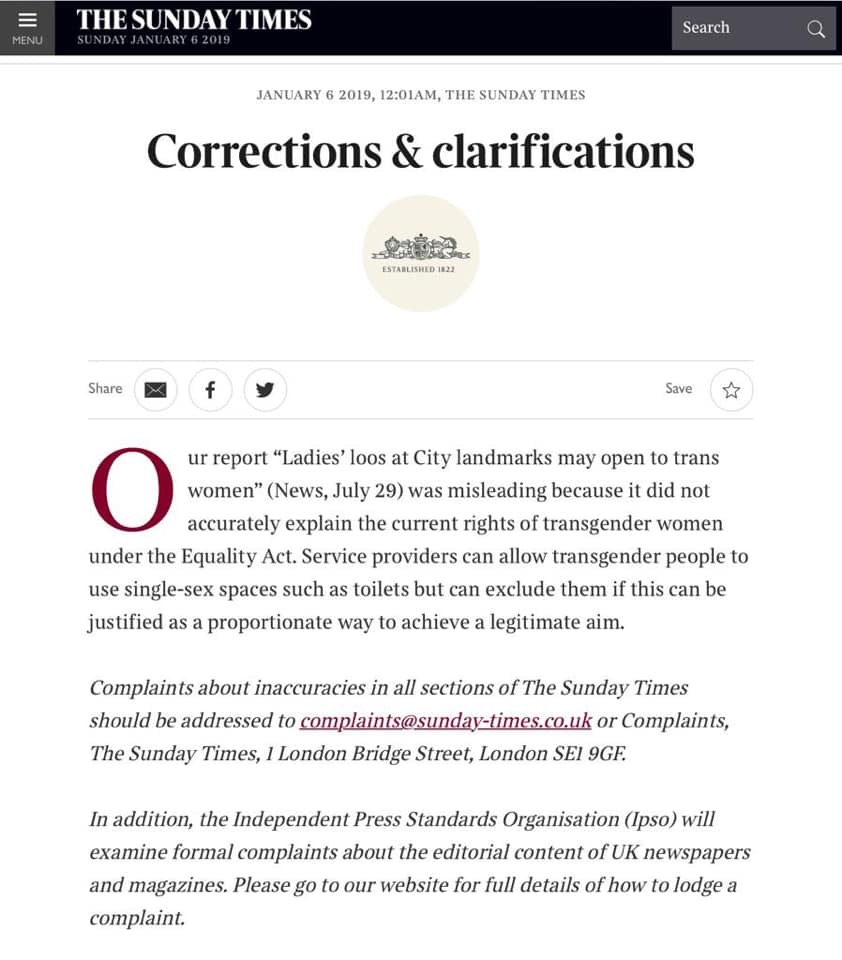
    Another day, another admission by The Sunday Times that an anti-trans article by Andrew Gilligan was made up. This time it was the one about women’s toilets in the City of London, in which Gilligan completely misrepresented the Equality Act to scaremonger about nothing.

    As I wrote at the time:

    I regret to inform readers that noted fantasist Andrew Gilligan has written another article. This week he’s suggesting that the City of London may let trans women use the ladies’ toilets…

    …which the City of London has been doing for eight years, because that’s the fucking law.

    Gilligan is well aware of the Equality Act 2010 and is reminded of it whenever he writes untrue things about trans people or their allies. He just chooses to pretend otherwise, because he’s a disgrace to journalism.

    Six months later…

    But of course, the damage is already done: the article, yet another in Gilligan and The Sunday Times’ ongoing campaign against trans women, appeared during the Gender Recognition Act consultation period and helped fuel anti-trans hysteria. Admitting that it was bullshit six months down the line, long after the consultation closed,  is far too little, far too late.

    To write one incorrect article about trans women is unfortunate. To do it repeatedly suggests malice.

    Update: Paris Lees shares some more mandatory corrections from Mail Online (completely misrepresenting the Mermaids charity, something Andrew Gilligan has previously been censured for too) and The Scotsman (an anti-trans column claiming a hospital has stopped doing gender surgeries when in fact, it is “fully committed” to providing such surgeries.

  • Writing for people who don’t want to read

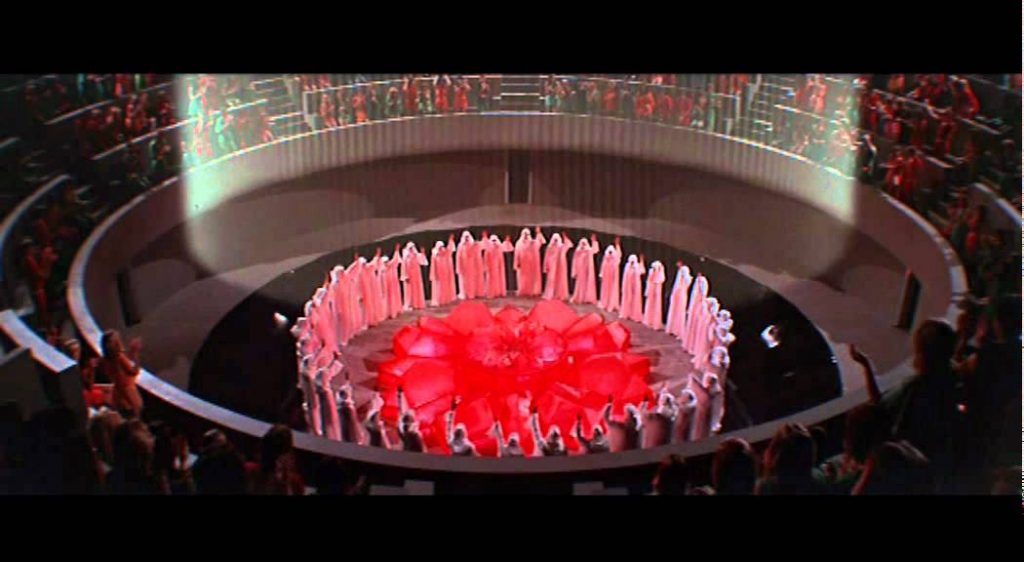
    Logan’s Run-style euthanasia of ageing columnists probably isn’t an option. 

    The editors of N+1 Magazine describe “The New Reading Environment”, where writers and readers are often sworn enemies.

    Readers lose patience, and the careful quoting, like snipping coupons with precision, becomes tearing — into lines, phrases, and points. The space grows for misinterpretation, co-optation, and misunderstanding. All it takes is one podcast host with a grudge and a modest following, like an Evangelical pastor of yore, for a small hell to break loose in your mentions. Your authorial control disintegrates. What you wrote is eclipsed by another person’s idea of what you wrote. It’s the reader’s text now — and so are you, an authorial construction, another text to be bandied about. Does anyone enjoy watching themselves get eaten and digested by other people?

    It’s very good on the resurgence of the op-ed as “an endless stream of annoying and offensive provocations” by controversialists of limited ability, and its origins in editors’ inability – or unwillingness – to differentiate between the “good” readers and the “bad”. All traffic is good traffic.

    FROM THE PERSPECTIVE of the op-ed editors, “good” readers who see through editorial bad faith and express their outrage have become indistinguishable from “bad” readers who don’t, since outrage is a sign of consequence, and both guarantee traffic.

    …When questioned about their motives, the editors responsible for all this irresponsible writing rarely answer. They say only that they are acting in good faith: furthering the dialogue, expanding the conversation, exposing their readers to new ideas, inviting everyone to the table.

    I’m amused by the ideal of “term limits for columnists”, although personally I’d go for the Logan’s Run approach of compulsory euthanasia for the you-couldn’t-make-it-up crowd. Sadly I don’t run the world so it’s likely that they’ll follow what N+1 describes as “compet[ing] for the attention of aging Americans with the dementia-inducing Fox News.” And sadly, I think the article’s conclusion is correct:

    But this is inadequate. Everything about the recent past, and the generalization of the op-ed form across the internet, suggests there is an inexhaustible fund of such figures, a reserve army of op-ed labor waiting in the wings. Twitter has helped turn the internet into an engine for producing op-eds, for turning writers into op-ed writers, and for turning readers into people on the hunt for an op-ed. The system will not be satisfied until it has made op-ed writers of us all.


  • Writers don’t use words by accident

    There’s been a bit of controversy over a new film, Girl, which is about a trans woman. It’s interesting to see how that’s been reported: almost without exception, the trans movie reviewers and reporters who’ve made legitimate criticisms of the film (such as a shocking scene of self-harm they worry might be imitated) have been described as “trans activists”.

    One such “activist” is Out.com’s director of culture and entertainment and former Los Angeles Times reporter Tre’Vell Anderson. Anderson is not amused by the New York Times report of the controversy, which described the criticisms as:

    trans activists and others who consider its scrutiny of a trans character’s body so dangerous that they urge no one to see it.

    That’s a blatant misrepresentation of what people are saying, as well as of the people who are saying it. The criticism suggests that the film may be irresponsible, that it could risk copycat behaviour. Anderson:

    The danger in this lies in the message it sends to the little trans and gender nonconforming kids that might stumble upon this film in their Netflix queue at the top of the year and do what kids do: follow suit.

    Nobody is demanding the film be banned, or that the filmmaker be silenced. But characterising the critics as “activists” – a pejorative term in this context – is an attempt to silence the critics. Anderson again:

    On Wednesday, Erik Piepenburg of The New York Times called the critiques a “firestorm,” invoking language that has long been used to keep critics who aren’t straight white men at bay. Piepenburg referred to us not as critics or reporters, but instead as “trans activists.”

    Frankly, this is a thinly-veiled effort to dismiss, ignore, and invalidate perspectives and critiques that differ from those dominated by newsrooms that are overwhelmingly white, cisgender, heterosexual, and male. Asserting that the pushback the film has received, including not making it to the Oscars foreign language shortlist, is the work of “activists,” erases the necessary and effective work of journalists and career film critics. Left in its place is the impression of a host of negligible, pesky, and unfounded opinions, now seen in the nation’s paper of record as extreme and unreasonable.

    This is something that happens time and again in mainstream media whenever trans-related issues are reported on by cisgender people: any trans person with an opinion, no matter how well informed, is described as an activist. The people on the other side are never characterised as “anti-trans activists”, even when that’s exactly what they are.

    The reason “activist” is pejorative here is because it suggests that, as Anderson explains, “my vantage point… is purely an emotional response and, therefore, must be uninformed.”

    This isn’t limited to trans people. People who don’t agree with the status quo are often described as activists,  zealots, militants, extremists. It’s a form of “poisoning the well”, a debating technique that attempts to undermine the other person’s argument before they can even make it.

    Anderson doesn’t say that the label of activist is inherently bad, but I’d argue that it usually is used in a pejorative sense. An angry trans person on Twitter isn’t a trans activist; a trans person writing to complain about a newspaper article isn’t an activist; a trans film critic with a nuanced analysis of a film isn’t an activist either. And yet that’s how they’re described in mainstream media reporting. To categorise people as such is to dismiss them, to suggest that what they have to say is worthless.

    This can’t be accidental. When you’re a writer of any kind, you know exactly what words mean and the power they have.

  • The war on observable reality

    Little Mix: definitely a thing that exists. And hurrah for that.

    There’s an interesting piece by Alex Hern, the Guardian’s tech correspondent, about online fakery. He thought it would ruin the world, but considerably less sophisticated bullshit got there first.

    On social media, the public is for the first time exposed to the raw firehose of news, with no ability or desire to perform the work of verification, with incentives for sharing the most sensationalist content.

    Faced with a race to keep up with the pace of change and an explosion in the availability of new information sources, hoaxes and untruths have gradually infiltrated the pages of even the most respectable journals…

    This is an internet-age phenomenon, technology making an age-old problem considerably worse.

    The internet has brought us what’s best described as a war on observable reality, and it goes rather like this:

    Expert: I have two legs.
    Person: No you don't.
    Expert: Yes I do. [points] One leg. Two. 
    Person: No.

    The real version usually has more swearing and personal abuse, but you get the idea.

    This isn’t the same thing as having a difference of opinion. This is rejecting observable reality.

    Let’s bring Little Mix into this for no good reason.

    Little Mix are a pop band. I think they’re very good. You might think they’re absolutely awful. But the fact that Little Mix exist, that they play concert venues, make videos and sell records is a fact. If I were to say that I think Little Mix are brilliant and you were to say that Little Mix don’t exist, you would clearly be a few sandwiches short of a picnic.

    And yet many people are denying provable reality, often about much more serious things. Donald Trump’s cry of “fake news!” when he really means “inconvenient news!”, the flat earthers and the moon landing truthers are the most obvious example, but it happens constantly, all over the place. Politicians say things that are provably untrue on air and aren’t challenged on it. Fringe views are given a platform as if they’re legitimate. Blatant falsehoods are circulated as if they’re facts. Propaganda is reprinted.

    As Hern notes, this is because gatekeeping has collapsed.

    Here’s how it used to work. Big-name American magazines (and some of the publishers I work for) famously use armies of fact checkers who go through entire articles demanding citations: where’s the evidence for this? How can you prove they said that? Which article was this in? If you can’t prove it – and proof requires more than some website by some crank – it doesn’t get published. The UK wasn’t quite so detailed but you still had to get through sub-editors, who were famously unforgiving.

    That scrutiny – any scrutiny – is increasingly rare. Women’s magazines run debunked and sometimes dangerous health advice by new-age idiots. Newspapers parrot bullshit by anti-LGBT pressure groups. Radio presenters let politicians tell the porkiest of porkies. TV news politicises real events by using terms such as “migrant crisis” to describe something that’s nothing of the sort.

    And because traditional media still has a cachet and some remaining trust, once bullshit makes it into the pages of a magazine or the website of a newspaper, many people think it’s true. Bad information is lent legitimacy.

    Commenting on Hern’s piece, journalist and former publisher Adam Banks, posting on Twitter, hit the nail on the head:

    Fake news tech isn’t the point. The point is we need media that’s incentivised to explain what’s real and debunk what’s fake, not paid for anything that catches anyone’s eye.

    Today we have the reverse, a toxic brew where what feels right is more important than what is right, where what gets clicks matters more than any of its consequences, where the only people getting paid are the ones who can make their readers, listeners or viewers angry or upset instead of better informed. It’s not sustainable, and it’s not valuable.

    We get what we pay for. This is what we get when we don’t want to pay at all.

  • Green sheep, bendy bananas and boys having periods

    It’s Sunday, the day when the UK press likes to post multiple anti-trans articles. I want to look at one from last week. It’s the story that virulently anti-trans MP David Davies described on Twitter as the “latest example of barking mad trans-activism”: the idea that eight-year-old boys will be told they can have periods.

    The story has legs: I’ve seen it turn up in Sky News Australia and the Monserrat Reporter. Talk radio hosts have used it as evidence that “the world’s gone mad” and of “bonkers Britain” and the usual columnists have weighed in to moan about the excesses of trans activism.

    Is it true?

    Here’s the document the coverage refers to (pdf). It’s a presentation by the neighbourhoods, inclusion communities and equalities committee of Brighton & Hove council on the subject of period poverty, the horrible situation where some students don’t have access to sanitary products because their parents are broke. This has an effect on their education because some of those students stay home when they have their period instead of attending school.

    In the 3,000 word document, trans people are mentioned exactly once, in a description of the period positive educational approach. The document notes that:

    • Trans boys and men and non-binary people may have periods.

    This is undeniably true: irrespective of how you identify, if you have the appropriate plumbing then you may have periods. And that means you can be affected by period poverty.

    This has got nothing to do with any sinister agenda: it’s an attempt at inclusivity. And yet what seems to me like a perfectly rational and humane point – that period poverty can affect students who do not necessarily identify as female – has been used once again to attack trans people, and young trans people specifically. Scoring a political point is more important than any child’s welfare.

    What we’re seeing here is an old trick with a new target.

    It’s sheep we’re up against

    Exaggeration and falsification have long been used by newspapers to attack people they don’t like and anything that’s happened since 1953. For example, in 2014 Mail Online readers in Australia finally got a story we Britons have known about since 1986: the evils of politically correct forces demanding children sing alternatives to “baa baa black sheep “because the black bit might be racist. 1

    It was a real story – a couple of Australian kindergartens had indeed changed the lyrics for fear of causing offence – but it was an isolated incident, just as it was in 1986 when a single nursery (Beevers Nursery in Hackney, London; a private nursery, not a council-controlled one) rewrote the song as an exercise for children and the newspapers went mad.

    The English story made the Daily Star and then The Sun and the Sunday World, and then the Daily Mail embellished it by claiming Haringey council, not Hackney, had ordered playgroup leaders to attend racial awareness courses where they were ordered to make children sing “baa baa green sheep” instead. 2

    As the saying goes, never let the facts get in the way of a good story. It was completely untrue, and Haringey council attempted to sue the newspaper but had to drop the legal proceedings for lack of funds. The Mail version of the story made it to the Birmingham Evening Mail, the Liverpool Echo, the Yorkshire Evening Press, the Birmingham Post, the Sunday People, the News of the World, the Sunday Mercury, the Carlisle Evening News and Star, the Yorkshire Evening Courier, the Ipswich Evening Star, the Sunday Times letters page, the Hendon Times and the Sunday Telegraph.

    The story continued to spread, this time with Islington council being blamed, and it turned up in the Economist, the Daily Telegraph, the Daily Express, the Daily Mirror and the Sun. The story was used in political broadcasts by the Social Democratic Party, and it came back from the dead in 1998 in the Sunday Times. Over the next five years it would pop up from time to time in various newspapers. In the two decades since it began, only two newspapers have printed corrections admitting that it isn’t true.

    Sheep weren’t the only fabrication. Stories about manhole covers being renamed were invented by the newspapers, as were supposed bans on black bin bags. Other stories about “super-loos for gypsies” or special treatment for gay people were pretty dodgy too.

    According to the Media Research Group of Goldsmith’s College in the University of London, British tabloids ran some 3,000 news stories about such “loony left” ideas between 1981 and 1987; the vast majority were either partially or wholly fabricated and were targeted against the handful of London councils under Labour control. 3

    Very similar stories were fabricated about the European Union too, most notably by a young journalist called Boris Johnson. Between 1989 and 1994 the Telegraph’s Brussels correspondent filed knowingly exaggerated and sometimes entirely invented stories about supposed EU madness, creating a whole new genre of Europhobic scare stories. Other journalists were appalled, but the stories were very successful and ultimately helped pave the way for 2016’s Brexit vote to leave the EU.4

    It’s not reporting. It’s propaganda. And it works.

    It works because most people remember just the headline – and that headline can have tremendous power. In a series of studies published in the Journal of Experimental Psychology: Applied, Ullrich Ecker of the University of Western Australia tested the effect of misleading headlines on people’s perceptions on hot issues such as genetically modified crops. As The New Yorker reports:

    In the case of the factual articles, a misleading headline hurt a reader’s ability to recall the article’s details. In the case of opinion articles, a misleading headline, like the one suggesting that genetically modified foods are dangerous, impaired a reader’s ability to make accurate inferences. For instance, when asked to predict the future public-health costs of genetically modified foods, people who had read the misleading headline predicted a far greater cost than the evidence had warranted. 1

    Everybody remembers the headlines about the EU’s bonkers ban on bendy bananas. It was completely invented, but the stories were a key part of a long campaign against the EU that ultimately resulted in the UK voting for Brexit.

    Most tabloid stories about trans activists or the sinister trans lobby are fictional too, but by the time they’re fact-checked – if they’re fact-checked at all; there are so many of them few people have the time – the damage is done. Throughout the land, breakfast tables vibrate to the sound of readers harrumphing about political correctness gone mad.

    anImage_2.tiff

    1 http://www.dailymail.co.uk/news/article-2796447/lyrics-baa-baa-black-sheep-changed-kindergarten-teachers-racial-overtones.html

    2 Curran, J.; Petley, J.; Gaber, I. (2005). Culture wars: the media and the British left. Edinburgh: Edinburgh University Press. pp. 85–107. ISBN 0-7486-1917-8

    3 John Gyford; Steve Leach & Chris Game (1989). “Political change since Widdicombe”. The changing politics of local government. Routledge. pp. 310–313. ISBN 9780044452997.

    4 https://www.theguardian.com/commentisfree/2016/jul/15/brexit-boris-johnson-euromyths-telegraph-brussels

  • Mining the culture wars for clicks

    Have you seen the gender neutral Santa story? Of course you have. It’s been everywhere. The tale that 1/4 of people want a gender neutral Santa has appeared in my news feeds so often I could recite it from memory, so I will.

    A new study found that 25% or 26% or 27% of people – the numbers vary from report to report – want Santa to be gender neutral.

    If you’ve reported it like that, you’re on the naughty list.

    The “study” was a survey by a graphic design company of a few hundred customers. Those customers of unspecified demographics were specifically asked what gender a modern Santa should be, and given the choice of male, female, or gender neutral.

    This is not what you would call a reliable poll.

    Nevertheless, the story is everywhere. It’s on BBC Three and in the New York Post, on News.com.au and PinkNews, on Fox News and Newsweek and in the Mirror and the Daily Mail.

    This kind of bullshit infests the media, and it has consequences. As Joseph Earp writes in Junkee:

    Throwing out these distorted figures and studies feeds the right-wing lunatics who believe that members of the LGBTQIA community are secretly plotting to take over the culture. And it encourages a pile-on of hatred towards the community from those who consider themselves to be part of the ‘sensible centre’ (whatever that means.)

    I’m not sure that Earp is right about the intent of the graphic design company, which “knowingly weaponised the ire of the mainstream media”. I suspect they just thought they were being funny and/or cute.

    But there’s no doubt about the malicious intent of much of the reporting. Somehow a bullshit story about a fictional character is evidence of the evils of LGBTQ people generally and trans people in particular.

    When the story reaches the likes of the Daily Mail or Breitbart, which of course it has done, it’s presented as the latest example of political correctness gone mad, of the sinister trans lobby pushing its values down ordinary god-fearing people’s throats.

    This tweet is by no means unusual.

    i’m all for same sex marriage, trans operations, etc,but the LGBTQ+ community is deadass starting to shove their way of life down people’s throats. equal opportunity for shows & movies is great, but not every movie needs a gay lead & Santa doesn’t need to be gender fuckin neutral

    This happens time and time again. A story with little or no connection to the LGBTQ community is presented as the latest example of their unreasonable demands and used to demonise them in the media and on social media. It’s already made its way into anti-LGBTQ opinion pieces, and it’ll continue to circulate for years to come as an example of those terrible LGBTQ activists and their unreasonable demands.

    Children who behave badly don’t get Christmas presents. Sadly there’s no such penalty for journalists.

  • Boo! I’m a ghost!

    Ghostwriting is a very odd thing to do for money. I’ve done quite a lot of it, from ghostwriting entire books to writing public statements and blog posts in character as various executive types. I’m good at it, but it’s a weird gig – especially in books, where the pay doesn’t really reflect the amount of work involved and your existence is kept a secret from the readers.

    Sometimes it just isn’t worth it. About a decade ago I was offered the gig of ghostwriting a book of cosmos-focused hippy-dippy bullshit by a Very Famous Television Personality, but I turned the gig down on the not unreasonable grounds that said Very Famous Television Personality was a twat. Some gigs just aren’t worth doing.

    That’s clearly the case for the ghostwriting gig Sean Patrick Cooper applied for, and writes about in Baffler magazine. You don’t need to be a writer to enjoy the story, although if you are a writer you’ll find yourself reading a lot of it through your fingers.

    Sundered from all the now-obsolete protections and best practices of a free and independent press, journalists will do what displaced workers everywhere must: get on with the necessary business of making a living. And a select few will fall into what is perhaps the grimmest possible simulacrum of journalistic endeavor: they will join the now burgeoning market for luxury ghostwritten memoirs.

    The whole piece is a horrible joy, and it has some interesting points to make about the horrible shit-show professional writing so often becomes.

    Faced with job that pays a pittance, Cooper decides that it’s better to outsource the task to a writer even more desperate than he is. The gig is horrifically paid to begin with, but Cooper’s plan – which I suspect is by no means uncommon – is to delegate it so that the person actually doing the work is paid even more horrifically.

    The future of media, I realized, wasn’t about writing well or sustaining a core democratic institution. It was about delegating to the lowest bidder. I calculated that if I got the LifeBook gig, with this American Ghostwriter’s going rate on a fully commissioned LifeBook project at worst 2.4 cents a word, then I should be able to find someone out there willing to do the writing exam for less than that, and still turn a profit of a few pennies.

    This particular piece is about a very particular niche, which is vanity projects for the 1%. But a lot of what Cooper describes is relevant to much wider range of writing. As he says at the very beginning of the piece:

    THE PROGNOSIS FOR AMERICAN JOURNALISM is not good. In due course, the cancerous forces of Google, Facebook, and algorithmic optimization will complete the terminal ravaging of the journalistic trade from the inside… as journalism slouches toward oblivion, it churns out high-outrage, low-grade content for its web-addled audience, who click and share anything that flatters their ideological preconceptions.

  • “We” didn’t miss anything

    This week, The New York Times made a podcast called “The Rise of Right-Wing Extremism, and How We Missed It”. Esquire’s Charles P Pierce is not amused: who, exactly, does the NYT mean by “we”?

    To take the simplest argument first, “we,” of course, did no such thing, unless “we” is a very limited—and very white—plural pronoun. The violence on the right certainly made itself obvious in Oklahoma City, and at the Atlanta Olympics, and at various gay bars and women’s health clinics, and in Barrett Slepian’s kitchen, and in the hills of North Carolina, where Eric Rudolph stayed on the lam for five years and in which he had stashed 250 pounds of explosives for future escapades.

    Pierce – rightly, I think – argues that the problem isn’t that these things aren’t noticed, or flagged up. It’s that the people who warn about them are ignored by a largely urban, white, straight media class.

    One of the best examples of that is the rise of the hard right in online spaces, where women and minorities have been yelling about the problems for many years now. Because the abuse didn’t affect people who weren’t women or minorities, media didn’t give a shit. This has been going on for a long time, and its reach is enormous.

    Here’s Matt Miller, also in Esquire, on how online trolls have poisoned Star Wars fandom.

    These “trolls” are the anonymous, despicable beating heart of America. They are holding up a mirror to our society. They are insuring that the worst of us have a voice to incite real change. They elected an amoral, racist golden toilet for a president. And that same sickness has bled into something once as harmless as a children’s space movie.

    Something that’d be funny if it weren’t so serious is the way anti-trans people so frequently follow the same script: starting off by being hateful towards us before – surprise! – being hateful to other groups too. So the anti-trans legislators in the US start with us and then target cisgender women and trans men’s reproductive freedom. Anti-trans cultural commentators turn out to be misogynist. Anti-trans voices variously include domestic abusers, racists and anti-Semites.

    It’s become a bleak running joke in some trans circles when yet another vicious bigot turns out to be viciously bigoted against more than one minority. That’s the thing about bigotries. They tend to travel together.

    I wrote about neo-Nazi ideology yesterday, and that’s a good example of the kind of thing that gets completely ignored until it explodes into real-world violence. It’s of particular interest to me because neo-nazis online are very specifically and openly attempting to groom “gender critical” – ie anti-trans – women because they believe these women are very close to being “red pilled” and becoming “tradwives”.

    Red pilling, if you’re not down with idiots, is an idea from the film The Matrix: if you take the red pill you will see the world as it really is. The fact that The Matrix was directed by two trans women, the red pill is based on estrogen tablets and the whole sodding film is quite probably a trans allegory escapes these dolts, because neo-Nazis aren’t very clever.

    And “tradwife”? A tradwife is a woman who rejects feminism and embodies “wifely” qualities of submission, chastity and domestic servitude.

    The idea that any self-respecting feminist would be in cahoots with these woman-hating tools is mind-boggling, and yet here we are.

    Again and again the most vocal anti-trans voices echo the tropes of the religious right and the alt-right, shaming women for supposedly inappropriate behaviour. reinforcing the biological essentialism that feminism fought so hard against and supporting serial abusers of women because their enemy’s enemy is their friend. To see feminist groups in open alliance with evangelical, anti-women groups is quite something to behold.

    This isn’t just happening in anti-trans circles. Neo-nazis have deliberately targeted anywhere they think they can find vulnerable, angry people: not just forums of angry women but for young, angry men who can’t get laid, forums for people with mental health issues, forums where people are lost and desperately need somebody coming along to take them under their wing.

    The problem with hate is not that nobody’s talking about it. It’s that by and large, the media isn’t listening to the people who are desperately trying to sound the alarm: women, ethnic minorities, LGBTI people, disabled people. And when rhetoric becomes reality, when online radicalisation makes a Christian shoot up a synagogue or a straight guy shoot up a gay bar or an “incel” drive a truck into a crowd of shoppers, they wail “how did this happen? How did we miss this?”

    You missed it because you weren’t listening.