Category: Bullshit

Pernicious nonsense and other irritants

  • Old news

    Here’s The Sun newspaper in 1992.
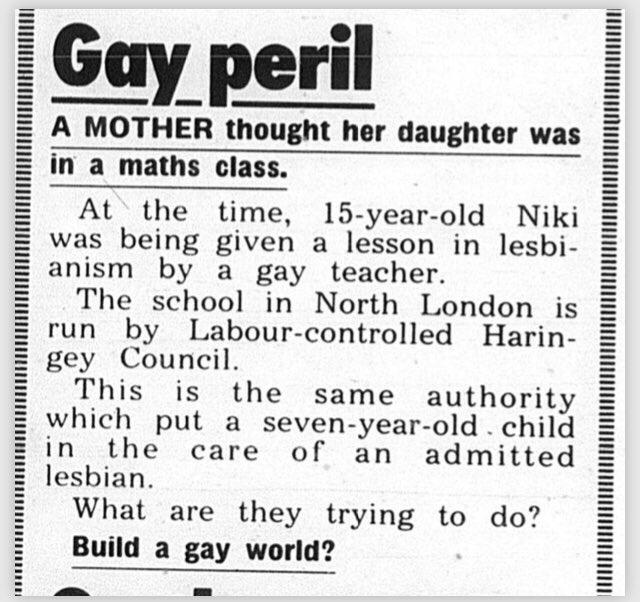
    If you think that sounds familiar, have a read of Terry Sanderson’s Media Watch column from that month, May 1992. Sanderson spent a quarter of a century battling against bigotry in UK newspapers, and sadly the publications and the writers don’t seem to have changed much.

    There was Julie Burchill:

    Julie Burchill is rapidly becoming the most prominent commentator on gay issues in the straight press… the message comes over loud and clear that Julie has reached the conclusion that gay men are the ultimate oppressors of women. This, I think, is her problem. It is because she imagines all gay men hate women (or, worse still, patronise them) that she has got this bee in her bonnet about Aids.

    Burchill would later turn her ire towards trans women, who she now appears to believe are the ultimate oppressors of women.

    There were single-issue pressure groups gaining disproportionate press coverage for their intolerant views and allegations of sinister lobbies endangering children:

    During the election campaign The CFC (prop. Stephen Green) was issuing press releases like confetti.

    Nearly all of them concerned homosexuality. At the CFC’s prompting, The Sun reported (26 Mar): “Social workers are telling ten-year-old kids in care that gay sex is part of growing up.”

    …The Daily Express (23 Mar) saying: “Labour and Liberal Democrat policies on gay rights would put children at risk from homosexuals.” Mr Green “condemned” the politicians concerned saying that any changes in the law would “endanger children”: What The Daily Express failed to extract from the CFC’s press release was revealed by The Independent (3 Apr). The CFC had actually said that Neil Kinnock and David Steel have supported “the child sex movement” (which is the CFC’s term for the gay movement).

    There was dubious crowdfunding for publications advocating dangerous conversion therapy:

    Mr Green revealed to the Independent that “he’s nearly raised the £11,000 he needs to publish a book on homosexuals provisionally entitled Emotional Orphans.” The book will explain “how homosexuals may achieve heterosexuality” which he says is a “painfully difficult process”.

    There were newspapers deliberately equating being LGBT+ with being a criminal:

    “Outrage as boy is handed over to lesbian criminal” said The Daily Mail (I Apr) with The Sun announcing: “Lefties put boy in care of lesbian jailbird”. Note how the words “lesbian” and “criminal” become interchangeable in these circumstances: which is the more horrid prospect for the small boy to cope with?

    And there was the “they’re coming for your children” moral panic as illustrated in the “gay peril” cutting at the top of this post.

    Awful, isn’t it? Two years later the Sunday Times, which railed against the so-called homosexual lobby, argued that HIV wasn’t the cause of AIDS and that saying so was the “HIV bandwagon” pushed by “the legions of the politically correct”. Andrew Neil, the editor at the time, believed that the link between HIV and AIDS was a conspiracy theory and that discussion of it was a “public misinformation campaign”.

    Also in 1994, the newspapers fired their final salvos in their crusade against moves towards equalising the age of consent for straight and gay people (the age for straight people was 16 but in 1994 it was decreased from 21 to 18 for gay people. Equality wouldn’t happen until the following decade).

    Sanderson:

    Naturally the “we must protect the children” argument was trotted out repeatedly. This is a sensitive area, and consequently was played for all it was worth by “family” groups and other politically and religiously motivated opponents of change.

    …The Daily Express, meanwhile, distorted the British Medical Association’s support for a lowering of the age of consent to 16 by headlining it: “Teenage Aids scourge” (January 14th).

    Richard Littlejohn had some thoughts, calling Peter Tatchell a “professional sodomite” who “holds recruiting drives outside schools”.

    And then there was the Telegraph.

    The article was illustrated by a cartoon that Goebbels wouldn’t have been ashamed of. It showed lock gates imprinted with the word “consent” being opened ready to engulf the unsuspecting people below.

    Ms Burrows, a woman of extraordinary fanaticism, alarmingly claims in her article that “a homosexual lifestyle reduces life expectancy from 75 to 42”. Where on earth does she get such a statistic? Why, from the Family Research Institute of Washington.

    The Family Research Institute is described by the Southern Poverty Law Centre, the US organisation that tracks neo-Nazis, race hate organisations and other lovely people, as an anti-LGBT hate group.

    This might sound familiar too.

    This latest gem about the reduction of life expectancy has been repeated at least twice over the radio by members of these “family” groups, and in neither instance was it challenged.

    Then, like now, bigots were given a platform to spout vicious bullshit about marginalised people without fear of challenge; then, like now, national newspapers incited fear and hatred of LGBT+ people; then, like now, the regulators did nothing and the victims’ pockets weren’t deep enough to fight the newspapers’ lawyers.

    A lot can change in 25 years, but apparently not in the UK mass media.
  • It’s not video games. It’s Nazis

    In the aftermath of the latest US gun massacres, there have been lots of attempts to pin the blame on things. Despite at least one shooter leaving yet another manifesto that says “I did it because I’m a huge Nazi”, US Republicans and right-wing types generally have been quick to apportion the blame for gun massacres to pretty much anything else. Some Republicans claim it’s because of the gays, others because of the trans folks, and quite a few have pointed the finger at video games.

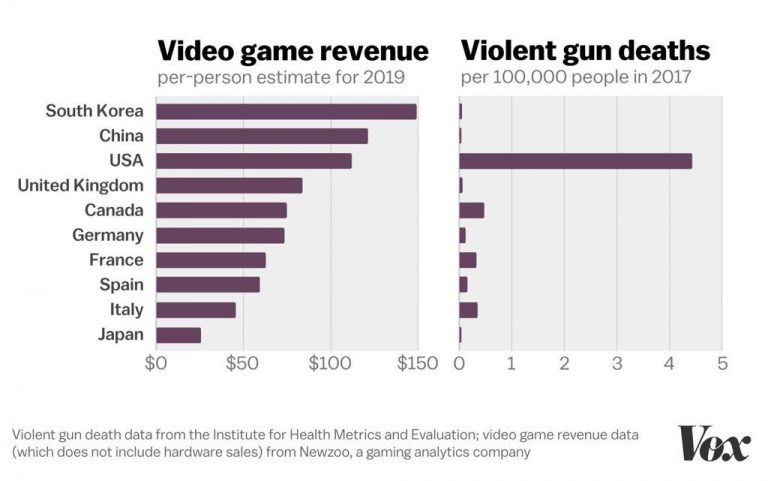
    Here’s an interesting graph.

    Clearly if video games caused gun deaths, you’d expect to see many more shootings in China and South Korea, where video games are even more popular than in the US. And you can’t say “ah, but they don’t play violent games like US gamers do”, because we do in the UK and we don’t have regular school shootings either.

    Access to guns is a huge part of it, but let’s not turn away from video game just yet. Here’s author Christopher Keelty on Twitter.

    Video games do not make murderers. If they did, China (which has almost as many gamers as the US has humans) would have constant domestic attacks.

    HOWEVER.

    Gaming-related media in America is filled with Nazi trolls working hard to recruit children.

    If you’re not of a generation that plays games, this may well be news to you. However, it’s been well known in tech and tech journalism for years.

    Sites like 4chan and 8chan [the site connected to the last five gun massacres] were built on gaming, by gamers for gamers. Reddit and YouTube have MASSIVE gaming communities. All are infested with white supremacist terrorists, working to get your kids killing for them.

    It’s often not the content itself that’s dangerous, it’s the comments. Virtually any Google search for ANY game will turn up at least one page with Nazi talking points in the comments. Try it and see.

    He’s right. People all over the world play video games, but people all over the world don’t have the same incredibly toxic online media that the US does.

    Games don’t cause murders and people who play video games aren’t Nazis. But gamers in the US in particular have proven to be a very fertile recruiting ground for some of the worst people in the world.

  • Stay in your lane

    In a study that’s caused much appalled amusement, researchers at Penn State have discovered that men avoid things such as using reusable shopping bags for fear others will perceive them as gay.

    It’s interesting but not surprising that the policing of this stuff is done by both men and women.

    In a series of studies, the researchers evaluated specific pro-environmental behaviors that previous research suggested were seen as either “feminine” or “masculine” and examined whether they affected how people were perceived.

    They found that men and women were more likely to question a man’s sexual orientation if he engaged in “feminine” pro-environmental behaviors, such as using reusable shopping bags. They were also more likely to question a woman’s sexual orientation if she engaged in “masculine” pro-environmental behaviors, such as caulking windows.

    A man with a Bag For Life is gay; a woman doing minor DIY is a lesbian.

    The researchers found that participants whose behaviors conformed to their gender were seen as more heterosexual than those whose behaviors did not conform to their gender, which may suggest participants were using traditional gender roles as clues to sexual identity.

    There’s a whole knot to unravel here, but ultimately it’s about the way we – often unconsciously – reinforce stereotypes. A man who does the recycling isn’t manly; a woman who can fix something isn’t womanly. Clearly, that means they’re gay.

    These beliefs are so facile there’s no point digging into them here. But the wider point is that these beliefs aren’t just perpetuated. They’re policed.

    It’s not just the policing by others that happens, although God knows that happens. We police ourselves too. We internalise the rules and actively try to ensure we don’t break them for fear of the consequences. Sometimes we pass on those rules to our siblings or our children, sometimes as advice and sometimes as mockery.

    Every day in myriad ways we’re told to stay in our lanes.

  • “Gender critical” philosophy doesn’t make sense

    The culture wars over trans people have made their way to the philosophers’ community, with some high-profile anti-trans people wrapping their views in philosophical arguments. Unfortunately, Luke Roelofs writes, those arguments don’t make sense.

    This is a long read, but it’s interesting if you’d like to understand why issues such as policing bathrooms are so complex and potentially bad for all women.

    Here’s a quick extract.

    So in practice, ‘gender-critical’ doctrines just provide rationales for policing gender nonconformity. And the big lie at the heart of it, that people are seeking transition to better fit gender stereotypes, justifies this by painting the nonconforming people being policed as the real gender police.

    Just like with bathrooms, the whole GC discourse about gender roles ultimately functions to obscure the real stakes and the real options. You can police people’s gender expression, or you can dismantle the prison of gender, but you can’t do both. GCRF [Gender Critical Radical Feminism] is a feminist fig leaf waved in front of social conservatism.

  • The Times doesn’t care about people in care

    Following on from my earlier post, The Times’ story about university places for care experienced people has grown worse.

    Something I didn’t spot in the original was the way the piece drew a distinction between “disadvantaged” pupils and “bright” pupils, as if the latter couldn’t possibly include the former. Again, the word choice is significant.

    Writing on Medium, Charlotte Armitage goes into more detail.

    What this type of article does is fuel discrimination towards Care Experienced people. It creates separation between ‘star pupils’ and Care Experienced pupils and it can be understood to be implying that someone cannot be both. This has been demonstrated by comments underneath the article, outraged that pupils “who happen to have stable and functioning families are penalised”.

    The Times’ editor has defended the piece as “balanced”. The comments have continued. Here are some that Armitage screenshotted:

    “Slap in the face to all the hardworking parents who actually love and take care of their children.”

    What matters isn’t the quality of the student, but the quality of their parents.

    “University should be for the brightest and not a test tube for social engineering.”

    People who’ve been in the care system are not the brightest.

    “Bright children denied a university place, so a thicko can have it?”

    People who’ve been in the care system are “thickos”.

    There is of course no connection whatsoever between whether someone’s been in care and their ability. But there are lots of reasons why their opportunities are more limited than those of, say, a middle-class kid.

    I was a middle-class kid. I didn’t suffer from disruption to my education from being moved from place to place, family to family, so I didn’t have to supplement my qualifications by doing further education classes to met any entrance requirements. Even if I’d wanted to do those classes, I would have had the luxury of a roof over my head, food in my belly and money in my pocket so I could concentrate fully on my studies.

    In the end I didn’t go to college or university. But I didn’t go because I chose not to, not because the option wasn’t available to me. Had I gone, I’m sure my parents would have supported me there too.

    As Armitage writes, that’s not how it usually works for care experienced people. The disruption in earlier life means you need to attend further education just to have the same qualifications as everyone else – and chances are you’ll be doing that while working multiple jobs to keep a roof over your head, trying to study when every bit of you aches with tiredness. All the while there is no plan B, no safety net, no helpful parent to bail you out if you lose your job or encounter an unexpected bill.

    A guaranteed offer of a university place doesn’t change any of those things. It’s still going to be much, much harder for people coming out of the care system to get into university than it is for people from more stable family backgrounds. But as Armitage says:

    The guaranteed offer is not about discouraging applicants who have had fortunate upbringings and were already likely to succeed. It is about giving the people who missed out on so much as result of childhood trauma and state intervention a chance, so that they too, can reach their full potential and go onto live prosperous and successful futures.

    It won’t turn privilege into disadvantage. Those with straight A’s will still gain entry into university. It just means Scottish campuses will provided the opportunity to learn to a more diverse array of students.

    Back to the article. The Times likes to write about groups of people without giving a voice to those people, and the coverage of care experienced people follows that model. Here’s one of the people they could have talked to: Kenneth Murray, writer and award-winning campaigner.

    Here are some bits from his tweets to The Times’ Scottish editor.

    @magnusllewellin I do quite a lot of work on the stigma that Care Experienced people face, particularly with the media.

    In fact I’ve worked with some of the journalists in your employ on the importance of language around issues of Care Experienced people.

    It makes me sad to see this shift.

    Whilst I understand there are real issues around quotas & access to university for many groups – using Care Experienced people in this way is incendiary.

    Care Experienced people like me have faced many struggles to get where we are. Through hard work, determination & some help.

    We really don’t need a national newspaper, a journalist and an editor from that paper compounding the stigma that surrounds us & any support we receive to help rectify decades of institutional failure.

    I find it really bizarre that such a quality newspaper, focused on providing great journalism would bypass anyone with experience of care.

    Your paper has managed this succesfully in the past. I really don’t understand why they haven’t this time.

    This is something various minorities have seen too: they give up their time to meet with and even deliver courses to journalists for publications that will later misrepresent and even demonise them.

    All too often, The Times and its journalists are not coming from a place of ignorance. They know what they’re doing is wrong, and they do it anyway.

  • I’m hacked off with it too

    I’ve written before about the toothless press regulator IPSO, which was set up by the press specifically for the purpose of not regulating the press. To take just one recent example, IPSO found that when The Times makes up quotes, doing so doesn’t breach the rules on accuracy.

    The ruling was on a story about transgender people, who have been subjected to an astonishing hate campaign for some time now. Newspapers have become adept at sticking to the letter of the rules rather than the spirit: all the rules on discrimination and demonisation apply to individuals, not to groups. So if a paper were to publish a column claiming that trans person X is a predator, that’s against the rules (as well as defamatory). If the column claims that all trans people are predators, that’s fine.

    In other words, it’s not okay to incite hatred against one person. But it’s fine if you want to do it against an entire minority group.

    The Hacked Off campaign is attempting to highlight this in its latest report, “The denigration, abuse and misrepresentation of the movement for transgender equality in the press”. It focuses on two dozen high profile and often very abusive articles that appeared in the mainstream press in recent months. As Hacked Off put it on Twitter: “Some newspapers have resorted to distortions, inaccuracies and explicit transphobic abuse.” Over this period, UK hate crimes against trans people have increased by 81%.

    The problem is specific to newspapers. We don’t have endless abuse of trans people on TV because Ofcom regulates broadcast media. There’s no such regulation for print.

    Despite the 2013 Cameron Government legislating for an independent system of media regulation, the current Government have not brought it into
    force. This has left one independent regulator operational – but membership is entirely optional. As a result, none of the major websites or newspapers have signed up.

    Instead, most publishers are members of IPSO, which is a newspaper association and complaints-handler under the control of newspaper executives. I

    In other words, the people being asked to decide whether content breaks the rules are the people who publish the content that breaks the rules.

    I used to be against press regulation, because many journalists are fine people who do important work. But some of the biggest publishers in the country have turned their platforms into bully pulpits, repeatedly, mendaciously publishing malicious content designed to hurt the most vulnerable people in our society: not just trans people but minorities of all kinds. We’ve seen exactly the same maliciousness directed at muslim people, for example, and the same rubber-stamping by IPSO.

    IPSO is not fit for purpose and sectors of the UK press are out of control. What they do is not journalism, and it does not deserve protection.

    There’s a petition demanding change here. Please sign it. Every name helps.

  • When Rod Liddle is trending

    The heart always skips a beat when a famous person’s name appears in Twitter’s “trending” chart. It usually means they’ve died or been implicated in sex offences. So when Rod Liddle turned up the other night, my immediate reaction was to wonder whether he’d punched another pregnant woman in the stomach. Thankfully no: he was trying to defend apparently racist columns on TV. I’m surprised he didn’t claim his column had been hacked, like he did when his account was caught posting racist bilge on a football fan forum.

    Liddle is a terrible human being who writes terrible things on behalf of terrible people. And now he’s excreted another terrible book.

    Is it any good? Of course it isn’t. But at least it means Fintan O’Toole can review it.

    Never,” Rod Liddle writes in his jeremiad on the “betrayal” of Brexit, “have so many blameless people in this country been held in such contempt, or been subject to such vilification by an elite.” Really? Who wrote in 2014 of Britain as “a nation of broken families clamouring about their entitlements siring ill-educated and undisciplined kids unfamiliar with the concept of right and wrong”? Who described with relish “the hulking fat tattooed chavmonkey standing in the queue at Burger King”? Who characterised the British masses as inhabiting “a dumbed-down culture”, being in thrall to “the background fugue of idiocy, the moronic inferno, of celebrity fuckstories”, and spending their time “watching TV, masturbating to pornography on the internet, getting drunk”? That would be Liddle in his last book, whose title, Selfish Whining Monkeys, may just possibly have had a slight whiff of contempt and vilification.

    And that’s just the opening paragraph.

  • Probably not coming to a newspaper near you

    One of the things anti-trans writers like to go on about is the spectre of “detransition” and surgical regret: according to them, trans-related surgeries are acts of mutilation that many people will go on to regret.

    As ever, the facts tell a very different story. I’ve mentioned previously that the NHS in England reported a detransition rate somewhat different from the 80% claimed by the anti-trans mob: it was 0.47%.

    Here’s more data, this time covering surgical regret rates from a much bigger sample: 6,793 people over 43 years.

    Despite the large increase in treated transgender people, the people who underwent surgery but regretted their decision was 0.5%.

    By comparison, the regret rate for knee replacement surgery is 20%.

    As Christine Burns MBE, author of Trans Britain, points out:

    If any other branch of medicine had such good results the doctors involved would be given medals. It says volumes about the state of mind of anti-trans commentators that they keep on trying to pretend that an outstandingly successful medical treatment is vastly regretted.

  • Schools protests to go nationwide

    Back in March, I wrote about the people protesting outside a Birmingham school over inclusive education and noted that while the protests were reported as Muslim, many of them were Christians. Also in March, I wrote that “US money is incoming and these protests will become more widespread.”

    Yesterday, INews reported that the protests are going nationwide thanks to the sudden appearance of “grass roots” activist groups.

    We’ve seen this pattern over the last couple of years with anti-trans groups, many of which have proven links with the US religious right. But trans people were only the testing ground for the evangelicals and their money.

    Now the focus is moving onto the wider LGBT+ community and women’s reproductive freedom. That was always the plan.

    A network of fringe activist groups such as Stop RSE, Parent Power, The Values Foundation and the School Gate Campaign have been set up over the past year, and campaigners are reportedly preparing to step up protests in September, encouraging parents to challenge the “radical sexualisation of kids” at schools.

    The School Gate Campaign, set up by an evangelical Christian mother, claims on its website that teaching children about gay people “hijacks and potentially perverts the course of natural child development.”

    Claiming that teaching about other people is “radical sexualisation” is of course a key claim of the religious right. Compare and contrast the bit from the article with the Family Research Council, the US’s horrific anti-LGBT+ evangelical group, who said this earlier this year:

    “Parents across the country pulled their children out of public schools on Monday for the “Sex Ed Sit Out”—a grassroots awakening of frustrated parents who are sick of the sexualization of children in their taxpayer-funded schools.”

    Same tactics. Same messaging. Same objective.

  • What’s being taught in our schools?

    Inviting organisations to talk about issues in schools can be a positive thing: for example, the Time For Inclusive Education campaign helps battle the bullying of LGBT+ kids. But what if the organisation has a track record of falsification and shock tactics?

    In an article about the tactics of anti-abortion groups, The Overtake notes that the Society for the Protection of the Unborn Child regularly gives presentations to Scots schoolchildren. 

    Statistics for England are “unavailable”, but in Scotland SPUC delivers talks in around 50 schools per year, often to meet a curriculum need.

    The SPUC declined to let the writer see any of the materials they use to meet this curriculum need.

    That’s deeply worrying. Here’s The Guardian, 11 years ago:

    Spuc, for example, tells teenagers there are links between abortion and breast cancer, although organisations such as Cancer Research UK and Breakthrough Breast Cancer have consistently presented research to prove there is no link. The Royal College of Obstetricians and Gynaecologists (RCOG) categorically states that abortion is not associated with an increase in breast-cancer risk.

    Here’s The Overtake, this week.

    a catalogue of educational leaflets are available from its website, many of which make for interesting reading. Its Abortion Pack includes a quotation from Dr Thomas Stuttaford which claims an “unusually high proportion” of women who had undergone an abortion later developed breast cancer. “Such women are up to four times more likely to develop breast cancer,” he says.

    Its pamphlet on Abortion and Women’s Health, dated April 2017 and authored by devout Catholic Dr Greg Pike, persists with the view that the relationship between abortion and elevated risk of breast cancer is “a controversial question”

    The facts, the science, hasn’t changed in the last decade.

    That’s just one example. The organisation also makes false claims about mental health and about how contraception works.

    Back to The Guardian:

    Many anti-abortion organisations refer to “post-abortion syndrome”, whose symptoms can include panic attacks, relationship problems, self-harm, drug and alcohol abuse, and depression. In fact, it is not a recognised medical condition. In August, the American Psychological Association concluded: “There is no credible evidence that single elective abortion of an unwanted pregnancy in and of itself causes mental-health problems for adult women.”

    …Spuc opts for both types of pictures. Having watched its presentation, labelled “standard abortion talk 2008”, I am not surprised to hear that in one class of 16- and 17-year-olds shown the presentation in July, half the students left distressed and some were physically sick.

    I can’t help wondering what the Venn diagram of “people who don’t want kids to learn that LGBT+ folks exist” and “people who are fine with forced birthers peddling verifiably false claims” would look like.

    Letting religious groups peddle demonstrably false information and make children vomit isn’t balance. It’s bullshit.

    The Guardian:

    Nobody I spoke to suggested that anti-abortion views should be shielded from young people. But, says Furedi, any discussion in school must be honest and provide accurate, impartial and up-to-date information. “Better still,” she says, “let’s move it out of the RE room and be much more upfront about the fact that one in three women will have an abortion at some time in their lives and that basically, if you’re fertile and sexually active, you are at risk of an unwanted pregnancy.”

    Children should learn about abortion. I’ve had several conversations with my 11-year-old daughter about it, conversations in which both sides of the argument have been explored. But it’s a health issue, not a religious issue, and should be taught as such.