Author: Carrie

  • The “Leopards Eating Your Face” party

    There’s a well-known gag on Twitter: “I can’t believe leopards are eating my face!” says woman who voted for the “Leopards Eating Your Face Party”.

    In the US and increasingly in the UK, self-described “radical feminists” who hate trans people are linking arms with virulently anti-women, anti-abortion, anti-LGBT groups such as the Heritage Foundation, convinced that these leopards will only eat other people’s faces.

    These leopards are behind much of the anti-trans legislation US republicans are trying to force through, much of which just so happens to restrict cisgender women’s reproductive rights. And again and again it does something we thought we’d left in the distant past: making legislation that reduces women to their reproductive function.

    Here’s the latest bit of anti-trans tomfoolery from Utah. The anti-trans HB.153 bill – which aims to prevent trans people changing their birth certificates, and which is supported by anti-trans “radical feminists” – defines “female” like this:

    I use the “for fuck’s sake” image too often on this blog, but:

    That’s a definition of an ovipositor, the external organ some animals have for laying eggs, so well done, Utah: you’ve created a definition of female that doesn’t include women. It’d be funny if it weren’t so serious: the legislations here are attempting to define women as baby-makers without any understanding of how babies are made.

    But it’s not funny, it’s serious. The bill’s definition also excludes intersex people, survivors of ovarian cancer, women who’ve had surgery to remove ovarian cysts, women who’ve had hysterectomies with oophorectomy… you get the idea.

    It’s perhaps not surprising to see such bone-headed ignorance in a badly-drafted bill presented by two middle-aged conservative Mormon men. But bone-headed, regressive ignorance is the new normal. This particular bill looks set to be defeated, but there are bills like it all over the US in which women are defined as baby-making machines, their worth based solely on their reproductive abilities.

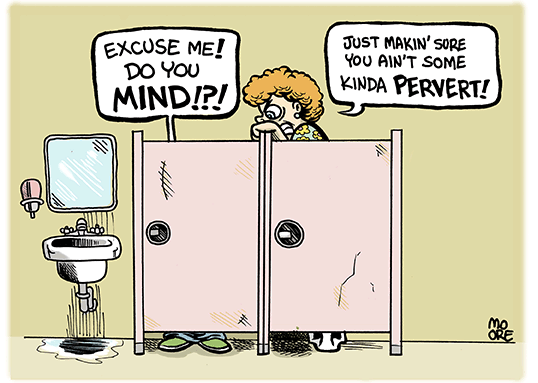
    Time for this cartoon again:

  • Thinking of the children

    There were lots of things about being a parent I didn’t expect. Fear was one of them. Almost overnight I became hyper-aware of the world’s many dangers, bursting into tears at newspaper reports of terrible things. It felt as if a layer of my skin had been peeled off, exposing me to things I’d previously been protected from.

    That’s universal, of course. You want to protect your child from all the pain in the world, from all its horror, and you can’t. And that realisation makes you realise just how much pain and horror the world contains.

    It gets more frightening still when your child is different in any way. It’s unfair, but life is often much smoother for children who conform, who don’t stand out in any way. If your child isn’t one of those children, they tend to get a rougher ride. And that continues into adulthood.

    It’s something you’re particularly aware of if you were a child who didn’t conform, because you know exactly what it’s like.

    Writing for the always-excellent Autostraddle, Catherine Kelly shares her experience of being the parent of a trans child. Trans children can be quite visibly different from their peers, and to be their parent must be heartbreakingly difficult, especially in the current viciously anti-trans climate. But if the parent is also LGBTQ, that adds a whole extra level of shittiness to it all.

    Shitty people “blame” bad parenting for kids being trans all the time, and straight cis parents have to deal with that horribleness, too. But we’ve even had kind of cool people “blame” us for our kid being trans. Obviously, the reasoning goes, we were too proud and weren’t considering what kind of influence we were having on our child, and now she’s forced to be trans. She was never allowed to “explore” if she’s cis.

    “Cis” is short for “cisgender”: it means people whose gender identity isn’t at odds with their body. It’s to “trans” what “straight” is to “gay” or “bi”.

    Straight parents are told this all the time, that they did something bad and hurt their kids by making them trans. But we in specific are being told our identities are bad, and it’s our identities that hurt our kid.

    This is incredibly common on social media and increasingly in print media too. It’s the right-wing evangelical argument that nobody is trans; parents are somehow forcing their kids to be trans for reasons nobody can adequately explain.

    Kelly’s article is honest, so isn’t an easy read. It also discusses something I haven’t seen written about before in the context of parenthood: internalised transphobia, homophobia and sexism.

    Internalised transphobia/homophobia is what happens when you’re LGBTQ and grow up in a culture that hates, fears and mocks LGBTQ people. I have it: it’s one of the biggest barriers to self-acceptance and happiness, because there’s always a little voice telling you you’re sick.

    And if you’re a parent of an LGBTQ kid, that voice talks about your child too.

    Kelly:

    However, for so many of us, we realized we were LGBTQ after we are already homophobic, heterosexist, and cissexist. It’s a weird thing to go through, to have to rekindle a love for ourselves while living in a world that hates us, especially after we participated in that hate once, too. We’re doing our best to help our child avoid that particular internalization, but her parents didn’t.

    I’ve mostly vanquished that voice in my head that says I’m not good enough because I’m not straight, but that doesn’t mean it’s gone.

  • Pick-up artists, misogyny and the alt-right

    One of the more odious groups of people to crawl out of the internet are the pick-up artists (PUAs), who treat women as commodities and whose tactics are thoroughly awful. There has been plenty of (rightful) condemnation of these clowns, most recently over the BBC Social investigation of repellent Scots PUA A-Game, although it’s worth remembering that a lot of men’s magazines and websites praised the early PUAs.

    If you’re not immersed in internet culture you might not be aware of the strong links between PUAs, the furious, violent culture of so-called Incel young men and the neo-Nazism of the alt-right. It’s all connected in what some people call the “Manosphere”, the various sites and forums centred on so-called men’s rights activism.

    This webcomic, by Charis JB for The Nib, does a good job of explaining it all. Including the murderous consequences.

  • What kind of biscuit are you?

    This is the latest version of the Genderbread Person, an attempt to clear up the differences between gender identity, sexual/romantic attraction and anatomical sex – differences that many self-appointed experts seem unwilling or unable to understand. The reason there are multiple versions is because it’s under constant review to make it as clear and understandable as possible.

    The diagram (PDF version and more details available from here) works pretty well without the key, I think: identity is who you are, attraction is who you love/fancy, expression is how you present yourself and sex is what body you have. But the key goes into a bit more detail.

    For what it’s worth, my genderbread person has a gender identity and gender expression that are significantly more female than male, my anatomical sex is more male than female (but it’s becoming more female due to HRT), my sex assigned at birth was male and my sexual/romantic attraction is towards women and femininity.

    As the diagram’s creator, Sam Killermann, explains:

    Look around. Listen inside yourself. Think about everything you’ve learned, been told, or absorbed. Maybe you wouldn’t name these components “identity,” “expression,” “sex,” and “attraction,” but you no doubt recognize their existence.

    You feel a certain way, inside. You have a personality, preferences, predispositions. You also look certain ways, dress certain ways, and your body is built in certain ways. You’ve likely noticed many of the ways that society (and your peers, and likely yourself) puts many of those aspects of yourself through a gendered litmus test: pink or blue? And you can surely name ways you, or someone you care about, has felt pressure, discomfort, ease, friction, and/or liberation in light of that.

    …That’s what the Genderbread Person is helping us to understand. It’s trying to map all of those amorphous feelings, noticings, and pressures to simple language and visuals.

    I think Sam’s done a good job.

  • Turning hate into hope

    Harris Brewis just did something amazing.

    Brewis is a gamer, known online as hbomberguy, and he decided to annoy Graham Linehan. Linehan is famous for co-writing Father Ted and Black Books a couple of decades ago, but in the last few years he’s done little of note beyond spending pretty much all of his time spreading hate about trans people on social media.

    Linehan’s most recent activities have focused on the Mermaids charity, which supports the parents of children who may be trans. He spearheaded a campaign to try and get the Big Lottery Fund to cancel its grant to the charity, so in response Brewis decided to try and raise a bit of money for Mermaids by playing the Donkey Kong video game online for hours.

    The goal? A few hundred dollars.

    The result? Three hundred and forty thousand bucks.

    It’s not just the money. It’s the joy. Twitter users posted their support for Mermaids and for trans people under the ironic hashtag #thanksgraham as the total soared, and various celebrities – such as Cher! – tweeted or retweeted in support. Gaming legend John Romero (creator of Doom, Linehan’s favourite game) joined Brewis live, as did inspiring US congresswoman Alexandria Ocasio-Cortes and a host of other prominent figures. For more than 48 hours, thousands of people hammered the message home: “trans people, we’ve got your back.”

    It won’t stop Linehan and his enablers; it’ll probably make them worse. And no doubt the usual suspects will write yet more fact-free op-eds about the sinister transgender agenda. But this feels important. Imagine what such positivity and support must feel like to a confused, closeted trans kid who sees trans people demonised online and in their parents’ newspapers every weekend.

  • Sage advice

    Women are being warned not to put herbs in their vaginas after a Marie Claire article suggested that they should use parsley to “kick-start” their periods.

    It’s easy to laugh, but it’s actually quite a serious problem: time and again magazines and online magazines aimed at women print deluded and sometimes actively dangerous health advice from people who haven’t got the faintest clue what they’re on about.

    Gwyneth Paltrow’s Goop site is a good example: it urges women to do all kinds of dangerous things to their genitals and weasels out of taking responsibility for any resultant injury or infection with a disclaimer effectively saying that “the products or procedures mentioned on the site are not intended to be a substitute for professional medical advice, diagnosis, or treatment.” Some of Paltrow’s fact-free tips have appeared in supposedly reputable magazines such as Women’s Health.

    A few years ago, one study looked at the articles about complementary medicine in a range of women’s magazines. Of the 150 articles studied in 15 women’s magazines, 131 “were written by non medically qualified contributors”. Of the 150 articles, 95 made unsubstantiated claims about herbal “remedies” that can be very dangerous for some people.

    I’m surprised Marie Claire slipped up, because as magazines go it’s one of the better ones. But it’s an industry-wide problem. Between “alternative” medicine, dangerous diets and cheerleading for cosmetic surgery, women’s magazines are often really bad for women’s health – and the more magazines move online and become low- or no-paying content farms, the worse the problem is going to become.

  • How about we try making the world better for men too?

    As ever, the Daily Mash does a great job of skewering a news story: this time, the ridiculous outrage over a Gillette ad.

    A RAZOR blade company has expressed surprise that its latest advert has pissed off a lot of dickheads.

    In a stunning development, the company’s latest campaign – which calls on the #MeToo movement to tell men to be ‘the best they can be’ by not being dreadful – resulted in a totally unexpected backlash from spluttering idiots.

    The most spluttering of the idiots are so-called men’s rights activists, who continually campaign for men’s right to suffer disproportionately from mental health issues and to die younger than women. They don’t quite put it that way, of course, but that’s ultimately what resisting change to ideas of masculinity means.

    The point that’s being spectacularly missed in angry rants kicking back against the idea of toxic masculinity is that the concerns are about the “toxic” bit, not the “masculinity” bit. It’s like responding furiously to an article about acid rain by saying #notallrain and suggesting that snowflakes want to ban all precipitation.

    Gaby Hinsliff, writing in the Guardian, sums it up very well:

    Feminism has endlessly opened up horizons for girls, giving them permission to be anything they want to be. They are bombarded with messages about how it’s fine to be both smart and pretty, encouraged to visualise themselves in male-dominated careers and to push the boundaries of behaviour considered “acceptable” for women. That paves the way for girls who never fitted the pink princess stereotype to be far more comfortable in their skins.

    But expectations of boys have remained more rigid, to the detriment both of those who don’t fit the macho stereotype and of those who will grow up to be the victims of insecure male rage. “Let boys be boys” is an excellent principle. But only if we recognise the full range of things boys are capable of being, when we let them.

    I’m reading The Guilty Feminist just now. It’s a great example of pop-feminism publishing: affirming, angry in places and often very funny. The message is a simple one: don’t let other people limit who you are and who you can be.

    The male equivalent of that isn’t men’s rights activists bleating about how liberals and feminists and LGBTQ people have ruined their world and demanding we stay in 1953 forever. It’s accepting that masculinity is just as broad a church as femininity. It’s making room for all kinds of men, and all kinds of expression. It’s about freeing men from suffocating stereotypes that tell them who they are and who they have to be, or have to pretend to be.

    It’s about ensuring our sons and our brothers get to be the best possible versions of themselves.

  • The kids are alright

    Wouldn’t it be great if, instead of the thinky thoughts of anti-trans columnists, we had some actual research into children, gender dysphoria and gender identity?

    Look what The Atlantic found!

    Since 2013, Kristina Olson, a psychologist at the University of Washington, has been running a large, long-term study to track the health and well-being of transgender children—those who identify as a different gender from the one they were assigned at birth. Since the study’s launch, Olson has also heard from the parents of gender-nonconforming kids, who consistently defy gender stereotypes but have not socially transitioned. They might include boys who like wearing dresses or girls who play with trucks, but who have not, for example, changed the pronouns they use.

    I’ve been a fan of the author, Ed Yong, for a long time: he’s a very talented and conscientious science writer. This is typical of his work: he’s taken Olson’s study and looked into it in some detail.

    Unlike newspaper columnists, who offer zero evidence with 100% confidence, Olson offers detailed evidence but is also quick to point out the limitations of the study. Nevertheless, it’s interesting: children’s gender identity appears to be a pretty good predictor of whether they’ll turn out to be trans. From the article:

    Charlotte Tate, a psychologist from San Francisco State University, says that this quantitative research supports what she and other transgender scholars have long noted through qualitative work: There really is something distinctive and different about the kids who eventually go on to transition. From interviews with trans people, “one of the most consistent themes is that at some early point, sometimes as early as age 3 to 5, there’s this feeling that the individual is part of another gender group,” Tate says. When told that they’re part of their assigned gender, “they’ll say, ‘No, that’s not right. That doesn’t fit me.’ They have self-knowledge that’s private and that they’re trying to communicate.”

    This bit is key:

    Olson’s team also showed that those differences in gender identity are the cause of social transitions—and not, as some have suggested, their consequence.

    In other words, children are not coerced into having a particular gender identity: you can put Jimmy in as many dresses as you want but if Jimmy isn’t trans, he won’t suddenly become trans or develop gender dysphoria.

    Older trans people are going “no shit, Sherlock” at this point: if it were possible to persuade people to change their gender identity, there wouldn’t be any trans people. You can’t talk people into or out of being trans any more than you can pray the gay away: some of us tried not to be trans for decades, and will spend decades trying to deal with the damage from that.

    Once again there are very strong parallels between today’s harmful anti-trans bullshit and previously harmful anti-gay bullshit. That’s something the Atlantic article makes explicit, describing the work of American psychologist Evelyn Hooker.

    In the 1950s, when many psychologists saw homosexuality as a mental illness (largely because they had only ever worked with gay people who had records of arrest or mental-health problems), Hooker surveyed a more representative sample and found that gay and straight men don’t differ in their mental health. That was instrumental in getting homosexuality removed from a list of mental-health disorders in 1987. “We’re sitting in a similar moment today with transgenderism,” says Devor. “The mental-health issues that we see are largely the result of living a life that blocks your expression of your gender. My view is that the work coming out of Olson’s group will have an Evelyn Hooker effect.”

    I’m not naive enough to think this will have any effect on the mainstream media coverage of trans people in general and trans kids in particular: the moral panic is too well established. But it’s yet more evidence of the growing gap between the reality-based community and the commentariat. All too often, the you-couldn’t-make-it-up brigade are doing exactly that.

  • “It was my first taste of what it meant to have my freedom taken from me.”

    Helen Taylor is the author of The Backstreets of Purgatory, which is ace. She’s a hell of a writer, a genuinely lovely person and the writer of this heartbreaking piece about being sectioned.

    We were supposed to have one-to-one sessions where I told him what I was feeling. It was meant to help, to give me some kind of release.

    ‘Ronnie, I think you are a prick,’ I told him.

    ‘I don’t give a fuck what you think,’ he told me in reply.

    If you’re not familiar with the term, “sectioned” means being detained under section 25 of the Mental Health Act. Taylor was sectioned after a traumatic experience made her existing depression considerably worse.

    It’s not an easy read, but it’s a powerful piece.

  • Screens are not safe

    A new study from Oxford University has been making waves today: it apparently demonstrates that despite much publicity over the dangers of screen use for children, screens are no more dangerous than eating potatoes.

    Inevitably, that’s not what the study actually says. In one of the few sensible reports, Techcrunch explains:

    the study does not conclude that technology has no negative or positive effect; such a broad conclusion would be untenable on its face. The data it rounds up are (as some experts point out with no ill will toward the paper) simply inadequate to the task and technology use is too variable to reduce to a single factor. Its conclusion is that studies so far have in fact been inconclusive and we need to go back to the drawing board.

    “The nuanced picture provided by these results is in line with previous psychological and epidemiological research suggesting that the associations between digital screen-time and child outcomes are not as simple as many might think,” the researchers write.

    The confusion is partly due to the university overselling the study, and largely due to crap reporting by people who just regurgitate the press release instead of actually reading the report. It’s quite impressive to see “study shows that knee-jerk articles about screens are based on shit science” reported as “screens are safe, says science!”