Author: Carrie

  • A sinister agenda

    One of the most widely circulated anti-trans stories is that Soham child murder Ian Huntley is trans. The Star reported it 10 months ago, and it’s regularly trotted out by anti-trans groups and repeated in newspapers.

    Look what Jeremy Vine posted today.

    It’s from yesterday’s Star.

    Like the vast majority of such stories, it was a complete fabrication. Good luck waiting for the retractions from The Guardian’s Hadley Freeman, The Sunday Times’ Janice Turner, The Telegraph, Fair Play For Women, The Spectator’s James Kirkup…

    The point here is not that bad people cannot be trans, or that trans people cannot be bad. The point is that some newspapers, journalists and celebrities are not objective or ethical when it comes to writing about trans people, and will print pretty much anything if it supports the narrative of a sinister transgender agenda. The Huntley story was always, obviously dubious, and yet none of the people who wrote about it bothered to do the simplest bit of journalism: get on the phone and find out if it was true.

    This is happening far too often for it to be anything other than malicious. UK newspapers have repeatedly had to retract stories about trans people because the stories were untrue. Those stories have been used by anti-trans bigots to campaign against trans people’s rights, and to spread fear and hatred of trans people. This particular story produces 95,000 Google results and is used so frequently that ten months since publication, anti-trans activists were posting about it on Twitter this morning – just before Vine posted the photo of the retraction.

    The stories, and the fear and hatred they engender, live on long after the inevitable retractions.

  • For frack’s sake

    The Times, on Twitter:

    Almost 50 geoscientists have urged the government to commission an urgent review of the fracking earthquake limit, which they suggest should be raised to allow the industry to expand

    Sam Knight, a writer, also on Twitter:

    Of the 48 people that signed the letter, I could not confidently identify 9. I think one works for BP and another works for Shell. Many are not experts in any recognisable way. But it doesn’t really matter. Because, of the remaining 39, all have links to gas and oil companies.

    …Several signatories openly brag about their industry funded research. Many used to work for oil and gas companies. Quite a few still work for those companies. And others are not even practising scientists, but directors of a business in the energy sector.

    This isn’t just yet another example of how The Times and its sister titles often publish advocacy and rarely bother to check credentials. It’s part of a wider problem where supposedly independent experts are nothing of the sort.

    The Taxpayer’s Alliance is a good example. It keeps its funding secret because it doesn’t represent the ordinary working stiffs it claims to; it’s an advocacy group for the super-rich, who fund it out of their very deep pockets.

    Whether it’s the super-rich pretending to be ordinary people, religious fundamentalists claiming to be ordinary parents or anybody else with an agenda pretending they don’t, every time they’re given a platform the platform provider is failing its viewers, its listeners or its readers.

  • Murderous delusions

    Image from Reddit. Creator unknown.

    On Friday, hundreds of US parents protested against the vaccination of children. I liked the Huffington Post headline: Parents Protest For Kids’ Right To Suffer From Preventable Illness. 

    The protest was in Washington State, which is currently in the middle of a measles epidemic. The parents are trying to stop a bill that would remove personal or philosophical exemptions for child vaccination. It’s an attempt to stop a dangerous trend: the WHO describes the anti-vaccination movement as one of the top threats to global health in 2019.

    The anti-vax movement is profoundly anti-scientific, and repeats the non-existent link between autism and vaccination popularised by the thoroughly discredited charlatan Andrew Wakefield. Wakefield, sadly, is still peddling his nonsense and thousands of parents believe it.

    It’s important to stress here that vaccines are among the most studied medicines in human history. There is no link between vaccination and autism. None.

    The parents who campaign against keeping children alive aren’t malicious. But they’ve fallen victim to the same thing that drives climate change denial or flat-Earthism: I can’t see it, therefore it can’t exist.

    It also ties in with anti-government, anti-expert sentiment. How dare you tell me what I need to do to protect my children?

    This isn’t a movement of stupid people, or uneducated people, although some anti-vax posters on social media might persuade you otherwise. The demographics skew heavily in favour of reasonably affluent, reasonably well-educated middle-class white women.

    It’s cruelly ironic that vaccines have fallen victim to their own success: we no longer see the victims of the diseases they eliminate. My generation and the generations after me haven’t grown up around children whose limbs have been destroyed by polio. We haven’t seen people’s faces scarred and distorted by smallpox. We don’t know of brothers or sisters who died from whooping cough.

    If we can’t see it, it doesn’t exist.

    The parents’ murderous delusion could kill not just their own children, but other people’s children too. Some children don’t have the luxury of choosing whether to be vaccinated or not: they’re too young, or they don’t have access to health care, or they have medical conditions that would make vaccination unsafe, or they’re still in the womb. With a successful vaccination programme those children are protected: herd immunity means that it’s effectively impossible for dangerous diseases to exist in a community, so the likelihood of these children being exposed is near zero.

    That only works if most children get vaccinated, though. When the numbers fall even a little bit, below 90 to 95%, herd immunity disappears and preventable, deadly diseases recur. That’s exactly what’s happening now. For example, in Clark County – part of the same state where the anti-vaxxers were protesting – just 78% of nursery school children have had the full slate of vaccination. 43 of those unvaccinated children have contracted measles. In the US alone, more than 9 million children are currently at risk of contracting measles as a result of under-vaccination.

    This isn’t an argument to be won on facts, on debating whether or not vaccines are safe. The anti-vaxxers have seen the evidence and simply choose not to believe it. The only way to change these people’s minds appears to be to show them the horrific consequences of the diseases the vaccines prevent, and the danger they’re putting so many children in.

  • Drill: the presumption of guilt

    Drill musicians Reds, K Trap and Mischief. Image from YouTube.

    As long as people have made music, other people have tried to censor it. The famously miserable song Gloomy Sunday, originally published in 1933, was banned by the BBC until 2002. George Formby’s When I’m Cleaning Windows was banned in 1940 for its supposedly smutty lyrics. More recently, bands were banned from airplay during the Gulf War for having the wrong name, such as Massive Attack. And of course there have been attempts to ban entire genres of music such as heavy metal and gangsta rap.

    It’s easy to laugh at this stuff, but sometimes it’s deadly serious. Take the case of drill music, a genre so subversive it can land you in prison for performing it. Guess which repressive regime that happens in?

    England.

    Writing in The Observer, Kenan Malik describes the case of two drill musicians, Skengdo and AM from the Brixton group 410. Last month they were given nine-month suspended sentences for performing a song.

    The case is deeply disturbing, because while the police claim that drill incites violence the two musicians have not been charged under the pertinent legislation. The instrument used against them was a Criminal Behaviour Order (CBO), the latest incarnation of the infamous anti-social behaviour order (ASBO).

    As Malik writes:

    Skengdo and AM were served with an injunction without having been convicted of a crime. Breaking the injunction is a criminal offence. They’ve been criminalised for making violent music without having been convicted of any offence of violence.

    I don’t understand drill music; it’s not really aimed at the oh-so-lucrative white middle-class middle-aged trans demographic. It may well glamourise violence, and it may well be linked with gang activity. But the law exists to protect all of us, and part of that protection means that we should not be criminalised without due process.

    Index on Censorship is no fan of drill music, but it points out that this is hardly the first time minorities have used music to describe their lives.

    Drill is less about inspiring violence and more about providing a narrative of lives defined by violence. They are telling the stories of their lives, minus the sugar-coating, just as other writers, poets and musicians have done before them.

    They continue:

    The right to freedom of expression is considered by many to be a cornerstone of a modern democratic society. Countries that fail to adequately protect this hallowed right – routinely censoring journalists, writers and musicians whose speech challenges and offends those in power – are rightly regarded by the West to be the worst examples of dictatorial, autocratic regimes.

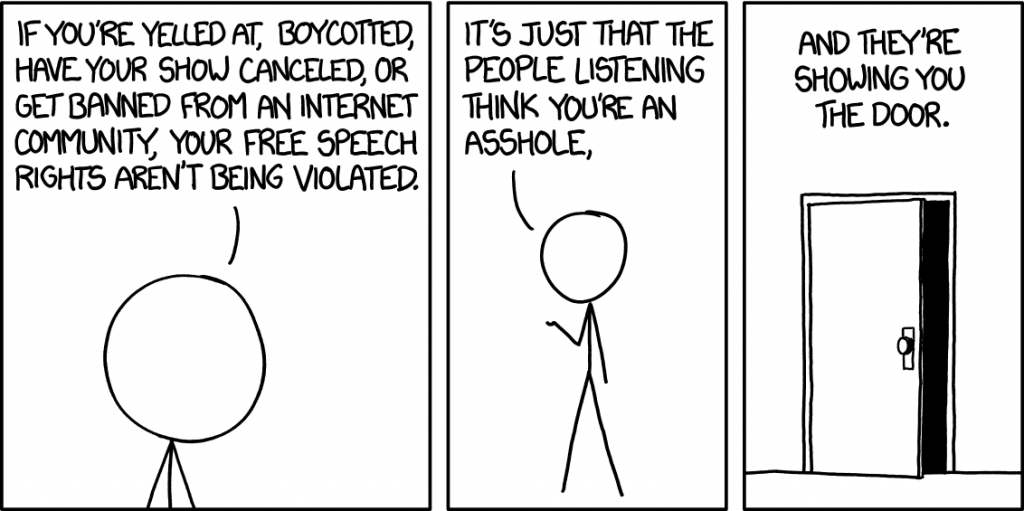
    Free expression is not the same thing as freedom from consequences. But there appears to be a curious double standard here.

    The press’s free-speech brigade are quick to defend the speech of racist populists such as Tommy Robinson, of alt-right dog whistling and of all kinds of repellent individuals. Freedom of speech, after all, means freedom of speech for views many people will find repellent. And yet the Spectator and Spiked and all the other Voltaire-misquoting defenders of offensive expression have been completely silent about the censorship and criminalisation of drill musicians.

    It’s strange, isn’t it? They defend the speech of the white Tommy Robinson, of the white Count Dankula, of the white Milo, of various other white alt-right types – sometimes even the speech of white people who are actual neo-Nazis. And yet they’re completely silent about the ongoing censorship and criminalisation of black musicians. I wonder what the difference could be?

  • MAGA: Make Auschwitz Great Again

    Dachau. Image by Nonethelesser, Wikimedia.org

    You don’t need me to tell you about the horrors of the Holocaust, of the brutally efficient attempts to wipe out Jewish people, Roma and LGBT people. But somebody clearly needs to tell the yahoos of Turning Point, the Trump-aligned, MAGA hat-wearing political group that’s just set up shop in the UK with the endorsement of Nigel Farage.

    There are tons of reasons to detest and refuse to give a platform to these arseholes, who illustrate the paradox of tolerance: if you refuse to silence the intolerant, eventually they will come to silence you. But even by their despicable standards, this is disgusting. Speaking in London, Candace Owens of Turning Point spoke favourably about Hitler:

    But if Hitler just wanted to make Germany great and have things run well, OK, fine. The problem is that he wanted, he had dreams outside of Germany. He wanted to globalize.

    Hitler just wanted to Make Germany Great Again. To Owens, taking his “dreams” global is “not nationalism”. She adds: “I don’t really have an issue with nationalism. I really don’t.”

    Owens is not some random who grabbed a mic. She’s Turning Point’s communications director, so presumably she’s articulating the organisation’s policy here. She doesn’t really have an issue with genocide as long as it’s local.

    This is Holocaust denial in a nice dress, Holocaust denial with millionaire backing, the kind of Holocaust denial that gets invited to dinner parties and to share its “controversial views” as part of a “debate”.

    To go online at the moment is to feel the dread hand of history repeating. Anti-semitism is once again widespread. Racism and bigotry is vocal and unafraid and raising huge sums via crowdfunding. Views that used to be the preserve of the National Front are given airtime, unchallenged, on our national broadcaster. And organisations such as Turning Point run “professor watchlists” of people they consider ideologically impure and consider themselves to be fighting a new world war.

    We say “never forget” and “never again” not just because the Holocaust was a horror it’s hard to contemplate without going mad, but because the Nazis didn’t begin with the camps. Germany went from one of the world’s most progressive countries to Hell on Earth in an incredibly, terrifyingly short period of time. They didn’t ride to power promising to murder Jews. They promised to make Germany great again.

  • O wad some Power the giftie gie us. To see oursels as ithers see us

    You might not be aware of this, but the anti-trans stance of English (and more recently, Scottish) newspapers is greeted with bafflement in the rest of the world. The New York Times tries to explain English anti-trans activism for its readers.

    If the idea that transphobic harassment could be “feminist” bewilders you, you are not alone. In the United States, my adoptive home, the most visible contemporary opponents of transgender rights are right-wing evangelicals, who have little good to say about feminism. In Britain, where I used to live, the situation is different.

    There, the most vocal trans-exclusionary voices are, ostensibly, “feminist” ones, and anti-trans lobbying is a mainstream activity.

    This is peculiar to mainland Britain. When anti-trans bigots tried to export their bile to Ireland, huge numbers of Irish feminists told them to piss off.

    So why is England so different? Edie Miller suggests that “the answer lies in part to the coalescence of a certain set of ideas in a very specific circle of voices in the early 21st century — voices that later went on to hold high profile positions in much of the U.K.’s print and broadcast media.” Between those voices and the anti-trans obsessives of Mumsnet – “Mumsnet is to British transphobia more like what 4Chan is to American fascism”, Miller writes – a moral panic has ensued.

    But why England? Back to the NYT.

    In other parts of the world, including America, mass movements in the 1990s, 2000s, and 2010s around the effects of globalization and police brutality have produced long overdue dialogue on race, gender and class, and how they all interact. In Britain, however, the space for this sort of dialogue has been much more limited. As a result, middle- and upper-class white feminists have not received the pummeling from black and indigenous feminists that their American counterparts have.

    Many of these people believe they are doing God’s work. But they’re working for the other guy.

  • This is what bias looks like

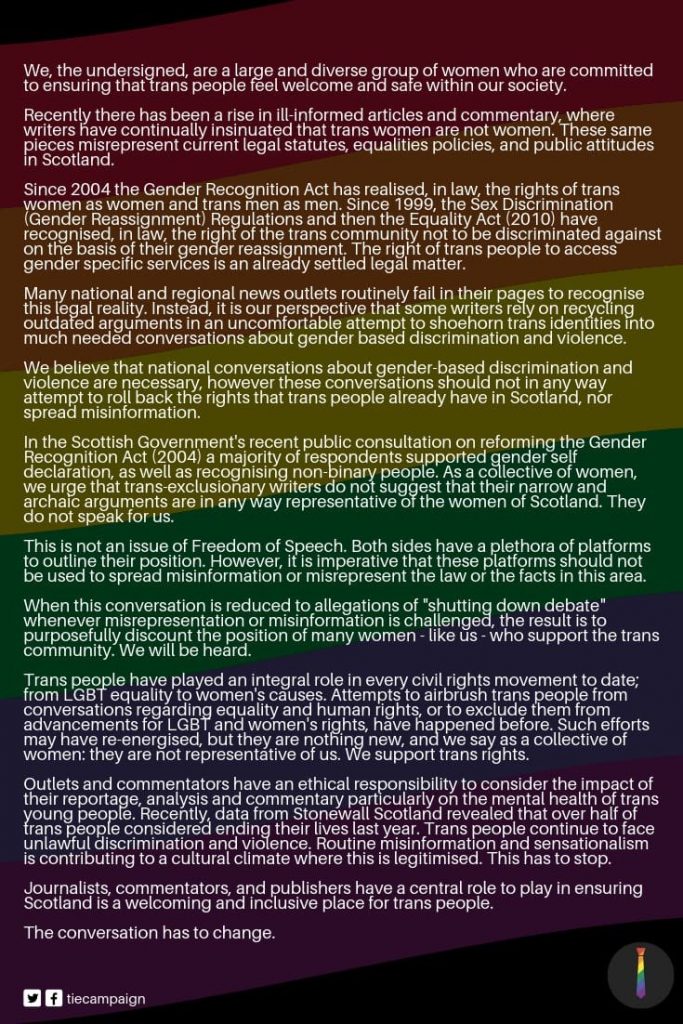
    This is the latest story in the Times and Sunday Times’ ongoing campaign against trans people. Even by those low standards, it’s a pathetic attempt at turning something innocuous into a hit piece.

    The tweet in question was posted in November. Here it is:

    It’s a thoroughly unremarkable bit of political social media, and the supposedly inflammatory poster – the fourth image in the tweet – is a pretty innocuous “don’t be a dick” poster suggesting that it’s possible to be pleasant and respectful to trans people. It’s worth pointing out, because the Times never does, that the major women’s groups in Scotland – Rape Crisis Scotland, Scottish Women’s Aid, Zero Tolerance, Close The Gap, Engender and Equate Scotland among others – are proudly trans-inclusive.

    “Pro-trans bias”.

    Lets unpick that, shall we?

    “Pro-trans bias”. Bias is a negative word; it means to be inclined or prejudiced for or against a particular group, usually in an unfair way.

    To put it in this context is to say that to be pro-trans (or as I’d put it, pro-not being a dick to trans people) is a bad thing. The entire article is based on the flimsy premise that to post something mildly supportive of trans people is somehow shameful and something a politician shouldn’t be doing. It implies that by suggesting we should perhaps not be bastards to trans people, the politician is biased against non-trans people.

    The headline’s doing a lot of work, isn’t it?

    As ever, you can illustrate the point by changing the words. Swap “trans” for “catholic”, “jewish”, “Asian”, “black”, “gay”, “disabled”.

    As I say, bias is prejudice for or against a particular group. It’s something you’d be guilty of if, say, you accused a politician of “pro-trans bias” over an innocuous, two-month-old tweet but failed to report (let alone criticise) the UK government officials who repeatedly meet with rabidly anti-trans groups (Transgender Trend and Fair Play For Women twice and A Woman’s Place three times, with FPFW invited to a further two “round tables” to discuss limiting trans people’s rights) or the MPs who post anti-trans sentiment to social media.

    It’s the kind of thing you’d be guilty of if your columnists were activist supporters of anti-trans groups but failed to declare that in their regular anti-trans columns.

    It’s something you’d be guilty of if you repeatedly ignored the medical consensus on trans people in favour of scaremongering from activist groups.

    It’s something you’d be guilty of… you get the idea.

    Anti-trans bias in the press is so commonplace that to simply detail it would be a full time job, but the Times/Sunday Times has become so blatant it’s almost a parody of itself. If you buy these titles you’re helping to fund this bullshit.

  • The Sunday Times printed nonsense? Time for my shocked face

    What’s that? The Sunday Times has printed a load of old bollocks again? I’m shocked! Shocked!

    My lecture yesterday was about calls for internet regulation, and I mentioned the media panics over “suicide sites” in 2001, 2006, 2011, 2012, 2014, 2016… you get the idea. We’re in the middle of another panic now.

    Enter the Sunday Times, which this weekend claimed we are raising a “suicidal generation” and that it’s all social media’s fault.

    Tom Chivers isn’t impressed:

    This is – and I don’t want to get too technical here, but bear with me – absolute bollocks from top to bottom.

    The truth is that while there are certainly tragedies, the actual number of teenagers who kill themselves is very small – and because the numbers are so small, even the slightest change can be made to look like a dramatic shift.

    Especially if you cherry-pick the numbers, as the Sunday Times did.

    The ST compared the most recent figures with 2010, which had the lowest rate of teen suicides since 1981. Chivers again:

    You could, if you wanted to, use the same trick to tell the exact opposite story. Facebook was first released in 2004, when the suicide rate among 15- to 19-year-olds in England and Wales was 4.7. But after six years of social media being available, it had dropped to 3.1! It’s a life-saver, no?

    The Sunday Times piece suffers from two key problems. One, social media isn’t causing a suicide epidemic among teenagers. And two, there isn’t a suicide epidemic among teenagers.

    If you look at 10- to 29-year-olds, it’s gone from a consistent plateau of about 15 per 100,000 from the late 1980s to the early 2000s, down to about nine per 100,000 by about 2004, and that’s where it’s stayed, pretty much. There’s a similar story among the population as a whole.

    Every suicide is a tragedy, but to peddle myths isn’t helping anybody. In fact, it might very well be letting the real culprits off the hook. As Natasha Devon MBE, who works with teenagers, posted on Twitter, the top reasons teenagers tell her their mental heath is suffering don’t include social media at all. They are:

    1. Academic anxiety;
    2. Lack of community support;
    3. Problems at home;
    4. No one to talk to;
    5. Loss of activities which helped them cope (eg sport/music);
    6. Worries about future.

    That doesn’t make for such an exciting headline. Reality rarely does.

  • If this is journalism, it deserves to die

    What is journalism actually for? According to the late humorist Finley Peter Dunne:

    Th newspaper does ivrything f’r us. It runs th’ polis foorce an’ th’ banks, commands th’ milishy, controls th’ ligislachure, baptizes th’ young, marries th’ foolish, comforts th’ afflicted, afflicts th’ comfortable, buries th’ dead an’ roasts thim aftherward.

    More recently, the American Press Institute explained:

    The purpose of journalism is… to provide citizens with the information they need to make the best possible decisions about their lives, their communities, their societies, and their governments.

    Journalism’s job is to tell the truth when other people try to obscure it. As George Orwell didn’t write (it’s widely attributed to him, but there’s no evidence that he ever wrote it):

    Journalism is printing what someone else does not want printed; everything else is public relations.

    So what should we make of the Shropshire Star’s coverage of the MP, Daniel Kawczynski, and his online comments about the Marshall Plan?

    If you aren’t familiar with the story, Kawczynski is an anti-EU backbencher. He posted to Twitter:

    Britain helped to liberate half of Europe. She mortgaged herself up to eye balls in process. No Marshall Plan for us only for Germany.

    That is untrue. The largest recipient of funds from the Marshall Plan was, er, Great Britain. We got 26% of the aid compared to 11% for Germany.

    The internet was quick to correct the MP, but his local paper chose to describe the story as a “row” where “critics” were “questioning the MP’s apparent claim.” Here’s how it sold the story on Twitter.

    Daniel Kawczynski hit back at critics saying: “Those affiliated to Europe in this country hate any challenge to their point of view.”

    That’s not the story. This is the story:

    Daniel Kawczynski lied.

    The linked article, by the paper’s senior reporter, gave the MP the opportunity to double down on his nonsense. It has since been edited after a “row” where “critics” pointed out that the paper was missing a fairly obvious point: the MP lied. It wasn’t an opinion. It wasn’t a different interpretation. It was a bare-faced, flat-out, easily checkable lie. Rather than say that, the paper went with a diversionary quote from the lying liar who lied, presenting the patently untrue claim as if it were just one side of a debate.

    This matters, as FT contributor David Allen Green explains.

    Politics in the UK – and USA and no doubt elsewhere – is in a poor shape.

    And one reason for this is the casual dishonesty of politicians and their supporters, and the unwillingness or inability of the media to check the falsehoods of politicians and their supporters.

    …A politician lies, people shrug, the political caravan moves on.

    The political lie serves its quick and cynical purpose, and is soon just forgotten.

    This particular example is over Brexit, of course, but the issue is endemic. It’s in the columnists who don’t declare conflicts of interest when they write about particular groups and who repeatedly lie in the service of a personal agenda. It’s in the churnalism that regurgitates press releases, prizing “truthiness” over actual truth. It’s in the collapse of fact checking and the “clicks first, check later” culture that makes so much modern journalism worthless. It’s the repositioning of news media as a branch of showbusiness.

    We’re regularly told of a crisis in journalism, the ongoing difficulty in getting people to pay for news. But the sad truth is that some news simply isn’t worth paying for. As I’ve written before, bullshit is not a precious and rare commodity.

    Journalism’s job is to ask questions; as the viral quote puts it, to “look out the fucking window” when somebody claims its raining. Journalism that doesn’t check facts, that enables liars to double down on falsehoods, is journalism that fails its readers. Journalism that doesn’t do its job is journalism that isn’t worth saving.

  • Feeling naked in public

    It’s the dream cliché: delivering a talk in your underwear.

    I think most of us have had the classic anxiety dream where we’re standing up in front of people and we’re either naked or in our underwear. I pretty much lived it today – although, you’ll be pleased to read, I was neither naked nor dressed only in my underwear.

    I was at Stirling University, where I’d been asked by a friend to deliver a guest lecture about internet things. To say I was nervous about it would be a major understatement. I barely slept last night. I don’t stand up in front of people very often, I haven’t addressed a room full of strangers for many years and I haven’t delivered such a long presentation in 21 years.

    Not only am I desperately out of practice, but I also have the added anxiety-inducing fact of being trans.

    Imagine the anxiety dream, but instead of doing it naked you’re doing it in a frock (if you’re male-bodied; if you’re female, imagine being in one of those horrible, scratchy hallowe’en costumes: anything you’d expect to get an odd reaction in a professional setting).

    Presenting male wasn’t an option, partly because it would have been a cop-out and partly because I’d been specifically asked as part of a policy of having more inclusive speakers – not just the same rotating cast of straight, white, cisgender men.

    It was fine, of course. Better than fine. The students were a genuinely nice bunch, nobody seemed in the slightest bit perturbed by the disconnect between my voice and my presentation – a disconnect that was bigger than usual today because God has a sense of humour and I have a cold that’s lowered my already-deep voice half an octave below its usual floor – and once the initial terror subsided, I found myself enjoying it. Not so much that I’m going to start volunteering to do tons more, but enough to make me think I made the right decision by saying yes.

    I was speaking to my lecturer friend before the lecture, setting the world to rights, and I said (in a different context) that progress is often something you only really see in the rear view mirror: it’s only when you look back that you can see how far you’ve travelled. For me, today was a great example of that.