Category: LGBTQ+

  • Stay in your lane

    In a study that’s caused much appalled amusement, researchers at Penn State have discovered that men avoid things such as using reusable shopping bags for fear others will perceive them as gay.

    It’s interesting but not surprising that the policing of this stuff is done by both men and women.

    In a series of studies, the researchers evaluated specific pro-environmental behaviors that previous research suggested were seen as either “feminine” or “masculine” and examined whether they affected how people were perceived.

    They found that men and women were more likely to question a man’s sexual orientation if he engaged in “feminine” pro-environmental behaviors, such as using reusable shopping bags. They were also more likely to question a woman’s sexual orientation if she engaged in “masculine” pro-environmental behaviors, such as caulking windows.

    A man with a Bag For Life is gay; a woman doing minor DIY is a lesbian.

    The researchers found that participants whose behaviors conformed to their gender were seen as more heterosexual than those whose behaviors did not conform to their gender, which may suggest participants were using traditional gender roles as clues to sexual identity.

    There’s a whole knot to unravel here, but ultimately it’s about the way we – often unconsciously – reinforce stereotypes. A man who does the recycling isn’t manly; a woman who can fix something isn’t womanly. Clearly, that means they’re gay.

    These beliefs are so facile there’s no point digging into them here. But the wider point is that these beliefs aren’t just perpetuated. They’re policed.

    It’s not just the policing by others that happens, although God knows that happens. We police ourselves too. We internalise the rules and actively try to ensure we don’t break them for fear of the consequences. Sometimes we pass on those rules to our siblings or our children, sometimes as advice and sometimes as mockery.

    Every day in myriad ways we’re told to stay in our lanes.
  • When stereotypes equal safety

    One of the many things that annoys me about anti-trans activists is that on one hand they accuse trans people of perpetuating gender stereotypes, and on the other they viciously mock trans women who don’t conform to stereotypical ideas of female beauty. As the wonderfully named Tranna Wintour writes in The Walrus, it’s very difficult not to conform when non-conformance is policed, sometimes violently.

    My being seen as the woman I am is almost entirely dependent on my ability to perform femininity as its been established in our culture—namely, to be beautiful. Here is how I feel most of us have been taught to process gender: if a person looks female, she’s a woman; if a person looks male, he’s a man. Those of us who don’t always look perfectly female or perfectly male are subject to being misgendered and misunderstood; we are often the subject of ridicule, judgement, and scrutiny.

    I’m not beautiful, but nevertheless my ability to go through the world as me is largely dependent on how I present: the blurrier the line between male and female the more unwanted attention I attract. To be blunt, in many contexts it’s better to be perceived as an ugly woman than a trans one.

    Transness, in its ambiguity and nonconformity, is seen as a particularly strong threat. Transness says, “Wait, I don’t have to be a woman or a man in the way the culture has taught me to be.” Transness says, “I can be my own person. I don’t have to conform.” But, in response to that defiance, the culture says, “If you transgress against the binary, we will make life hard for you. You will be ridiculed. You will be misgendered. Your safety will be at risk.”

  • “Gender critical” philosophy doesn’t make sense

    The culture wars over trans people have made their way to the philosophers’ community, with some high-profile anti-trans people wrapping their views in philosophical arguments. Unfortunately, Luke Roelofs writes, those arguments don’t make sense.

    This is a long read, but it’s interesting if you’d like to understand why issues such as policing bathrooms are so complex and potentially bad for all women.

    Here’s a quick extract.

    So in practice, ‘gender-critical’ doctrines just provide rationales for policing gender nonconformity. And the big lie at the heart of it, that people are seeking transition to better fit gender stereotypes, justifies this by painting the nonconforming people being policed as the real gender police.

    Just like with bathrooms, the whole GC discourse about gender roles ultimately functions to obscure the real stakes and the real options. You can police people’s gender expression, or you can dismantle the prison of gender, but you can’t do both. GCRF [Gender Critical Radical Feminism] is a feminist fig leaf waved in front of social conservatism.

  • The best of both worlds

    I was having a bad day on Saturday so I went to the pub to cheer myself up. It wasn’t entirely successful.

    First, a young woman who’d been standing next to me at the bar heard me speak, turned, and stared at me with open disgust.

    A few minutes later a drunk thirtysomething man put his arm around me and demanded I talk to him.

    That’s one of the great things about being trans. Why have your evenings ruined by people of just one gender when you can be made miserable by two?

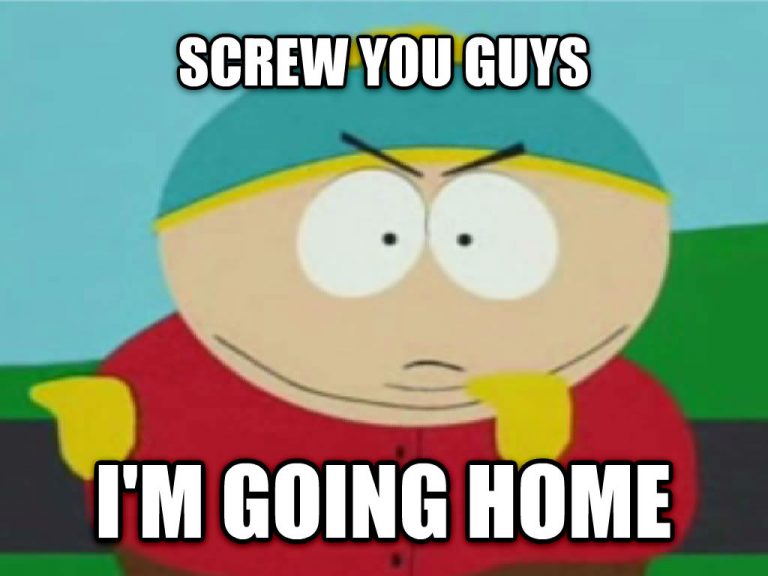
    As Cartman from South Park put it:

  • I’m hacked off with it too

    I’ve written before about the toothless press regulator IPSO, which was set up by the press specifically for the purpose of not regulating the press. To take just one recent example, IPSO found that when The Times makes up quotes, doing so doesn’t breach the rules on accuracy.

    The ruling was on a story about transgender people, who have been subjected to an astonishing hate campaign for some time now. Newspapers have become adept at sticking to the letter of the rules rather than the spirit: all the rules on discrimination and demonisation apply to individuals, not to groups. So if a paper were to publish a column claiming that trans person X is a predator, that’s against the rules (as well as defamatory). If the column claims that all trans people are predators, that’s fine.

    In other words, it’s not okay to incite hatred against one person. But it’s fine if you want to do it against an entire minority group.

    The Hacked Off campaign is attempting to highlight this in its latest report, “The denigration, abuse and misrepresentation of the movement for transgender equality in the press”. It focuses on two dozen high profile and often very abusive articles that appeared in the mainstream press in recent months. As Hacked Off put it on Twitter: “Some newspapers have resorted to distortions, inaccuracies and explicit transphobic abuse.” Over this period, UK hate crimes against trans people have increased by 81%.

    The problem is specific to newspapers. We don’t have endless abuse of trans people on TV because Ofcom regulates broadcast media. There’s no such regulation for print.

    Despite the 2013 Cameron Government legislating for an independent system of media regulation, the current Government have not brought it into
    force. This has left one independent regulator operational – but membership is entirely optional. As a result, none of the major websites or newspapers have signed up.

    Instead, most publishers are members of IPSO, which is a newspaper association and complaints-handler under the control of newspaper executives. I

    In other words, the people being asked to decide whether content breaks the rules are the people who publish the content that breaks the rules.

    I used to be against press regulation, because many journalists are fine people who do important work. But some of the biggest publishers in the country have turned their platforms into bully pulpits, repeatedly, mendaciously publishing malicious content designed to hurt the most vulnerable people in our society: not just trans people but minorities of all kinds. We’ve seen exactly the same maliciousness directed at muslim people, for example, and the same rubber-stamping by IPSO.

    IPSO is not fit for purpose and sectors of the UK press are out of control. What they do is not journalism, and it does not deserve protection.

    There’s a petition demanding change here. Please sign it. Every name helps.

  • Probably not coming to a newspaper near you

    One of the things anti-trans writers like to go on about is the spectre of “detransition” and surgical regret: according to them, trans-related surgeries are acts of mutilation that many people will go on to regret.

    As ever, the facts tell a very different story. I’ve mentioned previously that the NHS in England reported a detransition rate somewhat different from the 80% claimed by the anti-trans mob: it was 0.47%.

    Here’s more data, this time covering surgical regret rates from a much bigger sample: 6,793 people over 43 years.

    Despite the large increase in treated transgender people, the people who underwent surgery but regretted their decision was 0.5%.

    By comparison, the regret rate for knee replacement surgery is 20%.

    As Christine Burns MBE, author of Trans Britain, points out:

    If any other branch of medicine had such good results the doctors involved would be given medals. It says volumes about the state of mind of anti-trans commentators that they keep on trying to pretend that an outstandingly successful medical treatment is vastly regretted.

  • Schools protests to go nationwide

    Back in March, I wrote about the people protesting outside a Birmingham school over inclusive education and noted that while the protests were reported as Muslim, many of them were Christians. Also in March, I wrote that “US money is incoming and these protests will become more widespread.”

    Yesterday, INews reported that the protests are going nationwide thanks to the sudden appearance of “grass roots” activist groups.

    We’ve seen this pattern over the last couple of years with anti-trans groups, many of which have proven links with the US religious right. But trans people were only the testing ground for the evangelicals and their money.

    Now the focus is moving onto the wider LGBT+ community and women’s reproductive freedom. That was always the plan.

    A network of fringe activist groups such as Stop RSE, Parent Power, The Values Foundation and the School Gate Campaign have been set up over the past year, and campaigners are reportedly preparing to step up protests in September, encouraging parents to challenge the “radical sexualisation of kids” at schools.

    The School Gate Campaign, set up by an evangelical Christian mother, claims on its website that teaching children about gay people “hijacks and potentially perverts the course of natural child development.”

    Claiming that teaching about other people is “radical sexualisation” is of course a key claim of the religious right. Compare and contrast the bit from the article with the Family Research Council, the US’s horrific anti-LGBT+ evangelical group, who said this earlier this year:

    “Parents across the country pulled their children out of public schools on Monday for the “Sex Ed Sit Out”—a grassroots awakening of frustrated parents who are sick of the sexualization of children in their taxpayer-funded schools.”

    Same tactics. Same messaging. Same objective.

  • What’s being taught in our schools?

    Inviting organisations to talk about issues in schools can be a positive thing: for example, the Time For Inclusive Education campaign helps battle the bullying of LGBT+ kids. But what if the organisation has a track record of falsification and shock tactics?

    In an article about the tactics of anti-abortion groups, The Overtake notes that the Society for the Protection of the Unborn Child regularly gives presentations to Scots schoolchildren. 

    Statistics for England are “unavailable”, but in Scotland SPUC delivers talks in around 50 schools per year, often to meet a curriculum need.

    The SPUC declined to let the writer see any of the materials they use to meet this curriculum need.

    That’s deeply worrying. Here’s The Guardian, 11 years ago:

    Spuc, for example, tells teenagers there are links between abortion and breast cancer, although organisations such as Cancer Research UK and Breakthrough Breast Cancer have consistently presented research to prove there is no link. The Royal College of Obstetricians and Gynaecologists (RCOG) categorically states that abortion is not associated with an increase in breast-cancer risk.

    Here’s The Overtake, this week.

    a catalogue of educational leaflets are available from its website, many of which make for interesting reading. Its Abortion Pack includes a quotation from Dr Thomas Stuttaford which claims an “unusually high proportion” of women who had undergone an abortion later developed breast cancer. “Such women are up to four times more likely to develop breast cancer,” he says.

    Its pamphlet on Abortion and Women’s Health, dated April 2017 and authored by devout Catholic Dr Greg Pike, persists with the view that the relationship between abortion and elevated risk of breast cancer is “a controversial question”

    The facts, the science, hasn’t changed in the last decade.

    That’s just one example. The organisation also makes false claims about mental health and about how contraception works.

    Back to The Guardian:

    Many anti-abortion organisations refer to “post-abortion syndrome”, whose symptoms can include panic attacks, relationship problems, self-harm, drug and alcohol abuse, and depression. In fact, it is not a recognised medical condition. In August, the American Psychological Association concluded: “There is no credible evidence that single elective abortion of an unwanted pregnancy in and of itself causes mental-health problems for adult women.”

    …Spuc opts for both types of pictures. Having watched its presentation, labelled “standard abortion talk 2008”, I am not surprised to hear that in one class of 16- and 17-year-olds shown the presentation in July, half the students left distressed and some were physically sick.

    I can’t help wondering what the Venn diagram of “people who don’t want kids to learn that LGBT+ folks exist” and “people who are fine with forced birthers peddling verifiably false claims” would look like.

    Letting religious groups peddle demonstrably false information and make children vomit isn’t balance. It’s bullshit.

    The Guardian:

    Nobody I spoke to suggested that anti-abortion views should be shielded from young people. But, says Furedi, any discussion in school must be honest and provide accurate, impartial and up-to-date information. “Better still,” she says, “let’s move it out of the RE room and be much more upfront about the fact that one in three women will have an abortion at some time in their lives and that basically, if you’re fertile and sexually active, you are at risk of an unwanted pregnancy.”

    Children should learn about abortion. I’ve had several conversations with my 11-year-old daughter about it, conversations in which both sides of the argument have been explored. But it’s a health issue, not a religious issue, and should be taught as such.


  • Who’s paying for hate?

    One of the things that characterises the anti-trans movement in the UK is its use of crowdfunding, essentially an online begging bowl. But unlike many women’s organisations, the anti-trans groups don’t seem to put much effort into promoting their crowdfunders; also unlike many women’s groups, they attract suspiciously large donations.

    For example, the Transgender Trend group (effectively one individual, a sculptor who’s found a new career spreading anti-trans scaremongering) recently banked two anonymous donations totalling £35,000 within minutes of each other. Crowdfunding doesn’t usually work like that. Donations are usually £10 here, £20 there: even three figures is rare.

    In recent months, UK anti-trans groups and individuals have raised over £280,000 via crowdfunding. That money’s been raised to pay legal costs for cases that never went to trial, to raise money for “living expenses” and to sit in individuals’ bank accounts while they borrow from it to help their cash flow. A lot of it is apparently sitting around, unspent.

    When over a quarter of a million pounds has mysteriously appeared (and sometimes, mysteriously disappeared), it’s hard to avoid the conclusion that something rotten is going on here: tax evasion, dark money, possibly money laundering and in some cases what looks awfully like grifting.

    We know the US religious right has spent millions on funding supposed grassroots groups throughout Europe via dark money, and we know that the UK anti-trans movement has strong links with the US religious right.

    At least £279,729 has flowed into the coffers of UK anti-trans groups recently. That’s likely to be the tip of the iceberg: one group paid for a Metro wrap-around, market value £45K, before it started seriously fundraising; others accept donations via PayPal, which aren’t public (the UK Brexit party used this method to disguise its donors)).

    There’s an astonishing amount of money being moved around here.

    Imagine what a difference that kind of money could make to organisations such as, say, Rape Crisis Scotland instead of paying for bigots’ bedding.

    Where’s the money coming from?

  • No, acceptance of LGBT+ people isn’t going backwards

    The Guardian, and pretty much every other newspaper, reports today that acceptance of LGBT+ people is in decline. As The Guardian put it in a social media headline:

    Acceptance of gay sex in decline in UK for first time since AIDS crisis

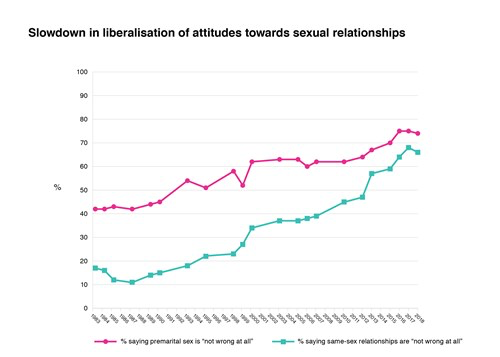
    That’s not what the social attitudes survey, which the headline refers to, says at all. It reports that in the last three years, the percentage of the 3,000 people polled who say there’s “nothing wrong at all” with same-sex relationships has been 66%, 68% and 64%.

    As Matt Singh, pollster, election analyst and person who is Very Good With Numbers put it on Twitter:

    Silly, sensationalist, clickbait. The measured proportion saying same-sex relations “not wrong at all” fell two points from the last BSA, well within the MoE (not acknowledged until para 7) and might simply be because 2016-17 saw a relatively big increase

    …As recently as 2012, this was a minority view. It is now the view of two-thirds of GB adults. Please don’t make LGB communities feel their acceptance is under threat because you find statistical caveats inconvenient.

    In 1987, 64% of people said same-sex relationships were wrong. In 2017, that figure was down to 19%. Here’s the graph.

    It’s not very clear, I know: the pink line is the percentage saying pre-marital sex isn’t wrong; the green one, same-sex relationships. The little downwards bit at the end is the difference in polls in just one year in a poll of 3,000 people.

    You’ll see there was a much bigger dip in approval of pre-marital sex in 1996 and another a few years later; nevertheless, the trend continued upwards. Acceptance of same-sex relationships may well be slowing down, but it’s unlikely that it’s peaked and you can’t infer decline from a difference that’s well within your poll’s margin of error. And yet even The Guardian is going for the most click-baity interpretation of the numbers, something that’ll delight the bigots.

    Acceptance isn’t going backwards. But journalism appears to be.