Category: LGBTQ+

  • Why the search for an LGBT+ gene is dangerous

    There’s been a lot of publicity over a new study into the so-called “gay gene”; the study reports that although there doesn’t appear to be a single genetic marker for gay people, there may be several. Similar studies have attempted to find a genetic marker for trans people.

    Here’s why that’s scary.
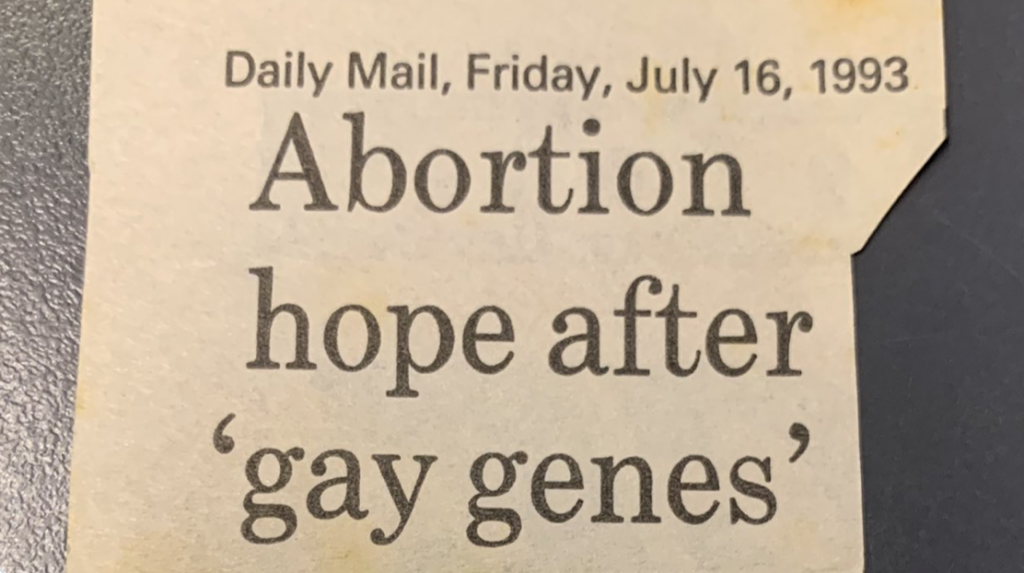
    This image was posted by Antony Tiernan, and in response the writer Huw Lemmey noted the context: “over a million British people still buy this paper every day.”

    Let’s be optimistic and believe that nobody would choose to abort a baby whose genes suggested they might be gay or trans. That doesn’t mean genetic screening for LGBT+ people couldn’t happen, or couldn’t be misused.

    The problem with any kind of genetic screening is that it’s a guide. For example, I’ve just had my genes analysed and I have a slightly raised risk of pulmonary disease. That doesn’t mean I will get it. It just means there’s a higher likelihood than perhaps you have.

    One of the things I was screened for is abnormalities relating to the BRCA1 and BRCA2 genes, which we know are implicated in many cancers. I’m clear – but the screening only checked a small proportion of the thousands of potential variants. I could still have a difference in one of those genes that means I’m more likely to get cancer.

    Now imagine I’d been screened for genes linked to being trans. The same thing could apply: you could check for 100 different anomalies, and that could come back negative – but there could be hundreds upon hundreds of other genetic variations that you don’t check for, and which have contributed to me being the fabulous trans woman you see today.

    Why does that matter?

    It matters because if we developed a genetic test for LGBT+ people we might decide to use it in asylum claims, because one reason people claim asylum is because they face persecution for being LGBT+ in intolerant countries. Imagine: we could easily differentiate between the real asylum seekers and the fakers!

    Far-fetched? Last week a British judge rejected an asylum seeker’s application because he didn’t seem gay enough. He contrasted the man’s demeanour with that of another man who “wore lipstick” and had an “effeminate” manner.

    In that case, the judgement was appealed and has been sent back for review. But what if the judge had rejected the applicant because his genes “proved” he wasn’t gay?

    It could also be used to “prove” that people are lying about their sexuality or gender identity in other circumstances. There’s already fierce and often malicious debate over whether some trans people are “trans enough”, so for example anti-trans bigots are keen to differentiate between “true” trans people, who they pretend to care about, and “fake” trans people – people like me who haven’t had surgery – whose human rights they want to curtail and whose healthcare and support services they want to defund.

    Could failing genetic testing mean I’d be denied NHS treatment such as hormone therapy?

    Scaremongering? Here’s TIME magazine with a short history of how bullshit science has been variously used to justify discrimination against people of colour and against women.

    In the early 20th Century, out of context IQ testing was used to justify the forced sterilisation of black and hispanic people.

    the notion of feeble-mindedness, at least partly determined by IQ tests, was used as a justification for the Supreme Court’s notorious Buck v. Bell decision, which allowed forced sterilization for “insanity or imbecility,” mostly among the population of prisons or psychiatric hospitals.

    One of the links in that article goes to a study of pseudoscience on women’s suffrage.

    many scientists supported the antisuffrage argument of “physical force,” claiming that women lacked inherent energy needed to physically enforce laws and should be excluded from voting. A secondary argument claimed that such cyclic elements as menstruation and menopause made women too irrational to vote.

    More recently, halfwits in Silicon Valley have been pushing the bullshit theory that men are better suited to tech jobs because of exposure to “prenatal testosterone”.

    Sexuality and gender identity are complicated and multifactorial, and they are normal variations in human behaviour and biology. That means there can never be a reliable genetic test for being gay or being trans, and we should be scared of anyone who wants to create one.

    As TIME’s Jeffrey Kluger writes:

    …as long as there is science—which means forever—there will be people willing to misuse what it teaches.
  • Everybody needs good neighbours

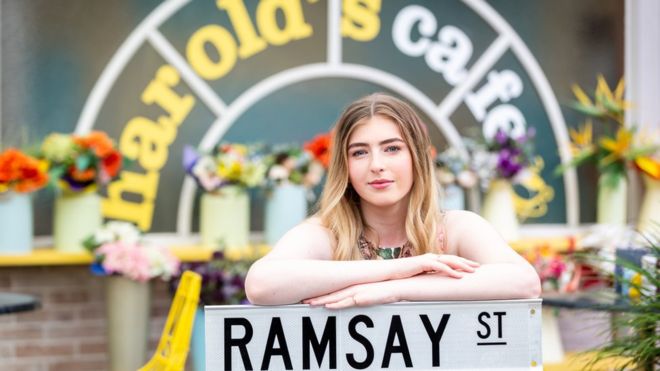
    Georgie Stone, who approached Neighbours with the idea for her character.

    The Australian edition of The Guardian continues to embarrass the UK arm by covering trans issues without scaremongering or platforming bigots. Here’s Alison Gallagher on the news that popular soap opera Neighbours will feature its very first trans character.

    …at a time when politicians and publications (including, on occasion, the UK arm of this one) have made trans people’s – and in particular young trans people’s – existence a target for “debate”, there is some nice, uncomplicated good in a young trans person playing a young trans character on a beloved, long-running program.

    If longstanding viewers couldn’t think of a single trans person before, now they can.

    If a young trans person has never seen someone they could relate to onscreen, now they will.

    And to that one young person, it could mean an awful lot.

  • People like us

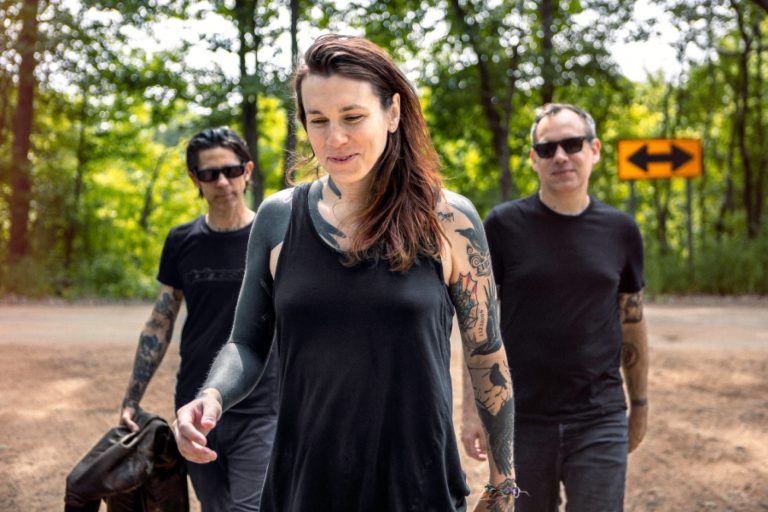
    Laura Jane Grace & the Devouring Mothers in studio (L-R: Atom Willard, LJG, Marc Hudson)
    Credit: Bryce Mata

    I went to see Laura Jane Grace and The Devouring Mothers last night. It was a fun gig, introduced me to music I hadn’t heard before and made me feel a whole lot better about myself. That’s because like me, Grace is trans.

    Grace is slightly younger than me – she’s 38 – but like me she began transitioning relatively late in life, in her case at the age of 32. That means like me she had to go through male puberty and grow a male body. Grace looks much more feminine than I do – she has better genes, is younger than I am and has had facial feminisation surgery – but I don’t think it’s unfair to say that you can tell she’s trans. This, to me and I suspect the many trans and non-binary people in last night’s crowd, is really helpful. As I’ve said many times before, some of the most powerful words in our language are “you are not alone”.

    When you’re the trans singer/guitarist in a noisy rock band, seeing a trans singer/guitarist in a noisy rock band is very life-affirming.

    Visibility, representation, matters. I spent unhappy decades without any role models such as Laura Jane Grace: the only trans people I saw were either the butts of cruel comedy or the miserable subjects of miserable documentaries.

    Things are different now. We have the internet, of course, and books such as Grace’s own memoir and those of trans figures such as Juno Dawson, Janet Mock and Sarah McBride are helping trans people (and cis people!) better understand what it’s like to be trans or non-binary, and of course the visibility of actors such as Laverne Cox is enormously helpful too. Five years ago Time magazine was moved to declare the “transgender tipping point”, and trans people have never been so visible.

    This story, to me, is huge. Teddy Quinlivan is the new face of Chanel. The 25-year-old model came out as trans two years ago, and as you can see she looks a bit prettier than I do. That’s mostly genetics, of course, but Quinlivan also started hormones when she was 17. The younger you begin transition, the better the results. Your body is still forming so the hormones can be very effective, and things like long hair and a smooth face don’t require thousands of pounds and months or even years of painful procedures to achieve.
    Quinlivan has what some of us call “passing privilege”: she looks like a pretty young woman because that’s exactly what she is, and she’s treated as such by society. She could easily have kept her trans history secret, but she chooses not to: she chooses to use her platform to help change people’s perceptions of trans people.

    As she says:

    “There’s a stereotype of transgender people based on what’s shown on Maury Povich or Jerry Springer. It’s that there’s something mentally wrong with them, that they are incapable of serving in the military or existing in the workplace normally. But that’s not true at all. I am proof—a successful model who happens to be transgender. And I think fashion, in terms of social power, is the most important industry. Advertising has tremendous impact in terms of who and what we find attractive…. If legislation is being made on my behalf as an American citizen, then it’s incumbent on me to speak up for the transgender taxpayers who deserve the same dignity and respect that a cisgender person receives.”

    Another very beautiful trans woman who doesn’t keep her history secret is Munroe Bergdorf, who lost her job as the face of L’Oreal after a coordinated campaign against her. As she says, having some pretty trans people on magazine covers isn’t enough.

    While media visibility, representation and public awareness are at an all-time high, trans people also face soaring levels of violence and a startlingly transphobic mainstream media presence, as well as bullying and harassment on social media… while some community figureheads are rightfully having their time to shine, this is not an accurate reflection of the reality of how it feels to be transgender in the UK today.

    But visibility still matters.

    I often say that if I had seen a Laverne Cox or a Janet Mock in a magazine when I was younger, everything that I was feeling during my adolescence would have begun to make sense a lot sooner. It wasn’t until I was 20 that I started to find transgender role models that I could truly relate to, and by that point I had internalised so much self-hate with regard to my gender and racial identity that it stopped me sharing how I felt with other people – a vicious cycle which severely impacted on my mental health.

    Like many trans people, I have to battle against the cumulative effect of years of being told that people like me are sick, that we’re deviants, that we’re perverts… you don’t need me to go through the charge sheet when some newspapers reprint it every week.

    What Bergdorf is describing is what anti-trans bigots try to convince you is “social contagion” or their invented illness, “rapid onset gender dysphoria”: it’s understanding that there are other people like you, and that they and you are just as valid as anybody else. It’s realising that you don’t have to fight who you are for the most important years of your life.

    To see the visibility of people like Laura Jane Grace, Teddy Quinlivan, Munroe Bergdorf and others is bitter-sweet: I’ve been trans all my life but I didn’t know that was okay until middle age – long past the point where I had any chance of going through life looking like an ordinary woman, let alone a pretty one. So I’m happy for the trans kids growing up now, and sad for those of us who had to grow up long before the transgender tipping point.

    Bergdorf:

    We must start working towards a time where trans people are not only celebrated on screen, but also in real life.

  • This is what conversion therapy is

    On a dull autumn day in 1964, two NHS doctors strapped a 17-year-old boy into a wooden chair in a dark, windowless room and covered him in electrodes. During hours of so-called therapy, they repeatedly electrocuted him while showing him images of women’s clothing.

    That’s the start of a BBC profile of Carolyn Mercer, a trans woman.

    At work, Carolyn bound her developing breasts to hide the effects of her treatment. But in 1994, a journalist learned she was taking hormones, and Carolyn’s personal life was plastered across tabloids claiming it was in the “public interest” to report the secret of a high-profile head teacher.

    It gets considerably more upsetting. Consider this a massive trigger warning.

    These stories matter. They matter because anti-trans activists still believe in attempting to “cure” trans people. They matter because newspapers still claim monstering trans people is in the public interest. And they matter because right now someone is doing just what Mercer did: trying to hide who they really are.

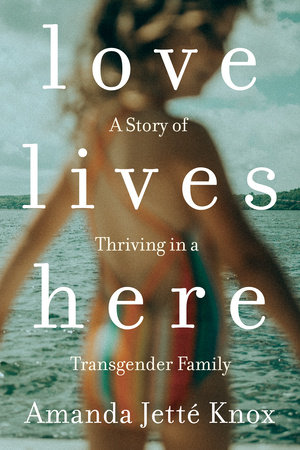
  • Book recommendation: Love Lives Here, by Amanda Jetté Knox

    I read this in a single sitting last night and cried through the whole thing.

    What would you do if your child came out as trans, or if your spouse did?

    What if both of those things happened?

    You may know Amanda Jetté Knox from Twitter, where she’s @mavenofmayhem. In this book she writes about what happened when not one but two of her family came out: first her daughter, then her spouse.

    Jetté Knox clearly has a huge heart, and she writes very movingly of what it was like for her partner to grow up living a lie even while she’s wrestling with her own feelings of loss and betrayal. She’s very honest about her fears for her daughter and later, for her partner, and she manages to find kindness even when she’s talking about utterly despicable behaviour by her peers at school and as an adult, her fellow parents.

    You don’t need to be trans or love someone who’s trans to enjoy this book: at heart it’s a really well-written, warm and fascinating memoir about love and families. But if you are trans or do love someone who’s trans, it’ll probably have you blubbing like it had me.

    It’s not a spoiler to say that this book has a happy ending: if you know her online you’ll already know that Jetté Knox is still married and is a strong, vocal trans ally. Sometimes love really does win.

    The publisher’s page for the book is here.

  • Turning shame into sadism

    A few days ago, a thread about radicalisation went viral. In it, Joanna Shroeder spoke about the way in which far-right activists recruit boys and young men by weaponising shame.

    The process goes something like this:

    • Boys are encouraged to transgress social norms by posting racist, homophobic, misogynist or anti-semitic jokes
    • The boys are then called out on it by parents, teachers, and (especially) girls and women.
    • The boys feel deeply embarrassed and shamed.
    • The far-right tells them they’re getting into trouble for nothing, that they’re the victims of “woke” people, PC gone mad, snowflakes and so on.
    • The boys are encouraged to hate the people who called them out for their racist, homophobic, misogynist or anti-semitic jokes.
    • The more hateful their behaviour, the more their new friends praise them.

    It’s not just teenagers, and it’s not just the far right. We’ve seen exactly the same thing happen with supposedly intelligent, successful adults – mainly, although not exclusively, relatively affluent, straight, cisgender, middle-aged white adults with jobs in media – when they say something awful about LGBT+ people. Their process goes like this:

    • They say something terrible or just incorrect about LGBT+ people.
    • They are called out on it by LGBT+ people and allies.
    • They feel deeply embarrassed and shamed.
    • Bigots tell them they’re getting into trouble for nothing, that they’re the victims of “woke” activists, snowflakes, PC gone mad, a sinister lobby and so on.
    • They are encouraged to hate the LGBT+ people who criticised them.
    • The more hateful their behaviour, the more their new friends praise them.

    This is how, say, a washed-up comedy writer ends up dedicating his every waking hour to spreading hate about trans women: he writes a tone-deaf episode, gets criticised for it, and his shame becomes rage against the entire demographic.

    This is how a moderate broadsheet journalist becomes evangelical about the supposed dangers to women of a tiny group of LGBT+ people, shouting over the women and women’s charities who tell him he’s wrong. He writes something incorrect, gets criticised for it, and his shame becomes rage against the entire demographic.

    This is how a successful blogger decides to use his platform as a bully pulpit against a minority group. He writes something inflammatory, gets criticised for it, and his shame becomes rage against the entire demographic.

    These men might not be shooting up supermarkets to express their rage against women, as some incels do, or taking AR-15s to mosques. But the shame and rage is the same. These men are red-faced little boys, vowing terrible revenge on the people who laughed at them.

  • Trans Guardian staff quit over transphobic reporting and “face to face rows”

    Buzzfeed news:

    Two Transgender Employees Of The Guardian Have Quit Over Its “Transphobic” Reporting

    …Her resignation marks a flashpoint in what multiple sources at the Guardian have described to BuzzFeed News as a deepening internal war over the rights of transgender people – and how the organisation reports on them. Staff members across several departments accused the paper of “institutional transphobia”, peddling transphobic tropes, and allowing a bitter schism to develop between pro- and anti-trans journalists.

    …Many at the paper who share her concerns told BuzzFeed News that the internal divisions over trans rights have resulted in face-to-face rows in the office, a widening rift between the UK and US offices (which is largely populated by pro-trans writers), and moves against staff who protest against transphobia. All of which, sources said, is affecting morale.

    As the story notes, the paper’s editorial stance has also persuaded high-profile trans columnists to refuse further commissions and moved staff to make formal complaints about the framing and language used in coverage of trans-related issues.

    The Guardian and [sister title] Observer have in previous years run opinion columns using language such as “trannies”, “shemales”, “man in a dress”, “dicks in chicks’ clothing” and articles that have argued that “sex change surgery is modern-day aversion therapy” – equating transition, which is elective and saves lives, to electric shocks to “cure” homosexuality, which is state-sponsored torture.

    The Guardian is quick to condemn other newspapers’ shameful coverage of minorities, but it appears to be throwing stones from inside a glass house.

  • Playing video games

    In the Mass Effect series, players can customise Jane (or John) Shepard (left). The version here is from the launch trailer; my Jane looked very different.

    Writing in Metro, Owl Stefania writes about the importance of video games in her coming out process: “Growing up, video games were my escape, providing an avenue where I could explore who I was.”

    I’ve written about this too, and a version of the following article was originally published in 404 Ink magazine in late 2017.

    Video games have a special appeal for trans people. In addition to the usual escapism from the everyday, some of them enable you to play as the gender you feel you should be, not the one you’ve been assigned.

    For many trans people the first such games were MMORPGs, massively multiplayer online role-playing games. Many of those games enabled you to play as all kinds of characters from humans to hobbits and space aliens). As many trans people discovered, when you communicate with other players in an MMORPG they’re quite happy to stay in character, so if your character is female you’ll be addressed as such. That isn’t always a good thing — there’s plenty of misogyny, homophobia and transphobia online, and online games aren’t immune to that — but as trans gamer Rissa Trent writes on MMOGames.com, being able to present as a female character is incredibly powerful. “To some people, it might just be pixels, but to those of us who want to break free from everyday life, and our own skins, it’s everything.”

    I never really got into MMORPGs, but I fell hard for a sci-fi series called Mass Effect. In the first three Mass Effect games you play Commander Shepard, and that commander can be John or Jane. Not only is Jane Shepard better company — she’s voiced by the wonderful Jennifer Hale, who makes even the daftest dialogue breathe — but you can completely customise the character’s appearance in the game. Hair colour, facial structure, eye shape, jawline, hair, makeup… given enough time, and believe me I gave myself enough time, you could create a Jane Shepard who was an idealised version of your feminine self. 

    To then have the game offer romantic options beyond the usual straight man/woman binary — something that caused controversy at the time, because while gamers had no problem with interspecies alliances (the same man-with-sexy-space-chick trope that goes back to Star Trek), same-sex attraction couldn’t possibly be a thing in the far future — was the cherry on top. Sadly the game wouldn’t let my character have a relationship with the character I really liked, the gorgeous, kick-ass soldier Miranda Lawson, and I clearly wasn’t the only one disappointed: the internet is packed with fan fiction where Jane and Miranda are an item.

    Mass Effect and MMORPGs (and other games where you can be a girl, such as Dishonored 2 or Destiny) are very different games, but they both offer trans people something really important: the opportunity to inhabit your preferred gender, if only for a while. And as games get more realistic and immersive, that’s going to become even more powerful. 

  • This is what a moral panic looks like

    Tea Uglow did an interesting thing. They took screenshots of articles containing the word “transgender” on a few English news outlets. Over the last 12 months, there were 878 articles. That doesn’t include publications such as the New Statesman, which has been home to a lot of anti-trans voices, and to regional press such as The Scotsman, The Herald and The National, all of which frequently print a disproportionate amount of content from anti-trans voices. It also doesn’t include articles that use “trans” instead of “transgender”, of which there are many more.

    Uglow:

    They’re not all bad – but they’re not all necessary.

    We hope this serves to understand what 3 ‘articles’ a day about your community feels like.
    Obviously, if we tried to track all ’trans’ articles online we would need someone clever.

    We stopped when results felt irrelevant. i.e. Transgender is mentioned in many hundreds of ‘news’ or opinion pieces without relevance to the news item in question. (Here’s looking at you Sunday Times)

    No, it’s not scientific. Yes, the methodology can be questioned.
    Knock yourself out / Do better / Or.. perhaps, just leave us alone.

    It may be a relatively small chunk of the anti-trans coverage we’ve seen in the last two years but it’s still a thoroughly saddening read. Trans people are repeatedly painted as a faceless, sinister mob that somehow has a stranglehold on politics and the media despite there being no trans politicians, columnists or editors.

    In the popular press, all trans people are activists and all anti-trans activists are not activists. People who call trans people unspeakable things and threaten violence against them are just ordinary mums and dads with reasonable concerns. People who keep getting suspended from social media for online abuse get to present themselves as innocent victims of political correctness gone mad. People who hound women who disagree with them off the internet are portrayed as noble defenders of women. People who roundly abuse trans people until someone snaps get to claim they’re the victims, not the perpetrators.

    You don’t have to read all 800-plus pieces to see the patterns. Again and again articles talk about the dangers of legal reform by scaremongering about completely different legislation. Articles repeatedly lie that children are given cross-sex hormones (they aren’t) and surgery (they really, really aren’t). Straight white men dust down their anti-gay columns from the eras of section 28, the lowering of the age of consent and the equal marriage debate and do a search and replace to swap “gay” for “trans”.

    There are fair and balanced articles about trans people, but not many. It’s easy to find articles trying to persuade readers that the Mermaids charity is trying to force kids to have surgery (which doesn’t happen). Good luck finding profiles of any families they’ve helped. Private GPs who treat trans people are demonised, but the crisis that forces so many trans adults to go private or to take a dangerous DIY route is rarely mentioned. It’s easy to find stories about the invented dangers of trans women in prisons but not ones about the actual violence trans people in prison experiences; or pieces about the invented dangers of minor legislative reform but none about the actual experiences of the only people who will be affected by it.

    All too often the same writers trot out the same bullshit. To them it’s a game, something to chortle about to their friends on social media. They know it’s cruel, because the cruelty is the point.

    It’s not a game for the people they’re defaming.

    Hate crimes against all LGBT+ people are up considerably since the press decided that actually, it’s okay to hate some LGBT+ people again. As anti-trans sentiment has increased in the press and online, it’s lead to a massive, disproportionate increase in hate crimes against trans people. What’s typed on a screen makes its way to the streets.

    This is not about legitimate debate. This is about the full power of the press being used to target, defame and demonise a tiny, vulnerable minority of people. We’re not a mob. We’re not a lobby. We’re people just like you. And right now, we’re very, very frightened.

  • Old news

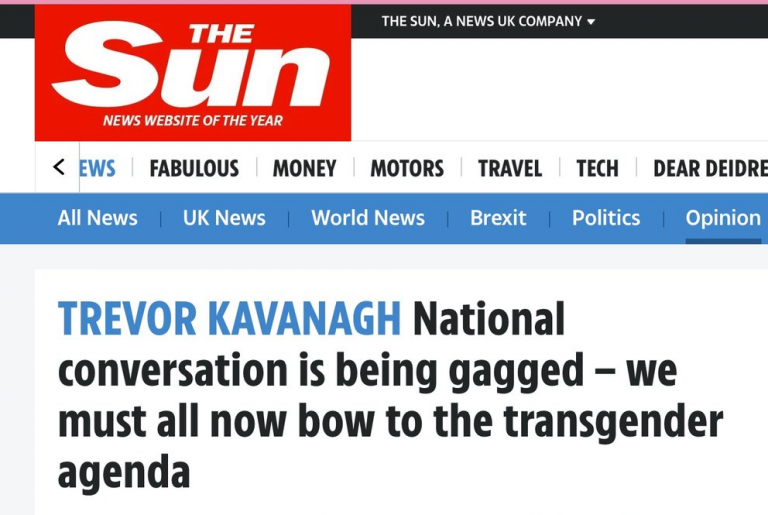
    Here’s The Sun newspaper in 1992.

    If you think that sounds familiar, have a read of Terry Sanderson’s Media Watch column from that month, May 1992. Sanderson spent a quarter of a century battling against bigotry in UK newspapers, and sadly the publications and the writers don’t seem to have changed much.

    There was Julie Burchill:

    Julie Burchill is rapidly becoming the most prominent commentator on gay issues in the straight press… the message comes over loud and clear that Julie has reached the conclusion that gay men are the ultimate oppressors of women. This, I think, is her problem. It is because she imagines all gay men hate women (or, worse still, patronise them) that she has got this bee in her bonnet about Aids.

    Burchill would later turn her ire towards trans women, who she now appears to believe are the ultimate oppressors of women.

    There were single-issue pressure groups gaining disproportionate press coverage for their intolerant views and allegations of sinister lobbies endangering children:

    During the election campaign The CFC (prop. Stephen Green) was issuing press releases like confetti.

    Nearly all of them concerned homosexuality. At the CFC’s prompting, The Sun reported (26 Mar): “Social workers are telling ten-year-old kids in care that gay sex is part of growing up.”

    …The Daily Express (23 Mar) saying: “Labour and Liberal Democrat policies on gay rights would put children at risk from homosexuals.” Mr Green “condemned” the politicians concerned saying that any changes in the law would “endanger children”: What The Daily Express failed to extract from the CFC’s press release was revealed by The Independent (3 Apr). The CFC had actually said that Neil Kinnock and David Steel have supported “the child sex movement” (which is the CFC’s term for the gay movement).

    There was dubious crowdfunding for publications advocating dangerous conversion therapy:

    Mr Green revealed to the Independent that “he’s nearly raised the £11,000 he needs to publish a book on homosexuals provisionally entitled Emotional Orphans.” The book will explain “how homosexuals may achieve heterosexuality” which he says is a “painfully difficult process”.

    There were newspapers deliberately equating being LGBT+ with being a criminal:

    “Outrage as boy is handed over to lesbian criminal” said The Daily Mail (I Apr) with The Sun announcing: “Lefties put boy in care of lesbian jailbird”. Note how the words “lesbian” and “criminal” become interchangeable in these circumstances: which is the more horrid prospect for the small boy to cope with?

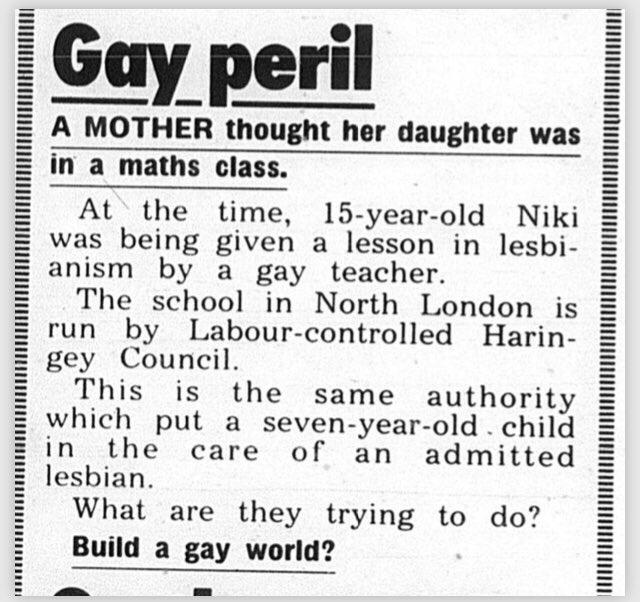
    And there was the “they’re coming for your children” moral panic as illustrated in the “gay peril” cutting at the top of this post.

    Awful, isn’t it? Two years later the Sunday Times, which railed against the so-called homosexual lobby, argued that HIV wasn’t the cause of AIDS and that saying so was the “HIV bandwagon” pushed by “the legions of the politically correct”. Andrew Neil, the editor at the time, believed that the link between HIV and AIDS was a conspiracy theory and that discussion of it was a “public misinformation campaign”.

    Also in 1994, the newspapers fired their final salvos in their crusade against moves towards equalising the age of consent for straight and gay people (the age for straight people was 16 but in 1994 it was decreased from 21 to 18 for gay people. Equality wouldn’t happen until the following decade).

    Sanderson:

    Naturally the “we must protect the children” argument was trotted out repeatedly. This is a sensitive area, and consequently was played for all it was worth by “family” groups and other politically and religiously motivated opponents of change.

    …The Daily Express, meanwhile, distorted the British Medical Association’s support for a lowering of the age of consent to 16 by headlining it: “Teenage Aids scourge” (January 14th).

    Richard Littlejohn had some thoughts, calling Peter Tatchell a “professional sodomite” who “holds recruiting drives outside schools”.

    And then there was the Telegraph.

    The article was illustrated by a cartoon that Goebbels wouldn’t have been ashamed of. It showed lock gates imprinted with the word “consent” being opened ready to engulf the unsuspecting people below.

    Ms Burrows, a woman of extraordinary fanaticism, alarmingly claims in her article that “a homosexual lifestyle reduces life expectancy from 75 to 42”. Where on earth does she get such a statistic? Why, from the Family Research Institute of Washington.

    The Family Research Institute is described by the Southern Poverty Law Centre, the US organisation that tracks neo-Nazis, race hate organisations and other lovely people, as an anti-LGBT hate group.

    This might sound familiar too.

    This latest gem about the reduction of life expectancy has been repeated at least twice over the radio by members of these “family” groups, and in neither instance was it challenged.

    Then, like now, bigots were given a platform to spout vicious bullshit about marginalised people without fear of challenge; then, like now, national newspapers incited fear and hatred of LGBT+ people; then, like now, the regulators did nothing and the victims’ pockets weren’t deep enough to fight the newspapers’ lawyers.

    A lot can change in 25 years, but apparently not in the UK mass media.