A version of the following article was originally published in 404 Ink magazine in late 2017, and in Carrie Kills A Man (2022).
Video games have a special appeal for trans people: in addition to the usual escapism from the everyday, some of them enable you to play as the gender you feel you are, not the one you were given.
For many trans people the first such games were MMORPGs, massively multiplayer online role-playing games. Many of those games enabled you to play as all kinds of characters from humans to hobbits and space aliens. As many trans people discovered, when you communicate with other players in an MMORPG they’re quite happy to stay in character, so if your character is female you’ll be addressed as such. That isn’t always a good thing — there’s plenty of misogyny, homophobia and transphobia online, and online games aren’t immune to that — but if a game is well written and acted, I’m not playing it. I’m living it.
Many games offer little more than the opportunity to play Grunty McGruntface, a space marine who runs about space shooting space Nazis with his collection of overcompensatory space guns. But when a game is well written with relatable characters I will absolutely climb between the pixels and not just play the character but become her. During the pandemic I was Ellie in The Last of Us Part 2, weeping throughout the closing hours as my quest for revenge made me lose my humanity. And before I made sense of all the trans stuff, I was Commander Jane Shepard.
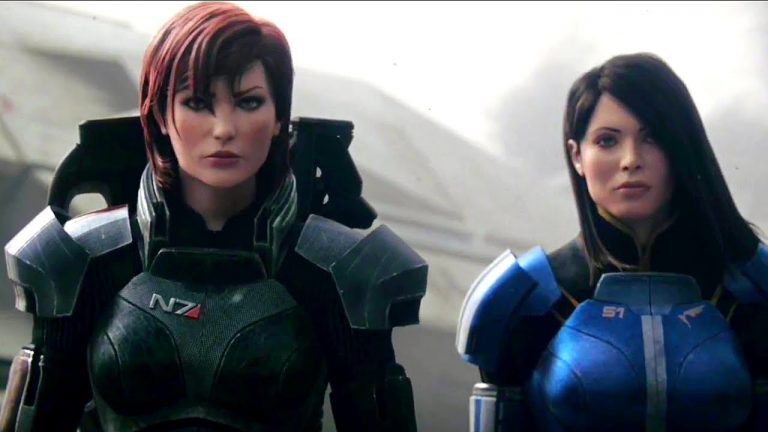
Commander Shepard is the hero / heroine of the first three Mass Effect games, a sci-fi series that enables you to explore far-flung galaxies and battle an incredible variety of enemies. While it’s possible to play the game as a man, Jane, or Femshep (a portmanteau of Female Shepard) as she’s known in fandom, is the best version of the character. That’s because she’s voiced by the wonderful Jennifer Hale, who can make even the daftest dialogue sing. Jane is much better company than her male equivalent, and you can completely customise the way she looks – hair colour, facial structure, eye shape, jawline, hair, makeup… given enough time, you could create a Jane Shepard who was an idealised version of your feminine self. So I did, and she saved all of humanity. You’re welcome.
I played the Mass Effect games again years later when they were remastered and reissued. As with the original titles, one of the things you can do in the game is pick Shepard’s outfit for when she’s not encased in ballistic armour. I think it’s telling and funny that years ago, my Shepard’s off-duty outfit was an impressive and impractical tight leather dress; today, it’s combats and a hoodie. I’ve also realised that the dark red I’ve been dyeing my hair for years now is the exact same colour my Shepard had, which amuses me immensely: when I was creating my Femshep, I was clearly trying to make the me I so wanted to be.
Mass Effect also offered romantic options beyond the usual straight man/woman binary: depending on your choices in the game you could romance other characters of various species and genders. It caused a lot of controversy at the time, because while gamers seem to have no problem with inter-species alliances (the human-man-shags-sexy-space-chick trope that goes back to Star Trek), same-sex attraction was beyond some people’s – boy people’s – limited horizons.
It’s a shame that the game wouldn’t let my character have a relationship with the character she really fancied, the gorgeous and super-smart Miranda Lawson: the developers decided to code her as straight, so romance was only an option if you played as John rather than Jane. I clearly wasn’t the only disappointed player: the internet was soon packed with fan fiction in which Jane and Miranda were an item.
I think there’s more to Miranda’s appeal than the perfection of her polygons. Miranda was a digital version of the Emmy-nominated actor Yvonne Strahovski, who lends the character her distinctive and expressive voice and makes the character really live. Miranda is much more nuanced and interesting than the copied-from-Aliens badass lady space soldier we tend to see in games: she has a complex history, family issues and a lot of guilt about the genetic engineering that gave her her powers. As she opens up to Shepard there’s a warmth and vulnerability to her that you don’t get with, say, the monosyllabic, metal-clad Marine you play as in Doom. She was interesting, and if there’s one thing I’m attracted to more than anything else it’s people who are interesting.
Mass Effect, MMORPGs and other games where you can be a girl, such as Deathloop and the Dishonored or Destiny franchises are very different games, but they all offer trans people something really important: the opportunity to inhabit your preferred gender, if only for a while.