Almost 50 geoscientists have urged the government to commission an urgent review of the fracking earthquake limit, which they suggest should be raised to allow the industry to expand
Of the 48 people that signed the letter, I could not confidently identify 9. I think one works for BP and another works for Shell. Many are not experts in any recognisable way. But it doesn’t really matter. Because, of the remaining 39, all have links to gas and oil companies.
…Several signatories openly brag about their industry funded research. Many used to work for oil and gas companies. Quite a few still work for those companies. And others are not even practising scientists, but directors of a business in the energy sector.
This isn’t just yet another example of how The Times and its sister titles often publish advocacy and rarely bother to check credentials. It’s part of a wider problem where supposedly independent experts are nothing of the sort.
The Taxpayer’s Alliance is a good example. It keeps its funding secret because it doesn’t represent the ordinary working stiffs it claims to; it’s an advocacy group for the super-rich, who fund it out of their very deep pockets.
Whether it’s the super-rich pretending to be ordinary people, religious fundamentalists claiming to be ordinary parents or anybody else with an agenda pretending they don’t, every time they’re given a platform the platform provider is failing its viewers, its listeners or its readers.
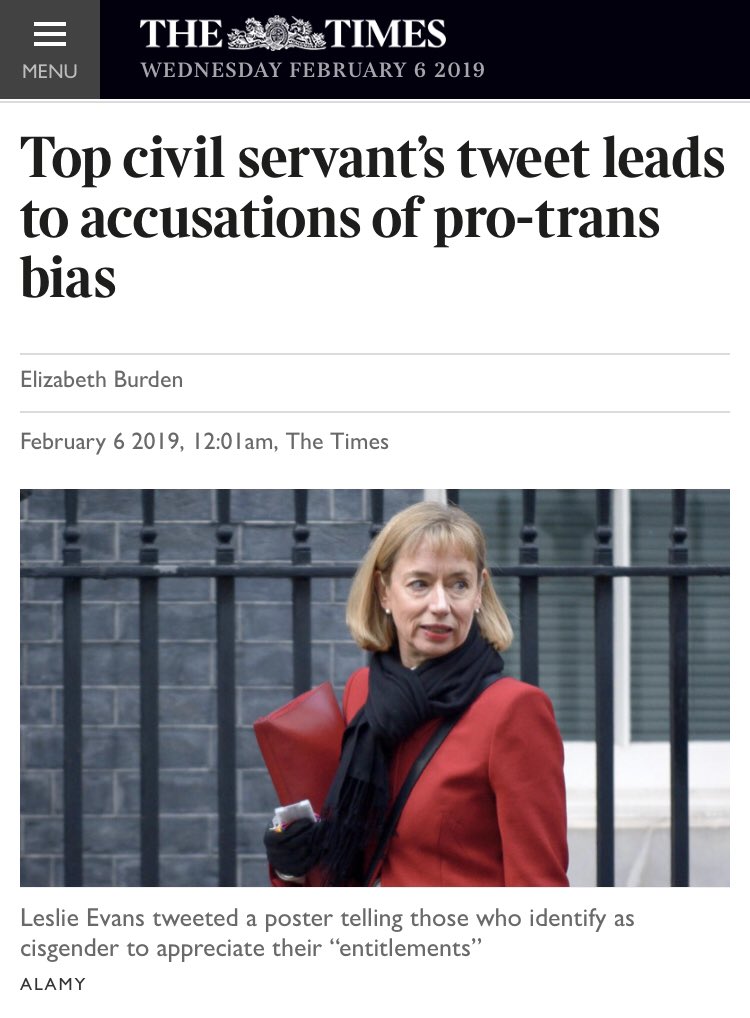
This is the latest story in the Times and Sunday Times’ ongoing campaign against trans people. Even by those low standards, it’s a pathetic attempt at turning something innocuous into a hit piece.
The tweet in question was posted in November. Here it is:
It’s a thoroughly unremarkable bit of political social media, and the supposedly inflammatory poster – the fourth image in the tweet – is a pretty innocuous “don’t be a dick” poster suggesting that it’s possible to be pleasant and respectful to trans people. It’s worth pointing out, because the Times never does, that the major women’s groups in Scotland – Rape Crisis Scotland, Scottish Women’s Aid, Zero Tolerance, Close The Gap, Engender and Equate Scotland among others – are proudly trans-inclusive.
“Pro-trans bias”.
Lets unpick that, shall we?
“Pro-trans bias”. Bias is a negative word; it means to be inclined or prejudiced for or against a particular group, usually in an unfair way.
To put it in this context is to say that to be pro-trans (or as I’d put it, pro-not being a dick to trans people) is a bad thing. The entire article is based on the flimsy premise that to post something mildly supportive of trans people is somehow shameful and something a politician shouldn’t be doing. It implies that by suggesting we should perhaps not be bastards to trans people, the politician is biased against non-trans people.
The headline’s doing a lot of work, isn’t it?
As ever, you can illustrate the point by changing the words. Swap “trans” for “catholic”, “jewish”, “Asian”, “black”, “gay”, “disabled”.
As I say, bias is prejudice for or against a particular group. It’s something you’d be guilty of if, say, you accused a politician of “pro-trans bias” over an innocuous, two-month-old tweet but failed to report (let alone criticise) the UK government officials who repeatedly meet with rabidly anti-trans groups (Transgender Trend and Fair Play For Women twice and A Woman’s Place three times, with FPFW invited to a further two “round tables” to discuss limiting trans people’s rights) or the MPs who post anti-trans sentiment to social media.
It’s the kind of thing you’d be guilty of if your columnists were activist supporters of anti-trans groups but failed to declare that in their regular anti-trans columns.
It’s something you’d be guilty of if you repeatedly ignored the medical consensus on trans people in favour of scaremongering from activist groups.
It’s something you’d be guilty of… you get the idea.
Anti-trans bias in the press is so commonplace that to simply detail it would be a full time job, but the Times/Sunday Times has become so blatant it’s almost a parody of itself. If you buy these titles you’re helping to fund this bullshit.
What’s that? The Sunday Times has printed a load of old bollocks again? I’m shocked! Shocked!
My lecture yesterday was about calls for internet regulation, and I mentioned the media panics over “suicide sites” in 2001, 2006, 2011, 2012, 2014, 2016… you get the idea. We’re in the middle of another panic now.
Enter the Sunday Times, which this weekend claimed we are raising a “suicidal generation” and that it’s all social media’s fault.
This is – and I don’t want to get too technical here, but bear with me – absolute bollocks from top to bottom.
The truth is that while there are certainly tragedies, the actual number of teenagers who kill themselves is very small – and because the numbers are so small, even the slightest change can be made to look like a dramatic shift.
Especially if you cherry-pick the numbers, as the Sunday Times did.
The ST compared the most recent figures with 2010, which had the lowest rate of teen suicides since 1981. Chivers again:
You could, if you wanted to, use the same trick to tell the exact opposite story. Facebook was first released in 2004, when the suicide rate among 15- to 19-year-olds in England and Wales was 4.7. But after six years of social media being available, it had dropped to 3.1! It’s a life-saver, no?
The Sunday Times piece suffers from two key problems. One, social media isn’t causing a suicide epidemic among teenagers. And two, there isn’t a suicide epidemic among teenagers.
If you look at 10- to 29-year-olds, it’s gone from a consistent plateau of about 15 per 100,000 from the late 1980s to the early 2000s, down to about nine per 100,000 by about 2004, and that’s where it’s stayed, pretty much. There’s a similar story among the population as a whole.
Every suicide is a tragedy, but to peddle myths isn’t helping anybody. In fact, it might very well be letting the real culprits off the hook. As Natasha Devon MBE, who works with teenagers, posted on Twitter, the top reasons teenagers tell her their mental heath is suffering don’t include social media at all. They are:
1. Academic anxiety;
2. Lack of community support;
3. Problems at home;
4. No one to talk to;
5. Loss of activities which helped them cope (eg sport/music);
6. Worries about future.
That doesn’t make for such an exciting headline. Reality rarely does.
It’s easy to laugh, but it’s actually quite a serious problem: time and again magazines and online magazines aimed at women print deluded and sometimes actively dangerous health advice from people who haven’t got the faintest clue what they’re on about.
Gwyneth Paltrow’s Goop site is a good example: it urges women to do all kinds of dangerous things to their genitals and weasels out of taking responsibility for any resultant injury or infection with a disclaimer effectively saying that “the products or procedures mentioned on the site are not intended to be a substitute for professional medical advice, diagnosis, or treatment.” Some of Paltrow’s fact-free tips have appeared in supposedly reputable magazines such as Women’s Health.
A few years ago, one study looked at the articles about complementary medicine in a range of women’s magazines. Of the 150 articles studied in 15 women’s magazines, 131 “were written by non medically qualified contributors”. Of the 150 articles, 95 made unsubstantiated claims about herbal “remedies” that can be very dangerous for some people.
I’m surprised Marie Claire slipped up, because as magazines go it’s one of the better ones. But it’s an industry-wide problem. Between “alternative” medicine, dangerous diets and cheerleading for cosmetic surgery, women’s magazines are often really bad for women’s health – and the more magazines move online and become low- or no-paying content farms, the worse the problem is going to become.
The Sunday Times isn’t the only supposedly respectable newspaper to mislead its readers in order to parrot the homophobic and transphobic views of its owner, Rupert Murdoch. The Wall Street Journal does it too.
The WSJ appears to have started the new year the way it means to continue, with an op-ed warning readers about the entirely invented syndrome of “rapid onset gender dysphoria”. Regular readers will recall that ROGD is a conservative, anti-trans invention and that the only supposedly scientific paper about it, a study based solely on interviews with parents who refused to believe their kids are trans, was torn to pieces by peers due to its shoddy premise and even shoddier methodology.
In short, ROGD is a right-wing attempt to rebrand conversion therapy, the same “pray the gay away” bullying that’s so awful it’s being made illegal in much of the world.
Transgender people have not come up with the entirety of our existence solely to hurt Tucker Carlson’s feelings. We do not embark upon transition because it’s groovy. We are here because our hearts demand it.
Have you seen the gender neutral Santa story? Of course you have. It’s been everywhere. The tale that 1/4 of people want a gender neutral Santa has appeared in my news feeds so often I could recite it from memory, so I will.
A new study found that 25% or 26% or 27% of people – the numbers vary from report to report – want Santa to be gender neutral.
If you’ve reported it like that, you’re on the naughty list.
The “study” was a survey by a graphic design company of a few hundred customers. Those customers of unspecified demographics were specifically asked what gender a modern Santa should be, and given the choice of male, female, or gender neutral.
This is not what you would call a reliable poll.
Nevertheless, the story is everywhere. It’s on BBC Three and in the New York Post, on News.com.au and PinkNews, on Fox News and Newsweek and in the Mirror and the Daily Mail.
Throwing out these distorted figures and studies feeds the right-wing lunatics who believe that members of the LGBTQIA community are secretly plotting to take over the culture. And it encourages a pile-on of hatred towards the community from those who consider themselves to be part of the ‘sensible centre’ (whatever that means.)
I’m not sure that Earp is right about the intent of the graphic design company, which “knowingly weaponised the ire of the mainstream media”. I suspect they just thought they were being funny and/or cute.
But there’s no doubt about the malicious intent of much of the reporting. Somehow a bullshit story about a fictional character is evidence of the evils of LGBTQ people generally and trans people in particular.
When the story reaches the likes of the Daily Mail or Breitbart, which of course it has done, it’s presented as the latest example of political correctness gone mad, of the sinister trans lobby pushing its values down ordinary god-fearing people’s throats.
This tweet is by no means unusual.
i’m all for same sex marriage, trans operations, etc,but the LGBTQ+ community is deadass starting to shove their way of life down people’s throats. equal opportunity for shows & movies is great, but not every movie needs a gay lead & Santa doesn’t need to be gender fuckin neutral
This happens time and time again. A story with little or no connection to the LGBTQ community is presented as the latest example of their unreasonable demands and used to demonise them in the media and on social media. It’s already made its way into anti-LGBTQ opinion pieces, and it’ll continue to circulate for years to come as an example of those terrible LGBTQ activists and their unreasonable demands.
Children who behave badly don’t get Christmas presents. Sadly there’s no such penalty for journalists.
Here we go again. In the latest bout of anti-trans madness, washed-up comedy writers are comparing trans people to Nazis to the delight of their many thousands of followers. In the aftermath, Scots MSP and newspaper columnist Joan McAlpine approvingly retweets an anti-trans group – a group that had been invited to the Scots Parliament to discuss gender recognition reform – saying much the same thing. The same group is currently putting anti-trans posters in toilets in Scottish bars.
According to the group, “there’s transactivists who are going to claim they were the victims of Nazis. We need to be clear, the LGBT victims were lesbians & gay men, not people who identify as trans.”
Nope. Trans people were sent to the concentration camps too, usually because the Nazis considered them to be gay. They weren’t big on nuance.
Cisgender, straight white women were okay though. Some of them got to be the camp guards.
The women here are Helferinnen, women auxiliaries. The photo is from Solahuette, a kind of holiday resort for the staff of Auschwitz.
Let’s have some history, shall we?
Before the Nazis came to power, Germany was a centre of excellence for trans knowledge. One of the most notable people in the field was Magnus Hirschfield, whose institute for sexual science carried out extensive research into the psychology and biology of trans people. Hirschfield was the first person to systematically describe and work with people he termed transvestites and transsexuals; what we’d call trans people today.
By the early 1930s, people came from around the world to undergo reassignment surgery in Berlin. Then Adolf Hitler was appointed Chancellor of Germany in January 1931. Two years later, his brownshirts broke into Hirschfeld’s institute and burned his journals and research. When Hirschfeld was out of Germany on tour, the Nazi student group marched on the Institute. Over 20,000 books were set aflame, as well as medical diagrams and photographs crucial to understanding sex reassignment surgery. Hirschfeld and his colleagues were Jewish, but it wasn’t just that. Hitler also publicly raged against the “vice†of homosexuality and the “degenerate†lives of transsexuals. They weakened the Aryan cause.
It is true that trans people were not categorized specifically as trans by the nazis (with few exceptions), because *they* saw trans people as Gay or lesbian due to a common misunderstanding in medicinal history to link gender and sexual orientation.
…Â This institute and Magnus himself advocated for LGBT rights in Weimar Germany, provided safe haven for many lgbt people and developed early methods of trans transitioning healthcare, many developed versions of which still exist today.
The Nazis targeted this place and saw no practical difference between LGBT people. They saw us all as sexual degenerates. They were nazis, they’re kind of dicks that way.
Were trans people targeted as a separate category? Mostly, no: they were considered gay or lesbian and given the same pink triangles. But there were exceptions. Sometimes trans people were targeted.
In November 11, 1933 the head of the Hamburg police was told to pay special attention to transvestites (a term which then means trans people as well as cross dressers) and bring them to concentration camps.
in 1938, a german medical journal recommended that the “phenomena of transvestism†be exterminated from public life and said that the current measures (concentration camps) were good enough for this task.
…during the bookburning of the entire library of the institute, the one thing they made sure to not burn was the member roster, which contained names and addresses which they used to round up as many people as they could and shuffle into concentration camps.
That roster, incidentally, is one reason trans people really, really don’t like the idea of any kind of register of trans people being created.
To say trans people weren’t targeted by the Nazis is patently untrue. In fact, it’s Holocaust denial: as soon as you ignore the evidence of what the Nazis did because you hate one of the groups they targeted, you open up the door to others: the homophobes, the racists, the anti-semites.
As a feminist woman I know put it (no name or link because I don’t want to send extremists her way):
This is not difference of opinion, or “debate†or “discussion†or “concern for women.†It is Nazi revisionism and it is fuelled by hatred and it should concern anyone opposed to far right rhetoric creeping into our democracy.
The Holocaust is not, and should never be, something to “debate”.
This is what happens when you demonise people, when you tell people that someone’s very presence is a threat to you and to your children. For some people, “looking a bit trans” is sufficient grounds for action against a complete stranger who’s minding their own business.
It’s not just people like me. It’s particularly horrific for refugees, especially since the whole Brexit mess began. The Overton Window, the range of political discourse that’s considered acceptable in society, has moved so far to the right that supposedly mainstream political parties are echoing the manifestos of the BNP and other far right groups from previous decades. What used to be unacceptable racism is now “asking difficult questions”.
That demonisation has consequences big and small, and it always, always ends up with people getting attacked. For example, this week we saw horrific footage of a Syrian kid being “waterboarded” by bullies; it’s the latest in a campaign of abuse that’s seen him being doused with water, verbally abused and his hair set on fire, as well as physical violence. His sister has been bullied too.
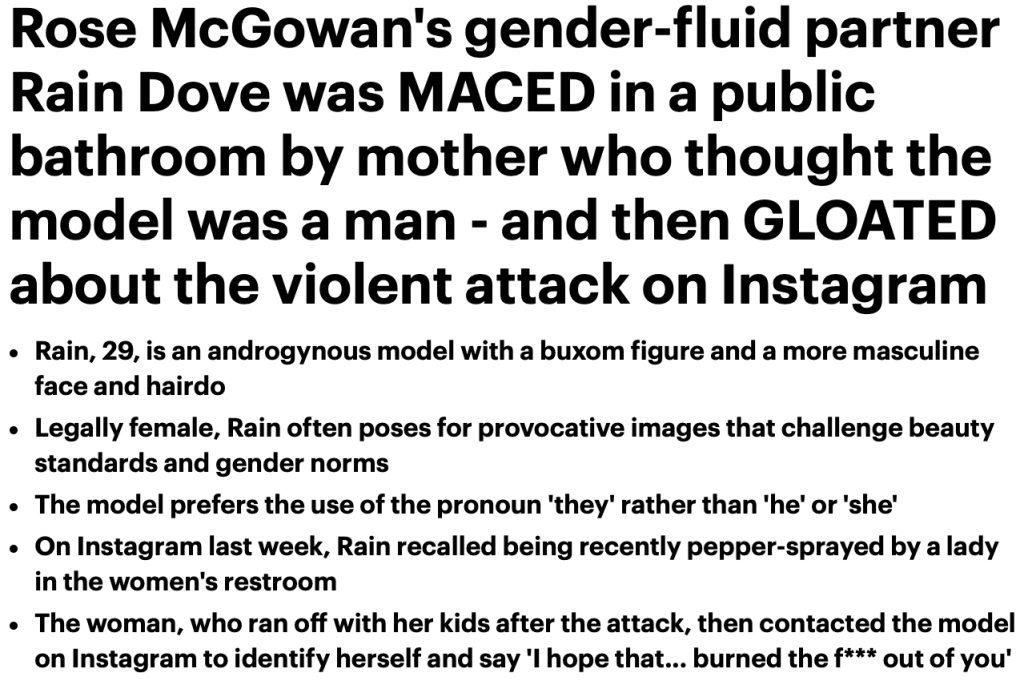
The same Daily Mail that’s so concerned about Rain Dove was also concerned about this kid: after years of demonising refugees, the Mail can’t imagine why anybody would pick on a child just because he’s Syrian. The Sun thinks it’s a shocking crime too. That’s the same Sun that paid Katie Hopkins to call immigrants “cockroaches”.
You’ve got to admire the process here. First of all, newspapers help to create a climate of fear and hatred. Then, they get to run shocked stories when people act on that fear and hatred.
These publications aren’t just reporting hate crime. They’re fostering it.
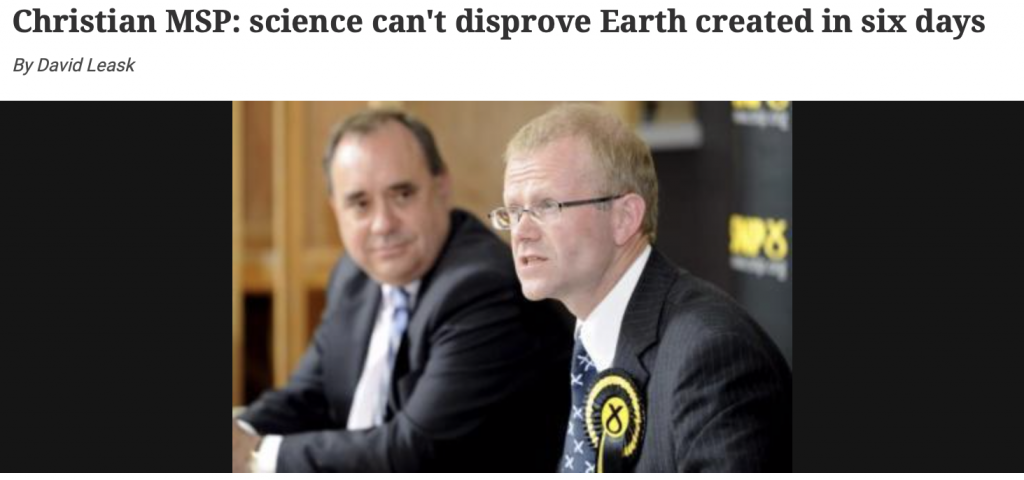
SNP MSP John Mason is outraged by plans to reform the Gender Recognition Act.
In a letter to Glasgow’s Herald newspaper, Mr Mason says he is deeply concerned that Scotland is “trying to override science” by recognising that trans people exist.
I’ll save you the scientific evidence, which I’ve linked to endlessly, and simply post this example of Mr Mason’s other robust pro-science views.
Last month, the extremely dodgy anti-trans group Fair Play For Women dropped a five-figure sum on a full page advert in the Metro claiming that reforms to the Gender Recognition Act would threaten women’s safety. It was cynical. It was designed to whip up hatred. And it was absolute bullshit.
Some of us complained to the Advertising Standards Agency, which regulates print advertising. They’ve just sent me their verdict.
With regards to the complaint you made, also along with several other complainants, we understand that you are concerned that the ad misleadingly implied that women will be at risk as a result of the Gender Recognition Act consultation. After assessing the ad in light of this concern, we think it may have broken the Advertising Rules on misleadingness and we have taken steps the address this.
Unfortunately the verdict is irrelevant and the steps – telling the group not to make such claims again – are pointless. The advertisement ran, the government consultation is now closed. Trans people were silenced; unfortunately the bigots weren’t.