I’ve written before about the toothless press regulator IPSO, which was set up by the press specifically for the purpose of not regulating the press. To take just one recent example, IPSO found that when The Times makes up quotes, doing so doesn’t breach the rules on accuracy.
The ruling was on a story about transgender people, who have been subjected to an astonishing hate campaign for some time now. Newspapers have become adept at sticking to the letter of the rules rather than the spirit: all the rules on discrimination and demonisation apply to individuals, not to groups. So if a paper were to publish a column claiming that trans person X is a predator, that’s against the rules (as well as defamatory). If the column claims that all trans people are predators, that’s fine.
In other words, it’s not okay to incite hatred against one person. But it’s fine if you want to do it against an entire minority group.
The Hacked Off campaign is attempting to highlight this in its latest report, “The denigration, abuse and misrepresentation of the movement for transgender equality in the press”. It focuses on two dozen high profile and often very abusive articles that appeared in the mainstream press in recent months. As Hacked Off put it on Twitter: “Some newspapers have resorted to distortions, inaccuracies and explicit transphobic abuse.” Over this period, UK hate crimes against trans people have increased by 81%.
The problem is specific to newspapers. We don’t have endless abuse of trans people on TV because Ofcom regulates broadcast media. There’s no such regulation for print.
Despite the 2013 Cameron Government legislating for an independent system of media regulation, the current Government have not brought it into
force. This has left one independent regulator operational – but membership is entirely optional. As a result, none of the major websites or newspapers have signed up.
Instead, most publishers are members of IPSO, which is a newspaper association and complaints-handler under the control of newspaper executives. I
In other words, the people being asked to decide whether content breaks the rules are the people who publish the content that breaks the rules.
I used to be against press regulation, because many journalists are fine people who do important work. But some of the biggest publishers in the country have turned their platforms into bully pulpits, repeatedly, mendaciously publishing malicious content designed to hurt the most vulnerable people in our society: not just trans people but minorities of all kinds. We’ve seen exactly the same maliciousness directed at muslim people, for example, and the same rubber-stamping by IPSO.
IPSO is not fit for purpose and sectors of the UK press are out of control. What they do is not journalism, and it does not deserve protection.
The Guardian, and pretty much every other newspaper, reports today that acceptance of LGBT+ people is in decline. As The Guardian put it in a social media headline:
Acceptance of gay sex in decline in UK for first time since AIDS crisis
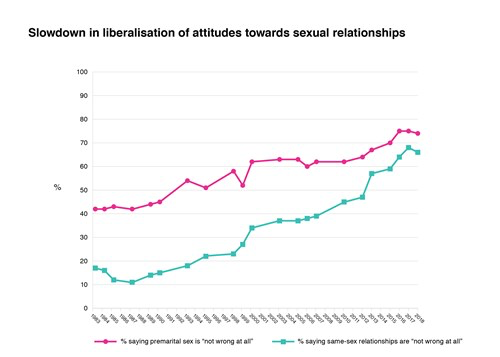
That’s not what the social attitudes survey, which the headline refers to, says at all. It reports that in the last three years, the percentage of the 3,000 people polled who say there’s “nothing wrong at all” with same-sex relationships has been 66%, 68% and 64%.
As Matt Singh, pollster, election analyst and person who is Very Good With Numbers put it on Twitter:
Silly, sensationalist, clickbait. The measured proportion saying same-sex relations “not wrong at all” fell two points from the last BSA, well within the MoE (not acknowledged until para 7) and might simply be because 2016-17 saw a relatively big increase
…As recently as 2012, this was a minority view. It is now the view of two-thirds of GB adults. Please don’t make LGB communities feel their acceptance is under threat because you find statistical caveats inconvenient.
In 1987, 64% of people said same-sex relationships were wrong. In 2017, that figure was down to 19%. Here’s the graph.
It’s not very clear, I know: the pink line is the percentage saying pre-marital sex isn’t wrong; the green one, same-sex relationships. The little downwards bit at the end is the difference in polls in just one year in a poll of 3,000 people.
You’ll see there was a much bigger dip in approval of pre-marital sex in 1996 and another a few years later; nevertheless, the trend continued upwards. Acceptance of same-sex relationships may well be slowing down, but it’s unlikely that it’s peaked and you can’t infer decline from a difference that’s well within your poll’s margin of error. And yet even The Guardian is going for the most click-baity interpretation of the numbers, something that’ll delight the bigots.
Acceptance isn’t going backwards. But journalism appears to be.
As I mentioned yesterday, one of the most common reactions to the news of increasing hate crimes was denial: the crimes are just touchy snowflakes going to the cops about the slightest thing on the internet.
To put it mildly, that’s a complete misunderstanding of what hate crime is, and what minority groups experience.
Something cannot be a hate crime if it isn’t a crime. The “hate” bit is a qualifier: a hate crime is a crime committed because of hostility or prejudice based on disability, race, religion, transgender identity or sexual orientation.
In law, a one-off case of shouting abuse at someone because of these characteristics is a “hate incident”. It only becomes a crime if it becomes a criminal offence under legislation such as the Malicious Communications Act or the Public Order Act.
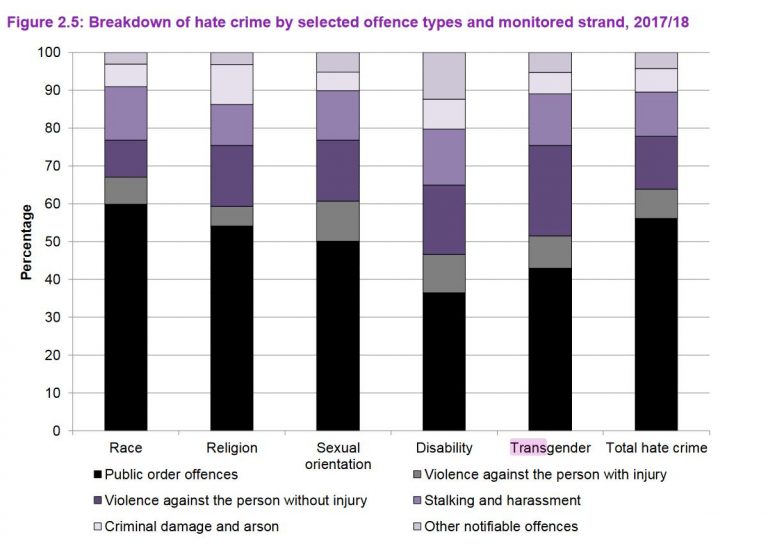
So what actually gets reported and recorded as hate crime? If only there were some kind of handy document such as the Hate Crimes England And Wales Statistical Bulletin 2017/18, published in October by the UK government. In the document it breaks down the kinds of crimes recorded. 56% were public order offences (threats of violence or intentional harassment, alarm or distress, usually involving more than one offender), Â and 33% crimes of violence.
You’ll see that “deliberately offensive tweets on the internet” doesn’t appear. That’s because of the total number of hate crimes reported by trans people, online abuse and harassment only accounted for 6%.
The most depressing stats aren’t the crimes, though. They’re the results. The percentage of reported crimes resulting in a charge – not necessarily a successful prosecution – are incredibly low: for violent hate crimes against trans people, the charge rate is 4%; for public order offences, 4%; for criminal damage and arson, 4%. The figures are very similar for other LGBT+ people.
As with the supposed free speech martyrs of the far right, the people trying to persuade you that hate crimes just mean nasty tweets are lying to you. Even those who embark in massive, ongoing abuse of LGBT+ people on the internet remain at large, entirely free to incite hatred online, free from the real-world consequences of the hate they post.
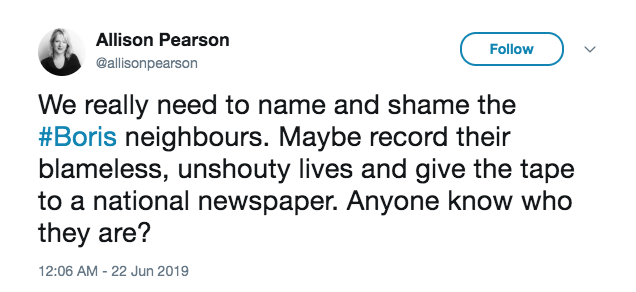
It seems Pearson has come very close to having people beaten up too. When Johnson’s neighbours called the police about what sounded like domestic violence, she tweeted this to her 38,000 followers:
The neighbours were duly named and shamed. And now they’ve had to leave their flat because of “a series of grim threats” to their safety.
I’ve written before about what appears to be a failure of basic journalism standards at The Times and Sunday Times under editor John Witherow. A new report suggests it’s even worse.
The report has the rather unwieldy title Andrew Norfolk, The Times Newspaper and Anti-Muslim Reporting – A Case To Answer, and it makes some very serious allegations. According to the campaign group Hacked Off, the detailed report describes a pattern of anti-Muslim reporting that looks distinctly malicious and which the toothless press “regulator” IPSO is both unable and unwilling to act upon despite clear breaches of journalistic standards.
That pattern is obvious in its reporting of trans issues too. The Times and Sunday Times are obsessed with trans people, running more than 300 anti-trans articles in a 365-day period. As with anti-muslim reporting and opinion, the coverage is careful to attack organisations and vaguely defined groups – activists, the trans lobby and so on – rather than individuals so that Clause 12 of the editors’ code doesn’t apply.
Clause 12 ostensibly covers discriminatory reporting, but only if it’s directed at identified individuals – although even if newspapers do attack specific individuals  IPSO can usually be relied on to take the newspapers’ side. IPSO usually takes an interesting view of Clause 1, accuracy, too: it’s repeatedly said that false claims don’t count as inaccurate because the writer really believed they were true.
Witherow seems to have done his best to try to make it appear as if O’Donnell’s barrister, Robin White, was a silly woman who just didn’t understand how journalism worked. However, what emerged under her admirably rigorous questioning was an all too clear picture of editorial standards at The Times, one which surely goes some way to explaining both why Norfolk’s articles were thought fit for publication in the first place and why the paper has resolutely refused to acknowledge their manifest shortcomings.
As Petley points out, the viciously anti-trans columnist Janice Turner has form with anti-muslim and anti-islam columns too, and Witherow’s claim that he knows nothing about her is clearly untrue.
One of the columnists cited by White was Janice Turner, whose many negative articles about trans people (sample headlines: ‘Children Sacrificed to Appease Trans Lobby’ and ‘Trans Ideologists Are Spreading Cod Science’) have caused widespread fury in LGBT circles. Given that she is not simply one of the paper’s leading columnists, but a particularly notorious one, who has also come under fire for her comments about Muslims and Islam, Witherow’s claim that ‘I don’t know anything about her’ simply beggars belief.
Petley doesn’t pull his punches.
It may seem a long way from articles about Muslims to articles about trans people, but both reveal the same things about the state of journalism at The Times, and, by extension, across much of the mainstream national press: the routine demonising of minority groups, with little apparent concern for the consequences; a cavalier attitude towards accuracy and truthfulness – particularly important journalistic qualities when the subjects in question are as sensitive and controversial as these; and an arrogant and dismissive stance towards any form of criticism, entailing a concomitant refusal to acknowledge any sense of journalistic accountability or responsibility.
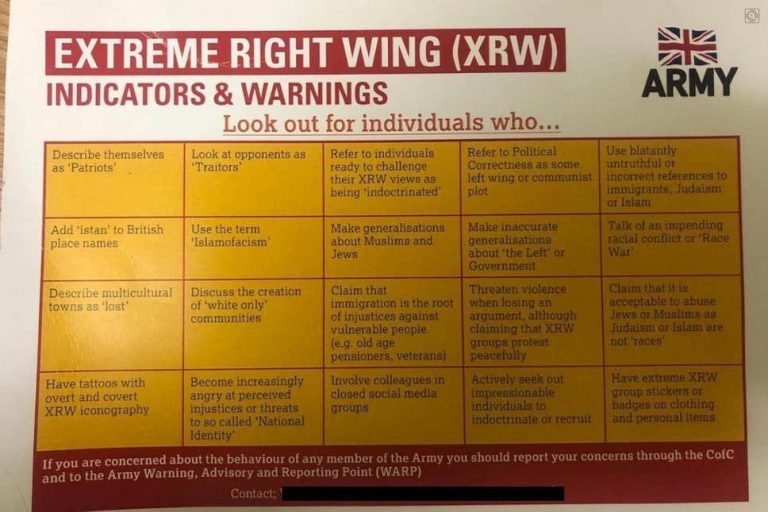
This is the British Army’s guide to spotting dangerous extreme right-wing (XRW) people, courtesy of James Wallis on Twitter.
Heres’s a summary.
They describe their opponents as traitors
They become increasingly angry about perceived injustices and threats to their national or cultural identity
They say their critics have been indoctrinated
They make sweeping generalisations and peddle untruths about specific minority groups
They claim their opponents’ ideology is the root of injustices against vulnerable people
They refer to political correctness as a left-wing plot
They make sweeping generalisations about “the left” or government
They claim they’re preparing for or already fighting a war
They actively seek out impressionable individuals to indoctrinate or recruit
They claim it’s okay to be abusive to specific minorities
They have columns in national newspapers
I may have added an extra point there.
You know where I’m going with this one. The signs the British Army urges squaddies to look for don’t just appear among young men in Army barracks. They’re visible among supposedly nice, respectable middle-class people with jobs in the media too.
The radicalisation described here doesn’t just apply to anti-Islam racism. It’s visible in other forms of bigotry too.
Herald columnist Iain Macwhirter, pictured, has gone off on one about trans people again. Yesterday he claimed on twitter that calling cisgender women cis “is the most extreme form of misogyny”, which I’m sure will be news to many women who’ve endured much worse things than being accurately labelled with a latin prefix.
Cis is to trans what straight is to gay; nothing more, nothing less.
He’s yet another example of something that happens again and again:
Ageing, straight, cisgender person writes about trans stuff, gets it wrong
A couple of trans people say “hey man, that’s not cool. You’re wrong about X.”
Ageing, straight, cisgender person shouts “DON’T YOU OPPRESS ME YOU TRANS BASTARDS!” and becomes a rabid anti-trans activist
It’s not the first time; it won’t be the last. So let’s just re-read this A Thousand Flowers piece from February about MacWhirter’s long opposition to women’s rights and disregard for the views of women’s groups.
So what exactly is Macwhirter’s history of standing with Scotland’s women when they asked for protection? Oh aye, he opposed all that feminism gone mad.  Yer New Definitely Feminist Hero last got a menshie on ATF for his opposition to the years of work done by women’s organisations, to pass the landmark Domestic Abuse (Scotland) Bill, which he condemned as “mince†in another Herald Da-sterpiece.
…Macwhirter is, sadly, far from alone in being a man guilty of uncritically parroting a tiny group of anti trans activists, while not doing even the most shallow bit of digging or asking any of the women’s organisations you’d imagine any journalist writing about gender would have on speed dial.
I’m writing about some really horrible things today so let’s start with something beautiful instead: here’s Swedish group Erato covering Robyn’s Call Your Girlfriend.
Here’s what I grew up seeing on the breakfast table (content warning: vicious homophobia and transphobia including offensive slurs).
Poofters. Benders. Shirtlifters. Bumboys. Lezzies. This was how British tabloid headlines referred to gay men and lesbians in the 1980s — an echo of the taunts heard on the street before a beating. The stories beneath would expand on the pejoratives, justifying them with news of “sick†“evilâ€, “predatory†gays; all arising from a presumption: that readers would agree.
…In a typical example from 1985, Sanderson is left returning fire on one homophobic piece after the other, all drawn from a single month. The first, a Sunday People spread under the headline “Ban the Panto Fairiesâ€, saw the comedian Bernard Manning arguing that gay actors should not be allowed on “television, on stage, in clubs or pubs†in order that they don’t “corrupt the childrenâ€.
…It wasn’t just the national newspapers. In the same column, Sanderson selected a delightful mezze of local paper bigotry. “Gays are EVIL†was the headline in a recent edition of the Bromley Leader. The Plymouth Evening Herald described a mere advert for a gay club as “an offensive gay club posterâ€. While the Solihull Daily Times blared in a headline: “Row over poofs and queersâ€.
In the same column, he reported that The Sun, Britain’s bestselling newspaper, had “negative gay stories almost every day for the past few weeksâ€. In one, the paper branded a council leader “barmy†for campaigning for black and gay people to be protected from murder.
It’s shocking to see how little regard the papers had for human lives. As Strudwick writes, the AIDS era produced some astonishingly vicious journalism in papers such as The Times.
Shortly after The Sun’s near-daily anti-gay coverage, The Times declared its official position in a leader editorial: “Many members of the public are tempted to see in AIDS some sort of retribution for a questionable style of life.â€
The Sun and The Times are both owned by Murdoch, as was The News of The World.
“The News of the World carried ‘gay plague’ headlines in three consecutive issues,†wrote Sanderson, detailing each one: “Victims of gay plague long to dieâ€; “My doomed son’s gay plague agonyâ€; “Art genius destroyed by gay killer bugâ€.
Stop me if you’ve heard this one before: The Sun ran a headline asking, “is it wise to share a lavatory with a homosexual?”
…The Sun then called gay men “walking time bombs†with the “killer disease AIDS†who are a “menace to all societyâ€
Even when the evidence was clear that heterosexuals also had HIV, The Sun, wrote Sanderson, “still insisted that AIDS sufferers were ‘gay plague victims’†and merrily printed headlines unencumbered by facts: “Beer mugs may spread the diseaseâ€.
There’s a generation of LGBT+ people who read this stuff daily. When some of us finally came out in later life, people around us expressed surprise. Why didn’t we come out earlier?
Here’s The Sun on 12 December 1987, when I’d just turned 15.
Perverts are to blame for the killer plague.
The Telegraph:
The homosexuals who have brought this plague upon us should be locked up… Burning is too good for them. Bury them in a pit and pour on quick lime.
Broadsheets advocating for the murder of gay people; tabloids demanding they be locked up. The national press celebrating anti-gay hate crimes. Even The Guardian got in on the act.
[Sanderson] accuses the outlet of “giving a voice to people who should never have one in a paper like that, simply because they felt they should have balance.†Sometimes it was worse than that. Media Watch highlighted the reporting of a vicar who had been caught cottaging, entrapped in a public toilet by a policeman, but rather than criticise the police The Guardian published the defendant’s home address.
Publishing a gay man’s home address during a time of homophobic murders and petrol bomb attacks. No doubt The Guardian later ran a story pondering the mysterious rise of anti-gay hate crimes.
As Sanderson notes, the focus later moved to trans women in columns containing ‘phrases such as “man in a dressâ€, “dicks in chicks’ clothingâ€, “shemalesâ€, “trannies†and a warning to trans people: “You really won’t like us when we’re angryâ€.’
The media regulator proved toothless for many years, and when it did finally rule against the press – against Garry Bushell’s Sun columns – they doubled down on the abuse.
And now, as Sanderson says, “the whole thing is starting again.”
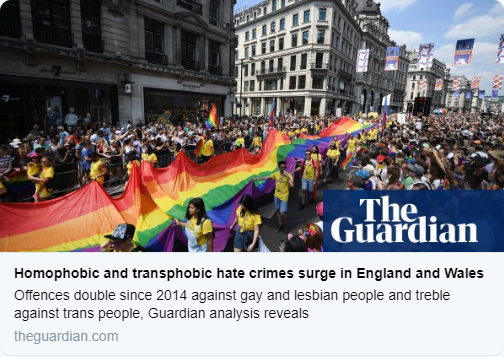
The same slurs, the same publications, often the same writers. There are growing demands for Section 28-style legislation to prevent children being “exposed” to the existence of LGBT+ people. Newspapers are telling their readers to be afraid of people in toilets. A tiny, vulnerable minority is being victimised by some of the most powerful people in the world. Hate crimes have doubled; for trans people they’ve trebled.
The newspapers didn’t stop the abuse because of press complaints adjudications, because the had a change of heart, or because they discovered basic human decency. They stopped because their readers didn’t share their hatred. There wasn’t money in it any more.
the backlash eventually ebbed, says Sanderson, as newspapers began to realise “which way the wind was blowingâ€. Their readers were changing before they were.
The current anti-LGBT+ abuse won’t stop until the same thing happens. That means voting with your feet, with your web browser and with your wallet.
If you buy the papers that are currently conducting a vendetta against LGBT+ people – such as the Spectator, The Sunday Times, The Mail on Sunday, even The Guardian – or read anti-LGBT+ content online, you can’t claim to be supportive of LGBT+ people.
Your money means you are part of this. You’re funding it. You’re fuelling it.
You are paying the wages of people who make a living inciting hatred against people.
Cis women’s intolerance should not be a legitimate reason for limiting the rights of trans women. The idea that all trans women should be denied civil rights because a trans woman might someday commit a crime is the essence of bigotry and goes against feminist values.
That’s not to say The Guardian doesn’t sometimes print voices supportive of trans people. It does, albeit vanishingly rarely, in what looks rather like an attempt to deflect criticism of its overwhelmingly negative portrayal of trans people – criticism of which goes back many years.
I was at a talk last night by Juliet Jacques, whose transition diaries appeared in the Guardian from 2010 to 2012. The diaries were longlisted for the Orwell Prize in 2011, but Jacques was under no illusions that the editors had any interest in reporting trans issues beyond tokenism: her attempts to describe the wider picture, both cultural and political, had to be done by stealth.
This attack and the ensuing media circus are par for the course in 2019. In both my native United States and here in the United Kingdom, it always has been and still is open season on the bodies of (in no specific order) people of colour, indigenous people, transgender people, disabled people, queer people, poor people, women and migrants. I have evaded much of the violence and oppression imposed on so many others by our capitalist, white supremacist, patriarchal system because of the privileges I enjoy by dint of my race, health, education, and conventional gender presentation. That has nothing to do with the merit of my character.
…The commodification and exploitation of my face came at the expense of other victims whose constant persecution apparently does not warrant similar moral outrage.
This is a powerful and important piece by Katelyn Burns, one of very few trans journalists, on the problem with mainstream reporting on LGBT+ issues: the lack of dedicated LGBTQ media is a disaster.
It begins with something depressingly common: a major newspaper highlighting the views of a website crank as some kind of expert, without seeking input from people who actually are experts.
This is the kind of reporting you get when LGBTQ writers and reporters are cut out from mainstream media. It turns our everyday experiences into fodder for pundits, cranks, and transphobes. Phony or inconsequential organizations like “Rethink Identity Medicine Ethics†are elevated to legitimacy by publications who think their readers need to hear “both sides†of an issue, even when one side is composed of hatred. Many in mainstream print media have fallen into this sort of lazy both-sides-ism which ends up promoting the junk science and wild conspiracy theories of the anti-trans and larger anti-LGBTQ movements.
Burns makes a point I’ve also made: the people reporting on LGBT+ issues don’t suffer from the consequences of their reporting. They aren’t beaten up on buses or yelled at in the street. They aren’t denied healthcare or evicted by bigoted landlords.
those largely responsible for covering the issues have no personal stake in the fallout from their reporting. Most writers and editors won’t ever have to worry about their parents kicking them out of homes for being LGBTQ.
There is a very large, very important imbalance in the mainstream reporting of LGBT+ issues and trans issues in particular. The right-wing, anti-science voices are platformed and amplified while the actual scientists and decades of scientific research are ignored. And that platforming has been happening for several years now.
Publications from Breitbart to The National Review have been feeding their audiences a steady diet of trans-based outrage for years now. As a result, there’s significantly more interest in trans issues on the political right than there is on the left — something I don’t think the average progressive voter even realizes.
In the UK, you can add Spiked, The Spectator, the Mail on Sunday and The Times and Sunday Times to the list. You can also add some left-wing publications, notably The Guardian and The New Statesman, which so far seem unable to spot the links between anti-trans faux feminists, hard-right politics and religious evangelism; The Guardian has a long and troubled history in its reporting of trans issues.
Burns quotes Gillian Branstetter of the National Center for Transgender Equality.
Every morning, Branstetter reads a collection of media clips on trans issues; she says recently she’s tracked the horrifying phenomenon of anti-trans talking points leapfrog right over the mainstream media from the right-wing press straight to Congress. “There are members who oppose the Equality Act, for example, or trans protections in the Violence Against Women Act or are in favor of the military ban who have picked up, word for word, the language and the messaging of far right media in discussing transgender people and issues,†she said. “So then you do suddenly see this messaging that’s baseless, that is not founded in anything, that is fear mongering seep into some of the triple-A media sites.â€
Many people believe that biological sex is binary: Either you’re male or you’re female. But as with many binaries, things are more complicated than they seem.
…Sex is our biology — what chromosomes, hormones, genes, sex organs, and secondary sex characteristics we have — while gender is how we think of our identity in the context of how norms function in our culture.
…The science is clear—sex is a spectrum.
And finally, a reminder that we’re talking about living, breathing, loving human beings here.
The Vatican says you can’t choose your gender. Trans and non-binary people don’t “choose†their gender. They know who they are, and they wish to live authentically and happily.