Category: Media

Journalism, radio and stuff like that

  • Sympathy for these devils

    I’ve just been to see the documentary Hail Satan? at Glasgow’s Film City, formerly Govan Town Hall. It’s a fascinating place, and Hail Satan? is a fascinating film.

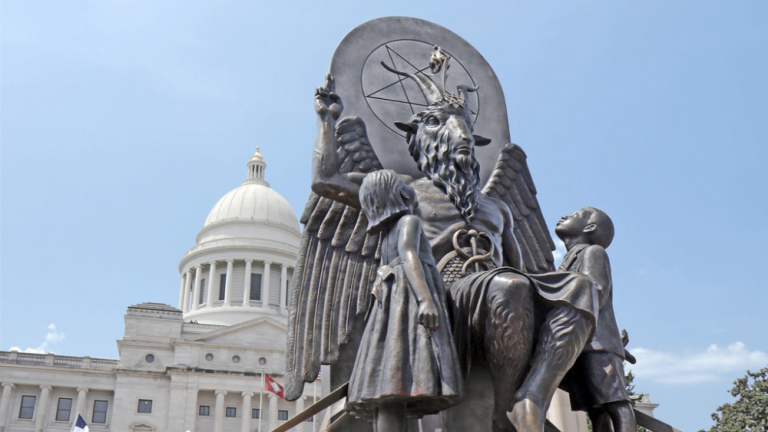
    The film is about The Satanic Temple, a group of merry pranksters with a very serious purpose: they draw attention to and sometimes battle the US religious right’s attempts to impose theocratic legislation under the guise of religious freedom. For example, if the Christian Right can have the Ten Commandments outside government buildings, shouldn’t Satanists have a statue of Baphomet?

    It’s funny, often hilariously so, but it’s also deadly serious. As Variety notes:

    The Satanic Temple’s combination of shock tactics and anti-discrimination lawsuits is check-and-mate against America creeping towards a Christian theocracy.

    …Satanists can be women in tattoos or geeky men with bowties. There’s hair colors of all shades and people who wouldn’t get a double-take at the grocery store.

    There are also quite a few gender non-conforming people: I think I saw more trans women in Hail Satan? than I have in the last ten years of watching TV and movies. And that’s part of the point. The Satanic Temple is comprised of, and speaks for, the people demonised (pun fully intended) by religious extremists: the women, the people who don’t want to be pregnant, the trans folks and anybody else who doesn’t fit a very narrow, politicised interpretation of God’s will. The documentary essentially asks: when the fundamentalists and the extremists have the power and the money and the government and the TV stations and the newspapers on their side, how do you fight back?

    The trailer’s here. The film’s on limited UK release just now and is also available to stream online.

  • “False balance is a serious problem”

    The UK has lost its measles-free status, which is deeply worrying.

    In response the BBC asks, “why are some children not being vaccinated?”

    Dr David Robert Grimes may have part of the answer. On Twitter this morning he posted this:

    Asked by regional BBC station to discuss falling vaccination rates – grand, except they wanted me on against someone claiming vaccines are dangerous. Explained this was textbook false balance, unethical, & against BBC trust guidelines. They wouldn’t budge, so I’m not doing it.

    Grimes isn’t bashing the BBC here. As he says, it’s a problem across the entire mainstream media.

    There is no debate on vaccination. There are not two sides. There is one side, which is where all the facts are, and then there are cranks. To pretend that both sides have equal value costs lives.

    The BBC knows this, because it’s reported on it.

    Vaccines against preventable illnesses like measles, tetanus, mumps and rubella are safe and effective, but healthcare professionals still find themselves having to push back against vocal anti-vaccination campaigns.

    …The problem facing medicine is global, where disinformation about vaccines is readily accepted as having equal or greater value than the work of scientists who have spent their careers fighting disease.

    As Grimes wrote previously in The Guardian:

    This is the crux of the issue with false balance – no matter how noble the intention of media outlets, presenting science and pseudoscience in an adversarial format gives a false impression that an issue is scientifically contentious. Worse again, it gives free rein for dubious motivations to masquerade as scientific opinion. Whether the issue is vaccination, climate-change, alt-med or anything else, presenting an evidence-free belief as being on equal footing with an established scientific understanding is corrosive to public understanding.

    I’ve encountered this too, and refused to go on air with people who flatly deny established facts, or who – often wilfully and maliciously – attempt to mislead listeners about science or the law.

    I’ve made this joke before, but: imagine if there was a news story about owls, and the programme demanded the RSPB debate someone who refused to accept that owls exist. We’d be appalled, and yet the only damage that “debate” would do is waste a bunch of people’s time. When people deny settled science, when they scaremonger about things (or people) that are perfectly safe, these so-called debates can lead to very serious consequences. In the case of vaccination, they can kill.

    Grimes again:

    it’s irresponsible and lazy to contrive a debate over something that has a real human cost.


  • Trans Guardian staff quit over transphobic reporting and “face to face rows”

    Buzzfeed news:

    Two Transgender Employees Of The Guardian Have Quit Over Its “Transphobic” Reporting

    …Her resignation marks a flashpoint in what multiple sources at the Guardian have described to BuzzFeed News as a deepening internal war over the rights of transgender people – and how the organisation reports on them. Staff members across several departments accused the paper of “institutional transphobia”, peddling transphobic tropes, and allowing a bitter schism to develop between pro- and anti-trans journalists.

    …Many at the paper who share her concerns told BuzzFeed News that the internal divisions over trans rights have resulted in face-to-face rows in the office, a widening rift between the UK and US offices (which is largely populated by pro-trans writers), and moves against staff who protest against transphobia. All of which, sources said, is affecting morale.

    As the story notes, the paper’s editorial stance has also persuaded high-profile trans columnists to refuse further commissions and moved staff to make formal complaints about the framing and language used in coverage of trans-related issues.

    The Guardian and [sister title] Observer have in previous years run opinion columns using language such as “trannies”, “shemales”, “man in a dress”, “dicks in chicks’ clothing” and articles that have argued that “sex change surgery is modern-day aversion therapy” – equating transition, which is elective and saves lives, to electric shocks to “cure” homosexuality, which is state-sponsored torture.

    The Guardian is quick to condemn other newspapers’ shameful coverage of minorities, but it appears to be throwing stones from inside a glass house.

  • Playing video games

    In the Mass Effect series, players can customise Jane (or John) Shepard (left). The version here is from the launch trailer; my Jane looked very different.

    Writing in Metro, Owl Stefania writes about the importance of video games in her coming out process: “Growing up, video games were my escape, providing an avenue where I could explore who I was.”

    I’ve written about this too, and a version of the following article was originally published in 404 Ink magazine in late 2017.

    Video games have a special appeal for trans people. In addition to the usual escapism from the everyday, some of them enable you to play as the gender you feel you should be, not the one you’ve been assigned.

    For many trans people the first such games were MMORPGs, massively multiplayer online role-playing games. Many of those games enabled you to play as all kinds of characters from humans to hobbits and space aliens). As many trans people discovered, when you communicate with other players in an MMORPG they’re quite happy to stay in character, so if your character is female you’ll be addressed as such. That isn’t always a good thing — there’s plenty of misogyny, homophobia and transphobia online, and online games aren’t immune to that — but as trans gamer Rissa Trent writes on MMOGames.com, being able to present as a female character is incredibly powerful. “To some people, it might just be pixels, but to those of us who want to break free from everyday life, and our own skins, it’s everything.”

    I never really got into MMORPGs, but I fell hard for a sci-fi series called Mass Effect. In the first three Mass Effect games you play Commander Shepard, and that commander can be John or Jane. Not only is Jane Shepard better company — she’s voiced by the wonderful Jennifer Hale, who makes even the daftest dialogue breathe — but you can completely customise the character’s appearance in the game. Hair colour, facial structure, eye shape, jawline, hair, makeup… given enough time, and believe me I gave myself enough time, you could create a Jane Shepard who was an idealised version of your feminine self. 

    To then have the game offer romantic options beyond the usual straight man/woman binary — something that caused controversy at the time, because while gamers had no problem with interspecies alliances (the same man-with-sexy-space-chick trope that goes back to Star Trek), same-sex attraction couldn’t possibly be a thing in the far future — was the cherry on top. Sadly the game wouldn’t let my character have a relationship with the character I really liked, the gorgeous, kick-ass soldier Miranda Lawson, and I clearly wasn’t the only one disappointed: the internet is packed with fan fiction where Jane and Miranda are an item.

    Mass Effect and MMORPGs (and other games where you can be a girl, such as Dishonored 2 or Destiny) are very different games, but they both offer trans people something really important: the opportunity to inhabit your preferred gender, if only for a while. And as games get more realistic and immersive, that’s going to become even more powerful. 

  • “We still occupy a Cold War headspace”

    This, by Jonathan Lis, is an interesting column about the problem with media coverage of modern despots.

    Across the so-called ‘advanced’ democracies, leaders are no longer playing by the old rules. Our media still is.

    Lis argues that the media is failing in its coverage of one despot in particular. The one in the White House.

    Perhaps the first thing we must do is shake off our ingrained awe and terror of the United States.

    We still occupy a Cold War headspace in which the US is on the side of good. The world oppresses; America liberates.

    The mainstream British media has no compunction in labelling Marine Le Pen in France or Matteo Salvini in Italy as far-right – because they are. These figures are safe targets for objective reporting.

    But there is not a cigarette paper between those leaders and Trump. Indeed, Trump’s rhetoric frequently exceeds theirs in obscenity. If we label them as far-right, why not also him?

    His point about Le Pen and Salvini is one I hadn’t thought of. If they do something racist, it’s reported here as such. But if Trump does it, we reach for the euphemisms: “racially charged” or “controversial.”

    Journalism cannot operate in a climate of either fear or deference. If something must be named, we must name it.

  • The Times doesn’t care about people in care

    Following on from my earlier post, The Times’ story about university places for care experienced people has grown worse.

    Something I didn’t spot in the original was the way the piece drew a distinction between “disadvantaged” pupils and “bright” pupils, as if the latter couldn’t possibly include the former. Again, the word choice is significant.

    Writing on Medium, Charlotte Armitage goes into more detail.

    What this type of article does is fuel discrimination towards Care Experienced people. It creates separation between ‘star pupils’ and Care Experienced pupils and it can be understood to be implying that someone cannot be both. This has been demonstrated by comments underneath the article, outraged that pupils “who happen to have stable and functioning families are penalised”.

    The Times’ editor has defended the piece as “balanced”. The comments have continued. Here are some that Armitage screenshotted:

    “Slap in the face to all the hardworking parents who actually love and take care of their children.”

    What matters isn’t the quality of the student, but the quality of their parents.

    “University should be for the brightest and not a test tube for social engineering.”

    People who’ve been in the care system are not the brightest.

    “Bright children denied a university place, so a thicko can have it?”

    People who’ve been in the care system are “thickos”.

    There is of course no connection whatsoever between whether someone’s been in care and their ability. But there are lots of reasons why their opportunities are more limited than those of, say, a middle-class kid.

    I was a middle-class kid. I didn’t suffer from disruption to my education from being moved from place to place, family to family, so I didn’t have to supplement my qualifications by doing further education classes to met any entrance requirements. Even if I’d wanted to do those classes, I would have had the luxury of a roof over my head, food in my belly and money in my pocket so I could concentrate fully on my studies.

    In the end I didn’t go to college or university. But I didn’t go because I chose not to, not because the option wasn’t available to me. Had I gone, I’m sure my parents would have supported me there too.

    As Armitage writes, that’s not how it usually works for care experienced people. The disruption in earlier life means you need to attend further education just to have the same qualifications as everyone else – and chances are you’ll be doing that while working multiple jobs to keep a roof over your head, trying to study when every bit of you aches with tiredness. All the while there is no plan B, no safety net, no helpful parent to bail you out if you lose your job or encounter an unexpected bill.

    A guaranteed offer of a university place doesn’t change any of those things. It’s still going to be much, much harder for people coming out of the care system to get into university than it is for people from more stable family backgrounds. But as Armitage says:

    The guaranteed offer is not about discouraging applicants who have had fortunate upbringings and were already likely to succeed. It is about giving the people who missed out on so much as result of childhood trauma and state intervention a chance, so that they too, can reach their full potential and go onto live prosperous and successful futures.

    It won’t turn privilege into disadvantage. Those with straight A’s will still gain entry into university. It just means Scottish campuses will provided the opportunity to learn to a more diverse array of students.

    Back to the article. The Times likes to write about groups of people without giving a voice to those people, and the coverage of care experienced people follows that model. Here’s one of the people they could have talked to: Kenneth Murray, writer and award-winning campaigner.

    Here are some bits from his tweets to The Times’ Scottish editor.

    @magnusllewellin I do quite a lot of work on the stigma that Care Experienced people face, particularly with the media.

    In fact I’ve worked with some of the journalists in your employ on the importance of language around issues of Care Experienced people.

    It makes me sad to see this shift.

    Whilst I understand there are real issues around quotas & access to university for many groups – using Care Experienced people in this way is incendiary.

    Care Experienced people like me have faced many struggles to get where we are. Through hard work, determination & some help.

    We really don’t need a national newspaper, a journalist and an editor from that paper compounding the stigma that surrounds us & any support we receive to help rectify decades of institutional failure.

    I find it really bizarre that such a quality newspaper, focused on providing great journalism would bypass anyone with experience of care.

    Your paper has managed this succesfully in the past. I really don’t understand why they haven’t this time.

    This is something various minorities have seen too: they give up their time to meet with and even deliver courses to journalists for publications that will later misrepresent and even demonise them.

    All too often, The Times and its journalists are not coming from a place of ignorance. They know what they’re doing is wrong, and they do it anyway.

  • How you tell a story tells a story

    This week, Scottish universities unveiled an important new initiative: people who’ve been in the care system will be guaranteed the offer of a university place if they meet new minimum entry requirements. It should double the number of care-experienced students to around 600 people.

    It’s designed to address some of the issues that don’t affect those of us who haven’t been in the care system. As The BBC puts it:

    For example, their education may have been disrupted as they moved between carers.

    It’s clearly a positive, progressive move that’ll benefit some disadvantaged people – which is how most of the press has reported it. Most of the press apart from The Times.

    People with straight As face losing out on a university place under a pledge to widen access for disadvantaged people.

    That’s the opener. The next paragraph adds that the pupils will be “potentially displacing a better qualified candidate with a more fortunate background.” It also chooses to provide its readers with different figures: instead of telling them that the number of students from care backgrounds may increase from 300 to 600, it says that “there are 15,000 ‘looked after’ children in Scotland”.

    Look at the word choice there. “Displacing”. Displacing means moving something from its proper or usual position. It’s often used to describe natural disasters forcing people to abandon their homes, and it’s a favourite of racists too. It’s a very loaded word, which should never be used lightly when talking about people.

    It’s a good example of how you can twist a narrative to suit a particular agenda, in this case to make your readers frightened that horrible poor people might prevent Tarquin or Jocinda from getting that place at university. It won’t, of course, and The Times knows it. But the story The Times wants to tell its primarily white, affluent, middle class to upper class readers is that the other – in this case, children from disadvantaged backgrounds – are coming to take away what you have.

    Possibly the worst, most telling example of this was a few weeks ago when a stowaway fell from an aeroplane in London. The man, from Kenya, died horribly. As one neighbour told the press, “there was blood all over the walls of the garden.”

    The Times ran this headline.
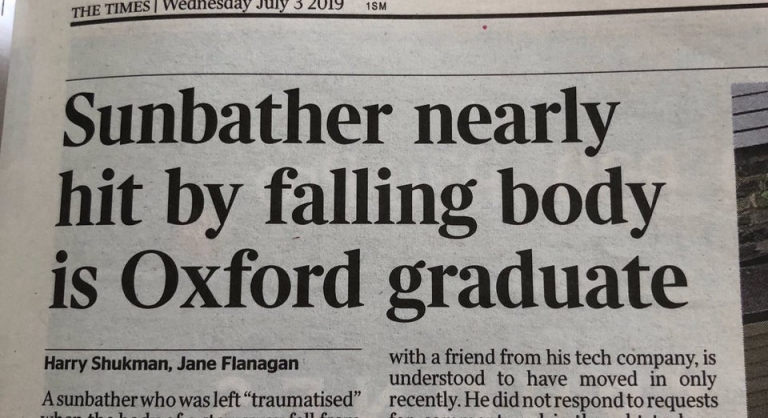
    Bloody foreigners coming over here, dying in our gardens, leaving us to clean up their shattered corpses.

    Once you’re aware of it, you’ll see it everywhere. Telling readers that some group of others is coming for their children is a Times (and right-wing media generally)  staple, whether it’s Muslims, LGBT people, foreign people (especially European people or brown people), poor people or women people.

    That’s because the Times is the house organ for privileged people, and what it’s serving them is “privileged distress.” Here’s Doug Muder to explain what that means.

    As the culture evolves, people who benefitted from the old ways invariably see themselves as victims of change. The world used to fit them like a glove, but it no longer does. Increasingly, they find themselves in unfamiliar situations that feel unfair or even unsafe. Their concerns used to take center stage, but now they must compete with the formerly invisible concerns of others.

    There’s another word for it.

    Supremacy.

    Here’s activist and playwright Wayne Self.

    I know that the word “supremacist” makes you think of “White Supremacists,” which makes you think of the KKK and cross-burning and lynching. We think of supremacist as a Southern thing, a rural thing, a racial thing, a militia thing, a hate thing.

    …Supremacy is the habit of believing or acting as if your life, your love, your culture, your self has more intrinsic worth than those of people who differ from you.

    …You don’t have to hate people to feel innately superior to them. After all, what kind of threat are your inferiors to you? You may be annoyed by them, from time to time, or you may even like them. You can even have so much affection for them that you might call that affection love.

    When the school a witness went to is more important than the dead man in his garden, that’s supremacy. When your right to offend is more important than others’ right to life free from harassment, that’s supremacy. When the university places of the most privileged in society are considered more important than those of students who don’t come from the right families, that’s supremacy. When tax cuts for the rich matter more than funding services for the poor, that’s supremacy. When men’s right to behave how they damn well please is more important than women’s safety, that’s supremacy.

    That’s not to say that Times readers are supremacists. Most of them, I’m sure, are decent and kind. But the thing about privilege is that you don’t notice it when you have it, so any attempt to improve equality can look like you’re being picked on, discriminated against. That’s why some people genuinely believe that cisgender, heterosexual, affluent white men face more discrimination than other minority groups. It isn’t remotely true, but to some it feels true.

    Telling people that their inferiors are coming for what they have is one of the oldest, most malicious tricks in the book. But it works, and it provides an opportunity for bad actors to weaponise it. Bigots of every stripe, the far right, disaster capitalists, billionaire media moguls.

    There’s a joke that I’ve seen circulate in various guises, but the basic point remains in each version.

    A billionaire, a Times reader and a Polish cleaner are sitting at a table with a plate of twelve biscuits in front of them.

    Slowly and deliberately, the billionaire eats eleven of the biscuits.

    His mouth covered in crumbs, the billionaire turns to the Times reader.

    “Watch out!” he says. “That cleaner’s going to steal your biscuit!”
  • I’m hacked off with it too

    I’ve written before about the toothless press regulator IPSO, which was set up by the press specifically for the purpose of not regulating the press. To take just one recent example, IPSO found that when The Times makes up quotes, doing so doesn’t breach the rules on accuracy.

    The ruling was on a story about transgender people, who have been subjected to an astonishing hate campaign for some time now. Newspapers have become adept at sticking to the letter of the rules rather than the spirit: all the rules on discrimination and demonisation apply to individuals, not to groups. So if a paper were to publish a column claiming that trans person X is a predator, that’s against the rules (as well as defamatory). If the column claims that all trans people are predators, that’s fine.

    In other words, it’s not okay to incite hatred against one person. But it’s fine if you want to do it against an entire minority group.

    The Hacked Off campaign is attempting to highlight this in its latest report, “The denigration, abuse and misrepresentation of the movement for transgender equality in the press”. It focuses on two dozen high profile and often very abusive articles that appeared in the mainstream press in recent months. As Hacked Off put it on Twitter: “Some newspapers have resorted to distortions, inaccuracies and explicit transphobic abuse.” Over this period, UK hate crimes against trans people have increased by 81%.

    The problem is specific to newspapers. We don’t have endless abuse of trans people on TV because Ofcom regulates broadcast media. There’s no such regulation for print.

    Despite the 2013 Cameron Government legislating for an independent system of media regulation, the current Government have not brought it into
    force. This has left one independent regulator operational – but membership is entirely optional. As a result, none of the major websites or newspapers have signed up.

    Instead, most publishers are members of IPSO, which is a newspaper association and complaints-handler under the control of newspaper executives. I

    In other words, the people being asked to decide whether content breaks the rules are the people who publish the content that breaks the rules.

    I used to be against press regulation, because many journalists are fine people who do important work. But some of the biggest publishers in the country have turned their platforms into bully pulpits, repeatedly, mendaciously publishing malicious content designed to hurt the most vulnerable people in our society: not just trans people but minorities of all kinds. We’ve seen exactly the same maliciousness directed at muslim people, for example, and the same rubber-stamping by IPSO.

    IPSO is not fit for purpose and sectors of the UK press are out of control. What they do is not journalism, and it does not deserve protection.

    There’s a petition demanding change here. Please sign it. Every name helps.

  • No, acceptance of LGBT+ people isn’t going backwards

    The Guardian, and pretty much every other newspaper, reports today that acceptance of LGBT+ people is in decline. As The Guardian put it in a social media headline:

    Acceptance of gay sex in decline in UK for first time since AIDS crisis

    That’s not what the social attitudes survey, which the headline refers to, says at all. It reports that in the last three years, the percentage of the 3,000 people polled who say there’s “nothing wrong at all” with same-sex relationships has been 66%, 68% and 64%.

    As Matt Singh, pollster, election analyst and person who is Very Good With Numbers put it on Twitter:

    Silly, sensationalist, clickbait. The measured proportion saying same-sex relations “not wrong at all” fell two points from the last BSA, well within the MoE (not acknowledged until para 7) and might simply be because 2016-17 saw a relatively big increase

    …As recently as 2012, this was a minority view. It is now the view of two-thirds of GB adults. Please don’t make LGB communities feel their acceptance is under threat because you find statistical caveats inconvenient.

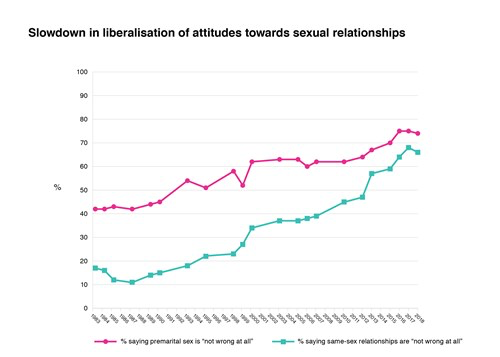
    In 1987, 64% of people said same-sex relationships were wrong. In 2017, that figure was down to 19%. Here’s the graph.

    It’s not very clear, I know: the pink line is the percentage saying pre-marital sex isn’t wrong; the green one, same-sex relationships. The little downwards bit at the end is the difference in polls in just one year in a poll of 3,000 people.

    You’ll see there was a much bigger dip in approval of pre-marital sex in 1996 and another a few years later; nevertheless, the trend continued upwards. Acceptance of same-sex relationships may well be slowing down, but it’s unlikely that it’s peaked and you can’t infer decline from a difference that’s well within your poll’s margin of error. And yet even The Guardian is going for the most click-baity interpretation of the numbers, something that’ll delight the bigots.

    Acceptance isn’t going backwards. But journalism appears to be.

  • You’re being lied to about hate crimes

    As I mentioned yesterday, one of the most common reactions to the news of increasing hate crimes was denial: the crimes are just touchy snowflakes going to the cops about the slightest thing on the internet.

    To put it mildly, that’s a complete misunderstanding of what hate crime is, and what minority groups experience.

    Something cannot be a hate crime if it isn’t a crime. The “hate” bit is a qualifier: a hate crime is a crime committed because of hostility or prejudice based on disability, race, religion, transgender identity or sexual orientation.

    In law, a one-off case of shouting abuse at someone because of these characteristics is a “hate incident”. It only becomes a crime if it becomes a criminal offence under legislation such as the Malicious Communications Act or the Public Order Act.

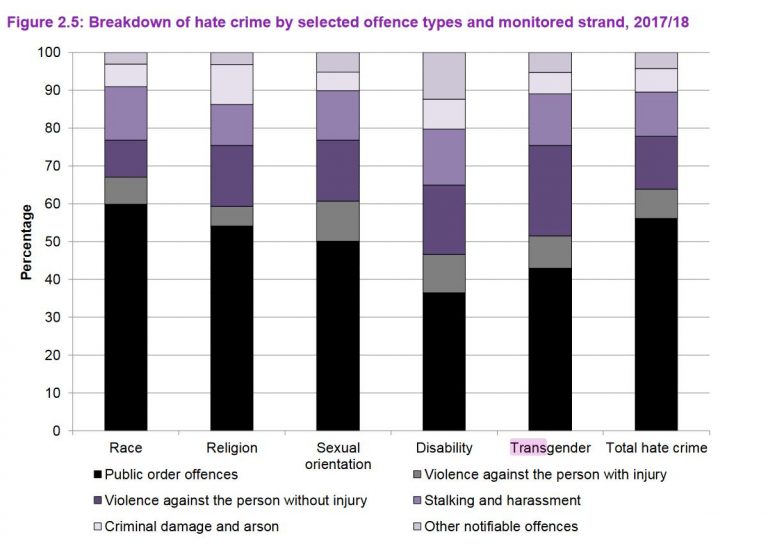
    So what actually gets reported and recorded as hate crime? If only there were some kind of handy document such as the Hate Crimes England And Wales Statistical Bulletin 2017/18, published in October by the UK government. In the document it breaks down the kinds of crimes recorded. 56% were public order offences (threats of violence or intentional harassment, alarm or distress, usually involving more than one offender),  and 33% crimes of violence.

    As NotCursedE on Twitter, from whom I found this information, points out, the report helpfully details the type of crimes committed against each protected characteristic:

    You’ll see that “deliberately offensive tweets on the internet” doesn’t appear. That’s because of the total number of hate crimes reported by trans people, online abuse and harassment only accounted for 6%.

    The most depressing stats aren’t the crimes, though. They’re the results. The percentage of reported crimes resulting in a charge – not necessarily a successful prosecution – are incredibly low: for violent hate crimes against trans people, the charge rate is 4%; for public order offences, 4%; for criminal damage and arson, 4%. The figures are very similar for other LGBT+ people.

    As with the supposed free speech martyrs of the far right, the people trying to persuade you that hate crimes just mean nasty tweets are lying to you. Even those who embark in massive, ongoing abuse of LGBT+ people on the internet remain at large, entirely free to incite hatred online, free from the real-world consequences of the hate they post.