As a young trans girl, I could only assume that the odds against me were long. What would happen, I wondered, if I spoke aloud the thing that was in my heart? Even worse: What would happen if I did not?
Boylan writes about something some of us fear: that our own children may be LGBT+.
Dear God, I thought. Anything but this. Given how hard being trans has made my life, it was the one thing I hoped my own child might be spared.
We’re not scared because deep down we feel there’s something wrong with being LGBT+. We’re scared because we know that there is nothing wrong with us but a great deal wrong with how some treat us. We know what it’s to be hated by strangers and hurt by people close to us, to endure the casual little cruelties of some and the monstrous, deliberate cruelties of others, to spend years trying to stop ourselves from being ourselves.
Being LGBT+ is tough, and not everybody makes it.
Who in their right mind would wish that experience on their children?
And yet.
It’s important to realise the parameters of your own worldview. To take an uncontroversial example, we all believe that the best music of all time is the music we loved in our late teens.
And that applies to more serious things too. The fear I felt going into the city centre last night in a dress – something I haven’t done for a while for various reasons; I’ll post about it some other time – is largely based on the attitudes I experienced growing up, and the hatred that I see online. But my lived experience is completely different to my expectation. The mental model I have of How Things Are is hopelessly out of date.
We see the world based on how it was for us, not necessarily how it is for the people in the generations that have come after us.
Boylan:
Why is my daughter’s generation better than mine when it comes to accepting abundance and variation in human sexuality and identity? Why, to them, is being queer a delight and a cause for celebration, when for me it was something for which I felt I had to apologize, over and over, and to endlessly explain?
I’m writing about some really horrible things today so let’s start with something beautiful instead: here’s Swedish group Erato covering Robyn’s Call Your Girlfriend.
Here’s what I grew up seeing on the breakfast table (content warning: vicious homophobia and transphobia including offensive slurs).
Poofters. Benders. Shirtlifters. Bumboys. Lezzies. This was how British tabloid headlines referred to gay men and lesbians in the 1980s — an echo of the taunts heard on the street before a beating. The stories beneath would expand on the pejoratives, justifying them with news of “sick†“evilâ€, “predatory†gays; all arising from a presumption: that readers would agree.
…In a typical example from 1985, Sanderson is left returning fire on one homophobic piece after the other, all drawn from a single month. The first, a Sunday People spread under the headline “Ban the Panto Fairiesâ€, saw the comedian Bernard Manning arguing that gay actors should not be allowed on “television, on stage, in clubs or pubs†in order that they don’t “corrupt the childrenâ€.
…It wasn’t just the national newspapers. In the same column, Sanderson selected a delightful mezze of local paper bigotry. “Gays are EVIL†was the headline in a recent edition of the Bromley Leader. The Plymouth Evening Herald described a mere advert for a gay club as “an offensive gay club posterâ€. While the Solihull Daily Times blared in a headline: “Row over poofs and queersâ€.
In the same column, he reported that The Sun, Britain’s bestselling newspaper, had “negative gay stories almost every day for the past few weeksâ€. In one, the paper branded a council leader “barmy†for campaigning for black and gay people to be protected from murder.
It’s shocking to see how little regard the papers had for human lives. As Strudwick writes, the AIDS era produced some astonishingly vicious journalism in papers such as The Times.
Shortly after The Sun’s near-daily anti-gay coverage, The Times declared its official position in a leader editorial: “Many members of the public are tempted to see in AIDS some sort of retribution for a questionable style of life.â€
The Sun and The Times are both owned by Murdoch, as was The News of The World.
“The News of the World carried ‘gay plague’ headlines in three consecutive issues,†wrote Sanderson, detailing each one: “Victims of gay plague long to dieâ€; “My doomed son’s gay plague agonyâ€; “Art genius destroyed by gay killer bugâ€.
Stop me if you’ve heard this one before: The Sun ran a headline asking, “is it wise to share a lavatory with a homosexual?”
…The Sun then called gay men “walking time bombs†with the “killer disease AIDS†who are a “menace to all societyâ€
Even when the evidence was clear that heterosexuals also had HIV, The Sun, wrote Sanderson, “still insisted that AIDS sufferers were ‘gay plague victims’†and merrily printed headlines unencumbered by facts: “Beer mugs may spread the diseaseâ€.
There’s a generation of LGBT+ people who read this stuff daily. When some of us finally came out in later life, people around us expressed surprise. Why didn’t we come out earlier?
Here’s The Sun on 12 December 1987, when I’d just turned 15.
Perverts are to blame for the killer plague.
The Telegraph:
The homosexuals who have brought this plague upon us should be locked up… Burning is too good for them. Bury them in a pit and pour on quick lime.
Broadsheets advocating for the murder of gay people; tabloids demanding they be locked up. The national press celebrating anti-gay hate crimes. Even The Guardian got in on the act.
[Sanderson] accuses the outlet of “giving a voice to people who should never have one in a paper like that, simply because they felt they should have balance.†Sometimes it was worse than that. Media Watch highlighted the reporting of a vicar who had been caught cottaging, entrapped in a public toilet by a policeman, but rather than criticise the police The Guardian published the defendant’s home address.
Publishing a gay man’s home address during a time of homophobic murders and petrol bomb attacks. No doubt The Guardian later ran a story pondering the mysterious rise of anti-gay hate crimes.
As Sanderson notes, the focus later moved to trans women in columns containing ‘phrases such as “man in a dressâ€, “dicks in chicks’ clothingâ€, “shemalesâ€, “trannies†and a warning to trans people: “You really won’t like us when we’re angryâ€.’
The media regulator proved toothless for many years, and when it did finally rule against the press – against Garry Bushell’s Sun columns – they doubled down on the abuse.
And now, as Sanderson says, “the whole thing is starting again.”
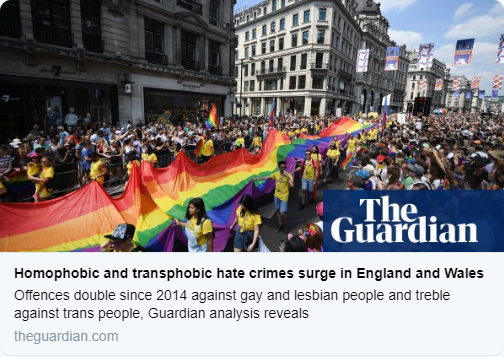
The same slurs, the same publications, often the same writers. There are growing demands for Section 28-style legislation to prevent children being “exposed” to the existence of LGBT+ people. Newspapers are telling their readers to be afraid of people in toilets. A tiny, vulnerable minority is being victimised by some of the most powerful people in the world. Hate crimes have doubled; for trans people they’ve trebled.
The newspapers didn’t stop the abuse because of press complaints adjudications, because the had a change of heart, or because they discovered basic human decency. They stopped because their readers didn’t share their hatred. There wasn’t money in it any more.
the backlash eventually ebbed, says Sanderson, as newspapers began to realise “which way the wind was blowingâ€. Their readers were changing before they were.
The current anti-LGBT+ abuse won’t stop until the same thing happens. That means voting with your feet, with your web browser and with your wallet.
If you buy the papers that are currently conducting a vendetta against LGBT+ people – such as the Spectator, The Sunday Times, The Mail on Sunday, even The Guardian – or read anti-LGBT+ content online, you can’t claim to be supportive of LGBT+ people.
Your money means you are part of this. You’re funding it. You’re fuelling it.
You are paying the wages of people who make a living inciting hatred against people.
Cis women’s intolerance should not be a legitimate reason for limiting the rights of trans women. The idea that all trans women should be denied civil rights because a trans woman might someday commit a crime is the essence of bigotry and goes against feminist values.
That’s not to say The Guardian doesn’t sometimes print voices supportive of trans people. It does, albeit vanishingly rarely, in what looks rather like an attempt to deflect criticism of its overwhelmingly negative portrayal of trans people – criticism of which goes back many years.
I was at a talk last night by Juliet Jacques, whose transition diaries appeared in the Guardian from 2010 to 2012. The diaries were longlisted for the Orwell Prize in 2011, but Jacques was under no illusions that the editors had any interest in reporting trans issues beyond tokenism: her attempts to describe the wider picture, both cultural and political, had to be done by stealth.
This attack and the ensuing media circus are par for the course in 2019. In both my native United States and here in the United Kingdom, it always has been and still is open season on the bodies of (in no specific order) people of colour, indigenous people, transgender people, disabled people, queer people, poor people, women and migrants. I have evaded much of the violence and oppression imposed on so many others by our capitalist, white supremacist, patriarchal system because of the privileges I enjoy by dint of my race, health, education, and conventional gender presentation. That has nothing to do with the merit of my character.
…The commodification and exploitation of my face came at the expense of other victims whose constant persecution apparently does not warrant similar moral outrage.
This is a powerful and important piece by Katelyn Burns, one of very few trans journalists, on the problem with mainstream reporting on LGBT+ issues: the lack of dedicated LGBTQ media is a disaster.
It begins with something depressingly common: a major newspaper highlighting the views of a website crank as some kind of expert, without seeking input from people who actually are experts.
This is the kind of reporting you get when LGBTQ writers and reporters are cut out from mainstream media. It turns our everyday experiences into fodder for pundits, cranks, and transphobes. Phony or inconsequential organizations like “Rethink Identity Medicine Ethics†are elevated to legitimacy by publications who think their readers need to hear “both sides†of an issue, even when one side is composed of hatred. Many in mainstream print media have fallen into this sort of lazy both-sides-ism which ends up promoting the junk science and wild conspiracy theories of the anti-trans and larger anti-LGBTQ movements.
Burns makes a point I’ve also made: the people reporting on LGBT+ issues don’t suffer from the consequences of their reporting. They aren’t beaten up on buses or yelled at in the street. They aren’t denied healthcare or evicted by bigoted landlords.
those largely responsible for covering the issues have no personal stake in the fallout from their reporting. Most writers and editors won’t ever have to worry about their parents kicking them out of homes for being LGBTQ.
There is a very large, very important imbalance in the mainstream reporting of LGBT+ issues and trans issues in particular. The right-wing, anti-science voices are platformed and amplified while the actual scientists and decades of scientific research are ignored. And that platforming has been happening for several years now.
Publications from Breitbart to The National Review have been feeding their audiences a steady diet of trans-based outrage for years now. As a result, there’s significantly more interest in trans issues on the political right than there is on the left — something I don’t think the average progressive voter even realizes.
In the UK, you can add Spiked, The Spectator, the Mail on Sunday and The Times and Sunday Times to the list. You can also add some left-wing publications, notably The Guardian and The New Statesman, which so far seem unable to spot the links between anti-trans faux feminists, hard-right politics and religious evangelism; The Guardian has a long and troubled history in its reporting of trans issues.
Burns quotes Gillian Branstetter of the National Center for Transgender Equality.
Every morning, Branstetter reads a collection of media clips on trans issues; she says recently she’s tracked the horrifying phenomenon of anti-trans talking points leapfrog right over the mainstream media from the right-wing press straight to Congress. “There are members who oppose the Equality Act, for example, or trans protections in the Violence Against Women Act or are in favor of the military ban who have picked up, word for word, the language and the messaging of far right media in discussing transgender people and issues,†she said. “So then you do suddenly see this messaging that’s baseless, that is not founded in anything, that is fear mongering seep into some of the triple-A media sites.â€
Many people believe that biological sex is binary: Either you’re male or you’re female. But as with many binaries, things are more complicated than they seem.
…Sex is our biology — what chromosomes, hormones, genes, sex organs, and secondary sex characteristics we have — while gender is how we think of our identity in the context of how norms function in our culture.
…The science is clear—sex is a spectrum.
And finally, a reminder that we’re talking about living, breathing, loving human beings here.
The Vatican says you can’t choose your gender. Trans and non-binary people don’t “choose†their gender. They know who they are, and they wish to live authentically and happily.
It’s no great secret that anti-trans bigots tend to be bigoted in other ways too; they just hide it. The ongoing hate-fest over the NSPCC working with and then dropping trans woman Munroe Bergdorf is a vivid demonstration.
The NSPCC has apologised for dropping Bergdorf, but its employees aren’t happy: 148 of its employees have written to the executives saying its actions are sending a terrible message to its LGBT+ staff and the children who need the charity’s help.
The anti-trans bigots, led by washed-up comedy writer Graham Linehan, are furious about this. So they have been trying to find details of those employees through social media to find out if there’s anything that can be used against them. Yesterday, they discovered that one of the employees is gay.
They are now demanding the NSPCC sack him.
This is “reasonable concerns”: telling a children’s charity to sack gay employees – because you believe gay people are a danger to children. A danger so dangerous the fact that the employee has an office job is no protection against the gay danger.
This isn’t a surprise. Again and again the anti-trans lot let the mask slip and reveal that bigotry isn’t about hating just one group of people. There’s a ton of homophobia, as well as racism and anti-semitism. The focus on trans people is just because that’s the bigotry you can still get away with in public.
a tawdry, sinister campaign is directed against trans people in the UK. Much of the media demonises them, playing the same tunes that were sung about gay people in the 1980s: sexual predators, deviants, grooming and brainwashing children. It not only erases the hatred directed at trans people, it legitimises and fuels it.
…Anti-trans activists claim they want trans people to have happy lives, but as their recent successful campaign to force the NSPCC to drop the trans model and activist Munroe Bergdorf as its first LGBTQ campaigner underlines, they want to drive trans people out of public life.
…And don’t believe you can demarcate transphobia from rising homophobia. The anti-trans activists who hounded Bergdorf are now demanding the sacking of a senior, gay NSPCC employee because they found pictures of him in fetish gear online, suggesting therefore he is not safe around children. This is the crude, unapologetic homophobia of 1980s Britain. The scaremongering over trans people has even led cis-gender lesbians – such as Stonewall chief executive Ruth Hunt – to be challenged over using women’s toilets. A minority of self-described feminists – who seem to talk of nothing other than the great trans menace – have no scruples about working with the anti-gay lobby.
As someone put it on Twitter yesterday, when the hateful anti-LGBT+ bigots are brown we damn them and get injunctions against them. When they’re white and middle-class…
Update: they’re now going after another gay man: Ben Hunte, the BBC’s first LGBT correspondent.
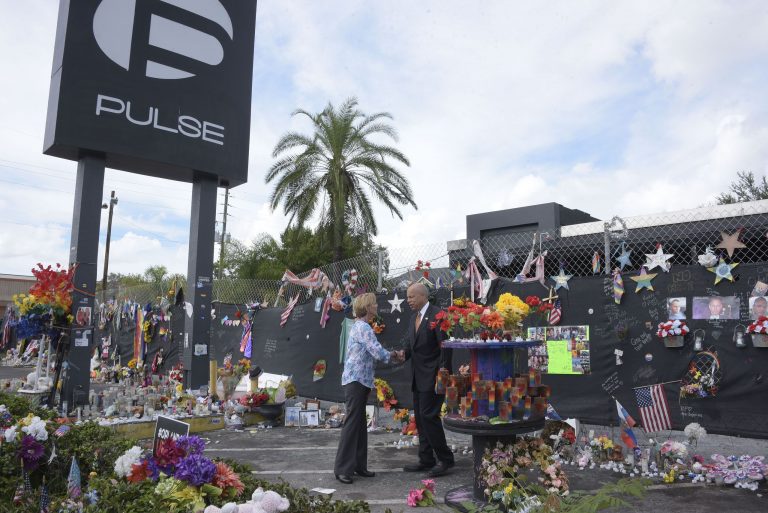
Today is the third anniversary of the Pulse nightclub shooting in Orlando, Florida, in which 49 LGBT+ people were slaughtered. It was the single deadliest lone gunman mass shooting in US history, the worst terrorist atrocity since 9/11.
To commemorate it, a number of US Christian fundamentalists will hold a rally in Orlando.
The rally is called Make America Straight Again.
The speakers include Pastor Steven Anderson, who hailed the shooting and has publicly declared his wish to kill gay people; Pastor Roger Jimenez, who wants the US government to execute LGBT+ people by firing squad; Pastor Tommy McMurtry, who believes gay people should be put “six feet under” and advocates violence against them; and Pastor Bruce Mejia, who says LGBTQ stands for “let them burn quickly”.
It’s easy to dismiss these barely evolved Bible-thumping, terrorist-embracing fucknuggets as Christian Taliban, a bunch of mouth-breathing throwbacks who are in for a big surprise when they end up in Hell. But thanks to social media, their hate echoes around the world.
I’m going to resist the temptation to make too many obvious jokes about The Pope’s latest damnation of trans people; you can come up with your own variations of “…says a man in a dress who thinks his boss lives in the sky”, I’m sure.
Nearly 70% of Catholics reported becoming more supportive of transgender rights over the last five years, versus 60% of nonwhite Protestants and 52% of white evangelical Protestants, the findings published Tuesday say.
The study isn’t a surprise. Again and again we’ve seen large scale surveys demonstrate rising support for LGBT rights generally and trans rights specifically, even among groups such as white evangelical Protestants.
That’s at odds with public reporting of such issues, which overwhelmingly centres the views of anti-trans individuals and organisations. Of course such people exist, but they’re not representative of the wider public. And the more the wider public actually gets to know trans people, the less representative the extremists’ views become.
Just like racism and homophobia, transphobia thrives on fear and ignorance. The more of us come out, the harder it becomes for the bigots to make you fear us. That’s why support is rising in tandem with increasing visibility. It’s easy to hate bogeymen. It’s harder to hate the people you life with, work with, socialise with.
TIME quotes Robert P. Jones, the CEO of the Public Religion Research Institute:
“Increase in support for transgender rights tracks fairly closely with the large increase in support for gay, lesbian and bisexual Americans,†he tells TIME. Jones also says the number of Americans who report having a close friend or family member who is transgender has doubled since 2015, and that “having a close relationship with someone transgender is strongly correlated with holding more supportive views of transgender rights.â€
Unfortunately the downside of this is that the more supportive the world becomes, the more vicious the zealots’ response. The media climate today is much more vicious towards trans people than it was five years ago, even though the world is much more accepting.
This is where you can make a difference. You can choose not to pay for publications that pick on trans people, or to entertain chat from people whose knowledge of trans people comes solely from those publications. You can donate to charities such as LGBT Youth Scotland, who try to help trans and gender non-conforming kids in an increasingly hateful media climate.
Most of all, you can refuse to be silent when you encounter misinformation, prejudice and ignorance. We can’t change the climate without you.
I lived up to a negative trans stereotype the other day: I hid in a toilet because I shouldn’t have been there.
It was the gents, of course.
I should probably explain.
Although I’ve transitioned legally and socially, there are times when I don’t present female: the days I’m getting electrolysis, which require me to have facial hair (you can’t stab and jab hair that isn’t there); and the days I’m with the kids, because it’s currently easier to do that in boy mode. So I’m leading a double life on those days, and inevitably that means I get confused from time to time.
I got confused on Saturday, when I was at a women-only event in a place catering for multiple different events. After a lengthy search for any toilet, I went into the gents without thinking. It was only when I sat down in the cubicle that I remembered about the make-up, and the wig, and the obviously female clothing.
Oops.
So I hid. I hid because I was intensely embarrassed, and because I could hear other people using the facilities and could really do without any kind of confusion or confrontation. And when I finally exited the cubicle, I walked straight into an old guy whose face did the most perfect “what the fuck?” expression I’ve ever seen.
Later that day, I did it again.
This time I was in the ladies, presenting male. We were in a fast food place and my young son needed to use the toilet; his sister escorted him but he then decided he wanted to chat with me as he went about his business. So I had to share a cramped cubicle with him in the ladies toilet for what felt like four hours.
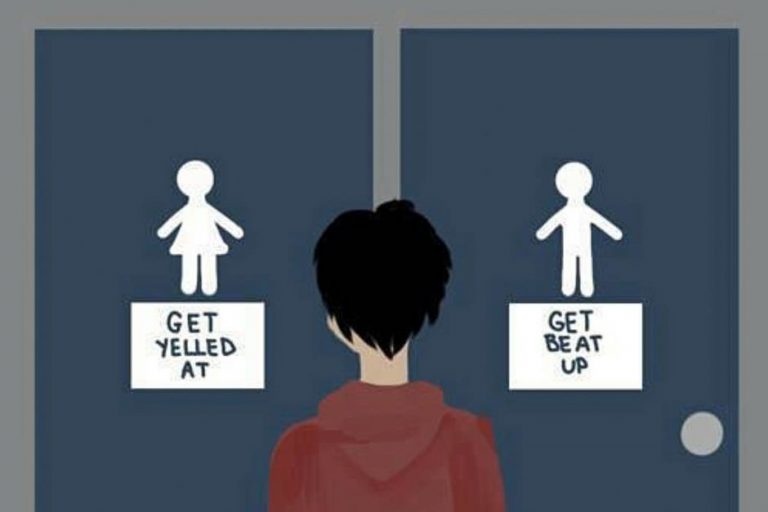
What both events have in common for me is fear. In both cases I was scared someone would yell at me for using the wrong toilet. And that’s a fear I have in my everyday life as me too. When I’m somewhere I don’t know I try not to drink too much liquid so I don’t have to go at all, and I avoid going until it’s actually painful. I’ve been known to get a taxi home in severe discomfort rather than use the ladies. This isn’t unusual. Many trans people, and trans kids in secondary school in particular, end up with infections because they avoid using toilets.
Even when I’m going places I do know it’s something I think about, something I take into consideration when I’m deciding what to wear. For example, I’m going to the pub quiz tonight in my local, and quiz nights are usually busier, the customers mainly people who don’t know me. So I’m already planning what I’m going to wear, asking myself whether it’s feminine enough so I can use the ladies without being yelled at. The fact I’ve never actually been yelled at doesn’t matter; it’s a fear, not a prediction.
I figured I’d miss some things about being male when I transitioned, but I never imagined I’d miss being able to go for a carefree wee.
Another day, another bunch of saddening headlines: armed neo-Nazis with a police escort intimidating Pride attendees in the US, lesbian women attacked in the street in England, the usual raft of anti-LGBT hatred in the press.
Two UK stories stood out for me, because they demonstrate two elements of the same thing: how anti-trans individuals and groups play the media and social media.
First up, Edinburgh University. An anti-trans event led to the mass resignation of the university’s staff pride network and lurid headlines about an attack on one of the speakers.
The reporting of this has been interesting. The staff pride network quit partly because of the event, but mainly because the university attempted to stop them from publicly criticising it. Fans of irony may want to use the words “silencing” or “erasure” here. They were also appalled by the university’s withdrawal from the Stonewall workplace equality index in “a reversal of the progress that the network has made over the last three years. We feel viscerally upset that the good work over the last three years is being undone.”
For most of the media, however, that wasn’t the story. The story, the bit that appeared in headline after headline, was that one of the speakers, Julie Bindel, was physically attacked by a trans woman.
Except she wasn’t.
Bindel, a well connected journalist and activist, has long agitated against trans people, and tends to attract protest when she speaks: some university LGBT+ groups have attempted to have her events cancelled on the grounds that they encourage hatred of LGBT+ students. Immediately after the Edinburgh event, she tweeted:
I was physically attacked as I left the event for the airport.
Except she wasn’t. She was shouted at.
I’m sure that was frightening, but a professional writer should know the difference between “physically attacked” and “shouted at”. Such as, “shouted at by protester” won’t get you in the papers; “physically attacked” will.
When PinkNews approached her for comment on the apparent difference between what she said on social media and what actually happened, Bindel  said: “I despise your woman-hating, anti-lesbian rag, and would rather give Donald Trump a massage than speak to you.”
It’s as if there’s some kind of agenda here.
Did someone say agenda?
Last week, the NSPCC threw Munroe Bergdorf under the bus. Bergdorf, a trans woman, is hate figure for anti-trans bigots; given the blurred lines between them, the alt-right and racists of various stripes the fact Bergdorf is a woman of colour no doubt played a factor too.
The news that Bergdorf was going to be one of the public faces of the NSPCC’s Childline led to a storm of protest and a cowardly decision by the NSPCC to “cut ties” with her.
The furore was spearheaded by Times columnist Janice “trans people are sacrificing our children” Turner. It claimed that Bergdorf was a “porn model” (a deliberately inflammatory reframing of the fact she once posed for Playboy) who shouldn’t be around children (one of the oldest tropes in the bigots’ playbook) and mobilised Twitter users to say they would cancel their direct debits to the charity.
Was any of it real?
Twitter user Helen, aka MimmyMum (parents of trans kids use pseudonyms on Twitter because of the abuse they’re subjected to) analysed the protesting accounts and found an interesting pattern. They don’t seem to follow the accounts of child protection groups or charities such as the NSPCC. But they do follow the most rabidly anti-trans pressure groups.
It’s as if there’s some kind of agenda here.
Update:
Many people have pointed out the apparent double standards of the NSPCC and of the activists here.
Previous Childline/NSPCC ambassadors have included the topless model Melinda Messenger and lingerie model Abby Clancy, neither of whom have attracted the attention of Janice Turner and the “protect children” crowd. By a strange coincidence, Messenger and Clancy are not black or trans. And the NSPCC’s current ambassadors include the cisgender, white, footballer Wayne Rooney, who has been arrested for drunk driving and whose controversial sex life includes many allegations about infidelity and the use of prostitutes. Nobody seems to have a problem with that either.
That the NSPCC could do this while proudly flying the pride rainbow has upset many, including UK Black Pride. Â “To the spineless leadership of the NSPCC,” they posted earlier, “remove the rainbow from your branding. You’ve quite the journey ahead to prove you’re worthy of flying our flag.”
One of the “straight pride” organisers out for a walk.
Most of the coverage I’ve seen of the so-called “straight pride” march apparently happening in Boston has demonstrated how broken much of the media has become. It’s been treated in “and finally…” style, a gently amusing little story in much the same style as a cat on a skateboard or a dog that can say sausages.
Whereas the reality is that it’s a stunt by a bunch of violent neo-Nazi thugs who want to create a white Christian ethnostate, who are preparing for a race war and who believe non-compliant women should be raped.
Tee-hee! Here’s Carol with the weather!
The organisation behind the proposed march is a rebrand of Resist Marxism, a violent, far-right group with very strong links to neo-Nazi extremists. Leader Mark Shahady organised a violent rally in late October to which he invited the notorious Proud Boys, who attacked protesters.
In December, Shadady hosted an anti-immigration “debate” where a known neo-Nazi organisation called Patriot Front provided “security”. As Antifash Gordon, an anti-Nazi activist, writes on Twitter:
Patriot Front is an openly neo-Nazi organization that endorses the use of “ethnostate rape gangs” to police the behavior of white women after they win the race war they think is coming. https://unicornriot.ninja/2018/americans-fascists-inside-patriot-front/
Do say: “If Straight Pride had been invented sooner, they might not have had to close all those branches of Burton.â€
Don’t say: “Where are all you guys going? The Boat Show’s that way!â€
Apparently there’s a lighter side to ethnofascism, violence and rape.
In fairness The Guardian has since reported on the background of the organisers, but like most such coverage it’s too little too late. A stunt by some utterly despicable, vicious, bigoted people has become a global news event, a funny little item at the end of a broadcast, yet another opportunity for the far right to spread their hate.
This is how the world ends. Not with a bang, but with a snigger.