…challenging the myth of a free speech crisis does not mean enabling the state to police and censor even further. Instead, it is arguing that there is no crisis. If anything, speech has never been more free and unregulated. The purpose of the free-speech-crisis myth is to guilt people into giving up their right of response to attacks, and to destigmatise racism and prejudice. It aims to blackmail good people into ceding space to bad ideas, even though they have a legitimate right to refuse. And it is a myth that demands, in turn, its own silencing and undermining of individual freedom. To accept the free-speech-crisis myth is to give up your own right to turn off the comments.
…The recent history of fighting for freedom of speech has gone from something noble – striving for the right to publish works that offend people’s sexual or religious prudery, and speaking up against the values leveraged by the powerful to maintain control – to attacking the weak and persecuted. The effort has evolved from challenging upwards to punching downwards.
It has become bogged down in false equivalence and extending the sanctity of fact to opinion, thanks in part to a media that has an interest in creating from the discourse as much heat as possible – but not necessarily any light. Central in this process is an establishment of curators, publishers and editors for whom controversy is a product to be pushed.
Update:
There’s a superb piece in The Nation about how the supposed crisis was created. Spoiler alert: a lot of it’s to do with the Koch brothers, who helped fund Spiked. Coincidentally, Spiked rails against protecting the environment, restricting corporations and the supposed evils of the supposed free speech crisis.
How did we get here? Very intentionally, as it turns out: For decades, the right has claimed a monopoly on the idea of “freedom†more broadly—and speech is no exception.
…The billionaires pushed a version of free speech that posited that limiting carbon emissions, taxing the rich, and any form of redistribution were equivalent to infractions on our constitutional rights. To do this, they not only needed to talk about market and economic deregulation; they needed to present their ideas as a radical remedy to the overbearing liberal state. So they funded dozens of books that argued that liberals were essentially limiting far-right speech through political correctness.
Welcome to the era of our supposed free speech crisis.
Yesterday, I blogged about right wing parties deliberately stoking anti-LGBT+ sentiment for political gain.
Last night:
‘According to one insider, Number 10 has been polling “culture war†issues, such as transgender rights, to see whether they can be weaponised against Labour in northern working-class constituencies.’https://t.co/5iB7AAMVhn
The Conservatives deny the report, as they denied reports last week that the Prime Minister would prorogue Parliament.
Leaving aside the implication that the Tories think everybody north of Watford is a bigot, there’s a very cynical calculation here. Trans people are such a tiny minority you can demonise them without losing a significant number of votes.
Sure, your attack ads will get many of them beaten up, maybe keep a few more in the closet, persuade a couple more to kill themselves. But that’s okay. They don’t really vote anyway, and when they do they don’t vote for the Conservatives.
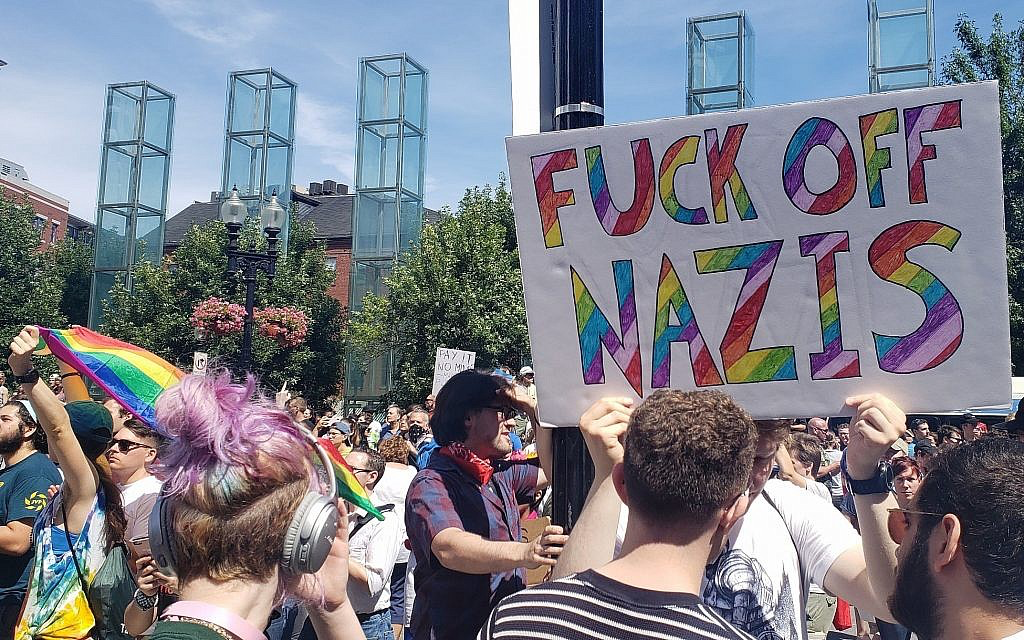
The much-hyped Boston event took place this weekend and proved that – surprise! – it’s a front for the far right. To all intents and purposes it was a Make America Great rally, complete with police pepper-spraying counter-protestors.
David here at the Boston Straight Pride Parade has been going on for the last 10 minutes ranting about how the Jews faked the holocaust, rule the world and created the LGBT movement to destroy America pic.twitter.com/awkkds7AAd
Bigots cannot count on a silent majority to look the other way anymore, so how do they continue to dig in their roots?
Easy. Construct a parade in direct contrast to Pride, tapping into the homophobic leanings of those not quite convinced to join the alt-right. After all, if LGBTQ people get their day, why shouldn’t straight people? Claim straight people as an “oppressed majority†facing discrimination from the city of Boston. Claim that denying straight people their right to parade in the street is unconstitutional. Gather the wavering masses under a single umbrella and disseminate the us-and-them mentality from there. When fascism can’t take hold through overt means, move it underground. Create a system of cycling dog whistles. Enmesh bullied kids into a toxic echo chamber of propaganda and build a new generation of fascists. Easy.
There will be other Straight Pride events, because what these rallies do is tell racists and bigots three things. One, you are not alone. Two, you are in the right. And three, the police and the state are on your side.
Here’s how that pans out elsewhere.
In Poland, July’s gay pride march was watched by spectators from over 30 anti-LGBT, mostly far right groups who outnumbered the marchers four to one. Those spectators didn’t just watch. They attacked the marchers with rocks. Dozens of LGBT people were physically assaulted before, during and after the event. Journalists were spat on and beaten. The police, while present, didn’t appear to do very much.
Both the Catholic Church and the Polish state actively work to create a hostile environment for the gay community.
…The ugly scenes in Bialystok were not an isolated incident. Several Polish regional parliaments have declared their districts to be “LGBT-free zones†in recent months…
…Officially the government decries the violence seen in Bialystok, but at the same time hints that LGTBQ groups are out to provoke. The education minister Dariusz Piontowski has questioned whether such marches should be allowed since they “awaken resistance†in the wider public.
The government stance is also backed by a powerful conservative media that has loaded Poland’s newstands with brazenly anti-LGBTQ magazine covers. One publication, Sieci, warned of a “Massive attack on Poland comingâ€, while another, Do Rzeczy, showed a mocked up prime ministerial podium flanked with rainbow flags.
A third, the Gazeta Polska, went even further, printing a cover warning that the LGBTQ movement wanted to “destroy their civilisation†and giving readers a “LGBT-free zone” sticker showing a black cross over a rainbow flag.
This is happening throughout Eastern Europe and in Russia, but it’s also happening elsewhere. Anti-LGBT sentiment is being deliberately stoked by right-wing politicians and media in Western Europe and in North and South America too. And that’s what Straight Pride marches are all about. They’re organised by the far right; the marchers are from the far right; their banners and memes and outfits are from the far right. And their claims of being oppressed, of being silenced… they’re from the far right too.
Let’s not play their game and pretend Straight Pride marches are about sexuality, or about gender identity. They’re about white supremacy.
As Anthony Oliveria put it on Twitter:
reviewing all the footage from the Straight Pride Parade hey so quick question I don’t spend much time at straight events are there always so many swastikas when we gays aren’t around or
Corinne Engber believes that the strategy is ultimately doomed.
Ultimately, this recruitment attempt will fail before it begins as the environment of the country leans toward support for Jewish people, people of color and LGBTQ people.
Jessica Valenti, a consistently superb writer, describes a Twitter spat that went out of control. It’s about a New York Times columnist called Bret Stephens, a fierce advocate of unfettered freedom of speech.
When a university professor made a mild joke about him, he attempted to get the professor sacked and then wrote a column in a national newspaper comparing the experience to the Holocaust.
This is someone who mocked sexual assault survivors for wanting a break room with counselors during a debate on rape culture, a writer who questioned the “moral proportion†of firing sexual harassers. Is targeting a professor’s job for a barely seen quip morally proportional? Are high-profile columnists more deserving of a “safe space?â€
This is not in any way unusual. For example, Piers Morgan frequently rails against touchy “snowflakes” who apparently can’t take criticism. If you criticise Morgan on social media, he’ll immediately block you. Other high profile free speech defenders such as millionaire comedians take a similar approach, often orchestrating social media pile-ons against anybody who dares question their great wisdom.
The Venn diagram of successful men who rail against “the woke left”, “snowflakes” and “safe spaces” vs men who bully others online or in print is a near-perfect circle.
What these men – and it’s mainly men – advocate isn’t freedom of speech. It’s the protection of their own status and privilege. They want to punch down without anyone of lesser status being able to punch up.
Valenti:
The real snowflakes aren’t rape survivors who request trigger warnings or students who’d like that we use their correct pronouns — they’re people with power who can’t abide even the slightest criticism without using their influence to demand consequences.
My band’s debut EP is released today. Unless I’ve mucked something up, Some People Are Inconvenient by Stadium* should be available on Spotify, Apple Music, Google Play Music, Amazon Music and even TikTok. It’s also available on Bandcamp, where you can order it on CD or as digital downloads in the format of your choice.
It’s also streaming on SoundCloud:
We’re very proud of the songs here. Bonesaw is the first song we ever wrote together, while A Moment of Clarity and Voodoo are hits at the various open mics I’ve been performing at. Safe Space would be too, I’m sure, but I haven’t worked out a way to do it on acoustic guitar yet.
There’s been a lot of publicity over a new study into the so-called “gay gene”; the study reports that although there doesn’t appear to be a single genetic marker for gay people, there may be several. Similar studies have attempted to find a genetic marker for trans people.
Here’s why that’s scary.
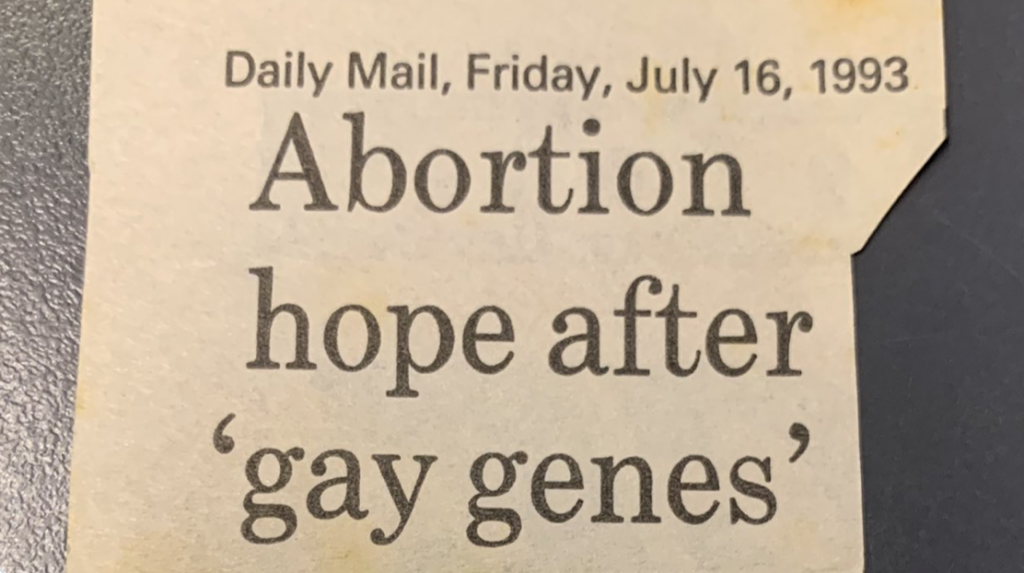
This image was posted by Antony Tiernan, and in response the writer Huw Lemmey noted the context: “over a million British people still buy this paper every day.”
Let’s be optimistic and believe that nobody would choose to abort a baby whose genes suggested they might be gay or trans. That doesn’t mean genetic screening for LGBT+ people couldn’t happen, or couldn’t be misused.
The problem with any kind of genetic screening is that it’s a guide. For example, I’ve just had my genes analysed and I have a slightly raised risk of pulmonary disease. That doesn’t mean I will get it. It just means there’s a higher likelihood than perhaps you have.
One of the things I was screened for is abnormalities relating to the BRCA1 and BRCA2 genes, which we know are implicated in many cancers. I’m clear – but the screening only checked a small proportion of the thousands of potential variants. I could still have a difference in one of those genes that means I’m more likely to get cancer.
Now imagine I’d been screened for genes linked to being trans. The same thing could apply: you could check for 100 different anomalies, and that could come back negative – but there could be hundreds upon hundreds of other genetic variations that you don’t check for, and which have contributed to me being the fabulous trans woman you see today.
Why does that matter?
It matters because if we developed a genetic test for LGBT+ people we might decide to use it in asylum claims, because one reason people claim asylum is because they face persecution for being LGBT+ in intolerant countries. Imagine: we could easily differentiate between the real asylum seekers and the fakers!
Far-fetched? Last week a British judge rejected an asylum seeker’s application because he didn’t seem gay enough. He contrasted the man’s demeanour with that of another man who “wore lipstick” and had an “effeminate” manner.
In that case, the judgement was appealed and has been sent back for review. But what if the judge had rejected the applicant because his genes “proved” he wasn’t gay?
It could also be used to “prove” that people are lying about their sexuality or gender identity in other circumstances. There’s already fierce and often malicious debate over whether some trans people are “trans enough”, so for example anti-trans bigots are keen to differentiate between “true” trans people, who they pretend to care about, and “fake” trans people – people like me who haven’t had surgery – whose human rights they want to curtail and whose healthcare and support services they want to defund.
Could failing genetic testing mean I’d be denied NHS treatment such as hormone therapy?
In the early 20th Century, out of context IQ testing was used to justify the forced sterilisation of black and hispanic people.
the notion of feeble-mindedness, at least partly determined by IQ tests, was used as a justification for the Supreme Court’s notorious Buck v. Bell decision, which allowed forced sterilization for “insanity or imbecility,†mostly among the population of prisons or psychiatric hospitals.
One of the links in that article goes to a study of pseudoscience on women’s suffrage.
many scientists supported the antisuffrage argument of “physical force,†claiming that women lacked inherent energy needed to physically enforce laws and should be excluded from voting. A secondary argument claimed that such cyclic elements as menstruation and menopause made women too irrational to vote.
More recently, halfwits in Silicon Valley have been pushing the bullshit theory that men are better suited to tech jobs because of exposure to “prenatal testosterone”.
Sexuality and gender identity are complicated and multifactorial, and they are normal variations in human behaviour and biology. That means there can never be a reliable genetic test for being gay or being trans, and we should be scared of anyone who wants to create one.
As TIME’s Jeffrey Kluger writes:
…as long as there is science—which means forever—there will be people willing to misuse what it teaches.
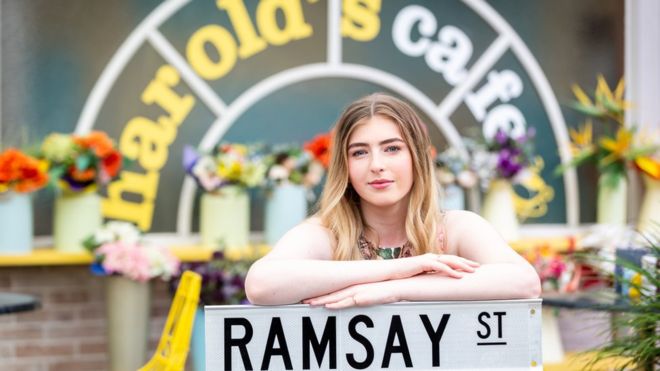
…at a time when politicians and publications (including, on occasion, the UK arm of this one) have made trans people’s – and in particular young trans people’s – existence a target for “debateâ€, there is some nice, uncomplicated good in a young trans person playing a young trans character on a beloved, long-running program.
If longstanding viewers couldn’t think of a single trans person before, now they can.
If a young trans person has never seen someone they could relate to onscreen, now they will.
And to that one young person, it could mean an awful lot.
When some people – and sorry guys, but I mean primarily men people – talk about how #MeToo and related anti-abuse movements have gone too far, I do tend to wonder: what, or who, are you hiding?
There’s been a good illustration of that this week, when multiple unconnected women in the video games industry have named men who’ve attacked, sexually abused and gaslit them. It began with a blog post by Nathalie Lawhead, a brave act that encouraged other women to speak out.
As the award-winning writer Leigh Alexander commented:
for each abuser you heard about today there are like 10 more we can’t talk about because of the retaliatory threats they’ve made to their victims, for whom it would be inappropriate to speak
Today it’s video games. Maybe tomorrow it’ll be music, or publishing, or civil engineering, or education, or bar work, or anywhere else men in positions of authority, formal or informal, are in a position to abuse their power.
I know it’s not all men. But it’s too many men. And one of the reasons they get away with this is power.
Power is partly because of the lack of diversity that’s still prevalent in too many industries. When you’re a member of a minority group, you have very little power. Who’s going to believe you? Who’s going to take your side?
Many of these men’s behaviour is an open secret. Women in many industries operate “whisper networks”, where they can privately warn one another of predatory men. But the behaviour is often well known to other men too: the men they work with, the men they socialise with, the men who laugh along when they describe something awful.
Earlier this week, a woman who works for a law firm shared a message her boss had intended for one of her co-workers but accidentally sent to her. The message said that he “hopes Sarah has her tits out” and that “one day I’m just gonna have to fuck her.”
Most people are rightly appalled by the content of the message (but not everyone, because it’s the internet: some are piling on the woman for daring to shame her unnamed boss). But one question I haven’t seen anybody asking is pretty important.
Why did the boss think it was okay to send that message to anyone?
Those who feel blood pressure rising at the idea a person or a thing might be scrutinised for its racism believe themselves to be personally and deeply maligned by a world in which other people matter, and which they have to share.
…All perspective is lost, and phone-ins pander to self-centred hysteria. Imagine if white people perpetually clinging to the past faced the societal exclusion others actually do on a day-to-day basis, rather than merely experiencing challenge to views that are anti-social and hateful?
Waddell isn’t suggesting we ban The Magic Faraway Tree (which she loved, and which my daughter loved too) or the Famous Five. But reading is hard, it seems. The first response to her on Twitter claimed that by stating that a racist was racist, she was in fact a racist.
Laura Jane Grace & the Devouring Mothers in studio (L-R: Atom Willard, LJG, Marc Hudson) Credit: Bryce Mata
I went to see Laura Jane Grace and The Devouring Mothers last night. It was a fun gig, introduced me to music I hadn’t heard before and made me feel a whole lot better about myself. That’s because like me, Grace is trans.
Grace is slightly younger than me – she’s 38 – but like me she began transitioning relatively late in life, in her case at the age of 32. That means like me she had to go through male puberty and grow a male body. Grace looks much more feminine than I do – she has better genes, is younger than I am and has had facial feminisation surgery – but I don’t think it’s unfair to say that you can tell she’s trans. This, to me and I suspect the many trans and non-binary people in last night’s crowd, is really helpful. As I’ve said many times before, some of the most powerful words in our language are “you are not alone”.
When you’re the trans singer/guitarist in a noisy rock band, seeing a trans singer/guitarist in a noisy rock band is very life-affirming.
Visibility, representation, matters. I spent unhappy decades without any role models such as Laura Jane Grace: the only trans people I saw were either the butts of cruel comedy or the miserable subjects of miserable documentaries.
Things are different now. We have the internet, of course, and books such as Grace’s own memoir and those of trans figures such as Juno Dawson, Janet Mock and Sarah McBride are helping trans people (and cis people!) better understand what it’s like to be trans or non-binary, and of course the visibility of actors such as Laverne Cox is enormously helpful too. Five years ago Time magazine was moved to declare the “transgender tipping point”, and trans people have never been so visible.
This story, to me, is huge. Teddy Quinlivan is the new face of Chanel. The 25-year-old model came out as trans two years ago, and as you can see she looks a bit prettier than I do. That’s mostly genetics, of course, but Quinlivan also started hormones when she was 17. The younger you begin transition, the better the results. Your body is still forming so the hormones can be very effective, and things like long hair and a smooth face don’t require thousands of pounds and months or even years of painful procedures to achieve.
Quinlivan has what some of us call “passing privilege”: she looks like a pretty young woman because that’s exactly what she is, and she’s treated as such by society. She could easily have kept her trans history secret, but she chooses not to: she chooses to use her platform to help change people’s perceptions of trans people.
As she says:
“There’s a stereotype of transgender people based on what’s shown on Maury Povich or Jerry Springer. It’s that there’s something mentally wrong with them, that they are incapable of serving in the military or existing in the workplace normally. But that’s not true at all. I am proof—a successful model who happens to be transgender. And I think fashion, in terms of social power, is the most important industry. Advertising has tremendous impact in terms of who and what we find attractive…. If legislation is being made on my behalf as an American citizen, then it’s incumbent on me to speak up for the transgender taxpayers who deserve the same dignity and respect that a cisgender person receives.”
Another very beautiful trans woman who doesn’t keep her history secret is Munroe Bergdorf, who lost her job as the face of L’Oreal after a coordinated campaign against her. As she says, having some pretty trans people on magazine covers isn’t enough.
While media visibility, representation and public awareness are at an all-time high, trans people also face soaring levels of violence and a startlingly transphobic mainstream media presence, as well as bullying and harassment on social media… while some community figureheads are rightfully having their time to shine, this is not an accurate reflection of the reality of how it feels to be transgender in the UK today.
But visibility still matters.
I often say that if I had seen a Laverne Cox or a Janet Mock in a magazine when I was younger, everything that I was feeling during my adolescence would have begun to make sense a lot sooner. It wasn’t until I was 20 that I started to find transgender role models that I could truly relate to, and by that point I had internalised so much self-hate with regard to my gender and racial identity that it stopped me sharing how I felt with other people – a vicious cycle which severely impacted on my mental health.
Like many trans people, I have to battle against the cumulative effect of years of being told that people like me are sick, that we’re deviants, that we’re perverts… you don’t need me to go through the charge sheet when some newspapers reprint it every week.
What Bergdorf is describing is what anti-trans bigots try to convince you is “social contagion” or their invented illness, “rapid onset gender dysphoria”: it’s understanding that there are other people like you, and that they and you are just as valid as anybody else. It’s realising that you don’t have to fight who you are for the most important years of your life.
To see the visibility of people like Laura Jane Grace, Teddy Quinlivan, Munroe Bergdorf and others is bitter-sweet: I’ve been trans all my life but I didn’t know that was okay until middle age – long past the point where I had any chance of going through life looking like an ordinary woman, let alone a pretty one. So I’m happy for the trans kids growing up now, and sad for those of us who had to grow up long before the transgender tipping point.
Bergdorf:
We must start working towards a time where trans people are not only celebrated on screen, but also in real life.