Category: Music

Gratuitous Girls Aloud references

  • U2 make me think about death

    I went to see U2 last night. They weren’t very good. Part of it was the sound – maybe it’s just me, but when I go to see a four-piece guitar band I quite like to hear the guitar and bass guitar – and part of it was that they seemed a bit lacklustre. Most of it, though, was me.

    I used to love U2. The Edinburgh leg of the Joshua Tree tour was my first big gig – a hugely happy memory – and the 1992 Zoo TV tour remains one of the most incredible gigs I’ve ever seen. I used to buy the music press to find out what Bono had to say, for crying out loud. And then I stopped loving them and started to detest them.
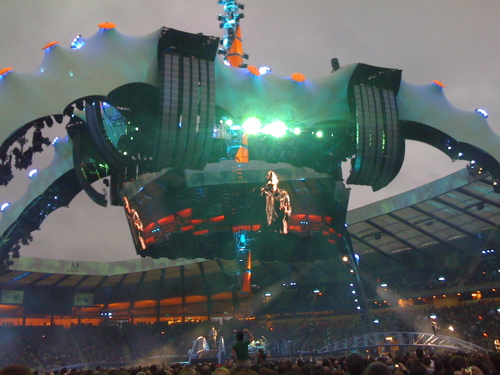
    U2. Nice telly.
    — U2. Nice telly.–

    I stopped loving U2 in 1997 when they were touring the Pop album. It wasn’t a great album, which is something even U2 admit now, and with hindsight going to see three consecutive gigs – two in Dublin and then one in Edinburgh – wasn’t very clever. The first night was okay, but it was no Zoo TV; the second night was rotten, because Princess Diana died and the band paid tribute mid-gig. That was a bit too Elton John for my liking, and when they did it again in Edinburgh – at least, I think they did; Murrayfield’s legendary acoustics meant they could have been paying tribute to Hitler for all I could hear – that was the end of my U2 fandom.

    Naturally, I decided to hate them instead. For a good few years they provided plenty of reasons to, as Bono got more and more annoying and the records got patchier and patchier. Old B-sides dug up and performed with Boyzone? The band who came up with The Unforgettable Fire churning out dross such as Elevation? Pffft.

    There’s a – sadly untrue – story about U2 that cracked and still cracks me up: the band are playing Glasgow, and after one of the anthems Bono stands stock still, clicking his fingers. He does this for a while, saying nothing. Click. Click. Click. “Every time I click my fingers,” Bono says in his most pompous voice, “Somebody in Africa dies.” There’s a pause, and then one of the punters yells out: “Well, stop fucking doing it, then!”

    Heh heh heh.

    The thing is, though, I still secretly wanted to love U2. I was like a teenage boy slagging off an ex-girlfriend while secretly hoping she dumps her boyfriend and comes running back. And from time to time, there were flashes of the U2 I used to love so much. Beautiful Day is wrapped in joy for me – it was the soundtrack to an extraordinary trip with the lady who is now Mrs Bigmouth – and the first time I heard Sometimes You Can’t Make It On Your Own, in circumstances I’d rather not share, I burst into tears. There was the odd flash at last night’s gig too. Stuck In A Moment… was the U2 of old, a staggeringly beautiful few minutes of music. But there weren’t many bits like that.

    And that’s because U2 aren’t the same band I fell in love with. They’re not the hungry band who toured the Joshua Tree, or the panicky reinventors of Zoo TV; they’re four middle-aged millionaires whose fans turn up to hear the songs they wrote 20 years ago, babysitter permitting. Creatively, they’re moving/have already moved into Rolling Stones territory: you go to the gig for the spectacle and cross your fingers that they don’t play too much of the new, rubbish stuff.
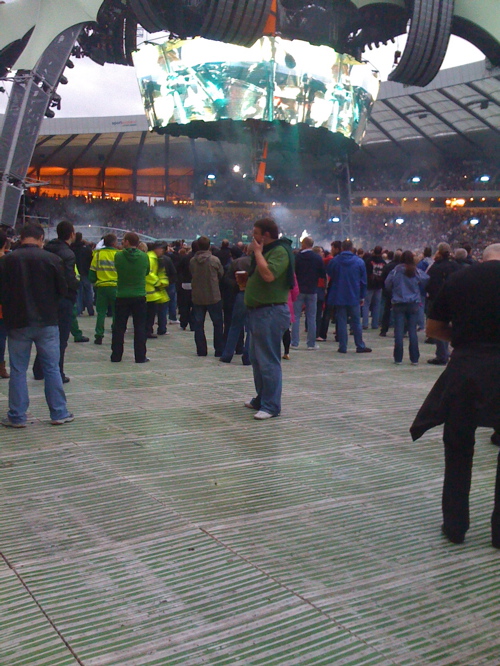
    Third song of the sell-out gig.
    — Third song of the sell-out gig.–

    And I’m not the person who fell in love with U2 either. You’re more likely to find me teaching Baby Bigmouth the “ma ma ma” bits of Lady Gaga’s Poker Face than poring over sleeve notes to work out what it all means, man. Musically, I’m moving into Dad territory: with the odd exception, the bands I’ll be listening to – and annoying Baby Bigmouth with – in a decade are the bands I was listening to a decade ago.

    For me, then, going to see U2 again and hoping to be blown away was like meeting up with a girlfriend twenty years later. In your head, she’s young and beautiful. In her head, you’re slim and sexy. In the flesh, she’s got an arse the size of Belgium and crow’s feet deeper than the Grand Canyon, while male pattern baldness and alcohol abuse mean you look like a sick potato. And when you talk, you soon discover that the only thing you have in common is that you both own your own legs.

    The defining moment of the gig for me wasn’t musical: it was when the screens showed baby-faced drummer Larry Mullen Jr, rock’s very own Dorian Gray. And he looked old. Of course he did: he is, and I’m not far behind him. In the end it wasn’t really a gig: it was a reminder that I’m not young any more, sponsored by BlackBerry.

  • The peculiar agony of the big-name artist’s album playback

    God, I love PopJustice. This is ostensibly about Shakira’s new album:

    We always find playbacks like this totally toe-curling. You’ve got someone who’s just spent a couple of years recording their (hopefully) incredible new album sitting in front of you and your fellow ‘scribes’, watching for your reaction to their new songs. But how do you look like you are ‘listening’ to a song? How do you look like you are enjoying it? You can’t just start dancing around shouting “I FUCKING LOVE THIS ONE!!!” at the top of your voice like you might do if you were, for example, at church.

  • Two on Techradar: let’s have a tech firm fight, and: should we bury online touts with Michael Jackson?

    Sorry I’ve been quiet. I’ve been away for a few days. Here are a couple of things I’ve written… first up, Mozilla says Internet Explorer is like malaria. Let’s have a tech firm fight!

    “IE is like malaria, is it?” Microsoft could say. “Well! Firefox is like a big fat boy on a girl’s bike! And also, your mum is fat!”

    Wouldn’t that be brilliant?

    Also, Michael Jackson’s death is going to leave a lot of ticket holders in a financial mess. Should Something Be Done about online ticket touting? The column has been reworded on grounds of taste and decency, but here’s one of the edited lines in its original form:

    Concert tickets have become an elaborate mechanism for doing to music fans what Michael Jackson allegedly did to [Er, let’s not go there – Ed].

  • Spotify: Android’s killer app – and bad news for iTunes?

    Could be…

    Have you seen the demo of Spotify on Android yet?

    If not, check it out and listen really carefully. That sound you can hear in the distance is Steve Jobs swearing.

    It looks like Android has found its killer app.

  • Free costs money. Who’s going to pay for it? Er, you

    Me, on Techradar:

    We’re so used to the idea that everything online should be free that we don’t even think about it.

    Of course the iPlayer should give us HD video for free. Of course Spotify should stream music for free. Websites? Free. News? Free. Video? Free. Software? Free.

    There’s only one problem. Free costs money, and there isn’t enough of it.

  • Is MP3HD the future of digital music?

    Er, probably not.

    MP3HD is a lossless format, which means it delivers a perfect digital copy of the original audio – but it manages to do it more efficiently than WAV or AIFF files, which can be massive…

    We’ve been here before. Nearly eight years ago Thomson announced a new, higher quality kind of MP3 called MP3Pro.

    Like MP3HD, it was backwards compatible, so your files would play on any MP3-supporting program or device; like MP3HD, it offered better sound quality by combining a high quality and low quality version in the same file. If your device didn’t support MP3Pro you’d get the low quality one; if it did, you’d get the high quality one. It was very clever, and with the exception of MusicMatch Radio, hardly anybody used it.

  • PRS versus YouTube: what PRS For Music is telling its members

    This was posted on Jockrock by Commander Keen. I haven’t seen the original.

    Dear Member

    You may have read the news stories this week about Google blocking access to ‘premium’ video content on YouTube in the UK as a result of their not agreeing a new licence with PRS for Music. Premium content appears to refer to music videos that are traditionally uploaded by record companies.

    You may also have read that Google took this decision unilaterally, without any request from us to do so. Their licence with us had expired at the end of December 2008 and we were negotiating their new one. We do not usually ask anyone to remove content as long as good faith negotiations are taking place.

    Immediately we heard news of Google’s decision to pull content from YouTube, and that they were talking to the press about it, we issued our own press statement. We expressed our outrage, shock and disappointment on behalf of UK consumers and on behalf of you, our members that Google should take this action.

    Google’s decision must be seen as an attempt to influence commercial negotiation and the focus on ‘premium’ content as an attempt to cause disruption within the music industry again. This content may account for about 1% of YouTube music streams.

    At the heart of Google’s precipitous action is the going rate for music. This is the rate set by the UK Copyright Tribunal in 2007. The Tribunal is the ultimate and independent arbiter of copyright dispute. Digital service providers pay a fraction of a penny per stream to the creator of the music.

    Most of the major digital service providers are licensed by PRS for Music. And just recently we have signed deals with Amazon, Beatport, Nokia Comes With Music and Qtrax.

    YouTube has signed-up to licences in very few countries around the world – we were one of the few. They have never before taken down content unless they have been forced to do so by copyright holders. Meanwhile, in the UK, consumer streams of YouTube ‘premium’ content have risen by almost 300% in the last year alone (up from 75m streams a quarter to nearly 300m streams a quarter). In total, Google want to pay 50% less than they paid before for that usage. Google think they paid too much last time. But their music usage, charged at the going rate, suggests they were significantly underpaying.

    A further delay to our negotiation has been that Google is, at present, not giving us the data we need to calculate correct royalty payments to you. We ask them to make returns on their music use in the same way that every other major licensee does in order that we can properly analyse it, charge the right fee and then pay the copyright owners we represent. If there’s a stream of a track we don’t control, Google won’t pay us for that stream. Google would like to see our database in order to match it against theirs so they can calculate how much they owe us.

    We look forward to continuing our negotiations with Google where we will be looking for them to pay an appropriate amount for the volume of music they use and the contribution that songwriters make to the success of their service.

    In the meantime, please help us to help you. There are numerous Internet blogs hosting discussions on songwriter royalties. All too often, the voice of the composer and songwriter is lost in the midst of issues relating to the freedom of the Internet. Many blog posters misunderstand how royalties work and how you get paid. We should not forget that more than 90% of PRS for Music members receive less than £5,000 per year in royalties.

    Wherever possible, please contribute fully to this online debate, putting the composer and songwriter point of view. Additionally, if you feel you could give your time, where needed, to talk or write to the media in support of PRS for Music and of the composer/songwriter community, please email us.

    With best wishes

    Steve Porter, Chief Executive, PRS for Music

  • Techradar: YouTube versus PRS, and banishing software irritants

    It’s Tuesday! First up: why the YouTube/PRS spat is bad news for musicians.

    Ultimately, though, the spat is like watching two bald men fighting over a comb. On one side we have a multi-billion dollar corporation demanding that musicians pay the price for its inability to find a properly profitable business model; on the other we have a rights agency that appears to be stuck in a pre-internet age and can’t or won’t accept that online streaming simply doesn’t bring in the same amount of money as traditional broadcasting.

    Also, 7 annoying apps you don’t have to put up with.

    Printing, as Eddie Izzard once ranted, shouldn’t be hard. Control-P-Print! So why do printer manufacturers insist on installing applications for every conceivable task, such as programs that enable you to add gaudy picture frames?

    Long-term readers will immediately spot that one of the nasties, Snap Shots, was briefly on this blog. I was young then, and crazy.

  • YouTube starts blocking music videos in the UK over PRS dispute

    From the official blog:

    PRS is now asking us to pay many, many times more for our licence than before. The costs are simply prohibitive for us – under PRS’s proposed terms we would lose significant amounts of money with every playback. In addition, PRS is unwilling to tell us what songs are included in the licence they can provide so that we can identify those works on YouTube – that’s like asking a consumer to buy a blank CD without knowing what musicians are on it.

    We’re still working with PRS for Music in an effort to reach mutually acceptable terms for a new licence, but until we do so we will be blocking premium music videos in the UK that have been supplied or claimed by record labels.

  • Bugger off and take your Beatles with you

    A slightly inflammatory piece by me on Techradar: why the music industry doesn’t deserve government help.

    Now, like General Motors, the record companies are hurting – and like General Motors, they want the government to save them. GM wants cash; the record companies want ISPs to act as their policemen, while the Digital Britain report suggests a broadband tax to create a new organisation to fight piracy and find new and exciting ways for DRM to annoy us.

    Why doesn’t the government tell them to get stuffed?

    The New Music Strategies blog linked in the article is well worth your time.