Category: LGBTQ+

  • How many debates do you need?

    Yes, another trans post. I’m as bored as you are, believe me. What many people call trans activism is just trans people being pissed off with constant attacks on their right to a quiet life, and with just days left in the UK government’s gender recognition consultation the attacks are getting pretty intense on social media (and the usual offenders in the mainstream too).

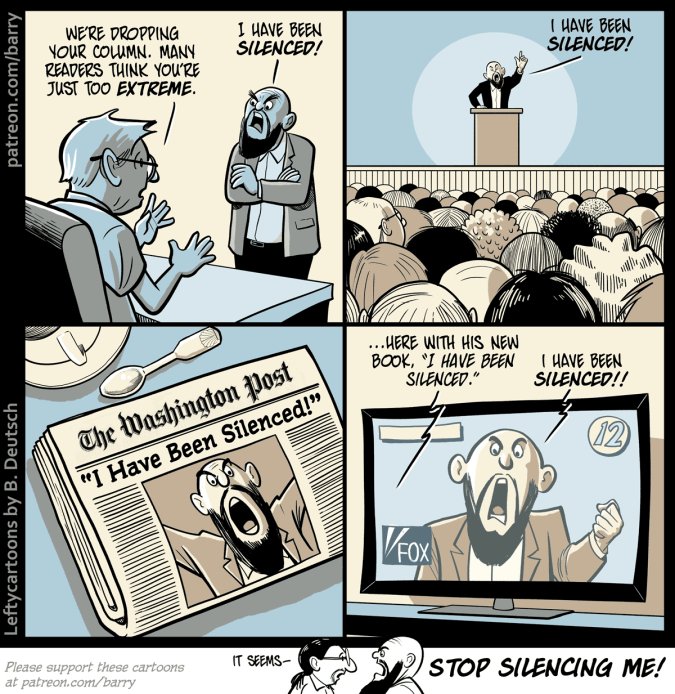
    One of the things we keep hearing about from anti-trans groups is that we need a “debate”, a debate that they claim is being “silenced” by trans people. They’re currently lobbying MPs to demand that debate (which naturally requires a suspension of any proposed reform, and ideally a roll-back of existing equality legislation).

    Christine Burns MBE knows a thing or two about trans history and legislation; she’s been involved in a lot of it. She posted this on Twitter today.

    The European Court of Human Rights has debated trans rights four times: in 1987, 1990, 1997 and 2002. Their conclusions underpin the reasons why we have a Gender Recognition Act.

    The European Court of Justice deliberated over the position of trans people once — in 1995/96 — that’s why Britain first legislated for trans employment rights nearly 20 years ago in 1999.

    The High Court and Court of Appeal had a right old debate about trans people in 1997/8. That’s why trans people have the confirmed right to receive fair treatment from the National Health Service.

    Parliament debated the rights of trans people to legal recognition in 2004, after lengthy consultations with affected bodies such as sports and insurance. That’s why the Gender Recognition Act was overwhelmingly passed in a free ‘conscience’ vote.

    Countless organisations have looked at trans people and how to fairly include them in corporate and social policies in the intervening years. Trans people, who first united to provide mutual support over 50 years ago, have been debated almost constantly for generations.

    Generations isn’t an understatement. Most of the current “talking points” and “legitimate concerns” have been kicking about since the early 1970s. They were debunked back then too.

    Maybe, just maybe, it isn’t really about informed debate.

    We’ve been debated into an exhausted mush, until the repeated calls start looking like cynical bullying rather than honest enquiry.

  • It’s a trans trans trans trans world

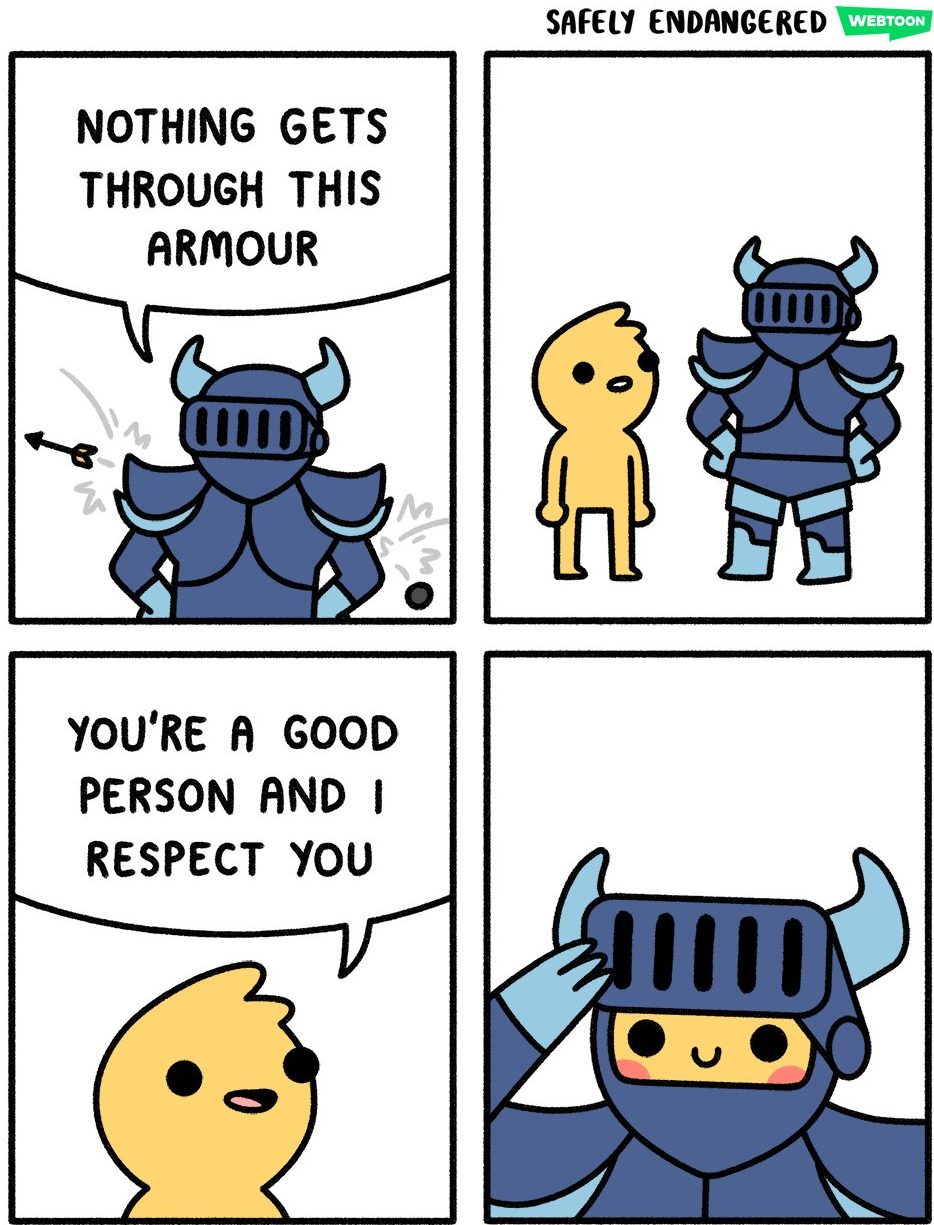
    Cartoon by Safely Endangered comic.

    The UK government’s consultation on gender reform finishes in a few days time (please fill out the consultation if you already haven’t; God knows, the bigots have in their hundreds). To mark the occasion, Vice magazine has published absolutely tons of trans-related stuff. It’s a welcome alternative to the barrage of anti-trans material in the newspapers and in current affairs magazines.

    Here’s a selection.

    Experts debunk the myths around gender recognition reform.

    Changes to the GRA are also vital for trans women in abusive relationships. As the GRA currently stands, trans people who are married before they transition must divorce or ask their partner for consent before they change their gender. This requirement puts trans people – especially trans women who are experiencing domestic abuse – at further risk of abuse and control from their partners.

    Trans people who transitioned when they were young share their stories.

    It is important to remember that a small number of children may be put on puberty blockers, and only after a period of assessment that identifies that the child’s wellbeing will be greatly improved by delaying puberty. For the vast majority, transitioning involves simple but life-changing social changes such as adopting a new name and changing pronouns in their day to day life.

    Why I co-founded a movement for lesbians to stand with trans people.

    I’ve experienced homophobia on the street when with female partners, I’ve had people tell me my sexuality isn’t valid and I’ve been fetishised by strangers and even friends. But in my local queer community, I cannot ignore the intensity of suffering experienced by my trans siblings. It doesn’t mean the prejudice I experience is unimportant; it’s about recognising the bigger picture and the fact that it’s all part of the same fight.

    Shon Faye: support trans equality now.

    It is no coincidence that we are currently seeing the rise of an emboldened right wing that seeks to roll back hard-won protections of the bodily autonomy of all women, all trans people and all gay people by the same stroke. That the same oppressors attack us all is no surprise. Patriarchy relies on removing agency; on compulsion and on telling women, non-binary people and queer and trans men that they do not know their own minds and cannot be trusted to pursue their own destiny.

    This, on a related note, is from PinkNews: The next frontier of LGBT equality? Reforming the Gender Recognition Act.

    Campaigning and lobbying to reform the GRA cannot solely fall on the shoulders of our trans siblings. You’ve probably seen online or in the news the hostility facing trans people at the moment. There are deeply misleading stories about young people being ‘turned trans’ and repeated arguments that being trans is a mental illness. For many cis lesbian, gay and bi people this should sound eerily familiar. It’s exactly how we were talked about in the 1980s.

    Now we look back and think how absurd it was that anyone was ever allowed to claim that same-sex attraction was a mental illness or that talking about it was like ‘brainwashing’ kids into a new identity. The world didn’t end when people of the same sex could finally marry each other. It won’t end when trans people are able to be recognised for who they are.

  • Paper tigers

    Keeping up with trans-related news is a pretty depressing exercise: most of it is ill-informed or malicious, often parroting the very same “talking points” set out by viciously bigoted evangelical organisations. You can usually tune out if you see the words “cultural Marxism” (an anti-semitic far-right trope), “transgender ideology” (a phrase coined by right-wing evangelists) or “transgender lobby” (the belief that trans people are secretly being funded to the tune of millions from shadowy sources, enabling us to control the media. Not only is that one laughable, but it’s usually anti-semitic too: the source of the trans lobby’s money is usually believed to be “the Jews”).

    The relentless and bigoted characterisation of trans women as dangerous is particularly galling when it comes from the likes of Rod Liddle, who accepted a police caution for allegedly punching his pregnant girlfriend in the stomach and who tends to take the side of alleged rapists. Or from Richard Littlejohn, who wrote about the murders of five sex workers in Ipswich: “in the scheme of things the deaths of these five women is no great loss.” I’d link to that piece but as so often happens with such columns, the Daily Mail has removed it from its website.

    This week, there’s lots of attention being given to a very flawed, politically motivated and thoroughly debunked study of a made-up condition, rapid onset gender dysphoria. Publications as diverse as Glasgow’s Herald newspaper, whose straight, white, male, conservative columnists rail against black people, feminism and LGBT people, and The Spectator, whose straight, white, male, conservative columnists rail against black people, feminism and LGBT people, have been quick to talk about it and strangely unwilling to note that the grown-ups have pointed out that it’s an enormous crock of shite.

    Meanwhile back in the reality-based community US psychologist Kristina Olson has been awarded a “genius” grant for her ongoing work studying the development of transgender children. Among many other interesting things about gender and inclusion her work has found that if trans kids are supported, they don’t want to kill themselves – something that many other studies have found too. As Quartz reports, Olson’s 2016 study:

    found that transgender children who have openly transitioned to the gender they identify with have similar rates of depression and anxiety as cisgender children.

    Of course, there’s been a pushback from right-wing media and social media: Olson avoided media interviews for eight months after online abuse.

    Meanwhile, yet another study has found genetic differences between trans women and cisgender (non-trans) women.

    they found a significant over-representation of four genes that are involved in processing sex hormones. This variation suggests a potential biological reason why certain people experience gender dysphoria.

    Those behind the study propose that these genetic variations can affect the male brain’s ability to process androgen, meaning that the brain develops differently in a way that is less “masculine” and more “feminine,” contributing to gender dysphoria in transgender women.

    This is an emerging field of research but there are already lots of solid studies that suggest there’s at least a genetic component to being trans (the field of epigenetics in particular is fascinating). I could link to reliable studies all day long. But such studies are inconvenient for the people who argue that being trans is a choice or a fad, which is why they don’t write about it.

    There’s an agenda, all right. But it’s not ours.

  • My country too

    Yesterday the Scottish Government published the initial results of its consultation on gender recognition reform. The public, including women’s groups dealing with the most vulnerable women in society, was overwhelmingly in favour of making life a little bit easier and a little more dignified for trans and non-binary people. It’s an interesting contrast to England, where the ongoing “debate” is dominated by misinformation, outright lies and scaremongering.

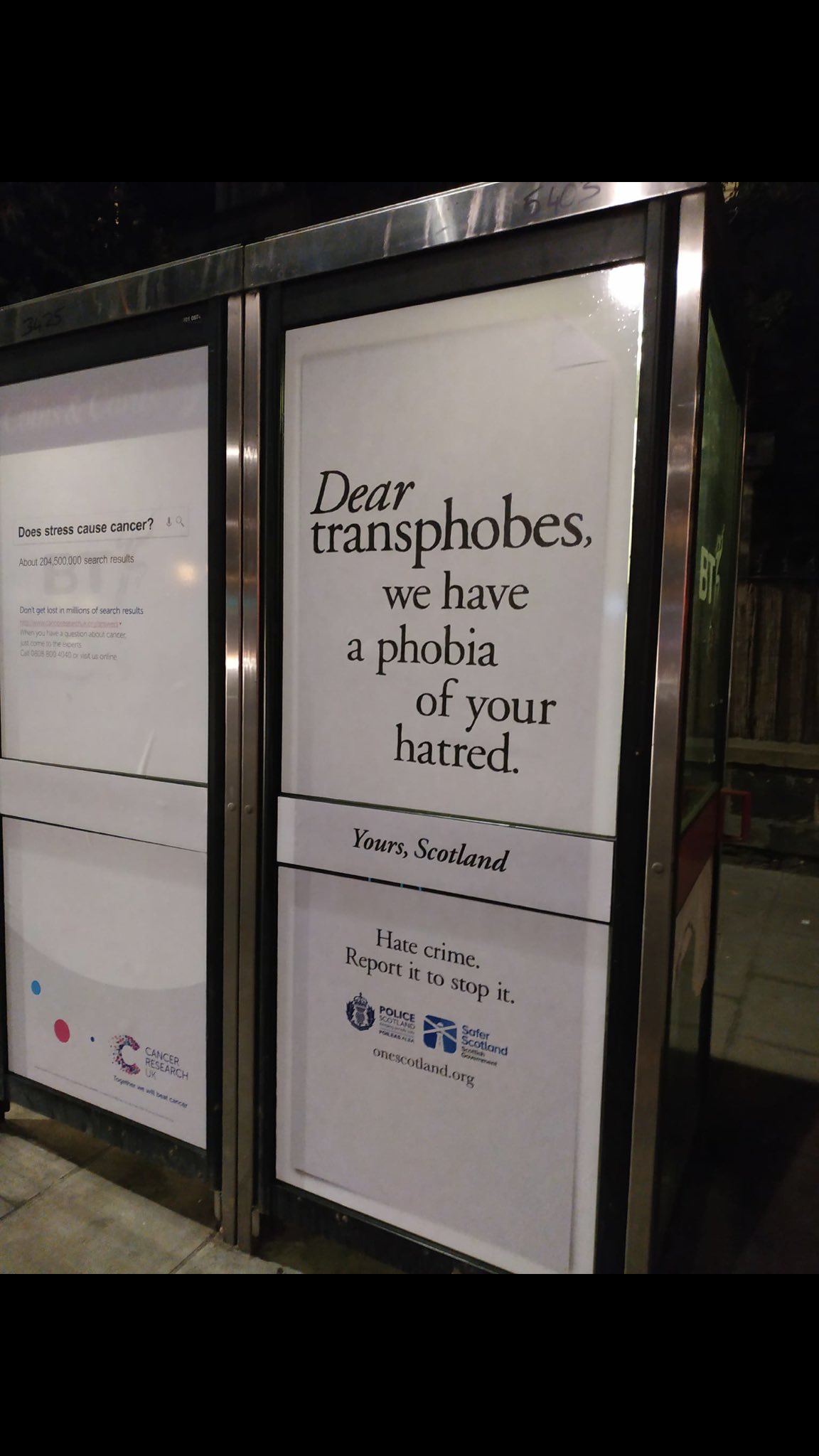
    Today one of my friends, the filmmaker Kate Adair, shared this photograph of a public awareness campaign by One Scotland.

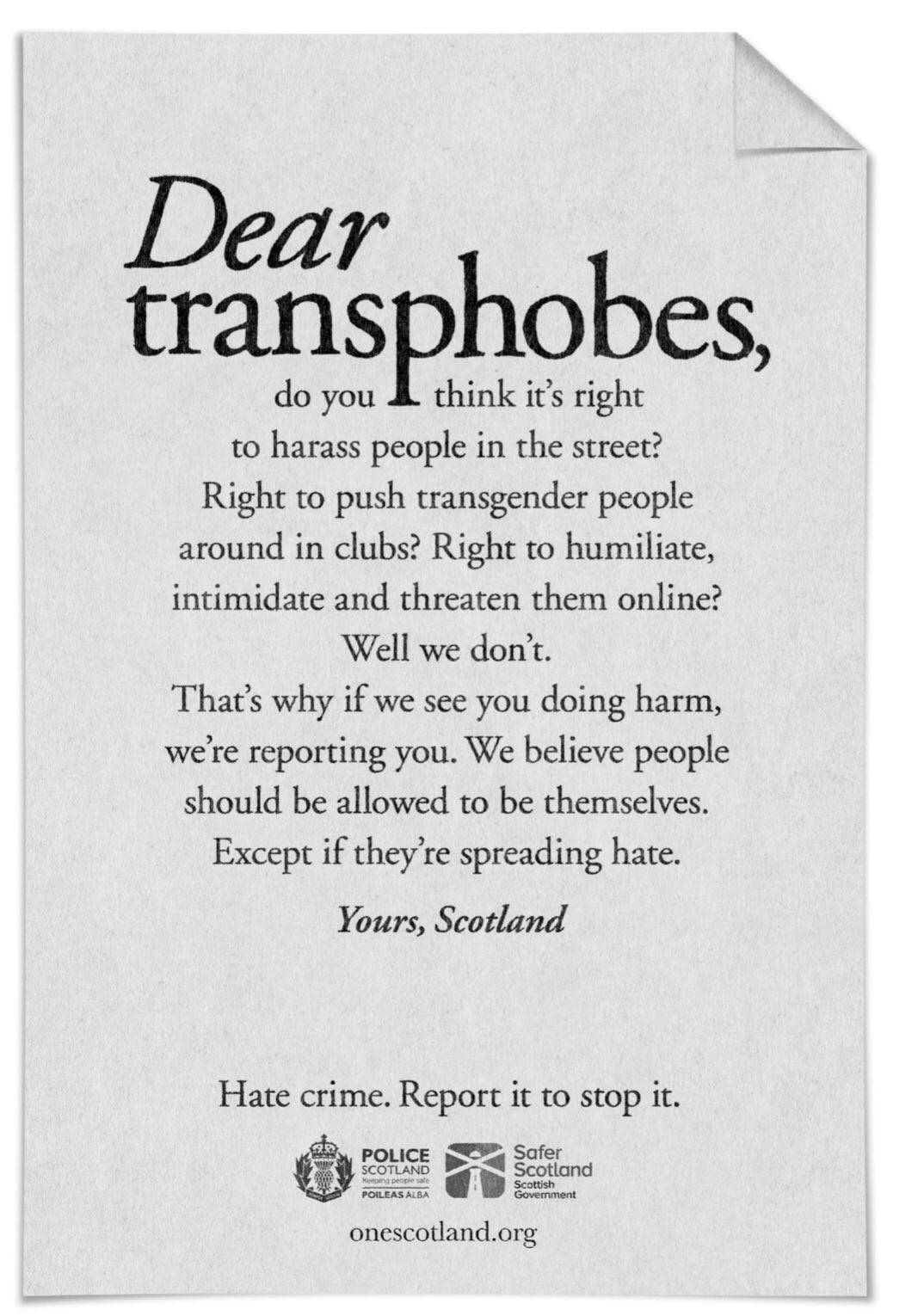
    One Scotland is an initiative by the Scottish Government and Police Scotland to stamp out hateful abuse. Here’s another one, this time from the website.

    One Scotland isn’t just about trans folks. It’s about hate crime in general. The campaign serves two important purposes. It urges the victims of abuse to report it, and it hammers home the message that such abuse has no place in our country.

    It also sends LGBTQ people in Scotland a powerful message: we’re on your side.

  • Every day’s a school day

    I got a taxi home last night. I think it’s safe to assume that there aren’t many openly trans people getting taxis from that Glasgow suburb: when the driver clocked that my appearance was rather different from my voice he had a lot of questions, all of them deeply personal and inappropriate.

    I could have been offended, but I thought it was really funny.

    Don’t get me wrong. I absolutely understand people who don’t see why it’s up to them to educate the wider world, and who think it’s exceptionally rude to ask a stranger what’s in their pants and whether they’re planning to change that – because of course, it is exceptionally rude. But I also think that if somebody’s intent is genuine, if they’re asking because they want to understand, then it’s okay to have a conversation.

    I was talking about this with a friend shortly afterwards, and she said that she didn’t think it was fair: people who aren’t LGBT don’t have to endure deeply personal questioning from LGBT people when they’re out and about. And I agree with her. In an ideal world people wouldn’t need to ask those kinds of questions, because trans people wouldn’t be “other”.

    Unfortunately, though, it isn’t an ideal world. There’s no shortage of bad actors peddling bad information about people like me. So which is better: telling the driver it’s none of his damned business and leaving him with a negative impression of trans people, or being open and funny and  busting a few myths?

    There are days I don’t feel like that, days where just being noticed is too much. But on other days I’d rather have the conversation, because in a very small way I think it helps.

    I’ve said before that most people probably don’t know any openly trans men or women: the best guesstimate is that we’re around 1% of the population, and an awful lot of us are in the closet. That means the information most people have about trans folk is about us but not from us, and as a result that information is often wrong. That means you can see these conversations not as negatives, but positives: they’re an opportunity to correct misinformation, to be seen rather than read about.

    For some of us, every day is a school day. Most days, I think that’s okay.

  • Cake day

    There’s a thing some trans people do on social media to mark “Cake Day”, the anniversary of them starting transition: it’s usually (but not always) the anniversary of them starting HRT. It’s my first Cake Day today.

    Cake Day is often celebrated by posting before and after photos, usually showing a really miserable person in the before and a really cute and happy person in the after. Unfortunately for me I can’t do that because (a) I’m much older than most of the people who post pics and (b) I look exactly the same except fatter. So here’s my version.

    Messing around aside, Cake Day photos can be really valuable when you’re still in the closet. I wrote about them a while back:

    I’d spent endless hours looking at trans women’s HRT transition timelines, the photographic evidence of the cumulative effects of hormone treatment and improving make-up skills. I actively searched for timelines of middle-aged MTF trans women, trying to see what was the result of HRT and what was just better lighting, good makeup and a cute smile.

    Looking at such images wasn’t new, nor was the strong yearning I felt to be one of the people in the pictures. I’ve had those things since I’ve had internet access. But something was different now. I no longer saw the photos as pictures of transformations that, for me, would be impossible and unattainable.

    I started to see them as maps of the possible.

    What struck me wasn’t the physical transformation; it was the difference in the way they looked at the camera, the smiles reaching their eyes. Even relatively minor physical transformations looked spectacular because of the difference in the way people held themselves and looked at the camera.

    Each timeline was the same story: unhappy people finally becoming happy in their own skin. I wanted that too.

    I might not look like Shirley Manson, and I never will. But a year on, I’m becoming happy in my own skin.

  • Identity and community

    I was reading a lot of blogs over the weekend, and one comment in particular really stood out for me:

    We don’t choose to be LGBTQ, but we choose whether to be part of the LGBTQ community.

    I think that’s very true. I didn’t choose to be trans, but I can choose whether to see myself as part of a wider community of people.

    That doesn’t mean uncritical support of everybody else, or even being nice to people I don’t like, or making placards and marching around the place (although all of those things can of course be really positive).

    It means understanding that you’re part of something bigger, that while your personal experiences and circumstances are different from other people’s you have common struggles and often, common enemies.

    Not everybody believes that, or believes it’s important enough to overcome their own self-interest. Wherever there’s a minority you’ll find a minority in that minority that doesn’t want to be associated with the wider group. In some cases they’ll even act in ways that are damaging to the wider group.

    For example, among gay men there’s a schism between “masc” – hyper-masculine – gay men and  their less macho peers. Some lesbian women have a real problem with bisexual women. And in trans circles there’s the long-running schism between what some call the TTT (Trannier Than Thou) brigade and trans people who haven’t had any medical treatment. In some cases TTT people actively campaign against rights for trans people in much the same way turkeys vote for Christmas.

    These schisms are all different, but they all have the same thing in common. Members of a group are demanding to be considered separately from other members of the same group.

    Sometimes it’s naked careerism: there’s money to be made by throwing your peers under the bus, especially in right-wing publications. Sometimes it’s neediness, the same thing that sometimes encourages the bullied to suck up to bullies in the hope that they might be spared and which lends legitimacy to bigots. If you want to be the equivalent of the only black person in UKIP, there’s always a vacancy.

    But a big part of it, I’m sure, is self hatred and internalised phobia. I’ve experienced it myself. “I don’t want people to think I’m like THOSE people.”

    And of course there’s self-interest too. If you’re in a group that’s under attack, there’s a concern that THOSE people are going to attract unwanted attention and that you’ll be caught up in it.

    I think there are two kinds of responses to that. The first is to say “fuck those people”, to run for the lifeboats while pushing women and children out of the way.

    You can see it in the famous attitude expressed by some affluent, conservative gay men who argue that “the battle for equality has been won”: they have equal marriage. The wholesale dismantling of LGBT people’s rights is of no concern to them, because it does not affect them. You can see it in op-eds by superannuated post-op transsexuals who transitioned a hundred years ago and who don’t appreciate young trans people demanding change. You see it in gay politicians who share sob stories about their teenage mental health traumas while leading a party that’s done terrible damage to mental health services.

    They’re all right, Jack. Fuck you.

    The other response is to say: I’m one of those people.

    I’m one of those people.

    I joked the other day that I’m a “real” trans person now: I have a medical diagnosis, and that means to some of the TTT brigade I’m valid in a way I wasn’t the day before I had the piece of paper with “transsexualism” written on it (although to some that still isn’t enough: if you haven’t had surgery, you’re faking it). It’s official. I’m not one of THOSE people any more.

    But in the wider world, I’m still one of those people.

    No matter how many fawning Facebook friends you have or how impressive your Twitter impressions or how many column inches you scrapbook, if you’re LGBT then it doesn’t matter if you’re gay, lesbian or bi, non-op, post-op or non-conforming. To many, you are one of those people, and you’ll be treated like those people, and demonised like those people, and discriminated against like those people, and hated like those people.

    Every one of us is one of THOSE people to somebody.

  • Real, real, real

    I got a letter from the NHS yesterday. I’ve been waiting for it for a long time.

    I’ve been waiting a long time because while it was dictated on the 9th of July, it wasn’t typed until the 2nd of August and didn’t get here until the 14th of September. It had been sent by mistake to my previous GP (NHS systems are not joined up, it turns out: just because my GP has the right details doesn’t mean other bits of the NHS do), and as my previous GP is an arse he didn’t let the sender know that I’m not his patient any more.

    Trans people are used to waiting, though. The letter is from the Sandyford gender identity service, to which I self-referred in October 2016. It’s taken 23 months to get a written diagnosis.

    This is it.

    The codes are from the World Health Organisation, and they’re out of date: as of June 2018, being trans is no longer considered to be a mental disorder and has been removed from the International Classification of Diseases, as homosexuality was in the 1970s. It takes a while for the medical establishment to catch up, though, so at the moment trans stuff still comes under the umbrella of mental health.

    So this is a bit of a double-edged sword, because on the one hand it’s confirmation that I’m not making this shit up – but on the other it gives me a pathology, a label of ‘disorder’ for something that the medical and psychiatric consensus agrees is not a disorder. There is nothing wrong with me, because being trans is just part of the infinite variety of human brains and bodies.

    But that’s a rant for another day. What difference does having a diagnosis actually make?

    The short answer is “not much”. It means the end of having to go to and pay for a private GP for my supervised hormone treatment, and it means all my healthcare is now in the hands of my (great!) local GP surgery. Although the savings I’ll make from not paying for prescriptions are dwarfed by the costs of electrolysis now my NHS funding has run out: I’m saving about £50 a month and paying out around £150 a week.

    The bigger picture? It makes no difference whatsoever. Being a “real” trans woman, ie someone who’s gone through the various gatekeepers, doesn’t impress the trannier-than-thou brigade for whom the only “real” trans people are the ones who’ve had bottom surgery. And it doesn’t make me any more acceptable to the bigots who lie and say they have no issues with “real” trans people.

    Mainly, though, it’s no big deal because it’s already in the rear view mirror. I know I’m trans. This is just the admin finally catching up.

  • “Why now, after all this time?”

    I’m a big fan of the writer Jenny Boylan, and about a month back I posted a link to a Twitter thread where she talked about being a late transitioning trans woman. She’s now turned it into a column for the New York Times.

    People often ask late transitioners, why now, after all this time? What kind of woman do you think you can be, after missing your girlhood and your adolescence? But those aren’t the questions one should ask.

    The question is, how did you manage to go so long? What enabled you to keep carrying your burden in secret, walking around with a shard of glass in your foot, for all those years?

    This story may be less about what it is like to come out as trans than it is about finding the courage to do a difficult thing, even if you are no longer young, even if you do not know how. Trans people are surely not the only ones who wonder how to close the gap between the people they feel they have to pretend to be and their authentic selves.

  • Think of the children

    This is Maddie. She’s 12.

    She’s “the transgender”, “the thing”, the “lil half baked maggot” that parents of other kids think should be sorted out with “a good sharp knife”.

    Maddie’s story went viral. I thought it was upsetting enough, but then I watched the Vice News video report. Seeing a wee girl pretending to be braver than she feels made the whole thing even more heartbreaking.

    Please watch it. One of the reasons anti-trans sentiment still spreads is because many of us don’t know any trans people. It’s easy to mistrust and even hate people you don’t know, people you’re told are different, and some of the worst people exploit that. But it’s a lot harder to hate when you see someone who’s just like your own kids (Maddie is only slightly older than my daughter. The thought of anybody, let alone parents, ganging up on her…), because of course trans people are just people.

    It’s not a long film, but there are plenty of moments to break your heart, to make you angry and sad. The police not so subtly implying that the filmmakers should get out of town or expect violence from the locals. The school board discussing everything but the case. The town mayor, who’s gay, having obvious difficulty defending bigotry. But the moment that really jumped out for me was an almost throwaway remark: when Maddie came to town, nobody knew she was trans until a teacher pulled the old records and told others.

    Teachers are supposed to be the protectors of our children.

    This particular case went viral, and strangers’ fundraising has enabled Maddie’s family to move to somewhere less backward. But there have been and will be many more Maddies whose stories you won’t hear, and for whom nobody will crowdfund anything.