Category: LGBTQ+

  • O wad some Power the giftie gie us. To see oursels as ithers see us

    You might not be aware of this, but the anti-trans stance of English (and more recently, Scottish) newspapers is greeted with bafflement in the rest of the world. The New York Times tries to explain English anti-trans activism for its readers.

    If the idea that transphobic harassment could be “feminist” bewilders you, you are not alone. In the United States, my adoptive home, the most visible contemporary opponents of transgender rights are right-wing evangelicals, who have little good to say about feminism. In Britain, where I used to live, the situation is different.

    There, the most vocal trans-exclusionary voices are, ostensibly, “feminist” ones, and anti-trans lobbying is a mainstream activity.

    This is peculiar to mainland Britain. When anti-trans bigots tried to export their bile to Ireland, huge numbers of Irish feminists told them to piss off.

    So why is England so different? Edie Miller suggests that “the answer lies in part to the coalescence of a certain set of ideas in a very specific circle of voices in the early 21st century — voices that later went on to hold high profile positions in much of the U.K.’s print and broadcast media.” Between those voices and the anti-trans obsessives of Mumsnet – “Mumsnet is to British transphobia more like what 4Chan is to American fascism”, Miller writes – a moral panic has ensued.

    But why England? Back to the NYT.

    In other parts of the world, including America, mass movements in the 1990s, 2000s, and 2010s around the effects of globalization and police brutality have produced long overdue dialogue on race, gender and class, and how they all interact. In Britain, however, the space for this sort of dialogue has been much more limited. As a result, middle- and upper-class white feminists have not received the pummeling from black and indigenous feminists that their American counterparts have.

    Many of these people believe they are doing God’s work. But they’re working for the other guy.
  • This is what bias looks like

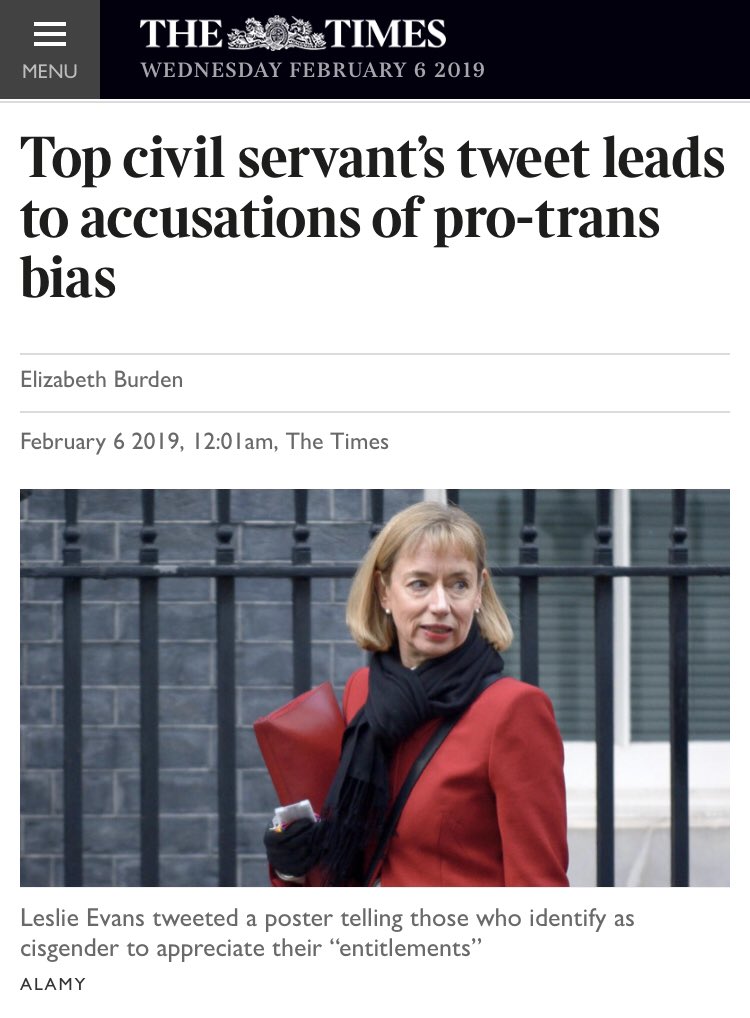
    This is the latest story in the Times and Sunday Times’ ongoing campaign against trans people. Even by those low standards, it’s a pathetic attempt at turning something innocuous into a hit piece.

    The tweet in question was posted in November. Here it is:

    It’s a thoroughly unremarkable bit of political social media, and the supposedly inflammatory poster – the fourth image in the tweet – is a pretty innocuous “don’t be a dick” poster suggesting that it’s possible to be pleasant and respectful to trans people. It’s worth pointing out, because the Times never does, that the major women’s groups in Scotland – Rape Crisis Scotland, Scottish Women’s Aid, Zero Tolerance, Close The Gap, Engender and Equate Scotland among others – are proudly trans-inclusive.

    “Pro-trans bias”.

    Lets unpick that, shall we?

    “Pro-trans bias”. Bias is a negative word; it means to be inclined or prejudiced for or against a particular group, usually in an unfair way.

    To put it in this context is to say that to be pro-trans (or as I’d put it, pro-not being a dick to trans people) is a bad thing. The entire article is based on the flimsy premise that to post something mildly supportive of trans people is somehow shameful and something a politician shouldn’t be doing. It implies that by suggesting we should perhaps not be bastards to trans people, the politician is biased against non-trans people.

    The headline’s doing a lot of work, isn’t it?

    As ever, you can illustrate the point by changing the words. Swap “trans” for “catholic”, “jewish”, “Asian”, “black”, “gay”, “disabled”.

    As I say, bias is prejudice for or against a particular group. It’s something you’d be guilty of if, say, you accused a politician of “pro-trans bias” over an innocuous, two-month-old tweet but failed to report (let alone criticise) the UK government officials who repeatedly meet with rabidly anti-trans groups (Transgender Trend and Fair Play For Women twice and A Woman’s Place three times, with FPFW invited to a further two “round tables” to discuss limiting trans people’s rights) or the MPs who post anti-trans sentiment to social media.

    It’s the kind of thing you’d be guilty of if your columnists were activist supporters of anti-trans groups but failed to declare that in their regular anti-trans columns.

    It’s something you’d be guilty of if you repeatedly ignored the medical consensus on trans people in favour of scaremongering from activist groups.

    It’s something you’d be guilty of… you get the idea.

    Anti-trans bias in the press is so commonplace that to simply detail it would be a full time job, but the Times/Sunday Times has become so blatant it’s almost a parody of itself. If you buy these titles you’re helping to fund this bullshit.

  • Feeling naked in public

    It’s the dream cliché: delivering a talk in your underwear.

    I think most of us have had the classic anxiety dream where we’re standing up in front of people and we’re either naked or in our underwear. I pretty much lived it today – although, you’ll be pleased to read, I was neither naked nor dressed only in my underwear.

    I was at Stirling University, where I’d been asked by a friend to deliver a guest lecture about internet things. To say I was nervous about it would be a major understatement. I barely slept last night. I don’t stand up in front of people very often, I haven’t addressed a room full of strangers for many years and I haven’t delivered such a long presentation in 21 years.

    Not only am I desperately out of practice, but I also have the added anxiety-inducing fact of being trans.

    Imagine the anxiety dream, but instead of doing it naked you’re doing it in a frock (if you’re male-bodied; if you’re female, imagine being in one of those horrible, scratchy hallowe’en costumes: anything you’d expect to get an odd reaction in a professional setting).

    Presenting male wasn’t an option, partly because it would have been a cop-out and partly because I’d been specifically asked as part of a policy of having more inclusive speakers – not just the same rotating cast of straight, white, cisgender men.

    It was fine, of course. Better than fine. The students were a genuinely nice bunch, nobody seemed in the slightest bit perturbed by the disconnect between my voice and my presentation – a disconnect that was bigger than usual today because God has a sense of humour and I have a cold that’s lowered my already-deep voice half an octave below its usual floor – and once the initial terror subsided, I found myself enjoying it. Not so much that I’m going to start volunteering to do tons more, but enough to make me think I made the right decision by saying yes.

    I was speaking to my lecturer friend before the lecture, setting the world to rights, and I said (in a different context) that progress is often something you only really see in the rear view mirror: it’s only when you look back that you can see how far you’ve travelled. For me, today was a great example of that.

  • Thinking of the children

    There were lots of things about being a parent I didn’t expect. Fear was one of them. Almost overnight I became hyper-aware of the world’s many dangers, bursting into tears at newspaper reports of terrible things. It felt as if a layer of my skin had been peeled off, exposing me to things I’d previously been protected from.

    That’s universal, of course. You want to protect your child from all the pain in the world, from all its horror, and you can’t. And that realisation makes you realise just how much pain and horror the world contains.

    It gets more frightening still when your child is different in any way. It’s unfair, but life is often much smoother for children who conform, who don’t stand out in any way. If your child isn’t one of those children, they tend to get a rougher ride. And that continues into adulthood.

    It’s something you’re particularly aware of if you were a child who didn’t conform, because you know exactly what it’s like.

    Writing for the always-excellent Autostraddle, Catherine Kelly shares her experience of being the parent of a trans child. Trans children can be quite visibly different from their peers, and to be their parent must be heartbreakingly difficult, especially in the current viciously anti-trans climate. But if the parent is also LGBTQ, that adds a whole extra level of shittiness to it all.

    Shitty people “blame” bad parenting for kids being trans all the time, and straight cis parents have to deal with that horribleness, too. But we’ve even had kind of cool people “blame” us for our kid being trans. Obviously, the reasoning goes, we were too proud and weren’t considering what kind of influence we were having on our child, and now she’s forced to be trans. She was never allowed to “explore” if she’s cis.

    “Cis” is short for “cisgender”: it means people whose gender identity isn’t at odds with their body. It’s to “trans” what “straight” is to “gay” or “bi”.

    Straight parents are told this all the time, that they did something bad and hurt their kids by making them trans. But we in specific are being told our identities are bad, and it’s our identities that hurt our kid.

    This is incredibly common on social media and increasingly in print media too. It’s the right-wing evangelical argument that nobody is trans; parents are somehow forcing their kids to be trans for reasons nobody can adequately explain.

    Kelly’s article is honest, so isn’t an easy read. It also discusses something I haven’t seen written about before in the context of parenthood: internalised transphobia, homophobia and sexism.

    Internalised transphobia/homophobia is what happens when you’re LGBTQ and grow up in a culture that hates, fears and mocks LGBTQ people. I have it: it’s one of the biggest barriers to self-acceptance and happiness, because there’s always a little voice telling you you’re sick.

    And if you’re a parent of an LGBTQ kid, that voice talks about your child too.

    Kelly:

    However, for so many of us, we realized we were LGBTQ after we are already homophobic, heterosexist, and cissexist. It’s a weird thing to go through, to have to rekindle a love for ourselves while living in a world that hates us, especially after we participated in that hate once, too. We’re doing our best to help our child avoid that particular internalization, but her parents didn’t.

    I’ve mostly vanquished that voice in my head that says I’m not good enough because I’m not straight, but that doesn’t mean it’s gone.

  • What kind of biscuit are you?

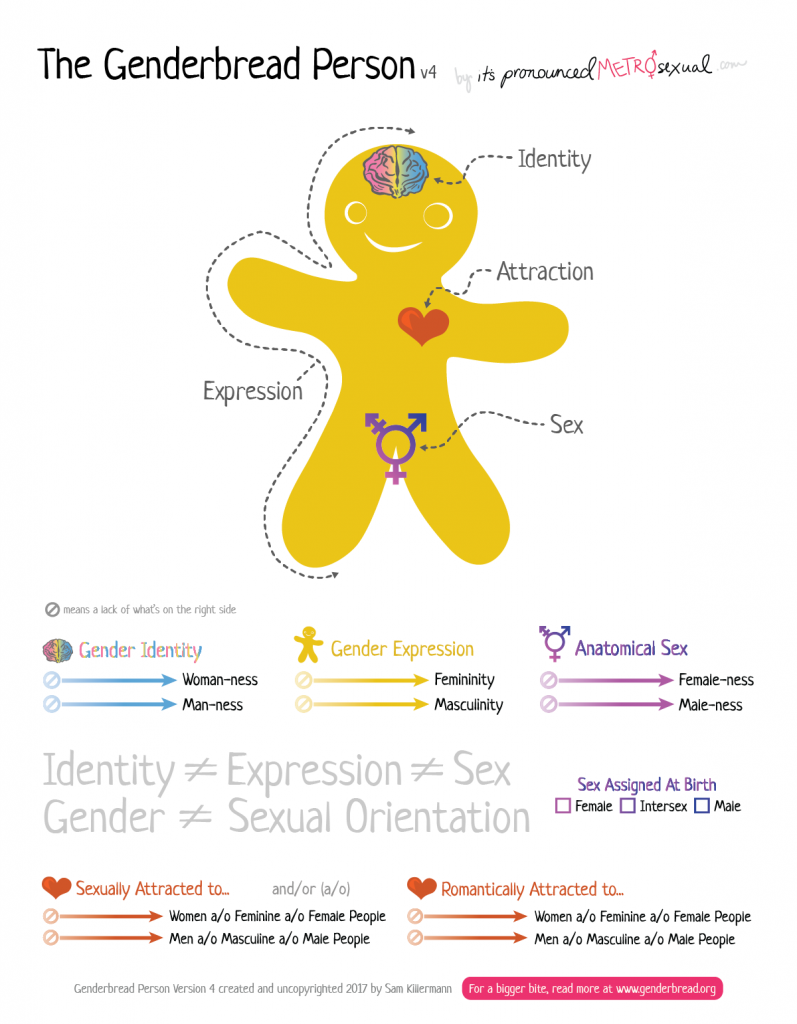
    This is the latest version of the Genderbread Person, an attempt to clear up the differences between gender identity, sexual/romantic attraction and anatomical sex – differences that many self-appointed experts seem unwilling or unable to understand. The reason there are multiple versions is because it’s under constant review to make it as clear and understandable as possible.

    The diagram (PDF version and more details available from here) works pretty well without the key, I think: identity is who you are, attraction is who you love/fancy, expression is how you present yourself and sex is what body you have. But the key goes into a bit more detail.

    For what it’s worth, my genderbread person has a gender identity and gender expression that are significantly more female than male, my anatomical sex is more male than female (but it’s becoming more female due to HRT), my sex assigned at birth was male and my sexual/romantic attraction is towards women and femininity.

    As the diagram’s creator, Sam Killermann, explains:

    Look around. Listen inside yourself. Think about everything you’ve learned, been told, or absorbed. Maybe you wouldn’t name these components “identity,” “expression,” “sex,” and “attraction,” but you no doubt recognize their existence.

    You feel a certain way, inside. You have a personality, preferences, predispositions. You also look certain ways, dress certain ways, and your body is built in certain ways. You’ve likely noticed many of the ways that society (and your peers, and likely yourself) puts many of those aspects of yourself through a gendered litmus test: pink or blue? And you can surely name ways you, or someone you care about, has felt pressure, discomfort, ease, friction, and/or liberation in light of that.

    …That’s what the Genderbread Person is helping us to understand. It’s trying to map all of those amorphous feelings, noticings, and pressures to simple language and visuals.

    I think Sam’s done a good job.

  • Turning hate into hope

    Harris Brewis just did something amazing.

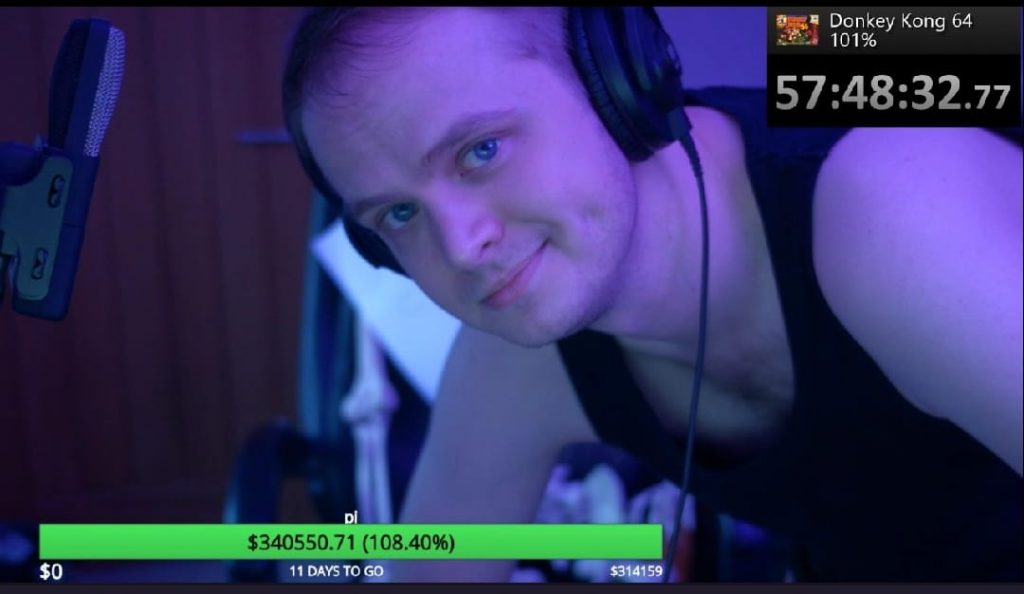
    Brewis is a gamer, known online as hbomberguy, and he decided to annoy Graham Linehan. Linehan is famous for co-writing Father Ted and Black Books a couple of decades ago, but in the last few years he’s done little of note beyond spending pretty much all of his time spreading hate about trans people on social media.

    Linehan’s most recent activities have focused on the Mermaids charity, which supports the parents of children who may be trans. He spearheaded a campaign to try and get the Big Lottery Fund to cancel its grant to the charity, so in response Brewis decided to try and raise a bit of money for Mermaids by playing the Donkey Kong video game online for hours.

    The goal? A few hundred dollars.

    The result? Three hundred and forty thousand bucks.

    It’s not just the money. It’s the joy. Twitter users posted their support for Mermaids and for trans people under the ironic hashtag #thanksgraham as the total soared, and various celebrities – such as Cher! – tweeted or retweeted in support. Gaming legend John Romero (creator of Doom, Linehan’s favourite game) joined Brewis live, as did inspiring US congresswoman Alexandria Ocasio-Cortes and a host of other prominent figures. For more than 48 hours, thousands of people hammered the message home: “trans people, we’ve got your back.”

    It won’t stop Linehan and his enablers; it’ll probably make them worse. And no doubt the usual suspects will write yet more fact-free op-eds about the sinister transgender agenda. But this feels important. Imagine what such positivity and support must feel like to a confused, closeted trans kid who sees trans people demonised online and in their parents’ newspapers every weekend.

  • The kids are alright

    Wouldn’t it be great if, instead of the thinky thoughts of anti-trans columnists, we had some actual research into children, gender dysphoria and gender identity?

    Look what The Atlantic found!

    Since 2013, Kristina Olson, a psychologist at the University of Washington, has been running a large, long-term study to track the health and well-being of transgender children—those who identify as a different gender from the one they were assigned at birth. Since the study’s launch, Olson has also heard from the parents of gender-nonconforming kids, who consistently defy gender stereotypes but have not socially transitioned. They might include boys who like wearing dresses or girls who play with trucks, but who have not, for example, changed the pronouns they use.

    I’ve been a fan of the author, Ed Yong, for a long time: he’s a very talented and conscientious science writer. This is typical of his work: he’s taken Olson’s study and looked into it in some detail.

    Unlike newspaper columnists, who offer zero evidence with 100% confidence, Olson offers detailed evidence but is also quick to point out the limitations of the study. Nevertheless, it’s interesting: children’s gender identity appears to be a pretty good predictor of whether they’ll turn out to be trans. From the article:

    Charlotte Tate, a psychologist from San Francisco State University, says that this quantitative research supports what she and other transgender scholars have long noted through qualitative work: There really is something distinctive and different about the kids who eventually go on to transition. From interviews with trans people, “one of the most consistent themes is that at some early point, sometimes as early as age 3 to 5, there’s this feeling that the individual is part of another gender group,” Tate says. When told that they’re part of their assigned gender, “they’ll say, ‘No, that’s not right. That doesn’t fit me.’ They have self-knowledge that’s private and that they’re trying to communicate.”

    This bit is key:

    Olson’s team also showed that those differences in gender identity are the cause of social transitions—and not, as some have suggested, their consequence.

    In other words, children are not coerced into having a particular gender identity: you can put Jimmy in as many dresses as you want but if Jimmy isn’t trans, he won’t suddenly become trans or develop gender dysphoria.

    Older trans people are going “no shit, Sherlock” at this point: if it were possible to persuade people to change their gender identity, there wouldn’t be any trans people. You can’t talk people into or out of being trans any more than you can pray the gay away: some of us tried not to be trans for decades, and will spend decades trying to deal with the damage from that.

    Once again there are very strong parallels between today’s harmful anti-trans bullshit and previously harmful anti-gay bullshit. That’s something the Atlantic article makes explicit, describing the work of American psychologist Evelyn Hooker.

    In the 1950s, when many psychologists saw homosexuality as a mental illness (largely because they had only ever worked with gay people who had records of arrest or mental-health problems), Hooker surveyed a more representative sample and found that gay and straight men don’t differ in their mental health. That was instrumental in getting homosexuality removed from a list of mental-health disorders in 1987. “We’re sitting in a similar moment today with transgenderism,” says Devor. “The mental-health issues that we see are largely the result of living a life that blocks your expression of your gender. My view is that the work coming out of Olson’s group will have an Evelyn Hooker effect.”

    I’m not naive enough to think this will have any effect on the mainstream media coverage of trans people in general and trans kids in particular: the moral panic is too well established. But it’s yet more evidence of the growing gap between the reality-based community and the commentariat. All too often, the you-couldn’t-make-it-up brigade are doing exactly that.

  • Why are LGBT people so sad?

    Stonewall Scotland has published a worrying report: half of LGBT people have experienced depression in the last year, rising to 72% among trans people. More than half of trans people have thought about taking their life in the last 12 months.

    Here’s the thing, though. LGBT people are not more prone to depression or suicidal ideation if they are in a supportive environment. In those environments, rates of depression and suicidal ideation pretty much revert to the same as non-LGBT people.

    The difference is largely environmental. If your everyday environment is abusive and unaccepting, it of course has a direct effect on your mental health.

    It’s not the only factor – trans people are currently treated under the auspices of mental health provision, which means we’re in a desperately unfunded part of a desperately underfunded part of a desperately underfunded NHS, a world where mental health counselling has a waiting list of more than a year – but it’s a significant factor. The newspapers that concentrate on the invented “dangers” of trans people in hospitals while ignoring a very real mental health crisis are part of the problem.

  • Same boss, same bullshit

    The Sunday Times isn’t the only supposedly respectable newspaper to mislead its readers in order to parrot the homophobic and transphobic views of its owner, Rupert Murdoch. The Wall Street Journal does it too.

    The WSJ appears to have started the new year the way it means to continue, with an op-ed warning readers about the entirely invented syndrome of “rapid onset gender dysphoria”. Regular readers will recall that ROGD is a conservative, anti-trans invention and that the only supposedly scientific paper about it, a study based solely on interviews with parents who refused to believe their kids are trans, was torn to pieces by peers due to its shoddy premise and even shoddier methodology.

    In short, ROGD is a right-wing attempt to rebrand conversion therapy, the same “pray the gay away” bullying that’s so awful it’s being made illegal in much of the world.

    If you’d like more detail, the inimitable Julia Serano has an excellent round-up here.

    I’m not going to link to the WSJ: outrage-clicks are the whole point of this bullshit. Instead, here’s Jennifer Finney Boylan in the New York Times.

    An abundance of scientific research makes clear that gender variance is a fundamental truth of human biology, not some wacky dance craze.

    Transgender people have not come up with the entirety of our existence solely to hurt Tucker Carlson’s feelings. We do not embark upon transition because it’s groovy. We are here because our hearts demand it.

  • Truth takes time

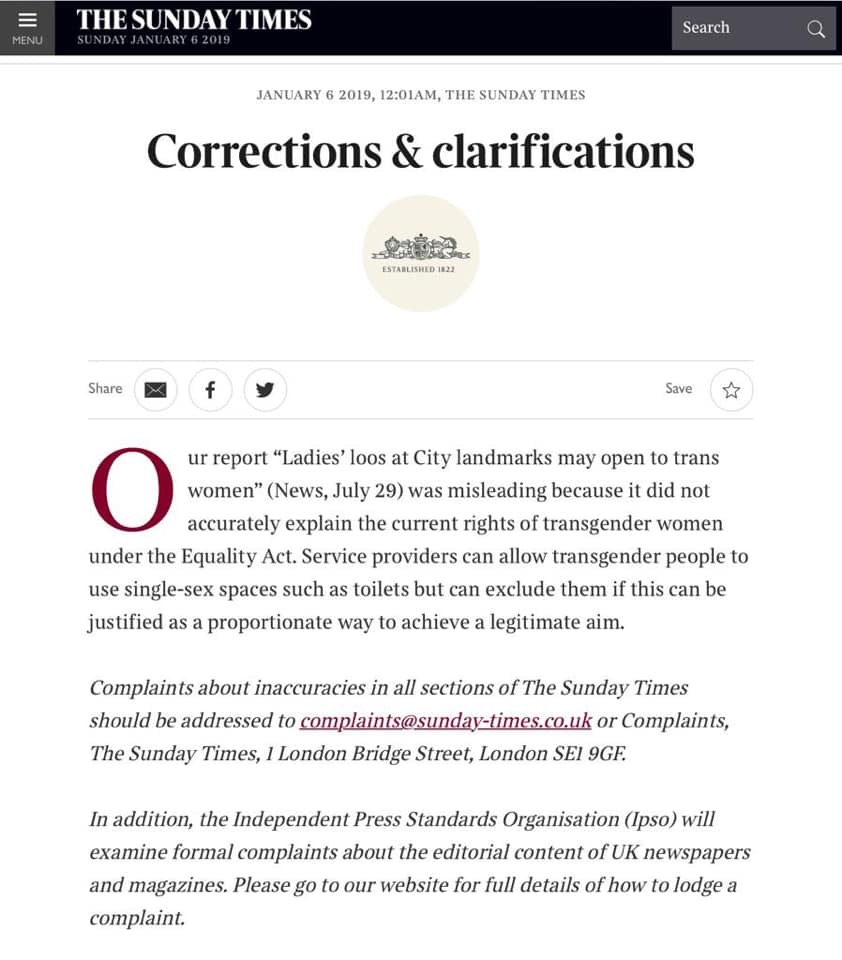
    Another day, another admission by The Sunday Times that an anti-trans article by Andrew Gilligan was made up. This time it was the one about women’s toilets in the City of London, in which Gilligan completely misrepresented the Equality Act to scaremonger about nothing.

    As I wrote at the time:

    I regret to inform readers that noted fantasist Andrew Gilligan has written another article. This week he’s suggesting that the City of London may let trans women use the ladies’ toilets…

    …which the City of London has been doing for eight years, because that’s the fucking law.

    Gilligan is well aware of the Equality Act 2010 and is reminded of it whenever he writes untrue things about trans people or their allies. He just chooses to pretend otherwise, because he’s a disgrace to journalism.

    Six months later…

    But of course, the damage is already done: the article, yet another in Gilligan and The Sunday Times’ ongoing campaign against trans women, appeared during the Gender Recognition Act consultation period and helped fuel anti-trans hysteria. Admitting that it was bullshit six months down the line, long after the consultation closed,  is far too little, far too late.

    To write one incorrect article about trans women is unfortunate. To do it repeatedly suggests malice.

    Update: Paris Lees shares some more mandatory corrections from Mail Online (completely misrepresenting the Mermaids charity, something Andrew Gilligan has previously been censured for too) and The Scotsman (an anti-trans column claiming a hospital has stopped doing gender surgeries when in fact, it is “fully committed” to providing such surgeries.