Here’s a simple question. What’s the purpose of anti-discrimination legislation?
Is it (a) to protect vulnerable people from discrimination, for example in employment, education or health care? Or is it (b) to enable people to be howling arseholes to vulnerable people?
If you answered (b), you may be a religious extremist.
I’ll preface this with my usual disclaimer: #notallchristians. This isn’t about Christians. It’s about arseholes.
The man goes by the title and name of Dr David Mackereth, but as he believes you should be able to call people what you like based on your sincerely held beliefs, I believe that I should call him Mrs Janice McBigotface and give her female pronouns. I sincerely believe that I can be an arsehole too!
Mrs McBigotface was represented by the Christian Legal Centre, whose business is based on representing some of the world’s worst people and losing in court. In the meantime, however, they get lots of headlines that distort the facts of the case and feed into a fictional narrative of Christianity under attack from political correctness gone mad.
This was no exception: for example, newspapers talked of Mrs McBigotface’s refusal “to refer to ‘any 6 foot tall bearded man’ as ‘madam’” in her meetings with DWP supervisors; as the tribunal notes, that exciting quote wasn’t used in any meetings and didn’t appear in any documents or testimony until a year later, by which point the claimant was being coached by the CLC. That was a year after the first lot of press coverage, which clearly wasn’t hysterical enough.
Was Janice “interrogated about her beliefs” as the coverage and her submission claimed? No. Was she asked to “renounce her beliefs”? No. Were there any discussions about six-foot bearded ladies? No. Was she even suspended for her behaviour? No: she stopped coming to work because she “felt too distracted” by the pressure of being asked to be polite to people: “in no sense could that be construed” as a suspension. The tribunal called the claimant “a poor witness whose perception of events was skewed”.
The verdict, which is linked in the BBC story, is perfectly clear. The law protects you from discrimination; it does not enable you to be a complete prick to other people and escape the consequences.
Mrs McBigotface refused to call people by their pronouns, which is a very basic courtesy, in an environment where people are already feeling scared and stressed. That refusal continued even when people had legally changed their sex to female on all official documentation, and McBigotface appears to have taken some satisfaction in talking about  how she was going to lose her job for it.
The impression the tribunal’s notes gives is that Mrs McBigotface was a kind of DWP Ricky Gervais, deliberately misgendering trans people and then, when someone said “Janice, maybe you should stop being such a dick to people, you’ll end up losing your job”, saying “That’s what the PC woke police want, isn’t it? They want to martyr me! But I shall stand proud against the forces of evil and continue to be a total dick to trans people, just like Jesus probably was, or something!”
According to Twitter, finding that it’s okay and legal to sack someone for breaking the law and being a prick to vulnerable people “is just like the Nazis”, “profoundly disturbing” and “a shameful case of religious persecution”.
No it isn’t. It’s much simpler than that. People’s right to religious belief is subject to article 9.2 of the European Convention of Human Rights.
Freedom to manifest one’s religion or beliefs shall be subject only to such limitations as are prescribed by law and are necessary in a democratic society in the interests of public safety, for the protection of public order, health or morals, or for the protection of the rights and freedoms of others.
The tribunal found that by refusing to treat trans people with respect and then demanding an unworkable and offensive triage system for trans clients, the claimant was infringing those rights and freedoms.
It’s really very simple. If  you don’t want to be sacked for being a dick to people, don’t be a dick to people.
It’s Sunday, so of course The Sunday Times is running more hit pieces on trans women.
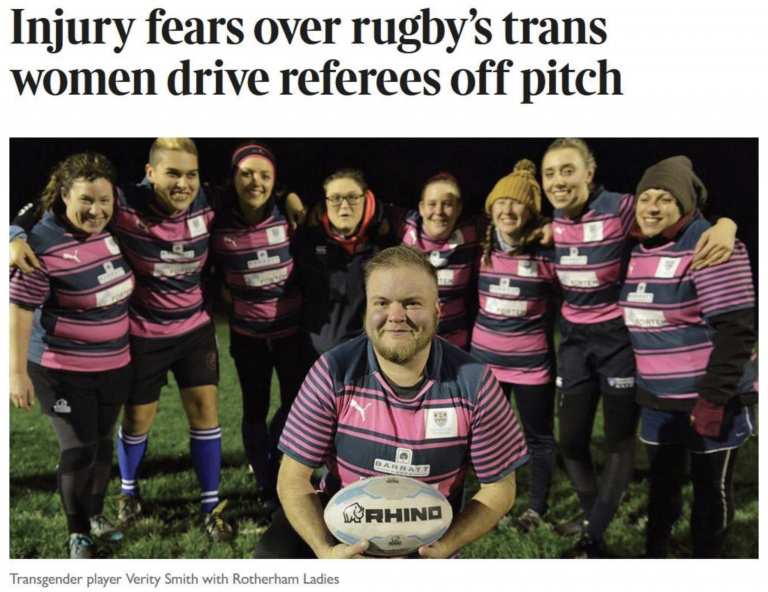
What’s wrong with this picture?
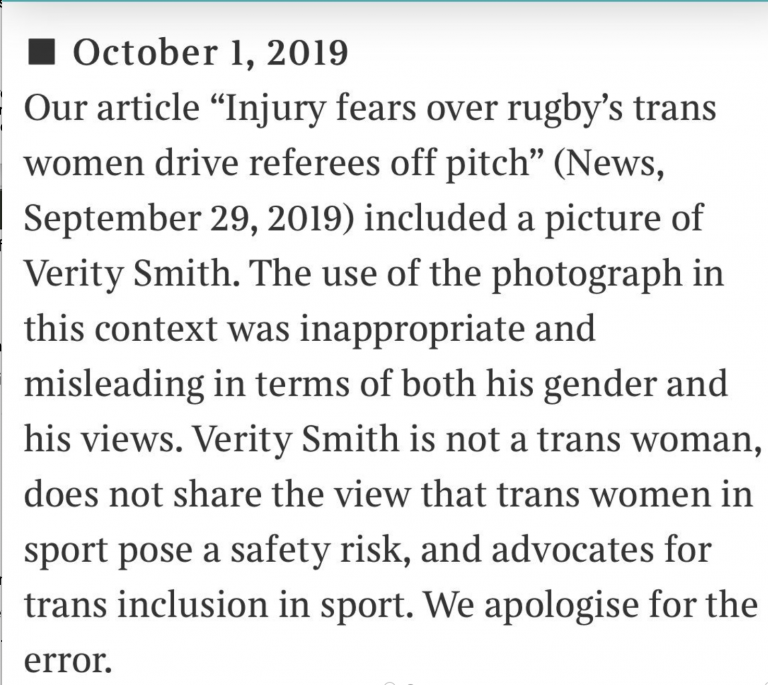
The clue’s in the caption. Verity Smith isn’t a trans woman. He’s a trans man, assigned female at birth and now transitioning to male.
The juxtaposition of headline and photo are clearly deliberate and malicious: you’re expected to see the words “trans women” at the same time as you see the very male rugby player in the photo.
And when the writer posted it on Twitter he tagged the anti-trans activist group Fair Play For Women (who he interviewed in the piece, enabling them once again to make unsubstantiated and unchallenged claims about “well funded and powerful trans lobby groups”) and the vocally anti-trans athlete Sharron Davies.
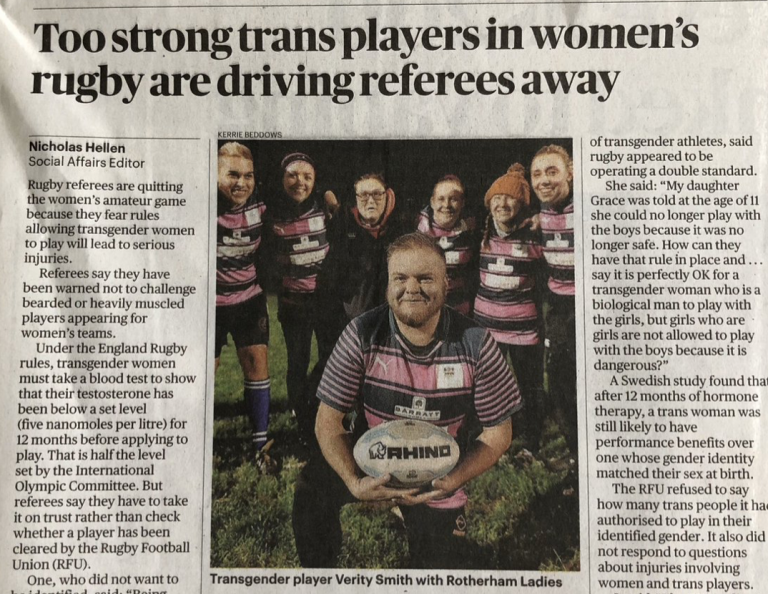
It’s notable that the online version – the one people will share – is more inflammatory than the printed one, which doesn’t do the same malicious juxtaposition. Here’s the printed one:
The article itself describes “bearded or heavily muscled” trans men, not trans women.
Smith has endured a lot since coming out. Â As he told CNN:
“I’ve been escorted off the pitch, outed on the internet, assaulted and pinned down and had blood spat in my mouth and the police wouldn’t do anything about it. That’s been the lowest point for me, just being dragged off the pitch and not being able to walk out there with the rest of my team having not done anything wrong other than be myself.”
Smith’s experience is what the anti-trans activists The Times loves so much would like all trans sports players to go through. First, he had to seek written permission from the sport’s governing body in order to be allowed to play at all. Second, he only plays in the team appropriate for the gender he was assigned at birth, not the gender he actually is. And thirdly, he has endured awful physical and verbal abuse on the pitch, around it and on the internet for which nobody has been held accountable.
And that’s still not enough. He also has to see his image used in a blatant attempt to make people hate and fear trans women.
And it works. The article – and the photo – is already being shared on social media by anti-trans bigots.
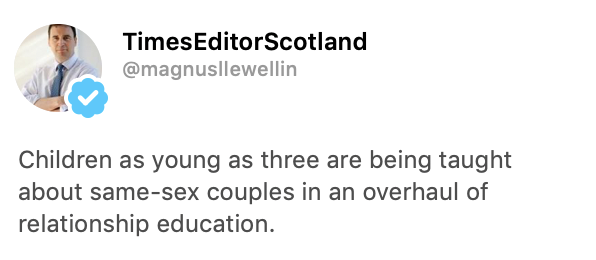
I’m not scaremongering; I’m not a snowflake; I’m not paranoid. There is a demonstrable anti-LGBT+ agenda at The Times and The Sunday Times, and while most of their energy is currently directed at trans women they are already beginning to target the rest of the community. This was the Scots editor on Friday:
The language here is telling. Can you believe that they’re teaching kids AS YOUNG AS THREE all about the gays?
What are they being “taught about same-sex couples”?
The first level, designed for preschool to P1, includes slides explaining that “some families have two dadsâ€, and recommends books such as Mommy, Mama and Me, about lesbian parents, and King & King, in which a prince marries a man.
Imagine if children discovered that someone in their class might have same-sex parents.
We have been here before, of course. In the 1980s, the completely innocuous book Jenny Lives With Eric and Martin became the centre of a media-driven moral panic – a panic that would lead to the infamous Section 28, which banned the supposed “promotion” of homosexuality in schools.
Back then, The Sunday Times – which was hardly a friend to gay people at the time – wrote in an editorial: “[Clause 28] is a throwback to a more intolerant age. It has no place in the new Britain.”
In January 1988, it printed an op-ed by Simon Callow. He wrote:
In recent years – so terribly recent – the work of erasing centuries of crude superstition and fear has begun, so that now everybody realises (what was always true anyway) that they know at least a couple of gay people, and that they are, after all, give or take the odd flourish, much like everyone else, sometimes nicer, sometimes nastier – that some children have gay parents, that some brothers have gay sisters, that some employees have gay bosses, that some priests are gay, some teachers, some criminals, some saints.
Thirty years later and the same newspaper is pushing “crude superstition and fear”.
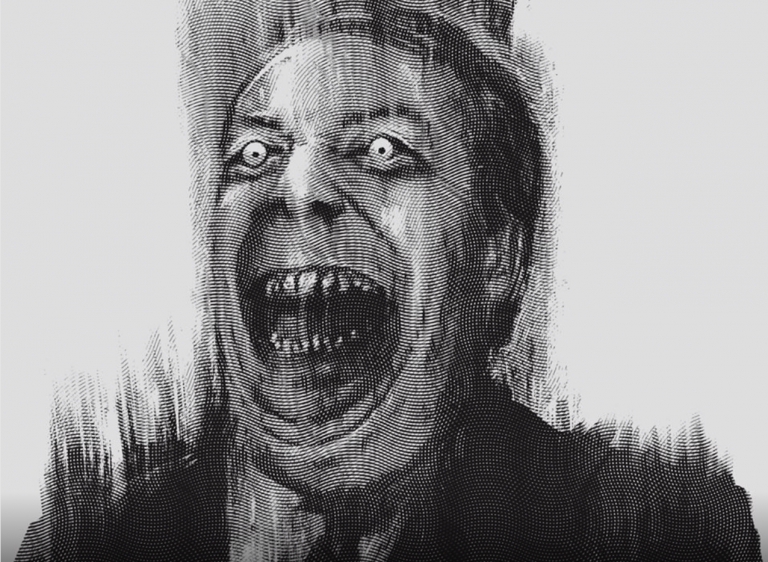
Image by Martin WeFail. You can buy his disturbing prints at wefail.art.
(Content warning: slurs)
If it were possible to bet on the public pronouncements of terrible people, you could make a ton of money with a very simple rule: if someone has awful opinions on trans people, sooner or later you’ll discover that they have lots of other awful opinions too.
Here’s just one day’s trawl.
First, SNP MSP John Mason lodged a Holyrood motion calling for the Scottish Parliament to restrict abortion. Trans people were shocked – shocked! – by the news that someone who is a vocal critic of trans women’s rights and bodily autonomy would also like to restrict the rights and bodily autonomy of other women.
“This is our shocked face,” we said.
Then, tiresome contrarian Brendan O’Neill of climate-denying, right wing billionaire-funded Spiked incited violence on a current affairs programme. Trans people were shocked – shocked! – by the news that someone whose publication repeatedly incites hatred against minority groups might also incite hatred against other groups.
“No, really, this is our shocked face,” we said. “We’re shocked. So, so shocked.”
What’s almost as tiresome as these tedious arseholes is the fact that a significant number of people couldn’t care less about any of it until and unless their own particular group is suddenly in the firing line.
Mason’s anti-trans stuff merited barely a squeak, but now he’s targeting cisgender women there’s finally talk on whether the SNP’s broad church should be a little less broad, and whether a modern, supposedly progressive political party should accommodate creationists with regressive views. There’s an irony to that, of course: two very high-profile SNP politicians are science deniers too, but because the science they deny is about trans people that’s apparently okay.
And then there’s Spiked, which rose from the ashes of the Balkan holocaust-denying LMÂ and whose writers are reliably on the wrong side of everything.
Despite its origins as a far-left publication, LM quickly tacked rightwards and was beloved of far-right thinktanks. It was against the anti-apartheid sanctions on South Africa, claimed straight people didn’t need to worry about AIDS, attacked environmentalism (the greens were “Hitler-loving imperialists”), told its readers that whaling bans were “cultural imperialism”, was against the no-platforming of the National Front and (as Wikipedia puts it)Â “engaged in a sustained campaign of denial of the 1994 Rwandan genocide.” They were memorably described by one old socialist as “media pranksters and disco fascists.”
To borrow a phrase from Douglas Adams, LM were a bunch of mindless jerks who’ll be first against the wall when the revolution comes. And yet they’ve carved out an important niche in the UK media.
Despite the obvious fact that you shouldn’t trust any of them to tell you the time, Spiked writers and O’Neill especially have been on the BBC’s speed-dial list for years to rail against feminism, LGBT+ rights, Muslims and of course trans people with very little opprobrium; it’s only when the hateful rhetoric finally extended to “ordinary” people that there seems to have been any sign of surprise, let alone a backlash.
Sorry, but if you invite someone who has written pieces like:
Why I’m Sick of Gay Pride
Now It’s The Tranny State
Angelina Jolie’s Mastectomy; When It’s Trendy to Be Ill
and
Breivik: A Monster Made by Multiculturalism
you can’t legitimately feign shock when he talks crap.
But it’s not just talking crap. It’s sowing division and in some cases, hatred. By the time “ordinary” people start to pay attention, those bitter seeds have already been sown.
And the media has played a huge part in it. In much the same way it ignored the danger of Trump because he was good for ratings, it treated genuinely dangerous people like Nigel Farage – who yesterday told the Brexit Party faithful that the people would “take the knife to the pen-pushers in Whitehall” – as ratings fodder. Spiked’s BBC presence has long been massively out of proportion to its UK readership because its writers can be relied upon to say “controversial” things on cue. And thanks in a large part to the state broadcaster, we’ve been encouraged to see hateful, unethical and amoral people such as Jacob Rees-Mogg and Boris Johnson as hilarious comic figures.
It’s been really strange to see so many people’s reaction to the Prime Minister’s furious, frightening posturing this week. Boris – BoJo – is bad? But he’s the funny man from the TV!
Because of course, for most of us Boris is the funny man from TV – a character the media continued to push, despite the reality being much darker. This is of course the man who as a journalist, falsified stories; the man who as a more junior politician conspired to have a journalist beaten up; the man who as a schoolboy was part of a group famous for destroying restaurants and humiliating homeless people.
It’s the same with Rees-Mogg, another hilarious rich man from the TV. His unlawful machinations around Brexit are entirely in keeping with his record. Suzanne Moore in The Guardian:
Rees-Mogg is a class warrior (for his class alone) who has a track record of voting down every socially progressive policy. Far from being “eccentric†or “freethinkingâ€, as the extreme right likes to characterise itself, he embodies their tick-box views: anti-gay marriage; anti-abortion; doesn’t believe in climate-change legislation, votes against any rise in benefits, even for disabled people; supports zero-hours contracts and tuition fees. He supported Trump, although he has since distanced himself. This is pure neocon territory.
He’s like a walking version of Spiked. And inevitably, where one lot of intolerance exists, more is just around the corner.
…When the Tory party was pushing for more ethnic-minority candidates, he warned against having too high a proportion of them. “Ninety-five per cent of this country is white. The list can’t be totally different from the country at large,†he said. In 2013, he was “guest of honour†at – and gave a speech to – the annual dinner of Traditional Britain Group (TBG), which describes itself as “the home of the disillusioned patriotâ€. It wants to return black people to “their natural homelandsâ€.
Can you believe that a man with terrible right-wing views seems to be racist too? This is my shocked face.
the “big thinkers†who pander to these instincts are never going to be the ones getting hurt.
…To adapt that phrase of the alt-right to whom you tack closer every day: mobs don’t care about your feelings. If I had to come up with an adjective to help you understand mobs, it would probably be mob-like. Very mobby. Mobtastic. If you go to the country in a people v parliament election, you may indeed get elected and be part of a triumphant Tory majority. But when you have been elected, and when you’ve “got Brexit done†– which is to say, when you’ve either taken the UK off the no-deal cliff, or opened up the next however many painful years of trade negotiations fuckery-pokery, which is never going to solve the problems it is magically supposed to – you, then, are “parliamentâ€.
The even angrier people are then versus YOU. That’s when they come for you, because you asked them to. You invited them in. I don’t know if you’ve ever heard this line “the revolution devours its children� That’s you, babe.
There is a well-worn path between demonising minorities and advocating violence – whether literal violence or metaphorical violence such as a “hostile environment” that treats some people as lesser humans, or a state that deprives humans of their rights. But again and again we ignore that and put terrible people on TV because they’re good for ratings. We give them publicity, and a presence. And by doing so we give them terrible power.
As Postman wrote, Huxley’s vision was that the people in power wouldn’t need to seize our rights because we would be persuaded to hand them over voluntarily.
in Huxley’s vision, no Big Brother is required to deprive people of their autonomy, maturity and history. As he saw it, people will come to love their oppression, to adore the technologies that undo their capacities to think.
What Orwell feared were those who would ban books. What Huxley feared was that there would be no reason to ban a book, for there would be no one who wanted to read one. Orwell feared those who would deprive us of information. Huxley feared those who would give us so much that we would be reduced to passivity and egoism. Orwell feared that the truth would be concealed from us. Huxley feared the truth would be drowned in a sea of irrelevance. Orwell feared we would become a captive culture. Huxley feared we would become a trivial culture, preoccupied with some equivalent of the feelies, the orgy porgy, and the centrifugal bumblepuppy.
At the very end of his book, Postman concluded:
What I suggest here as a solution is what Aldous Huxley suggested, as well. And I can do no better than he. He believed with H. G. Wells that we are in a race between education and disaster, and he wrote continuously about the necessity of our understanding the politics and epistemology of media. For in the end, he was trying to tell us that what afflicted the people in Brave New World was not that they were laughing instead of thinking, but that they did not know what they were laughing about and why they had stopped thinking.
In Today’s Scottish edition of The Times, the odious yahoos at For Women Scotland – a single-issue anti-trans pressure group – get a headline claiming that women’s services are being “starved by trans funding”.
1/ This anti-trans group has been ‘disqualified’ from government funding because they are actually trying to break the law. The 2010 Equality Act makes clear that trans people can access single-sex spaces aligned with their gender identity.
2/ The group then claims that women’s organisations who aren’t trans-inclusive are being ‘deprived of government funds’, but there is no evidence or examples given of where this is happening (spoiler: because most of these services are trans-inclusive already).
3/ So who is being ‘starved’ for funding as the headline suggest? Well, it has to be this group… which the article shows to be a single-issue lobbying group against GRA reform – meaning they don’t actually even provide any services for women/girls to qualify for funding anyway
4/ Meaning this whole article is based on the bigotry of one anti-trans group to try and pressure the Scottish Government to stop supporting funding for services that help all vulnerable women, including trans women. Which… is their legal duty. Not that that’s mentioned…
“Lobby group isn’t being given government money because it doesn’t qualify for government money” is hardly newsworthy. But if that group hates the trans, then The Times is all over it.
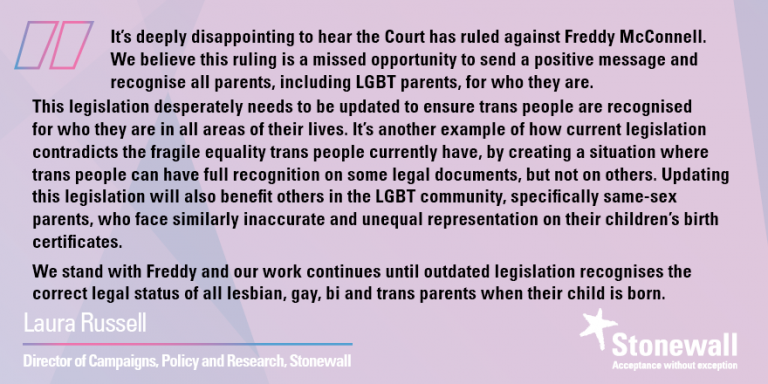
McConnell is his child’s dad, and as he has a gender recognition certificate he is legally a man. However, the court has taken the view that what matters isn’t McConnell’s legal status but his birth sex – and the way we record birth certificates overrules the Gender Recognition Act.
In the first legal definition of a mother in English common law, Sir Andrew McFarlane, the president of the high court’s family division, ruled on Wednesday that motherhood was about being pregnant and giving birth regardless of whether the person who does so was considered a man or a woman in law… Whilst that person’s gender is ‘male’, their parental status, which derives from their biological role in giving birth, is that of ‘mother’.â€
The usual suspects will spout half-remembered stuff about chromosomes or bitch and moan about “snowflakes”, sinister anti-family agendas and tradition, but you might as well go and yell at the tide coming in in the evening. Human biology is more complicated than you learned in school, trans people are real and some trans men retain their reproductive capability. And our systems, both legal and medical, will have to adapt to cope with that. So from that perspective, today was a missed opportunity.
It’s also really worrying if you’re trans or non-binary. Sex and gender are generally used interchangeably in UK law; anti-trans activists have been fighting to change that in order to deny existing legal protections to trans people. This judgement will delight them.
Here’s Buzzfeed’s Patrick Strudwick on Twitter:
Experts in family law have already hit out at the judgment. Hannah Saxe and Scott Halliday at Irwin Mitchell said: “It cannot be right that a person can be legally recognised as male is some respects, such as on a Gender Recognition Certificate, but not in others.”
And QCs for McConnell set out the implications: Previous legal protections for trans people, could be unpicked. Reforms to surrogacy laws will be halted. Same-sex parents would be blocked from birth certificates. Fertility clinics will not be able to offer treatment to trans ppl.
This is about much, much more than one person’s birth certificate.
A few months ago, Irish TV channel RTE gave airtime to a notorious anti-trans bigot and bully in order to “balance” the insights of people who actually know what they’re talking about.
The wonky-eyed washed-up yokel impersonator from a village currently missing an idiot was given multiple opportunities to spout ill-informed, often malicious nonsense; when a number of people complained that the human ham was allowed to make comments that were “inaccurate, harmful and displayed prejudice against transgender people,” the broadcasting regulator effectively said: Hey! That’s showbiz!
More specifically, it said:
it would be wrong to limit contributors to people with personal experience or expertise
Imagine if we started having people with “expertise” on our current affairs programmes!
I was asked by LGBT Health and Wellbeing to speak at an event about LGBT+ mental health yesterday: the three other panelists and I were asked to share our own experiences of mental health provision, where it falls short and where it might be improved. This is a slightly more coherent version of my talk.
I decided not to tell my NHS counsellor that I was trans when she looked me in the eye and said “you need to remember, there are babies in Africa who have it even worse.â€
We were talking about me wanting to kill myself. I figured that if this was the high quality help I was going to get, there wasn’t much point asking her how I could come to terms with my gender stuff too. After all, when she asked if I’d planned to kill myself since our last meeting and I said yes, yesterday, she said “But not today! So we’ll just tick no!†as she tapped her iPad.
It wasn’t the first time I’d gone to mental health services and bottled it. In my 20s I was referred to a psychologist with what I now understand was depression. Guilt and fear and shame meant I didn’t tell him the single most important reason for why I was so sad. With imperfect information, he gave me imperfect advice.
So I stayed sad for another 24 years.
My counsellor with the baby comment was an aberration: most of the people I’ve met in the NHS have been skilled, dedicated and kind. My current counsellor is a life-saver. But at the time, it confirmed everything I thought about being trans: nobody could help.
I certainly couldn’t talk to my GP about it. He resembled Jacob Rees-Mogg and he clearly didn’t like me; when he diagnosed severe depression in my early 40s it was with the kind of disdain you get from a disapproving dad. God knows how he’d react if he knew I was the kind of person the Daily Mail warned him about.
I know now that all was wrong with me was a bit of body chemistry and a boring wardrobe, but I didn’t get the help I needed because I didn’t want to tell a doctor or a nurse or anyone else that I was trans.
There were no rainbow flags in my GP’s surgery, no posters about LGBT+ helplines, just a bunch of magazines about expensive things for straight people. With hindsight, if there had been even the slightest hint that someone in my GP’s surgery understood LGBT+ issues, I might have tried talking about the gender stuff years earlier. But there wasn’t, and I didn’t.
On the day I came out, many years later, I called the gender clinic, hands shaking so badly that I could barely hold the phone, and for the very first time I said out loud that I was transgender. I told the answering machine that I needed help. I told it that I needed to talk to somebody.
That was October 2016.
My first counselling session was March 2019.
I was lucky. I was able to do tons of research myself and I was able pay to for private treatment: a counsellor who helped me through a very dark period; hormones that made the depression drugs unnecessary after just a few weeks; a private GP to make sure my medication wasn’t killing me. By the time I finally got my initial appointment at the gender clinic, I was already well on the way to addressing my mental health issues.
But I’d had to do it outside the NHS.
I’m absolutely certain that if I hadn’t been able to see a private counsellor, if I hadn’t been able to take the admittedly dangerous route of self-medication, I wouldn’t be here now.
Waiting times are not the beginning of our journey. We don’t wake up one morning and go “eek! I’m a girl! I must call a gender clinic!” I spent three decades working it out, fighting it and being too scared to tell anybody about it.
So there’s an accidental cruelty to the process where you finally sum up the courage to tell somebody and nothing happens for more than a year.
When I phone my gas provider they keep telling me I’m important to them and that I’m 16th in the queue. But with the gender clinic, which is a bit more life and death, your referral and your answerphone messages are prayers: you hope someone got your message, but you’ve no way of knowing for sure.
Waiting times are probably the cruelest thing about trans healthcare: I waited thirteen months for my first appointment, four more for my second, two more months for a counselling assessment and another ten months before I finally started the counselling that’s helping me hang in there.
But there are little cruelties throughout the system.
The complete silence during the year-plus between referring to the GIC and getting an appointment.
The lack of information about what’s involved in assessment, so you turn to forums who convince you you’ll be judged Not Trans Enough if you say the wrong thing or wear the wrong shoes.
The phone greeting that says you must not call unless it’s absolutely urgent: send an email instead, so you do, and you never, ever get a reply.
The assumption that you know the system, so when you phone up to ask about your next appointment date you’re told coldly that you should have made the appointment when you were in three months ago and they might be able to fit you in in a month.
The follow-up appointment you’re told you can’t schedule at all because your doctor’s quit and nobody’s taken her place.
The blood tests the labs reject because their system says you’re male, so those levels can’t possibly be right. So you’re told you have to change your gender marker on the NHS system, oh and by the way if you’re admitted to hospital you’ll be put in a female ward and you haven’t even thought about that yet because you’re so early in transition and the prospect terrifies you.
The delays that mean you get bloods drawn in February to see if your chemistry is making you miserable again, and nobody looks at the results until August.
The letter about your prescription that takes three months to travel the half-mile between the gender clinic and your GP.
The pharmacist who refuses to fulfil part of your prescription because he’s pretty sure the NHS board doesn’t fund it, even though you know it does.
With the exception of one counsellor, every single person I’ve dealt with in the NHS since I came out has been great.
But it feels like they’re part of a system that just isn’t fit for purpose, a system where reception staff are unaffordable luxuries, a system where it takes a year and a half to get a counselling assessment and another year for your first appointment, a system where people trained in psychiatry are expected to do bloods and monitor hormone levels while the waiting lists for psychiatric assessments grow longer, a system where staff are so overloaded a letter dictated in July isn’t delivered until late September.
If you were to design a system that worked for LGBT+ people, you wouldn’t design it like this.
And maybe the biggest cruelty, the waiting list, isn’t fixable by anyone who isn’t in government. But someone, somewhere has the power to fix the little cruelties. It won’t make the system perfect. But it’d make it hurt a little less.
Over the course of a six-month trial, critics, academics, psychiatrists, and even a minister spoke in Bruce’s defense—none more beseechingly than Bruce himself.
“Don’t finish me off in show business,†he pleaded before his verdict was delivered. “Don’t lock up these six thousand words. That’s what you’re doing—taking away my words, locking them up.â€
None of it mattered. He was convicted and sentenced to four months of service in a workhouse. On August 3, 1966, Bruce, out on bond for the appeal of his case, was found dead of a morphine overdose. In his 1971 book Ready for the Defense, Bruce’s attorney Martin Garbus quoted a statement of remorse from Assistant District Attorney Vincent Cuccia, one of Bruce’s prosecutors. “We drove him into poverty and bankruptcy and then murdered him,†he said. “We all knew what we were doing. We used the law to kill him.â€
To some modern comedians, this is exactly the same thing as criticising one of their jokes on Twitter.
Nwanevu’s piece is a devastating demolition of so-called “cancel culture” in comedy, where comedians squeal censorship after making lame jokes about women and minorities. As he points out, the supposed cancelling of Dave Chappelle (anti-Asian and anti-trans jokes), Aziz Anzari (sexual misconduct) and others appears to have had little or no effect on their careers.
Ansari, reputedly dead, in a professional sense, released a new Netflix special in July and returned to Forbes’ highest paid comedians list this year for the first time since 2015, having earned an estimated $13 million between this and last spring.
Lenny Bruce he ain’t.
As far as comedy is concerned, “cancel culture†seems to be the name mediocrities and legends on their way to mediocrity have given their own waning relevance. They’ve set about scolding us about scolds, whining about whiners, and complaining about complaints because they would rather cling to material that was never going to stay fresh and funny forever than adapt to changing audiences, a new set of critical concerns, and a culture that might soon leave them behind. In desperation, they’ve become the tiresome cowards they accuse their critics of being—and that comics like Bruce, who built the contemporary comedy world, never were.
This isn’t to say, of course, that there aren’t real instances of intolerance and repression around for our putative chroniclers of cultural ostracism to take an interest in. In April, a 23-year-old Dallas woman named Muhlaysia Booker backed into a car in an apartment parking lot. The driver of the other car then held her at gunpoint to force her to pay damages. As the confrontation took place, a bystander was offered $200 to attack Booker. He obliged. In a video that subsequently went viral, a mob—a real one—can be seen joining in, punching and kicking her in the head and yelling slurs as she squirms and struggles on the ground. She was hospitalized with a concussion and facial fractures.
Muhlaysia Booker isn’t going to be given a column in which she might describe her treatment to the public. She won’t be appearing on any panels or podcasts. She won’t be doing any standup sets. Muhlaysia Booker is dead. A month after the attack, her body was found face down in an East Dallas street with a gunshot wound. She was one of nineteen transgender people to have been murdered so far this year in a wave of violence the American Medical Association has called an epidemic.
The cultural power the critics of cancel culture breezily ascribe to progressive identity politics did not save them.
Last night in Dallas, a trans woman was shot repeatedly and is in serious condition after what police believe is a hate crime.
Investigators say a man driving a pickup pulled alongside the woman late Friday, yelled slurs about her gender identity and fired several times, striking her in the chest and arm.
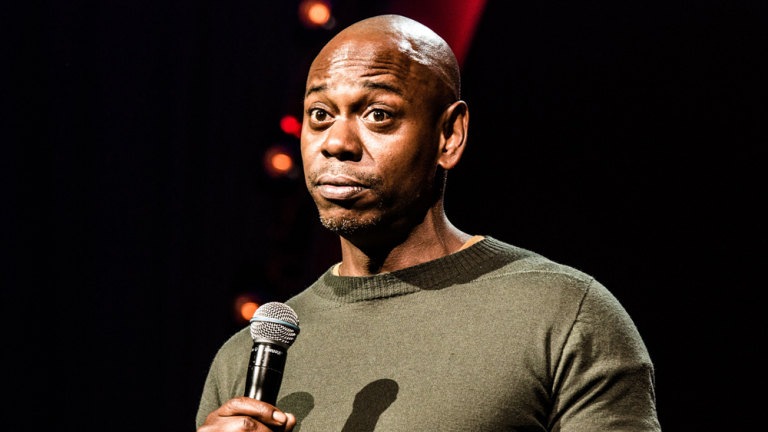
I’m sure Dave Chappelle will find that “fucking hilarious”.
Right-wing shite-peddler The Federalist has printed a piece urging parents of trans and gender non-conforming kids to cut them off from the internet and their peers and beat them daily until they renounce transgenderism and its Satanic ways.
I’m exaggerating, but only slightly. The latest in a string of similar pieces misrepresents research, makes unsubstantiated claims and advocates a course of action that we know to be incredibly damaging to children: conversion therapy.
As author and commentator Brynn Tannehill points out, it won’t have the consequences the parents want. But it will have consequences.
If you do this, and it doesn’t end up driving your kid to suicide, you kid will hate you for the rest of your fucking life.
Tannehill has interviewed many trans people whose parents did exactly what The Federalist is advocating.
Universally, they have zero desire to ever see their parents again after they were treated in exactly the manner described above. Turning 18 was like getting out of jail, and they have no intent of going back. They ghost their parents and disappear.
That’s the best case scenario. Not all kids with unaccepting parents make it to 18.
Conversion therapy causes lifelong harm, and transgender adults who were exposed to it are 4X more likely to have attempted suicide than those who weren’t, whether the therapy was professional or religious.
There are Internet forums haunted by angry, bitter, lonely parents whose children severed contact with them as soon as they legally could. The parents rage and the parents mourn, and the parents tell each other that their children hate them because of social contagion, because of peer pressure, because of invented pseudoscientific bullshit such as “rapid onset gender dysphoria”.
Occam’s razor offers a better explanation, an explanation that they are unwilling or unable to accept: they lost their children because they made it clear to them that they’d rather have a dead child than a trans one.
I’ve written before that I have some sympathy for unaccepting parents of LGBT+ people:
…to the point where I can understand the fury and denial that leads some of them to excommunicate their family members and even become anti-trans activists.
But the more I think about it, the more I’m starting to think that no, I don’t have sympathy for them after all. It’s one thing to find it difficult to understand or accept your child’s sexuality or their gender, or to worry that their lives will be harder because of it. It’s another thing altogether to be the one to make their life harder, to embark on a course of action that will traumatise them or perhaps even put them in an early grave.
I’ve been thinking about this kind of thing a lot recently, probably because I’ve spent a lot of the last fortnight in hospital rooms looking at my son with tubes going into various parts of him, the only soundtrack a mix of his breathing, the beeps of the monitors and the thoughts in my head.
There’s a particular agony to seeing your child so vulnerable, to seeing your child in pain. All parents know that primal urge to protect, the urge to do absolutely anything to take that pain away, that unshakeable desire to make everything okay – so I understand why parents stay loyal to children who have done terrible, unspeakable things.
What I don’t understand is parents who do terrible, unspeakable things to their children. And conversion therapy is one of those things.
Tannehill:
Let’s get down to the brass tacks: if you think its better to have a child who never sees you again than to have a transgender child, do what The Federalist says.
If you would rather bury your kid in the clothes you pick out for them than accept their gender identity, by all fucking means do what The Federalist says.
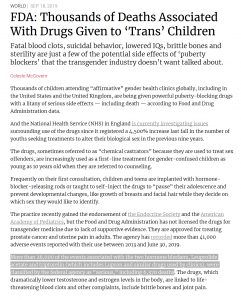
The National Catholic Register has published a terrifying article implying that there have been thousands of deaths from puberty blocking.
Is it bullshit? Of course it is. Even if you didn’t know that the National Catholic Register is a right-wing religious rag that really hates trans people, the use of the phrase “transgender industry” in the copy is a pretty big clue that we’re not dealing with good faith here.
How many serious adverse reactions among gender dysphoric people over ten years?
Two.
How much bullshit is in the article?
100%.
They conveniently ‘forgot’ to mention that the drug is used for LOTS of conditions. It has been prescribed to tens of millions of people over decades.
It is a very effective and safe drug that is on the WHO’s Model List of Essential Medicines.
…What they’ve done is, quite deliberately, is used rare adverse events from a drug given to many, many people for other conditions and implied that it was a deadly threat to trans children ‘because adverse events and deaths’.
You could do the same thing with acetaminophen [paracetamol].
The article has, of course, made its way to the anti-trans activists on Mumsnet with surprising speed, so it’s no doubt just a matter of time before it’s written about by Janice Turner in the Times, James Kirkup in the Spectator or the rest of the anti-trans mob. At which point it will become yet another piece of scaremongering bullshit that trans people will have to debunk again and again and again.

 The National Catholic Register has published a terrifying article implying that there have been thousands of deaths from puberty blocking.