Category: LGBTQ+

  • Trying to walk like a man

    It took me a very long time to realise how good Bruce Springsteen is: like many people, I misinterpreted Born in the USA as a tub-thumping, chest-beating, USA! USA! USA! anthem and didn’t investigate further. I’m a lot older and a little bit wiser now, and while I wouldn’t call myself a fan – I don’t own most of his albums, and I’ve only seen him live once – he’s written some of my very favourite songs. Walk Like a Man is one of them, and it makes me cry every time.

    Well so much has happened to me
    That I don’t understand
    All I can think of is being five years old following behind you at the beach
    Tracing your footprints in the sand
    Trying to walk like a man

    Springsteen wrote it about trying to be the man his father expected him to be and feeling that he was falling short; his relationship with his dad was rocky, his father unimpressed by his artistic leanings and his long hair. But good songs can take on a life beyond the specific circumstances they were written about, and Walk Like A Man is a very good song.

    Here’s Naomi Gordon-Loebl, writing in The Nation, on “the queerness of Bruce Springsteen.”

    In “Walk Like a Man,” from 1987’s Tunnel of Love, Springsteen sings about the lessons he learned from his father and whether he’ll ever know what he needs in order to “walk like a man”… the words seemed to perfectly encapsulate my experience of growing up in a body out of alignment with my gender, trying to walk a path that was not made for my feet and being constantly, painfully aware of the dissonance.

    Me too. Gordon-Loebl and I were driving in different directions – as I understand it she’s a masculine-presenting gay woman, whereas I’m a trans femme –  but we clearly drove the same road and had the same connection with this song.

    That line about being “painfully aware of the dissonance” really resonates with me. It’s a great way to describe the fear and frustration and sadness I felt throughout my old life, my frustration at being unable to perform a role my peers did automatically and effortlessly. I never lost that feeling of being five years old, trying and failing to walk like a man.

    As Gordon-Loebl says, Bruce Springsteen couldn’t be more straight. But that doesn’t mean his songs can’t reflect other people’s experiences too. There’s a powerful melancholy to much of his music, and many of his best songs are about people who don’t fit in and who yearn to escape the circumstances they’re in. It’s no wonder that they resonate with people who feel suffocated.

    But no matter where it comes from, there is an unmistakable echo of queer loneliness in his work. “Everybody’s got a secret, Sonny, something that they just can’t face,” Springsteen sings on “Darkness on the Edge of Town.” “Tonight I’ll be on that hill ’cause I can’t stop…. I’ll be there on time and I’ll pay the cost / For wanting things that can only be found / In the darkness on the edge of town.”

    …Perhaps nothing is so fundamentally queer about Springsteen as the pervasive feeling of dislocation that’s threaded through his work, the nagging sense that something has been plaguing him since birth, and that he’s dreaming of a place where he might finally fling it off his back.
  • JK’s trolling

    The thing about bored celebrities taking pops at trans people isn’t so much what they say: we have heard it all before. It’s that their celebrity means we hear it again and again and again.

    I don’t follow JK Rowling, whose opinions on trans people are well known (and no longer explained away as “middle-aged moments” by panicky PRs). But I’ve seen her latest tweets several hundred times this morning already. Not just on Twitter, but in my news app, my RSS reader app, on Reddit and in my social news app. And they’ve caused a whole bunch of cisgender people to come into places such as trans-friendly subreddits hurling abuse and demanding “debate me, cowards!” And over the next few days we’ll see the second wave in the press and online as various right-wingers and anti-LGBT+ groups hail Rowling as a hero for refusing to be “silenced” by the “wokerati”.

    Celebrity gives people a platform. It’s a shame some people choose to use it as a bully pulpit.

  • “the hardest thing to do is admitting that others may have it worse”

    Katelyn Burns, writing for Vox: The LGBTQ civil rights fight is far from over.

    Often, the common perception of LGBTQ people’s lives in the US is filtered through the experiences of white, upper-middle-class, cisgender lesbian and gay people [who] live in coastal cities and happen to have access to large media platforms. Kirchick’s piece is filled with the common gripes of white, cis, gay men, citing protests of Pride parades by Black Lives Matter activists, questioning the inclusion of asexual people under the LGBTQ banner, and displaying general disregard for the needs of trans people.

    I have no doubt that some cisgender gay and lesbian white people, with their local nondiscrimination protections and their ability to marry their partners, have had all their needs met by the achievements of the gay rights movement. But calls for the end of LGBTQ activism ring hollow to those of us who still hold marginalized identities within the community.

  • Protect trans kids

    A sad but sadly unsurprising study is yet more evidence that not only are LGBT+ young people more at risk of depression and suicide than straight kids, but that the risk is even higher for trans youth.

    PinkNews:

    compared to their cisgender LGB+ peers in the Trevor Project survey, young people who identify as trans and non-binary are still more than twice as likely to experience depressive symptoms, seriously consider suicide, and attempt suicide – adjusting for age, family income and ethnicity.

    …Trans males are the the highest-at risk group, with 35 per cent having attempted suicide in the past 12 months – but trans females and non-binary youth were also significantly more likely than cisgender LGB+ youth to report seriously considering suicide

    One of the key factors in LGBT+ suicides is bullying. A separate study by the Yale School of Public Health found that bullying is much more likely to be a precursor to suicide among LGBT+ youth than among their peers.

    Death records from LGBTQ youths were about five times more likely to mention bullying than non-LGBTQ youths’ death records, the study found. Among 10- to 13-year-olds, over two-thirds of LGBTQ youths’ death records mentioned that they had been bullied.

    There are lots of these studies, and the anti-trans mob’s reaction is always the same: DARVO. It’s a term used to describe a key tactic of abusers: deny, attack, reverse the victim and offender. So whenever a study shows more avoidable deaths, the response is to say that the figures are false, that trans teens are drama queens and that trans activists use the threat of suicide to silence legitimate criticism.

    DARVO is necessary for some because otherwise they’d have to admit that they are abusers. And many anti-trans activists are. They might not be doing the abusing directly (although some do online), but they may contribute to it by the attitudes they express to others or by the causes they crowdfund or support in other ways – such as legal action to make trans kids more vulnerable in schools.

    In the US and UK, evangelical-backed individuals and organisations are targeting cash-strapped councils and school districts with legal action to try and force the withdrawal of inclusive anti-bullying materials and policies.

    While parents mourn their children, others are trying to rip up what little support currently exists for other vulnerable children like them.

    Under the banner of “protect the children”, they want to remove protection for the most vulnerable children of all. They try not to say it, but the meaning is clear: better to have dead kids than trans ones.

  • Offensively ignorant

    The LGB Alliance, on the actual anniversary of Section 28:

    “We never demanded society change its laws” isn’t just shockingly ignorant, although of course it is. It’s also a grossly offensive insult to the thousands of gay, bisexual and lesbian people (and of course trans people, but the LGBA doesn’t even pretend to care about them) whose lives were ruined by anti-gay legislation over hundreds of years. Very little of that legislation was changed by LGBT+ people asking nicely.

    It’s also a raised middle finger to the very many brave gay, bi and lesbian activists (and of course trans activists, but the LGBA etc etc etc) who fought so hard and in many cases lost so much to gain the most basic human rights for LGBT+ people.

  • “Capitalism needs women to work for free”

    There’s an interesting interview in PinkNews with Alison Phipps, author of Me Not You: The Trouble With Mainstream Feminism. The book is very critical of the often very privileged white women whose feminism excludes women of colour, poor women, incarcerated women, sex workers, trans women and disabled women.

    This bit is short and to the point:

    “Although not everybody identifies with the [gender] binary, it basically sorts people into one of two categories.,” Alison says.

    “One category is about productive, useful, honourable, well-rewarded labour… and the other category is about all the shit stuff.”

    Phipps has been vilified by many of the people she criticises because of her unequivocal support of trans rights. She argues that the politicians who go after trans women’s rights inevitably go after all women next.

    You can see it in these right-wing movements worldwide. So, for example, Orbán in Hungary – he cracked down on trans rights first, and now he’s cracking down on laws against domestic violence. It’s all part of the same package. Preserving the gender binary. Preserving the nuclear family.

    Phipps’ book is really interesting and definitely worth checking out.

  • Battling homophobia?

    David Paisley took a look at the Twitter feed for the LGB Alliance on the international day against homophobia, biphobia and transphobia (#IDAHOBIT); you’d expect a group that says it’s standing up for lesbian, gay and bisexual people to have something to say about ignorance and bigotry.

    He made this image. On the left, all the posts the LGB Alliance made about homophobia and biphobia on #IDAHOBIT. On the right, the posts they made on the same day attacking trans people, criticising LGBT+ organisations, attacking inclusive education and attacking LGBT+ people for supporting trans people.

    As Paisley points out, the single post to mark #IDAHOBIT was “just a hashtag and a link to an article two years out of date.”

    Paisley:

    Let’s look at the response of their followers.

    For their #IDAHOBIT tweet:
    Retweets: 1
    Likes: 11

    For their anti trans tweets:
    Retweets: 467
    Likes: 4126

    The organisation went on to attack the Council of Europe for publishing guidance designed to protect LGBT+ people from discrimination and to attack Amnesty International for saying trans rights are human rights.

    Paisley:

    The majority of their posts are about trans exclusion, not “LGB” supportive issues… despite the abusive language of their followers they are careful not to be abusive themselves.

    Sometimes, though, the mask of respectability slips. The other week, the group and its followers went after SNP MP John Nicolson with often blatantly homophobic abuse; when presented with evidence of it, two crowdfunding websites ejected the LGB Alliance from their platforms.

    That was an expensive mistake that they’ll no doubt try not to repeat, but I suspect the mask will slip again soon enough: after all, this is an organisation whose co-founder suggested that gay teachers are predators.

  • “We do not need protecting from trans people.”

    Many [press reports say “thousands” of] cisgender women have signed an open letter to women and equalities minister Liz Truss expressing their concern at her apparent plans for the gender recognition act.

    Trans equality was not widely seen as an issue until the Transgender Equality Inquiry of 2015 triggered a concerted campaign in the media to depict trans rights as a new threat to cisgender women like ourselves.

    We reject this assessment. As cisgender women, we are angry that these groups claim to speak for us, and try to justify their bigotry against a vulnerable minority in our name. It is disturbing to hear an equalities minister repeat their talking points almost word for word while outlining plans to reform trans rights.

    The fact that you chose to make this a priority during the biggest crisis the world has faced in decades is even more disturbing.

    I don’t know how effective such letters are; we’ve seen the current government press on with all kinds of terrible measures in the face of facts, best practice and common sense. But it can’t do any harm.

  • A shameful anniversary

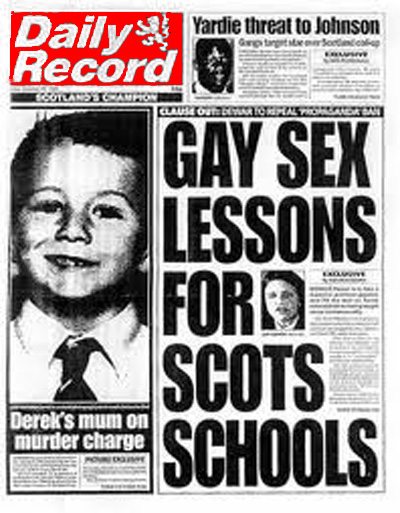
    It’s 32 years since the Conservatives introduced Section 28. Stop me if you’ve heard this one before:

    Children who need to be taught to respect traditional moral values are being taught that they have an inalienable right to be gay. All of those children are being cheated of a sound start in life. Yes, cheated.

    That was Margaret Thatcher in 1987.

    The newspapers were full of stories of a sinister “gay agenda” pushed by an equally sinister “homosexual lobby” determined to turn all your children gay. Politicians said they weren’t concerned with “responsible homosexuals”; they were concerned about the “sick” ones who had “an urge to persuade other people that their way of life was a good one.”

    This video, shared by Ben McGowan, makes me wonder how much has really changed.

    The video includes quotes from politicians, including one who decried “Labour’s appalling agenda encouraging the teaching of homosexuality in schools” in a piece in the Spectator in 2000, compared equal marriage to bestiality and wrote about “tank-topped bum-boys” in a column about the politician Peter Mandelson.

    He’s the Prime Minister now.

  • A sinister cult

    Pinknews:

    The ‘gender critical’ feminist movement is a cult that grooms, controls and abuses, according to a lesbian who managed to escape.

    …“They really don’t even care about gay people, which is the bottom line [for me],” she says. “They’re going for gay rights too, including marriages, the rainbow, LGBT+ clubs in schools.”