Author: Carrie

  • Beauty and sadness in children’s books

    One of the great joys of being a parent is reading to your children (or as is happening more and more often these days, having them read to you). There are more kids’ books to choose from than ever before, and I’m often struck by the power and beauty of them.

    This, from Town Is By The Sea (Joanne Schwartz; illustrated by Sydney Smith) is glorious.

    It’s a deceptively simple book set in a mining community in Nova Scotia but relevant everywhere. In it, a child talks about his day and his routines while his dad mines for coal under the sea. It’s quietly heartbreaking – the book very cleverly hints at the danger and fear of the men working underground without breaking the spell of the main narrative – and very beautiful.

    Another writer I’ve come to love is Oliver Jeffers, whose children’s books are just perfectly pitched: my son’s current favourites include The Great Paper Caper, in which a bear is ruining the forest because he wants to follow in his father and grandfathers’ footsteps. I don’t want to spoil the excellent twist. My son also loves How To Catch A Star, which really evokes the way kids think, and pretty much everything else Jeffers has produced. We’re big fans.

    Jeffers is probably best known for Lost And Found, a tale of a boy and a penguin that was animated for TV, but I think his best work may be The Heart And The Bottle, which I can barely think about without getting all teary.

    It’s about love and loss, and it will take your breath away.

  • UKIP: a genuinely inclusive political party

    Some people think UKIP is just a party of racists. Nope! It’s a party for bigots of every kind. Whether you hate the blacks, the gays, the muslims or the trans, UKIP is the party that’ll tell you the problem isn’t you, it’s them.

    I’ve been reading the latest UKIP interim manifesto – yes, this is what my Saturday mornings are like; yes, I’m amazed I’m single too – and the whole thing is of course a horrific pile of shit. But there’s a new addition to it this year: the blatant anti-LGBT bigotry previously limited to stallholders at the UKIP conference is now official party policy.

    The phrase “Cultural Marxism” is always a giveaway: it’s right-wing shorthand for “boo hoo we’re not allowed to be bigots all the time any more”. UKIP says cultural Marxism “seeks to close down discussion and alternative views, so that only one extreme left-wing ‘politically correct’ viewpoint is allowed.”

    You can see their point of view. You can’t turn on Newsnight or pick up the Daily Mail, the Daily Express, The Sun or the Daily Telegraph without being subjected to nothing but one extreme left-wing politically correct viewpoint.

    The proposed solutions are the usual pie of guff: repeal of all hate speech legislation and guidelines, the end of Public Space Protection orders, repeal of the Equality Act 2010, and a free golliwog and Roy Chubby Brown DVD for every pure-bred Englishman, woman and child.

    In a sane world we’d just laugh at these clowns. Sadly it’s not a sane world.

  • When smart people are really, really stupid

    The Sky News / Tommy Robinson fiasco is a good example of something that’s all too common in media: smart people being really, really stupid.

    There’s an idea, oft expressed, that sunlight is the best disinfectant; that exposing terrible ideas to the harsh glare of publicity will make those terrible ideas wither and die.

    Unfortunately that isn’t true.

    Giving extremists a platform fuels them.

    And smart people are often too stupid to realise that that’s what they’re doing: they tell us they want to have a debate, when really what we’re seeing is a performance.

    They’re not providing a platform. They’re providing a stage.

    Laurie Penny, writing for Longreads:

    If we deny racists a platform, they feed off the appearance of censorship, but if we give them a platform, they’ve also won by being respectfully invited into the penumbra of mainstream legitimacy. Either way, what matters to them is not debate, but airtime and attention. They have no interest in winning on the issues. Their image of a better world is one with their face on every television screen.

    Look at Tommy Robinson in my previous post, happy as a pig in shit: he got on the telly and still managed to claim he was being silenced.

    You see exactly the same with anti-trans bigots, homophobes and other terrible people. They don’t debate the facts because they don’t care about the facts. They don’t listen to the debate because to them it isn’t a debate. It’s an opportunity to get their message across, to reach their supporters and give the impression that extreme, bigoted beliefs aren’t so extreme and bigoted after all.

    You only listen to the other guy so you can work out how to beat him, and ideally, humiliate him.

    It’s a growing problem because all too often, broadcasters in particular thrive on conflict. If they have one person who believes X, because X is indisputably true, they will comb the darker corners of the internet to find someone who says X is false – often someone who is very good at sounding convincing even when they’re spouting absolute garbage. The viewer or listener is then left with the false belief that there are two sides to the story when really, there aren’t.

    I’ve refused to take part in such discussions, and I know very many people who do the same. They simply won’t lend their name to the legitimisation of extremist views.

    As Penny puts it, in her case with reference to Trump’s former right-hand man Steve Bannon:

    Inviting someone like Steve Bannon to your conference about how to build a free and open society is a little like inviting Ronald McDonald to your convention on solving world hunger.

    She argues that sunlight, far from being a disinfectant, enables some of the world’s worst people to build a brand. The rise and fall of right-wing troll Milo is a good example of that; his star rose as the column inches about him increased, but when he finally got booted off Twitter and stopped making news his career went into what I sincerely hope is terminal decline.

    Penny:

    What stopped him was progressives collectively refusing to put up with his horseshit.

    …there is a choice, and this, to my mind, is the sensible one: To refuse to dignify these people with prestigious public platforms, or to share them. To refuse to offer them airtime or engage them in public debate.

    If you give people with dangerous agendas a platform, you’re not impartial. You’re complicit.

  • Sky news: a spectacular own goal

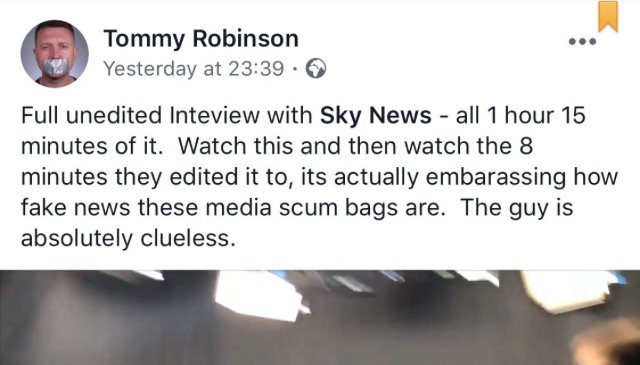
    Sky News was very proud of its exclusive last night: an interview with former EDL leader and Nazi poster boy Tommy Robinson. Don’t do it, they were urged. All you’re doing is giving fascists the oxygen of publicity they so crave, and helping create the impression that they’re a legitimate group with legitimate concerns. He’ll use the slot to get his talking points aired and then tell his followers how he outsmarted you.

    Robinson on Twitter today:

  • Evil man

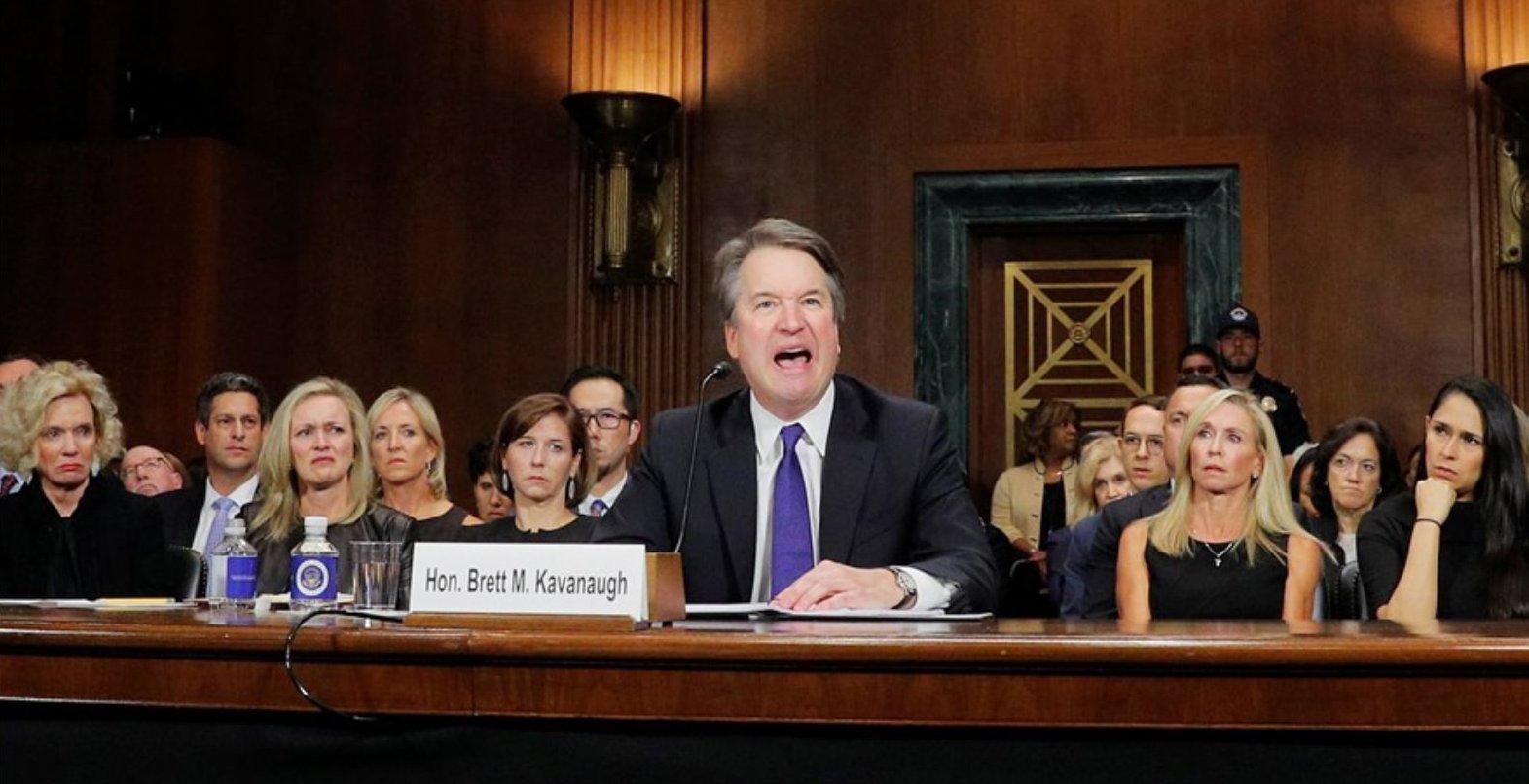
    There’s nothing I can say about this horrific, pathetic excuse for a man that isn’t expressed better by the faces of the every single woman in this photograph.

  • Making the world a little better

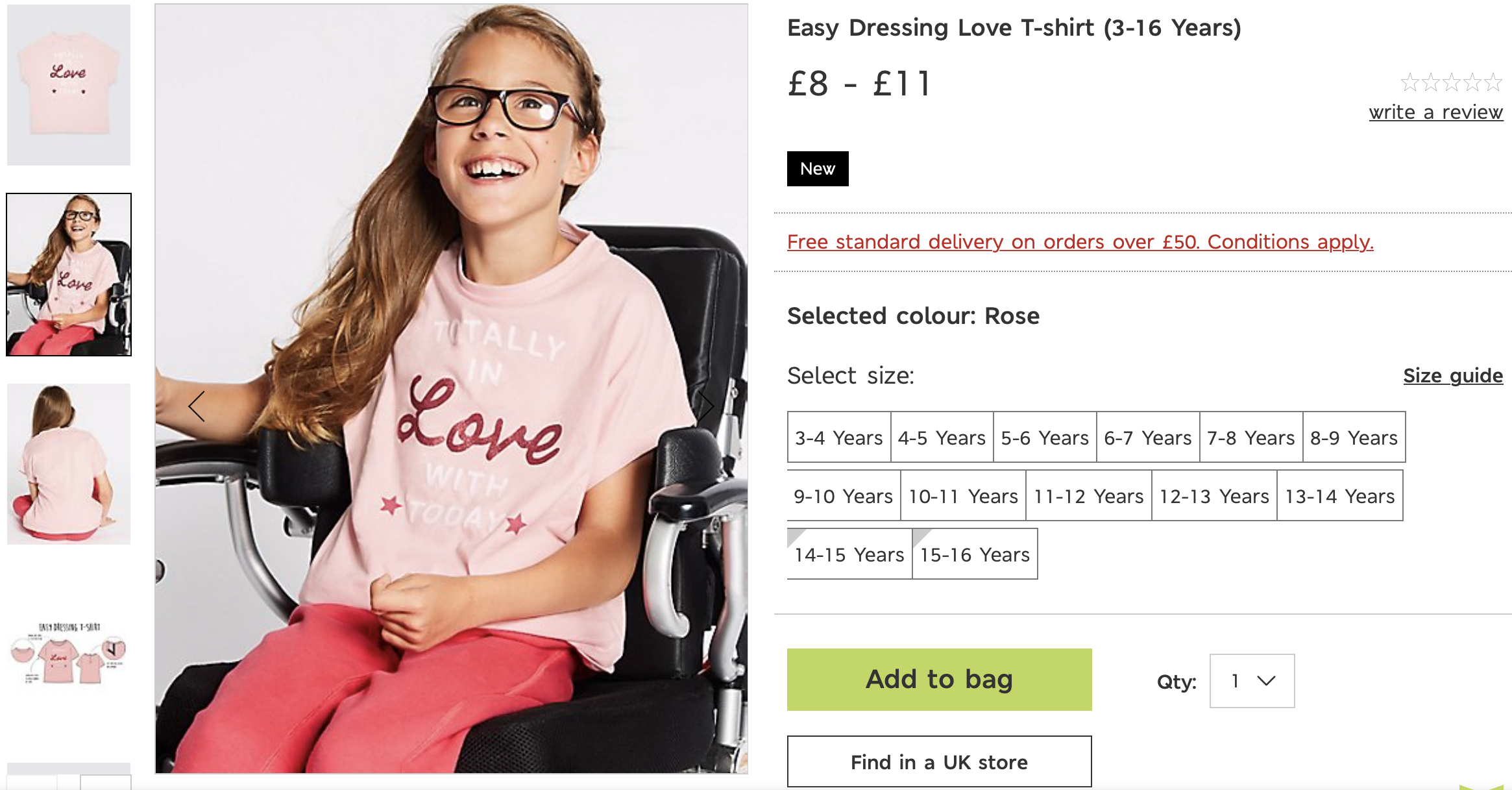
    Marks & Spencer has launched a new “easy dressing” range for children. The clothes are largely identical to the rest of the retailer’s children’s clothing (there’s a school uniform section too), but there are some crucial differences. Some have been tailored to make extra room for leg or arm casts, or have pockets with concealed bits for feeding tubes. They’re made using exceptionally soft materials, the care labels are hidden to avoid irritation and a great deal of thought has gone into each time. And crucially, they don’t cost extra.

    Rebecca Garner is M&S’s kidswear designer.

    “Parents passionately told us that disabilities don’t define their children, so the adaptations shouldn’t define their clothes, it’s why all the products are inclusively designed and modelled closely on our main collection.

    “So whilst big sister might wear a dress with sequins, the little one who wants to match but has sensory needs will have a softer glitter.”

    I’m an M&S shopper anyway – as much as I like to think there’s a punk rock edge to me, I’m actually at home in M&S and Sainsbury’s – but the brand has just rocketed in my estimation. The new range is a little bit of M&S’s clothing business, but it’s a very big deal to the kids (and their parents) who’ll benefit from it.

  • My country too

    Yesterday the Scottish Government published the initial results of its consultation on gender recognition reform. The public, including women’s groups dealing with the most vulnerable women in society, was overwhelmingly in favour of making life a little bit easier and a little more dignified for trans and non-binary people. It’s an interesting contrast to England, where the ongoing “debate” is dominated by misinformation, outright lies and scaremongering.

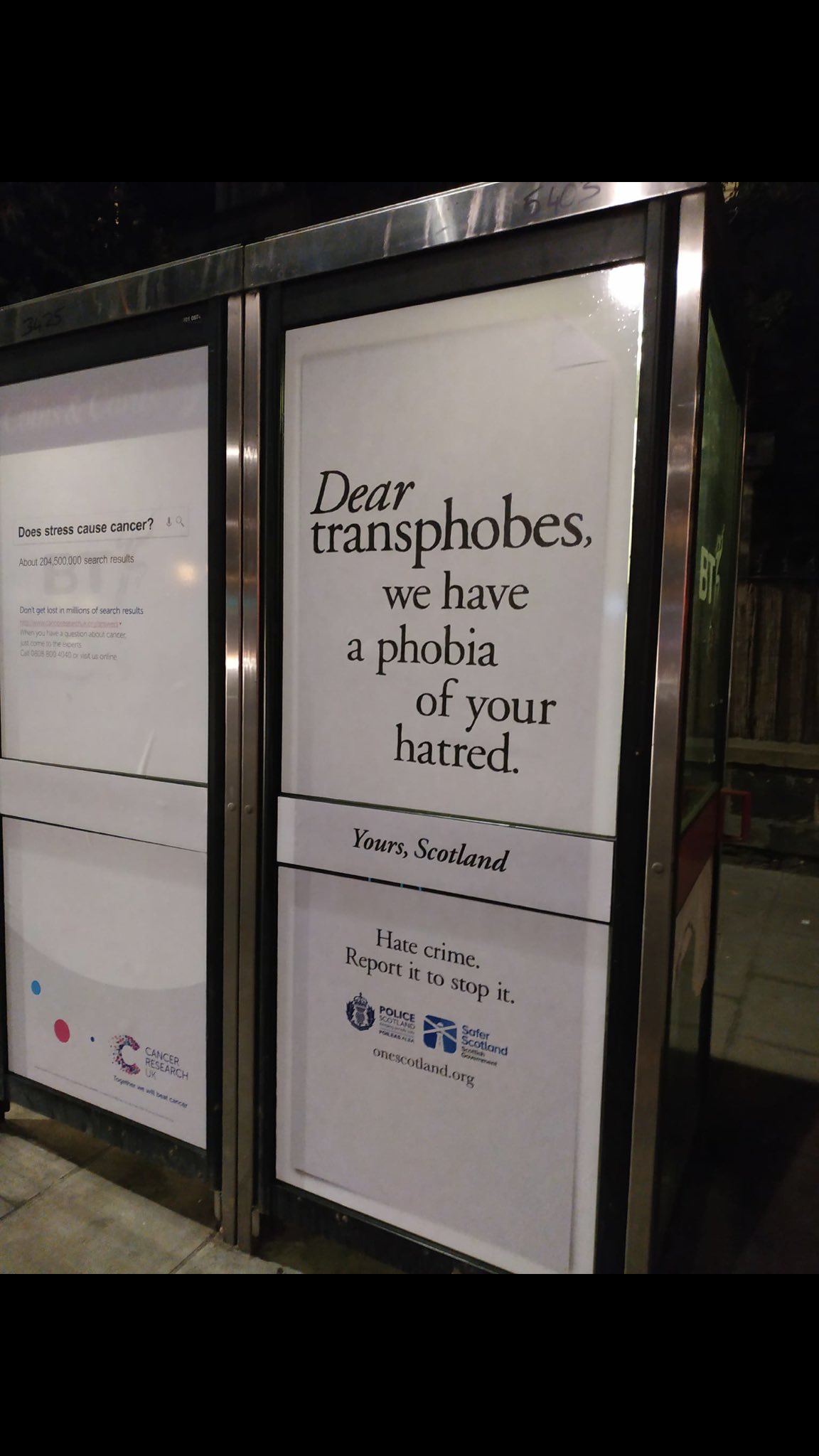
    Today one of my friends, the filmmaker Kate Adair, shared this photograph of a public awareness campaign by One Scotland.

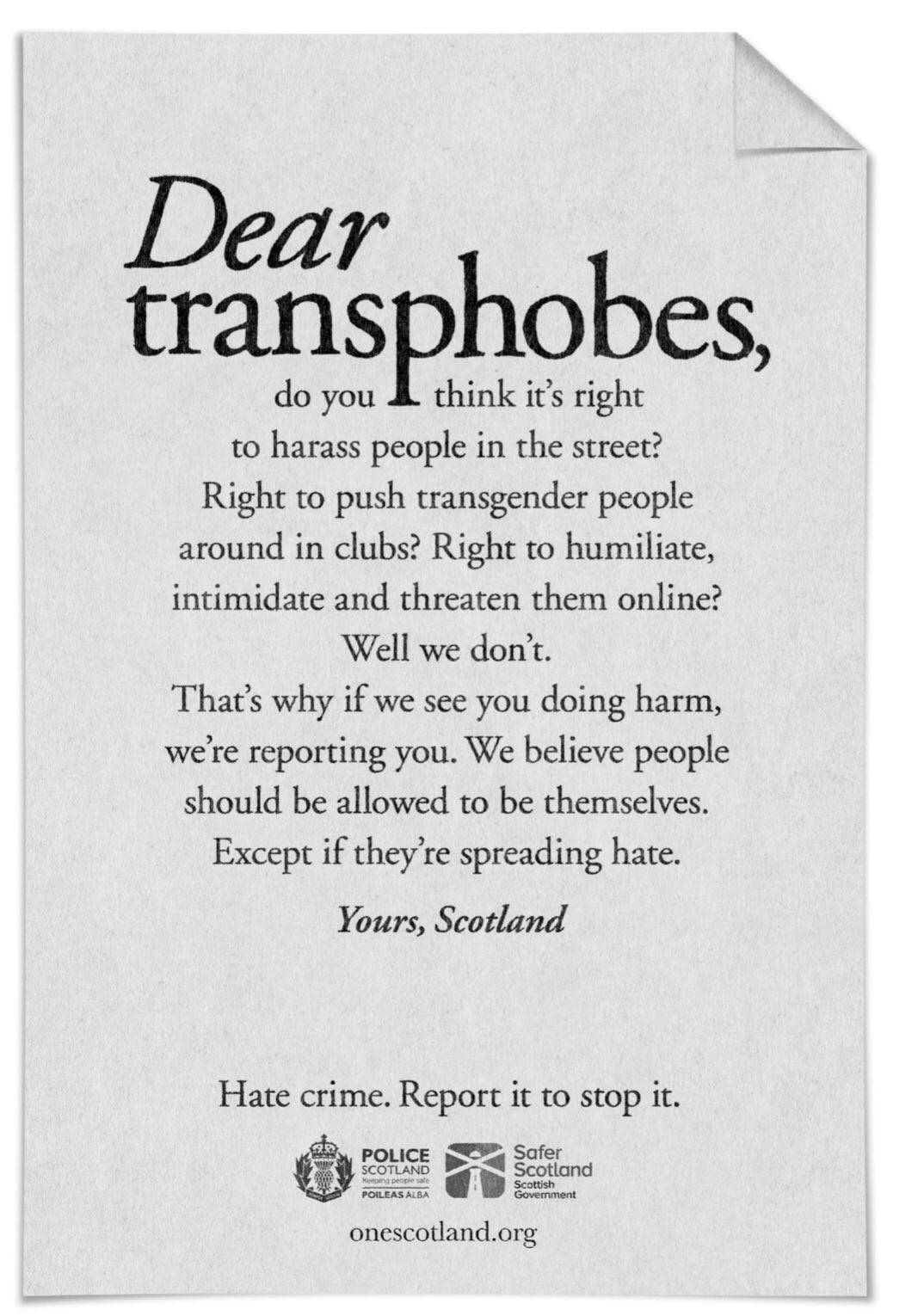
    One Scotland is an initiative by the Scottish Government and Police Scotland to stamp out hateful abuse. Here’s another one, this time from the website.

    One Scotland isn’t just about trans folks. It’s about hate crime in general. The campaign serves two important purposes. It urges the victims of abuse to report it, and it hammers home the message that such abuse has no place in our country.

    It also sends LGBTQ people in Scotland a powerful message: we’re on your side.

  • Every day’s a school day

    I got a taxi home last night. I think it’s safe to assume that there aren’t many openly trans people getting taxis from that Glasgow suburb: when the driver clocked that my appearance was rather different from my voice he had a lot of questions, all of them deeply personal and inappropriate.

    I could have been offended, but I thought it was really funny.

    Don’t get me wrong. I absolutely understand people who don’t see why it’s up to them to educate the wider world, and who think it’s exceptionally rude to ask a stranger what’s in their pants and whether they’re planning to change that – because of course, it is exceptionally rude. But I also think that if somebody’s intent is genuine, if they’re asking because they want to understand, then it’s okay to have a conversation.

    I was talking about this with a friend shortly afterwards, and she said that she didn’t think it was fair: people who aren’t LGBT don’t have to endure deeply personal questioning from LGBT people when they’re out and about. And I agree with her. In an ideal world people wouldn’t need to ask those kinds of questions, because trans people wouldn’t be “other”.

    Unfortunately, though, it isn’t an ideal world. There’s no shortage of bad actors peddling bad information about people like me. So which is better: telling the driver it’s none of his damned business and leaving him with a negative impression of trans people, or being open and funny and  busting a few myths?

    There are days I don’t feel like that, days where just being noticed is too much. But on other days I’d rather have the conversation, because in a very small way I think it helps.

    I’ve said before that most people probably don’t know any openly trans men or women: the best guesstimate is that we’re around 1% of the population, and an awful lot of us are in the closet. That means the information most people have about trans folk is about us but not from us, and as a result that information is often wrong. That means you can see these conversations not as negatives, but positives: they’re an opportunity to correct misinformation, to be seen rather than read about.

    For some of us, every day is a school day. Most days, I think that’s okay.

  • Cake day

    There’s a thing some trans people do on social media to mark “Cake Day”, the anniversary of them starting transition: it’s usually (but not always) the anniversary of them starting HRT. It’s my first Cake Day today.

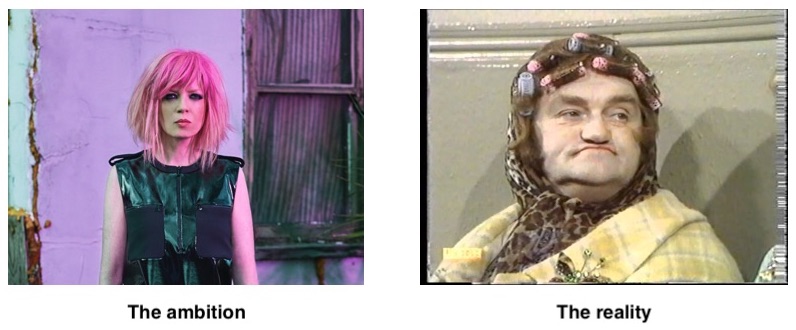
    Cake Day is often celebrated by posting before and after photos, usually showing a really miserable person in the before and a really cute and happy person in the after. Unfortunately for me I can’t do that because (a) I’m much older than most of the people who post pics and (b) I look exactly the same except fatter. So here’s my version.

    Messing around aside, Cake Day photos can be really valuable when you’re still in the closet. I wrote about them a while back:

    I’d spent endless hours looking at trans women’s HRT transition timelines, the photographic evidence of the cumulative effects of hormone treatment and improving make-up skills. I actively searched for timelines of middle-aged MTF trans women, trying to see what was the result of HRT and what was just better lighting, good makeup and a cute smile.

    Looking at such images wasn’t new, nor was the strong yearning I felt to be one of the people in the pictures. I’ve had those things since I’ve had internet access. But something was different now. I no longer saw the photos as pictures of transformations that, for me, would be impossible and unattainable.

    I started to see them as maps of the possible.

    What struck me wasn’t the physical transformation; it was the difference in the way they looked at the camera, the smiles reaching their eyes. Even relatively minor physical transformations looked spectacular because of the difference in the way people held themselves and looked at the camera.

    Each timeline was the same story: unhappy people finally becoming happy in their own skin. I wanted that too.

    I might not look like Shirley Manson, and I never will. But a year on, I’m becoming happy in my own skin.

  • Hate-clicks as a business model

    One of the more depressing things about the internet is the way that some publications have embraced hate clicks. Hate clicks are when you publish something terrible and then lots of people share it, not because they agree with it but because they’re shocked by how awful it is. The statistics show that lots of people read it, so the publication commissions more of it and the world gets a little bit worse.

    The latest example of that comes once again from Glasgow’s Herald newspaper, which seems increasingly determined to sacrifice its reputation for the sake of a bit of online outrage. Its columnist Brian Beacom is a kind of Tesco Value Richard Littlejohn, writing really tired columns with exactly the kinds of views you’d expect from a straight, white, middle-aged pub bore. Beacom doesn’t have a high opinion of black music, or trans people, or women. And this week’s column is particularly bad.

    This is the opening sentence.

    TIME to give Zoe Ball a little kicking.

    See what he did there? A ball is something you kick. So it’s okay to make a joke about violence against women.

    I’m genuinely amazed that made it into print. How many people saw that and thought “yeah, suggesting a woman needs a kicking is absolutely fine”?

    Beacom is outraged – he says it’s “anger following on from frustration” – because while “Ball isn’t a bad presenter” she has breasts, and therefore shouldn’t be allowed to present the Radio 2 breakfast show. The only way for men to present prestigious radio programmes is for them to grow breasts too.

    If you’re a man hoping for radio’s most prestigious slot, the only chance is to transgender and hope the oestrogen pills kick in before Chris Evans sets off to become a reborn Virgin.

    It’s a sad day when a professional writer can’t even make his lazy slurs grammatically correct. Transgender is an adjective, not a verb.

    Beacom’s argument is that the BBC is “pushing women beyond the level of their talent” and should stick with – surprise! – middle-aged straight white men like him. The Radio 2 breakfast show has always been presented by men, and should continue to be presented by men because it has always been presented by men. QED.

    Whether he means it or not doesn’t really matter. What matters is that it got published, woman-kicking sentiment included, and a bunch of straight white guys in the comments saw it as validation. It even made it to TV, although many of the women journalists approached to appear with him refused on the grounds that “old man has bigoted views” is hardly newsworthy and they had proper journalism to be getting on with.

    It’s so, so lazy. Anybody can do it, and most people could do a better job of it than Beacom. The irony here is that he’s claiming the BBC is not a meritocracy from the perspective of a white, middle-aged man who has a newspaper column despite not being any good at writing newspaper columns.

    The Herald has clearly pushed him beyond the level of his talent.