Author: Carrie

  • Singing from the chandelier

    NPR has a great profile of Sia, one of the most talented and fascinating songwriters of our age.

    On the verses she trips across syllables like skipping stones and chews vowels like gum — an affectation that’s spawned no end of affectionate memes. On the pre-chorus, she switches to the sloshed gutters of her low register, Auto-Tune bubbling off the vocal like a Poliça record. On the chorus — a big one — she belts loud, but it’s not the immaculate belt of a Whitney Houston, but one with exertion and rasp, strain and push (in the spinto sense, pushing away air). Where traditional divas’ voices sound like centers of gravity, Sia sounds like she’s fighting against gravity itself. She’s singing about it, too; the chorus doesn’t end with a big high note, but an almost-mumbled oath: “holding on for dear life.”

  • The darkness

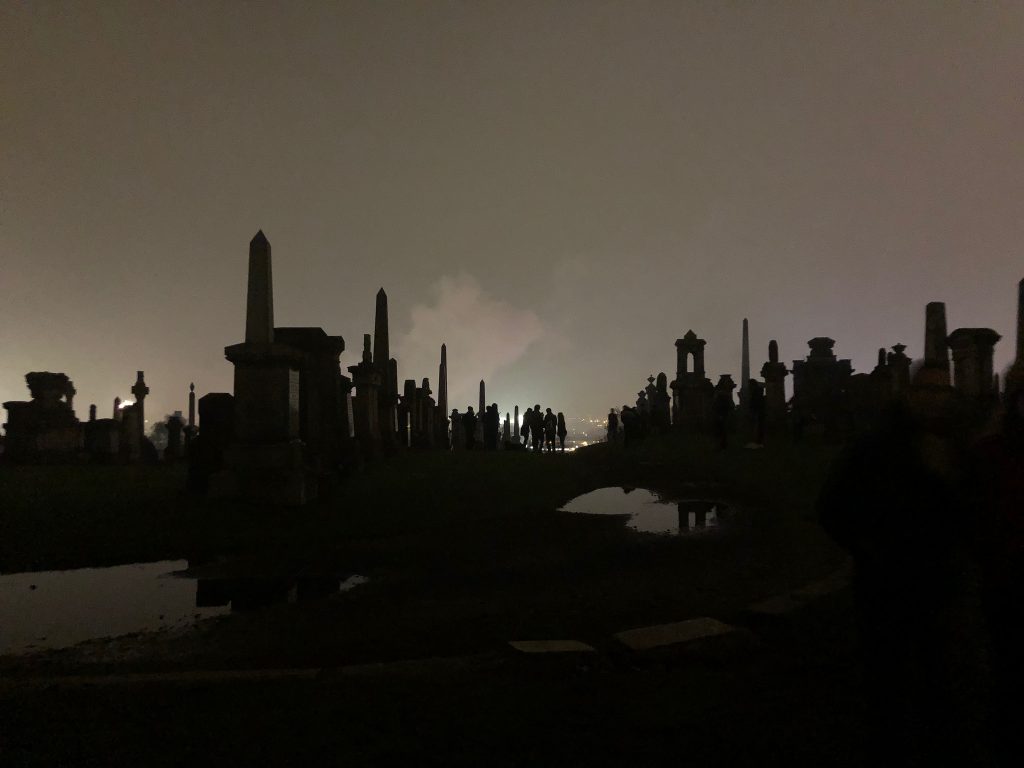
    Photo by me

    This is Glasgow’s city of the dead, the Necropolis. It’s also a brilliant place to watch fireworks, which is what the people in the photo were doing last night. I love this shot, it looks more like I’ve stumbled upon some kind of ritual.

  • Trans kids aren’t being fast-tracked to anything

    I’ve written many times about the “detransition myth”, the oft-repeated and thoroughly debunked claim that most trans kids who go through medical transition then change their minds. The short version: anti-trans groups tell you that 80% of trans kids detransition; the actual numbers show that 80% of gender non-conforming kids aren’t trans. Those kids aren’t given any medical treatment whatsoever.

    It doesn’t stop the bullshit, unfortunately. The weekend papers were full of it once again this week, prioritising scaremongering nonsense from anonymous “concerned parents” over actual facts.

    Wouldn’t it be great if the newspapers had some real numbers to work with?

    Over the weekend, the various medical experts that comprise the World Professional Association for Transgender Health (WPATH) had a conference. This is important, because it’s the WPATH guidelines that (eventually) inform the healthcare trans people are given. They’re a serious bunch.

    One presentation analysed detransition rates in the Nottingham gender clinic, a very large provider of trans-related assessment, counselling and healthcare. Of the 303 trans kids studied, how many do you think detransitioned?

    It should be easy. If there’s an 80% detransition rate, you’d expect to see 242 people detransitioning.

    The actual number?

    One.

    From the study:

    Only one person of the 303 reviewed made a detransition (0.33%). They later transitioned again.

    There were two other detransitioners, but they withdrew before ever attending the clinic. But even if you take them into account, the real world detransition rate was 0.99%.

    The “why” is as interesting as the “how many”. Detransition wasn’t because the patients realised they weren’t trans. The patients said they couldn’t continue because their families were unsupportive: things were just too difficult.

    Unlike the newspapers, I’m going to point out the flaws in the numbers I’m using to make my point. It was a study over one year, it’s just one gender clinic, and over time you’d expect more people to revert to their original gender presentation because as I’m the first to admit, this shit is hard. Forums are full of stories of people who came out and attempted transition only to retreat because their lives were so spectacularly shit due to lack of familial acceptance and the prejudice of others. Eventually they re-transition, but it’s often many years later.

    I would expect the actual numbers over a longer period to be higher than 0.99%.

    However, the numbers do correlate with others: the numbers from private trans health providers, many of whom can’t name a single case of permanent detransition; the surgical regret rate of 2% among gender confirmation surgery patients (that’s the kind of regret rate many surgeons can only dream of. It’s much higher among, say, cosmetic surgery providers); the many studies that show trans kids with supportive families living happier lives and the ones with unsupportive families living miserable ones.

    One of the reasons detransition rates are so low is because we already have a cruel but effective way of weeding out people who aren’t serious or who aren’t strong enough to cope. It’s called the NHS. The system is so overloaded and waiting lists are so long that the supposed “fast tracking” you read about in the papers is a process that can take two or three years just to get to an initial assessment, with another couple of years of assessments.

    What’s fast about that?
  • The threat of white nationalism, and what law enforcement isn’t doing about it

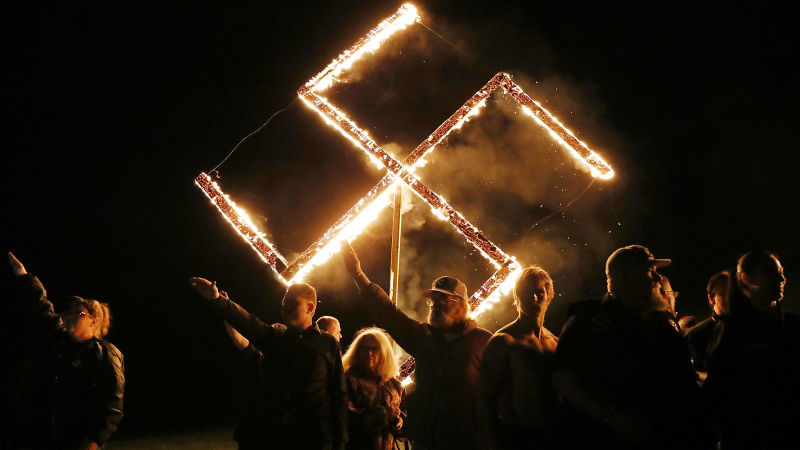
    We haven’t quite reached this stage, thank God. In the US, Nazis like these yahoos in Georgia are still a fringe group. Neo-Nazis are much more subtle, and much more dangerous.

    The New York Times has brought forward its planned cover story for next week to coincide with the US midterm elections. It’s a horrific story about the rise of neo-fascism and the real threat posed by white nationalism.

    White supremacists and other far-right extremists have killed far more people since Sept. 11, 2001, than any other category of domestic extremist.

    And yet as the NYT details, it’s been almost entirely ignored by law enforcement.

    Data compiled by the University of Maryland’s Global Terrorism Database shows that the number of terror-related incidents has more than tripled in the United States since 2013, and the number of those killed has quadrupled. In 2017, there were 65 incidents totaling 95 deaths. In a recent analysis of the data by the news site Quartz, roughly 60 percent of those incidents were driven by racist, anti-Muslim, anti-Semitic, antigovernment or other right-wing ideologies. Left-wing ideologies, like radical environmentalism, were responsible for 11 attacks. Muslim extremists committed just seven attacks.

    Meanwhile the US President vilifies muslims and describes white supremacists as “good people”. But this isn’t just a problem with the current administration. As the NYT notes, it goes back decades and its anti-semitism goes back further still. It’s just that a toxic mix of right-wing politics, shockingly negligent journalism and institutional incompetence has created the perfect storm for it to flourish. Some 22 million Americans currently believe that neo-Nazi or white supremacist views are perfectly acceptable. And there are multiple credible reports of white supremacist groups deliberately targeting law enforcement jobs, moving what’s already a largely conservative workforce much further to the right.

    As I’ve written many times before, social media has played a significant role in normalising and spreading neo-Nazi propaganda. The NYT again:

    alt-right memes, while dripping in irony, were also, in essence, hate speech, part of a propaganda war arguably intended to spread terror just as much as any ISIS execution video.

    The so-called debates we see, the platforming of the likes of Steve Bannon or various alt-right “shitlord” trolls, are playing into their hands. They’re amplifiers, enabling extremists to reach enormous audiences. What liberal media types (yes, people like me) seem unable to understand is that they’re being played. The alt-right aren’t interested in debate. For them, there really is no such thing as bad publicity.

    We’re living in very frightening times, I think, and things are going to get worse before they get better.


  • Even The Guardian reckons The Guardian is scaremongering

    In the final days of the Gender Recognition Act consultation, the (UK) Guardian newspaper published a one-sided string of anti-trans pieces culminating in an editorial regurgitating a lot of bigots’ tropes about dangerous predators. The latest criticism of it comes from an unlikely source: most of the US edition’s writers and editors. For journalists to openly criticise their colleagues in such a fashion is incredibly unusual.

    The piece, published yesterday, is credited to three writers but is apparently representative of almost all the US editorial team’s opinion. Reporter Sam Levin on Twitter:

    The @Guardian published an editorial about trans rights that many @GuardianUS staff felt was transphobic. Nearly all reporters and editors from our US offices wrote to UK editors with our concerns.

    Senior reporter Lois Beckett:

    Nearly all reporters and editors on @GuardianUS staff wrote our UK editors with concerns about a recent @guardian editorial on trans rights, which we believe promoted transphobic viewpoints.

    The article has also been shared approvingly on social media by a number of women journalists, some of whom are Guardian contributors.

    It doesn’t pull its punches.

    The editorial’s unsubstantiated argument only serves to dehumanize and stigmatize trans people. Numerous academic studies have confirmed that trans-inclusive policies do not endanger cis people. On the contrary, there is overwhelming evidence that trans people, particularly women of color, are victimized at disproportionately high rates and suffer abuse in places of public accommodations. Levels of HIV and depression are at crisis levels, all brought about through extreme prejudice and social and economic marginalization.

    …Cis women’s intolerance should not be a legitimate reason for limiting the rights of trans women. The idea that all trans women should be denied civil rights because a trans woman might someday commit a crime is the essence of bigotry and goes against feminist values.

    The UK edition has occasionally featured positive trans voices, albeit sparingly: Juliet Jacques’ transition diaries in 2012, for example, or one-off pieces by trans writers such as Shon Faye more recently. But the editorial appears to be the final straw for many of those voices.

    It’s a final straw because there’s a difference between having a columnist put forward a point of view and having the newspaper’s leader column do it. The former is “this is what one individual thinks”. The latter, “this is what the newspaper stands for.” By nailing anti-trans colours to its mast, the UK edition has told its trans contributors as well as its trans readers that it doesn’t value them, that it doesn’t respect them, and that it has no interest in speaking for them.

    The Guardian likes to quote its former owner and editor, CP Scott. It’s less keen on mentioning that he was on the wrong side of history on several issues, most notably the “misguided fanaticism” of the suffragettes. The Manchester Guardian was on the wrong side then, and the UK edition of The Guardian is on the wrong side now.

  • Three times three minutes of joy

    I’ve been trying and failing to persuade one of my friends that Carly Rae Jepsen’s Call Me Maybe is one of the greatest pop songs ever made, which of course it is.

    I was genuinely dancing to this when I played it this morning. Given that I was in a dressing gown at the time I resembled an asylum escapee, but that’s fine. It’s the power of pop!

    This song’s great too, and the video has Tom Hanks, making it twice as great.

    And now there’s a new one, Party For One. And guess what? It’s great! (and mildly unsafe for work)

    I hate people who pretend to like pop music ironically, or call it a guilty pleasure. Good pop music is one of the greatest art forms, an expression of pure joy and so much more.

  • Facebook needs a new broom

    Facebook is currently running an ad campaign telling you that it’s against hate speech.

    Facebook was simultaneously enabling advertisers to target people with an interest in “white genocide” just days after the Pittsburgh massacre.

    This is horrific.

    After selecting “white genocide conspiracy theory” as an ad target, Facebook provided “suggestions” of other, similar criteria, including interest in […] far-right-wing news outlets…

    Other suggested ad targets included mentions of South Africa;  a common trope among advocates of the “white genocide” myth is the so-called plight of white South African farmers, who they falsely claim are being systematically murdered and pushed off their land. The South African hoax is often used as a cautionary tale for American racists — like, by all evidence, Robert Bowers, the Pittsburgh shooter — who fear a similar fate is in store for them, whether from an imagined global Jewish conspiracy or a migrant “caravan.”

    You may recall that this time last year Facebook enabled advertisers to target “jew haters”. To enable one group of white supremacists is unfortunate. To do it again suggests incompetence.

    This wasn’t a mistake, or a computer error. Joe Osborne is a spokesperson for Facebook:

    Osborne also confirmed that the ad category had been used by marketers, but cited only “reasonable” ad buys targeting “white genocide” enthusiasts, such as news coverage.

    Facebook is an ongoing example of the law of unintended consequences. It didn’t set out to enable hate groups. But it’s made tools that enable hate groups to flourish.

    I’ve previously linked to articles suggesting Facebook is Dr Frankenstein, deliberately making a monster it (wrongly) thinks it can control. But I think it’s more like Mickey Mouse in Fantasia, so impressed by its own cleverness that it doesn’t see the mess it’s making until it’s too late to fix it.

    In Fantasia, a grown-up (Yen Sid, the sorcerer) comes along and fixes everything. Facebook, clearly, needs some grown-ups too.

  • Writing For Social Media, by me

    The second of my British Computer Society books was published as an ebook today.

    The print editions of the series (there are four books in total) will go on sale in a couple of weeks.

    Here’s the info:

    Writing for social media is different to standard business writing and it can be difficult to get right. Even big brands can get it very wrong. This book walks you through how to deliver maximum benefit for your business through your social media writing. Topics include how to develop a consistent online persona, how to tailor your messages across different social media platforms, how to appeal to your core audience, and useful tools to help you craft and monitor your posts. The dark side of social media is also explored, with examples of social media writing gone wrong, tips on how this can be avoided and advice on how best to handle online criticism.

  • The right side of history, and of science


    Law.com:

    Dozens of companies, including Microsoft Corp., Google Inc. and The Coca-Cola Co., pushed back against recent attempts by the Trump administration to reduce protections for transgender people under federal civil rights laws. They instead stressed the importance of equality in a public statement released Thursday.

    The 56 companies include major financial institutions, tech companies and retail giants, among other household names, such as JPMorgan Chase & Co., Deutsche Bank, IBM Corp. and American Airlines.

    It’s notable that Twitter and Facebook are on the list: their support doesn’t seem to extend to doing anything about the widespread, vicious abuse of trans people on their services.

    Still, it’s good to see such important organisations making such public support – although in the long term, we’ll see it as a “well, of course they did” thing because despite what you might read online, the science is firmly on our side.

    It’s hard to see many positives to the Trump administration’s war on trans people, but one little bit of sunlight is the horrified response from the scientific community.

    At the time of writing some 1,642 scientists, including 8 Nobel laureates, have written an open letter to politicians about Trump’s anti-trans plans. The list includes “Biologists, Geneticists, Psychologists, Anthropologists, Physicians, Neuroscientists, Social Scientists, Biochemists, [and] Mental Health Service Providers”.

    They are not a lunatic fringe. More:

    Scientific American: The Trump Administration’s Proposed “Redefinition” of Gender Is Scientifically Absurd
    Nature: US proposal for defining gender has no basis in science
    Wired: Trump’s plan to redefine gender makes no scientific sense
    The Union of Concerned Scientists: Trump Administration Proposal on Gender is Discrimination, Not Science
    Center for Biological Diversity: Statement on Reported Trump Memo Targeting Transgender People
    STAT: Scientists see a problem with Trump plan on defining sex: biology
    STAT: CDC’s Redfield on Trump’s transgender proposal: Stigma is ‘not in the interest of public health’
    New Yorker: The Trump administration’s plan to redefine gender recalls an earlier rejection of science
    TIME: The Idea of a ‘DNA Test’ for Transgender People Is Part of a Long, Dark History
    TIME: If the Government Redefines Gender to Exclude Trans People, It Could Worsen an Urgent Public Health Crisis
    NYT: Anatomy does not determine gender, experts say
    The Scientist: Trump Administration’s Definitions of Sex Defy Science
    Mashable: The Trump administration says there are two sexes. The science says they’re wrong
    Psychology Today: Trump administration’s definition of gender is not science
    Healio: Rolling back transgender protections would endanger patients, experts say
    Washington Post: The Trump administration is trying to tell people they aren’t who they are
    Washington Post: Powerful gay rights groups excluded trans people for decades — leaving them vulnerable to Trump’s attack
    Kaiser Health News: Defining A Person’s Sex At Birth And Making It Unchangeable Would Be ‘An Insult To Science,’ Biologists Say
    Truthout: Right-wing fantasies about gender are killing trans people
    Esquire: Trump’s new attack on transgender people is another sign it’s about the cruelty itself
    Philly.com: With lie-filled ‘nationalist’ war on caravan, transgender people, Trump moves US toward tyranny

    It’s interesting to compare the UK and the US. In the US, the politicians are scaremongering about trans people and the press is largely pro-science. In the UK, the politicians are largely pro-science and the press is doing the scaremongering.

  • Out

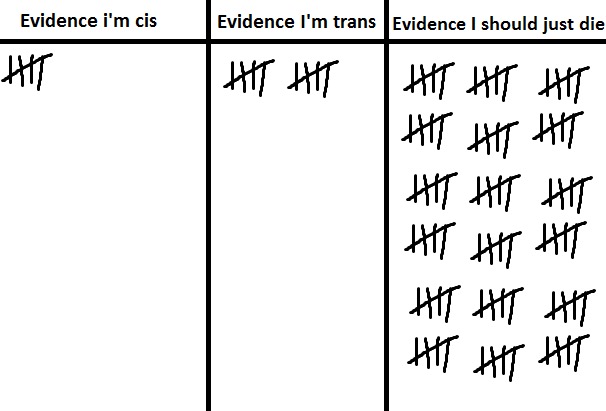
    Image from Reddit.

    Two years ago today, I began coming out as trans. I say “began” because while the initial announcement is an event, it’s merely the beginning of a process. I come out all over again every time I walk out the door, every time I pick up the phone, every time I meet someone new.

    Not everybody chooses to come out. On a forum I frequent, one trans woman has decided not to come out. She fears losing her relationship with her family, fears her ex making it hard to see her kids, works in an environment where she has reason to believe coming out would cost her her job.

    “It really feels like a step too far,” she says, “especially with attitudes towards trans people being what they are in the UK at the minute. I’m not sure I could take the abuse if it came.”

    Her decision is the opposite of mine: better to live a miserable life than to lose family, friends, job and everything else. And for her it’s clearly the right decision.

    I can understand that. In very many ways the last two years have been the worst two years of my life. They’ve definitely been the hardest. I lost my marriage, moved out of the family home and see much less of my children. I lost most of my friends and have had many close relationships stretched to breaking point. Maybe beyond breaking point. I spend two hours a week getting stubble torn from my face in an ultimately futile attempt to make me appear more feminine, my face sore and swollen for days afterwards, while the hormones that make me feel better have made me put on so much weight I can’t bear to see myself in photographs. People stare, and talk about me. Some days I’m so sad I can’t function. I have no doubts that I’ll die alone.

    I was asked the other day: was it worth it?

    And I honestly can’t answer that, because I don’t feel it was a choice. I didn’t come out because I wanted to. I came out because I had to. I’m certain that if I hadn’t, I wouldn’t be here. And sometimes I wish I’d taken that option instead.

    Don’t worry. I’m fine. I have good friends now, reasons to be cheerful. But sometimes I think we need to stop fixing a smile for just a little while and say: you know what? Being trans is incredibly, unbelievably shit sometimes. I’m amazed that so few people detransition (that is, go back to living in the gender they were assigned at birth): to be looked at and often stared at every time you go anywhere, to be constantly misgendered, to be attacked by politicians and pundits, to see a body you didn’t want in the mirror, to spend a significant amount of your time feeling scared… who would choose that?

    I chose that. But it wasn’t really a choice.