Author: Carrie

  • #24daysoflove

    My friend Karie Westermann has started something really lovely on Twitter: 24 days of love.

    I’m a great starter and a terrible finisher, so I very much doubt I’ll manage 24 days. But I’ll start with this: I heard it for the first time the other day and I’m absolutely in love with it. The video’s great too: I love seeing people smiling, singing and dancing.

  • Words have consequences

    The Daily Mail:


    Elsewhere in an American high school, members of staff attempt to break into a locked toilet stall because a trans  teenager is in it. In a different school, a lesbian student is beaten up because of her boyish presentation. In October a lesbian woman was kicked out of a bowling alley for looking ‘too masculine’. The same thing happened in North Carolina in June, when a lesbian woman was thrown out of a bathroom by the police: “You got no ID? Get out!” In May, a woman was harassed in a toilet because she was wearing a baseball cap: ‘the woman went up to Aimee and said “you’re disgusting” and “you don’t belong here” before flipping her off.’

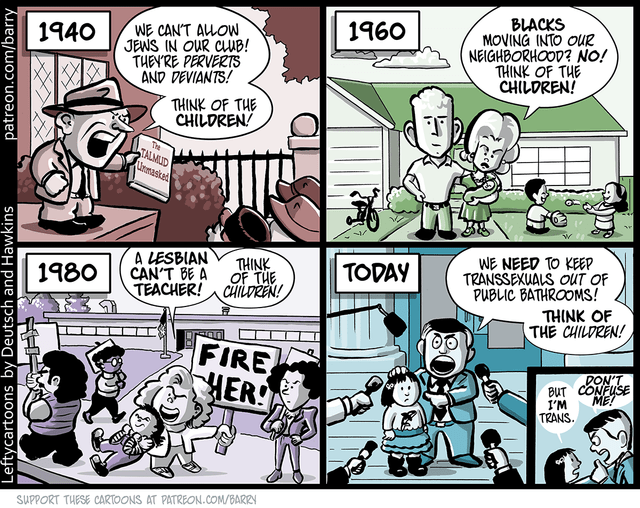
    This is what happens when you demonise people, when you tell people that someone’s very presence is a threat to you and to your children. For some people, “looking a bit trans” is sufficient grounds for action against a complete stranger who’s minding their own business.

    It’s not just people like me. It’s particularly horrific for refugees, especially since the whole Brexit mess began. The Overton Window, the range of political discourse that’s considered acceptable in society, has moved so far to the right that supposedly mainstream political parties are echoing the manifestos of the BNP and other far right groups from previous decades. What used to be unacceptable racism is now “asking difficult questions”.

    That demonisation has consequences big and small, and it always, always ends up with people getting attacked. For example, this week we saw horrific footage of a Syrian kid being “waterboarded” by bullies; it’s the latest in a campaign of abuse that’s seen him being doused with water, verbally abused and his hair set on fire, as well as physical violence. His sister has been bullied too.

    The same Daily Mail that’s so concerned about Rain Dove was also concerned about this kid: after years of demonising refugees, the Mail can’t imagine why anybody would pick on a child just because he’s Syrian. The Sun thinks it’s a shocking crime too. That’s the same Sun that paid Katie Hopkins to call immigrants “cockroaches”.

    You’ve got to admire the process here. First of all, newspapers help to create a climate of fear and hatred. Then, they get to run shocked stories when people act on that fear and hatred.

    These publications aren’t just reporting hate crime. They’re fostering it.

  • “What the hell am I doing here? I don’t belong here”

    One of the weird things about being trans – and it’s one thing from a long list – is that if you’re male to female, you move from a life of great privilege to one where you’re among a minority. That’s not to say pre-transition you live a life of great power and glory, but in everything from career assumptions to how safe you feel walking home from the pub you inhabit a very different world from the one women do and the one you’ll come out into.

    That can cause dissonance sometimes, or at least it does for me.

    Here are two examples. One, a friend asked me to do a talk to some students. And two, I signed up for a mailing list dedicated to music.

    These are things I’ve done before, but this time they were different. In example one, the person organising the talks has a policy to always look for lecturers from minority groups (it’s a field dominated by straight white guys). And in example two, the group is for women in music.

    It’s very strange. In both cases I’ve been specifically included – my friend invited me partly because she knew I’d be up for it, and partly because as a trans person I’m part of a minority; the mailing list says it is for women and “people who identify as women” – but I still feel as if somebody’s wired my impostor syndrome to the National Grid. I’m worried that in the first case I’m taking the place of someone more deserving; in the second that I won’t have anything valuable to offer and that I’m going to be viewed with a certain degree of suspicion due to my previous life as a bloke.

    More than anything, I feel embarrassed by privilege I don’t have any more.

    A lot of this is internalised transphobia, I know: today, like every other day, national papers have run pieces suggesting that trans women are just men trying  to fraudulently gain access to women’s spaces. Even though I know it’s bullshit, four decades of that stuff means that a lot of it sticks.

    But I think it’s also that to be trans and transition as an adult can leave you in a strange place. It certainly did for me. I was never any good at being male, but I spent too long living in that identity for me to ever feel comfortable being female or to feel that I deserve to be included in anything affirmative. It may say Great Britain on my passport but I’m a citizen of nowhere.

  • God, save me from your idiot followers

    SNP MSP John Mason is outraged by plans to reform the Gender Recognition Act.

    In a letter to Glasgow’s Herald newspaper, Mr Mason says he is deeply concerned that Scotland is “trying to override science” by recognising that trans people exist.

    I’ll save you the scientific evidence, which I’ve linked to endlessly, and simply post this example of Mr Mason’s other robust pro-science views.

    Update: Just after I posted this, the following article from Tidsskriftet (the Journal of the Norwegian Medical Association) appeared in my news feed.

    the ideas of purity that are partly rooted in national conservatism and partly in religious fundamentalism are not echoed by science.

    The timing amused me. Maybe that was part of God’s plan.

  • Oh, the places you’ll go!

    I’ve written about my love of children’s books before, but I didn’t mention one of my absolute favourites: Oh, The Places You’ll Go!

    It’s the last of Dr Seuss’s books to be published during his lifetime, and it’s a very warm, witty and wise book that’s as relevant to adults as it is to children: apparently it’s a popular gift for newly graduating students, and I got a new copy as a birthday present from a great friend.

    I was reading it to my son last night and I could barely get the words out: while the book is full of joy it’s also touched by sadness, and reading lines such as…

    All alone!
    Whether you like it or not,
    Alone will be something
    You’ll be quite a lot

    …is devastating when you’re reading it to someone you want to keep in bubble wrap, protected from sadness forever. But of course, we’ll all experience sadness and loneliness in our lives. That’s one of the reasons the book resonates so much.

    This video should be everything I hate: it’s a bunch of people at the Burning Man festival reciting the book. But you can’t mess up such beautiful words, and just like the book this video made me cry.

    And when you’re alone there’s a very good chance
    you’ll meet things that scare you right out of your pants
    There are some, down the road between hither and yon,
    that can scare you so much you won’t want to go on.

  • Scottish Government analysis of Gender Recognition Act reform

    A bit of light Friday reading for anybody interested in trans rights: the Scottish Government has published its analysis of its consultation over possible reforms to the Gender Recognition Act.

    It’s interesting for all kinds of reasons, including numbers: the anti-trans hysteria hadn’t really got into gear in time for this one, so there were just under 16,000 responses compared to more than 100,000 for the English consultation. Despite that, the (small) majority of responses were from people and organisations outside Scotland who would not be affected by any changes.

    Overall, 49% of respondents to the consultation are resident in Scotland, with 38% resident in the rest of the UK and the remaining 13% resident elsewhere in the world.

    A phrase that comes up again and again in the analysis is that a particular point of view – inevitably, an anti-trans one – was largely put forward by respondents from outside Scotland.

    Nevertheless, sober voices prevailed.

    The majority of respondents, 60% of those answering the question, agreed with the proposal to introduce a self-declaratory system for legal gender recognition.

  • Pop songs played on chainsaws

    I’ve written a lot about my love of pop music, but I don’t think I’ve included a particular favourite: pop music played on chainsaws. What I mean by that is strong melodic pop music played in a very aggressive way, usually through ridiculously distorted amplifiers by young men and women full of substances they’ll regret taking in later life.

    Imagine. It’s the mid-eighties, you’re a teenager and like all teenagers you’re full of unfocused rage and confusion. For all its pop joys, Frankie by Sister Sledge really isn’t going to articulate that.

    And then a friend plays you this.

    What a glorious, frightening, exhilarating noise. Three decades on and it still gives my goosebumps goosebumps.

    It’s the Byrds song reimagined by psychopaths, and it’s one of my very favourite records of all time. Guitarist Bob Mould is one of my favourite musicians, and in my latest band I’m ripping him off quite shamelessly.

    If you’re interested in Hüsker Dü, I really recommend the excellent podcast Do You Remember: it’s a fascinating broadcast from a very different world, a world without the internet and social media and where music was still fiercely tribal.

  • “Be yourself, man. Whatever that is.”

    It’s international men’s day today. This, on masculinity, is very good.

    There’s nothing wrong with masculinity. But to be a man often means trying to live up to a very narrow definition of what masculinity means, and that can be suffocating if you don’t fit that definition.

    Fraser Stewart articulates it very well in this video: by all means be stoic and strong if that’s who you want to be, but don’t try to be somebody you aren’t.

    These expectations [of strength and stoicism] are dangerous for the men who feel sad, or feel lonely, or anxious, or depressed, but who have been told throughout their life that to be a man you have to bottle up your feelings, that this is an intrinsic part of your masculinity.

    It’s not easy to be a man or a boy, but sometimes we make it harder than it needs to be. It’s okay to be vulnerable, to be sad, to be a man who doesn’t fit in a narrow box marked “stiff upper lip”.

  • What if we didn’t keep so many secrets?

    My friend Chris posted an interesting question on Twitter last night.

    What would be the worst outcome of your innermost thoughts – not literally ‘your internet history’, but it’s a decent proxy, I guess – being made public? What would be the best?

    I’m thinking a lot just now about how we hold onto unvoiced concerns about ourselves, internalised, received-wisdom self-hatred that we daren’t interrogate, making them all huge and black and important… while most people wouldn’t give a damn.

    The corollary to ‘everyone around you has a story as rich and deep as yours’ and the implication that this might come as a surprise is that ‘nobody around you thinks your story is particularly important’, and perhaps that can be a catalyst for honesty and growth.

    I can answer some of that, because of course my darkest, most terrible secret is no longer a secret: I’m – surprise! – one of those trans people the papers warn you about. And what happens is your fear loses its power. You move from being terrified of anybody even suspecting the slightest hint of your secret to moving through the world without really giving it much thought. Fears lose their power incredibly easily.

    So the glib answer is: your life gets better. Not necessarily easier, but better because living a lie is really hard work.

    But that’s a pretty extreme example. What about the day to day things, the smaller things we don’t say out loud? As I responded to Chris:

    …a lot of secrets are really hard work too. For example, the classic “I’m in love with them but I’m too scared to tell them”. I’ve lost half my life to that one :) 

    But there are also everyday ones, the things we don’t always articulate. The love we have for our partners, our friends, our children. The sadness we feel at accidental or not so accidental cruelties of others. The times we’re barely hanging on and desperately need a shoulder to lean on but can’t bring ourselves to ask. 

    [total honesty] would also mean people I quite like hearing the less pleasant things I observe about them, so it’s not all good. But my gut is that we silence more valuable stuff than bad stuff. Maybe :)

    How many times have you bitten your tongue at something that’s really made you sad, or wanted to tell someone how much they matter but just went red instead?

    What would happen if you stopped pretending, if you didn’t censor everything? I don’t mean not censoring anything – I’d be barred from supermarkets if I vocalised what I thought about my fellow shoppers sometimes – but the important things, the things that make you feel things.

    What would happen if you were more honestly you?

  • Music to watch girls by

    I spent many years playing in bands, and despite public demand I’ve joined another one. This time it’s different, though, because this time I won’t be presenting male. That means thinking about things I’ve never had to think about before: what I should or shouldn’t wear on stage, whether I can fake the confidence I don’t feel, how I’ll deal with abuse and/or inappropriate behaviour.

    I never had to think about that as a male singer. But then, as Beth McLeish writes, it’s different for girls.

    Writing on Transistor, McLeish describes a change of opinion: when she was asked a few years ago about what it’s like to be a girl in a band, she didn’t think it was a particularly big deal.

    I said that it was no different from being a boy in a band, as we were, quite simply doing the same thing. I recognised the barriers between women and music careers, but ultimately, I believed that things were by far better now than they used to be.

    And she was right, because things are better than they used to be. And yet…

    …surely it is not unreasonable for me to be getting tired of being one of only two girls on an entire gig line-up. From what I’ve gathered, the type of music we play, and the music scene, in general, is a boy’s club. For a long time, I just didn’t think there was that many women in bands. But now I’ve learned that this is 100% not the case. We just aren’t getting booked as much as our male counterparts.

    Half of all guitar purchasers are women, but that isn’t reflected on stages. Festival line-ups are often embarrassingly male-dominated, and the same patterns filter down to the smallest clubs.

    Putting on a line-up where the only thing the bands have in common is having a female band member isn’t helpful either. It’s tokenism.

    Would you describe a band of guys with a male lead singer as “male fronted?” No, no one would say this, because sadly the assumption is that musicians are male. Surely, it’s not fair then to disregard women’s songwriting and their art, and just make it about their gender?

    Musically, there is very little commonality between, say, Petrol Girls, St Vincent, Wolf Alice and Kathryn Joseph. And yet all too often women are reduced to their gender in a way male artists aren’t. Boys are classified by genre. And boys don’t have to worry about being objectified by audiences in the way girls do.

    Whenever I play gigs, I feel the need to dress up in my coolest clothes and wear lots of makeup. It’s that constant pressure to look good that affects so many women in bands, and a lot of the time it matters more than what the music sounds like sadly. Of course, boys in bands are scrutinised for how they look too, and there is, of course, an expectation for them to look cool. But for female musicians, it almost seems like they’re there to be sex symbols, and their music is secondary.

    The music business has long been sexist, and often misogynist. If they’re allowed to be more than just eye candy to look lovingly at the male performers, women artists have long been packaged with their sexuality first and their art second. That’s something that’s still very much in evidence today.

    The treatment of women by male artists and the predominantly male people at every level from roadie to A&R rep has been famously bad. I could make my point pretty clear by listing just a few of the songs about “young girls” in which older men sing about the joys of statutory rape, or the underage lovers of your favourite rock stars or DJs. Or listing some of the court cases where powerful music business figures have exploited female artists both economically and sexually, sometimes simultaneously.

    I’m constantly amazed there hasn’t been a #metoo for the music business. I suspect it’s because there’s just too much of it, the prospect of swimming against the tide must seem incredibly daunting. And once again, we’re not just talking boardrooms and limos here. We’re talking the toilet circuit of tiny venues and local radio showcases. I’ve played plenty of shows where I’ve seen appalling behaviour towards women musicians by DJs, by promoters, by audiences and by other bands’ members, and to my great shame like everybody else I said and did nothing.

    McLeish has two important questions, to which her answers are “not yet”:

    Are gigs safe spaces for women and girls?

    Are women musicians respected and recognised for their art?

    Neither of these issues are insoluble. Representation is a huge part of it. If you have more diverse people writing about music, promoting music, playing music, then it becomes less of a skinny white boys’ club. And it means things that were previously just seen as “just the way it is” can be changed.

    Dream Wife. Image: Wikipedia

    Here’s an example. A few weeks ago I went to see Dream Wife, a pop/punk band that’s generating a lot of buzz. And very early in the show, they stopped and asked the audience to do something very simple:

    Look behind you. If the person behind you is smaller than you, swap places.

    And the audience looked, and they swapped places. And it was brilliant. The largely female crowd was actually able to see the show without having to try and see past hulking great blokes (and hulking great trans women; I stayed at the bar because I’m massive); the guys’ enjoyment of the gig wasn’t affected one tiny bit.

    Why doesn’t that happen at every gig?

    I go to loads of gigs, and it’s become really clear that the more female and fabulous the crowd, the better the atmosphere. If you go and see, say, queer punk band Queen Zee it’s a riot of cis and trans, straight and gay folks all bouncing around together. Go and see a band popular with middle-aged men and everybody’s angry-pissed, territorial and furious.

    When did we collectively decide that it was okay for men to use their physicality to block the view of people who are typically smaller and socialised to be less aggressive than them?

    The venue (Glasgow’s SWG3) was also plastered with posters telling attendees to report any abuse or inappropriate behaviour, and on a purely practical level it had sufficient toilets for the girls as well as the boys.

    Why doesn’t that describe every venue?

    And then, of course, there’s the sexual assault.

    The existence of campaigns such as Safe Gigs for Women should shame us all. The group’s statement regarding this year’s festival season was sobering: they note that at many festivals “there are bands and artists who are accused or convicted of domestic abuse, physical abuse, sexual abuse, or rape… Some are accused or have admitted to inappropriate behaviour with fans. Some may have songs that are anti-woman or pro-abuse.”

    It’s not enough to change the physical environment at gigs, although adopting guidelines such as the White Ribbon Project’s Safe Gigs advice for venues of all sizes would be a big step in the right direction. We need to address the wider culture too. Respect for all women, onstage and off, should be the rule, not the exception.

    Update:

    My friend Professor Batty writes from Reykjavik, where he’s been at the Iceland Airwaves music festival. The ratio of men to women performers? 1:1. The ratio of male to female event workers? Also 1:1. “I have seen the future, and I like what I see,” he says.

    More here.