…That’s why I wept. It’s not that he has created this nightmare. It’s that so many people — including ones I love — think it’s all just fine.
This is what “reasonable debate” about trans people looks like.
Update: that’s not even the maddest thing these yahoos and their supporters have claimed today. Apparently it’s impossible to raise estrogen levels to typical female levels artificially, which is going to be a surprise for the endocrinology profession and the many cisgender women on hormone replacement therapy. Oh, and they’re also arguing that testosterone is not made by the testicles. No, apparently it’s made by the penis, which is a magical hormone tube.
Lags at four nicks are getting state-of-the-art football pitches [The Sun]
Motors? Lags? Nicks? Who’s writing this stuff? Guy Ritchie?
When they’re not pretending to be in English gangster movies, they’re using slang to downplay the seriousness of violent acts.
Air passenger headbutts police officer in flight rammy [Daily Record]
A man was taken to hospital for severe facial injuries after a rammy... [Daily Record]
Many of these are headlines, but offenders lurk in the text too. Trinity Mirror’s Glasgow Live frequently uses “eaterie” to describe restaurants, “lost their battle” to describe cancer patients dying and “sadly died” in subheads about death.
I’m annoyed by these partly because they’re annoying, but also because it’s proof that a whole kind of journalism job has gone. In the days when sub-editors ruled the newsrooms, you wouldn’t get away with “eaterie” – it’s an affectation – or “lost their battle” – it implies that people who die of cancer didn’t fight hard enough – or “sadly died”, because it doesn’t mean what you think it means: it’s the opposite of “died with a smile on their face”. It doesn’t mean “they died and that is sad”.
I know, I know, it’s not important in the great scheme of things. But precision in language is yet another thing we’ve lost in the name of cost-cutting, something of value sacrificed by people whose spreadsheets show the cost of everything but never their value.
Let’s talk about gender recognition. I mean, it’s not as if it’s a controversial subject.
[Carrie looks sideways at the camera while comedy music plays]
Here’s the thing about the WHO’s long-anticipated removal of “transsexualism” and gender dysphoria from its classification of diseases and disorders: if being trans isn’t a mental disorder, which it isn’t, what happens to legislation that’s based on the understanding that being trans is a mental disorder?
The GRA enables us to change our official paperwork – our birth certificates, our HMRC records and so on – so that it reflects our actual gender, not the one we were assigned at birth, and it makes our assigned gender “protected information”. If you disclose protected information in an official capacity – i.e. if you “out” us – you may be breaking the law.
Why would we need such a thing?
The GRA came about after two trans women, Christine Goodwin and another unnamed litigant, won a landmark legal case against the UK government. Goodwin argued that the government’s refusal to recognise her correct gender violated her right to a private life and her right to marry.
Goodwin had been living in her correct gender since 1985, and had gender confirmation surgery in 1990. However, more than a decade later the UK government insisted that she was a man.
The Department of Social Security refused to give her a new NI number or change the marker on her file from male to female; she was ineligible for the state pension (which at the time started at 60 for women); she felt unable to claim things she was entitled to, such as the Winter Fuel Allowance, because doing so would require her to produce her birth certificate – which still said male. The world was even harsher for trans people in 2002 than it is now, and effectively outing yourself wasn’t something you’d want to do unless you absolutely had to.
Goodwin also argued that by refusing to recognise her gender, the government was depriving her of her right to marry. Despite being a straight trans woman the law considered her to be a gay man, and as such she could not therefore marry a man (the Marriage (Same Sex Couples) Act 2013 was still more than a decade in the future).
The court was unanimous. To use a legal term, the UK government were being dicks: there was no good reason to refuse to change Goodwin’s legal status or to let her marry.
Hence the GRA. Without a gender recognition certificate, you can’t change the gender on your birth certificate and you can’t change the gender marker on your HMRC/DWP records (other forms of official ID don’t require it: you don’t need a GRC to change your passport, for example).
To apply for a GRC, you need to “have lived in your acquired gender for at least 2 years”, “intend to live in your acquired gender for the rest of your life” and have been “diagnosed with gender dysphoria (this is also called gender identity disorder, gender incongruence or transsexualism)”.
In support of your application you need to provide various bits of evidence. One of the most important, compulsory ones is a report “made by a registered medical practitioner or registered psychologist practising in the field of gender dysphoria and must include the details of your diagnosis of gender dysphoria.”
No diagnosis, no report, no GRC.
So we now have a system where the UK law is out of date: gender dysphoria is an outdated term for a variation no longer classified as a disorder by the World Health Organisation.
This is one of the reasons why the GRA needs reform; it’s not the only reason (for example it doesn’t recognise non-binary people), but we’ve known for a long time that the various health organisations were depathologising being trans and that the law would need to change accordingly.
And this is where some people get angry, because we use the phrase “self-identification”. That has been widely and often wilfully misinterpreted.
The existing GRA system already works on the basis of self-ID. It has to. There’s no blood test that tells you you’re trans, no DNA analysis, nothing you can hold up to a lightbox and stroke your chin to. The diagnosis is based entirely on interviews with the person who has come to the conclusion, usually after a great deal of pain and soul-searching, that they’re transgender.
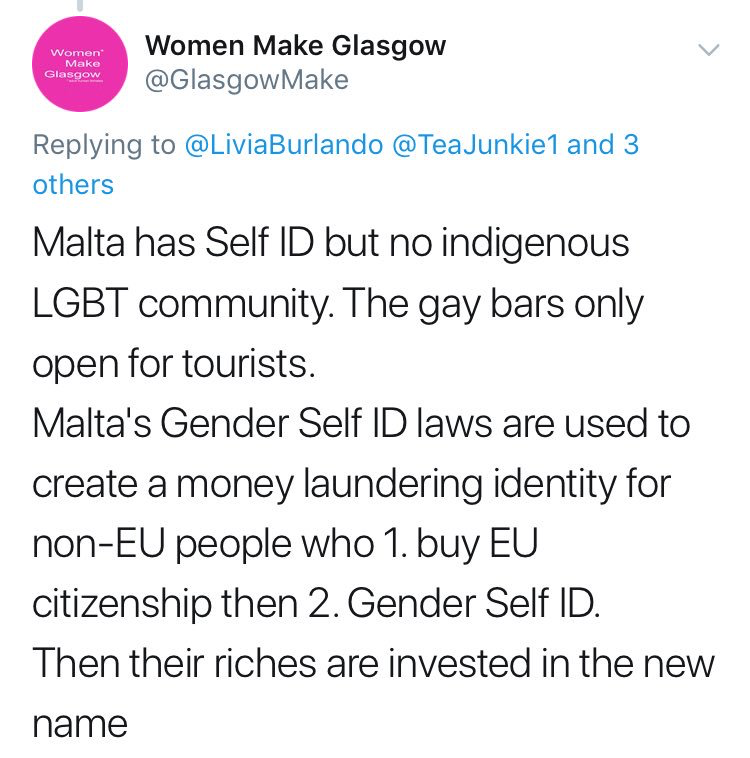
That’s why so many other places (Ireland, California, Malta, Norway, Argentina, Portugal, Belgium, Denmark, Pakistan, Chile) have dropped the requirement for medical evidence in legal gender recognition: it’s just an unnecessary (and expensive) bit of bureaucracy. After all, we don’t ask gay people to prove they’re really gay before they can marry. Why medicalise trans people when they’re just as capable of knowing their own minds?
Here’s the most likely reform: Instead of an outdated, expensive, complex (and for some, humiliating) application process to persuade a faceless, faraway panel that you’re trans, you complete a statutory declaration saying you’re trans and pay a small admin fee. Unlike a GRC, if you get your statutory declaration under false pretences you can be prosecuted.
I’ve still to see a coherent, factual explanation of why such a change would be detrimental to women. The self-declaration process hasn’t been abused in the various other countries where it’s law. A GRC doesn’t change who can access what (in the UK, that’s the Equality Act’s department; that isn’t under review). And I can’t think of a single reason why a predatory man, or anyone, would complete a bad faith registration. All it does is sort out your government paperwork,  enable you to marry whoever and however you wish and give you a birth certificate that doesn’t out you. A GRC is of no benefit whatsoever to a predator.
Under the current system, I’ll be eligible for a gender recognition certificate later this year. If reform plans aren’t announced then I’ll probably apply for one, because it means I’ll finally have all my government records in sync: my HMRC and DWP records will finally match my NHS ones, my passport and my driving licence and the Electoral Roll.
It’ll make my life very slightly simpler, and it won’t affect yours at all.
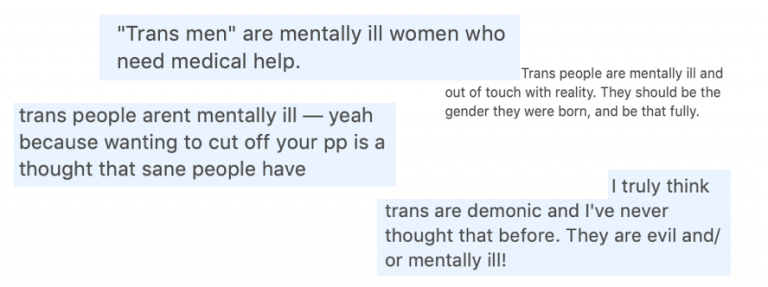
There isn’t a single day when I don’t see somebody claiming that trans people are mentally ill and/or degenerates. Here’s some geniuses from this morning.
A huge problem is that public awareness of trans people – and of what the medical consensus is about trans people – is incredibly out of date.
For a long time, normal human variety and behaviour has been pathologised – that is, labelled as a medical problem when it isn’t.
A good example of that is in the pathologisation of women. In the Victorian era, women who rebelled against domesticity could be labelled insane and thrown into asylums. Doctors considered women to suffer from an invented condition called “hysteria”, a condition that should be cured by finding a husband. In the 1950s, women were routinely sedated to deal with their unhappiness. In the 1960s and 1970s, feminism was considered by many to be a medical problem.
And that’s before we get to the queer folk. In the US, homosexuality was classified as a medical condition until 1973. It isn’t, of course, but the supposed science was based on gender beliefs about the supposedly essential qualities of men and women. To put it simply, if you weren’t a manly straight man or a girly straight girl there was clearly some sort of medical problem.
The treatment was harsh. Some people were given electro-shock therapy, a practice that continues in China to this day, or aversion therapy, or other supposed cures that caused great damage.
American psychiatry mostly ignored this growing body of sex research and, in the case of Kinsey, expressed extreme hostility to findings that contradicted their own theories.
Some gay activists were complicit in this.
…some mid-20th century homophile (gay) activist groups accepted psychiatry’s illness model as an alternative to societal condemnation of homosexuality’s “immorality†and were willing to work with professionals who sought to “treat†and “cure†homosexuality.
It’s easy to condemn now, but “be nice to them, they’re mental” was a step forward from “throw rocks at them, they’re perverts”.
Eventually, though, science won: fact beat faith, and homosexuality was no longer a medical condition in the DSM III onwards – although it remained a “sexual orientation disturbance” until 1987. Nevertheless, “APA’s 1973 diagnostic revision was the beginning of the end of organized medicine’s official participation in the social stigmatization of homosexuality. Similar shifts gradually took place in the international mental health community as well.”
There was a wider context to this: the World Health Organisation’s International Statistical Classification of Diseases and Related Health Problems, ICD for short. In 1948, the WHO published version six of the ICD, ICD-6, which classified homosexuality as a “sexual deviation”.
The ICD listed homosexuality as a mental disorder until 1992.
Most people understand that gay people are perfectly normal, but until very recently the official medical literature said otherwise. And that legitimised hatred.
As a result [of removing homosexuality from the DSM and ICD], cultural attitudes about homosexuality changed in the US and other countries as those who accepted scientific authority on such matters gradually came to accept the normalizing view. For if homosexuality was no longer considered an illness, and if one did not literally accept biblical prohibitions against it, and if gay people are able and prepared to function as productive citizens, then what is wrong with being gay? Additionally, if there is nothing wrong with being gay, what moral and legal principles should the larger society endorse in helping gay people openly live their lives?
The result, in many countries, eventually led, among other things, to (1) the repeal of sodomy laws that criminalized homosexuality; (2) the enactment of laws protecting the human rights of lesbian, gay, bisexual and transgender (LGBT) people in society and the workplace; (3) the ability of LGBT personnel to serve openly in the military; (4) marriage equality and civil unions in an ever growing number of countries; (5) the facilitation of gay parents’ adoption rights; (6) the easing of gay spouses’ rights of inheritance; and (7) an ever increasing number of religious denominations that would allow openly gay people to serve as clergy.
Most importantly, in medicine, psychiatry, and other mental health professions, removing the diagnosis from the DSM led to an important shift from asking questions about “what causes homosexuality?†and “how can we treat it?†to focusing instead on the health and mental health needs of LGBT patient populations.
Guess what? The DSM and ICD also pathologised trans people. The DSM detailed “gender identity disorder” until 2013, when DSM-5 reclassified it as “gender dysphoria” – not perfect, but better.
The widely circulated belief in a made-up condition called Autogynephilia (short version: trans women are either narcissists or confused gay men; as ever, trans men aren’t given much thought) has been thoroughly debunked; being trans is not considered a mental illness in the DSM any more: the problem isn’t being trans, but the distress that comes from trying not to be.
The same thing is happening with the ICD. As the WHO announced last year, “transsexualism” is being removed from ICD-11 – so the diagnosis I have, of “transsexualism male to female ICD10 F64”, will be consigned to the history books. The change was ratified this month by the Assembly of States of the WHO.
As with the DSM, some concerns remain (not least whether US insurers will continue to pay for trans people’s transition-related healthcare).
Here’s the Council of Europe Commissioner for Human Rights.
While the removal of gender identity from the list of mental illnesses is a positive step, several concerns remain with the ICD11, and I call on WHO member states to continue improving the text to promote respect of human rights.
Such concerns include the term “gender incongruence†retained in the ICD11 which may lead to interpretations suggesting abnormality, as well as the continued listing of gender incongruence in childhood in the ICD.
I particularly regret that no progress was achieved in the ICD11 toward depathologisation of intersex people, and that terms such as “sex development disorders†continue to appear in the text. Language in the ICD Foundation suggesting sex “normalising†surgeries remains, which is of major concern.
As with the DSM, it’s not perfect, but it’s better. As the Commissioner says:
The pathologisation of trans people has served to justify serious violations of their human rights over the years, including attempts to “cure†them through conversion or reparative therapies; psychiatric evaluations, and sterilisation. In many countries, legal gender recognition is only possible upon medical diagnosis.
Science, knowledge and understanding isn’t a fixed point. We now know that feminist women are not hysterical or insane. We know that you can’t pray the gay away or make people straight by electrocuting them. And we know that being trans isn’t an illness.
Writing on Twitter, co-founder Ev Williams (@ev) talks about the problem of abuse and harassment on the platform.
*And*, yes, we (Twitter) should have invested more heavily in abuse before. I think we did more in the early days than we often get credit for (and they are doing way more today). *And* I personally underestimated the looming problem during my brief tenure as CEO.
Had I been more aware of how people not like me were being treated and/or had I had a more diverse leadership team or board, we may have made it a priority sooner.
This is something you see from all the social media heads: if only we knew people were being bad on our services! But they did know. High profile publications were highlighting the problem of abuse more than ten years ago.
Here’s just one example, from the high profile news site C|Net. It describes Twitter’s “wishy-washy” approach to online abuse and compares it unfavourably to other social sites.
Either way, what Waldman calls “community management” is something that Twitter has to sort out–fast. As Twitter breaks further out of Silicon Valley culture, the service will invariably have to deal with users who cry foul over far tamer situations. Much like its famous outages, which the site finally addressed in full this week, abuse and harassment is something that Twitter can’t simply ignore.
This is where it leads. The “reasonable concerns”. The “just asking questions”. The denial of science. The platforming of extremists who seem like such nice people. The endless articles telling you trans people are dangerous.
The Trump administration says it’s okay to let trans people die.
Under the discrimination administration’s latest plans, healthcare can be denied to trans people.
Insurers can refuse to pay for treatment.
ERs can refuse to treat trans people.
Paramedics can refuse to save our lives.
Doctors can refuse to treat our children.
Pharmacists can refuse to dispense hormones (something that’s already happening; in one case the pharmacist held onto the prescription so the trans person couldn’t get it filled anywhere else).
It’s not just us, of course. The rest of the LGBT umbrella is being targeted too, as are women who’ve had abortions.
We’re just the headline. People who aren’t trans read it, think “nothing to do with me” and move to the next article.
This is how human rights are lost.
This is how people die.
I’m not exaggerating. I’ve blogged before about Tyra Hunter, left to drown in her own blood because emergency workers discovered she was trans.
I remember when I lived in Michigan and a trans woman that I knew had to call 911, because a serious wound she had (from an unrelated medical condition) started hemorrhaging overnight.
One of the EMTs went upstairs to her room, and when that EMT realized she was transgender, was visibly disgusted and left the room. Her mom overheard the EMT mocking her as he spoke to the other EMT, referring to her as an “it.”
But the worst part of it was that, when it was decided that she needed to go to the hospital, they made her walk down the stairs herself without helping her. She was hemorrhaging blood from a leg wound. They stood impatiently and just watched her struggle.
…A trans man named Robert Eads died of ovarian cancer after TWENTY SEPARATE DOCTORS refused to treat him. Lambda Legal reported that one of the doctors said the cancer diagnosis should make Eads “deal with the fact that he is not a real man.â€
I have known trans people who have been mocked while they were gravely ill in a hospital bed. I have known trans people who were outright turned away by doctors, or have had pharmacists refuse to fill prescriptions that were desperately needed.
I need you to understand that when we say that these protections are a matter of life and death, we mean that LITERALLY. Transgender people have already died in utterly preventable and tragic ways because medical “professionals” turned their backs on us when we needed help.
The scale of this is truly frightening.
The administration wants homeless shelters to refuse entry to trans people. It plans a religious exemption law that enables adoption agencies to discriminate against LGBT families. It has banned trans people from the military. It puts trans refugees in solitary confinement. It has given government agencies and private businesses the right to discriminate against LGBT people provided it’s on religious grounds. Prison policy has been rewritten to place trans prisoners among people of their assigned birth gender, so trans women go to men’s prisons with predictable consequences.
It is slowly but surely removing every single bit of legal protection for LGBT people.
Finch:
This is not about politics. This is about fundamental human rights. I want you to imagine getting into a serious car accident, and as you are literally dying before someone’s eyes, they are MOCKING you when you thought they had come to help you.
I want you to imagine getting a cancer diagnosis, and going to doctor after doctor, TWENTY TIMES, to no avail. Imagine one callously remarking that maybe the cancer would teach you a lesson. Imagine the time is ticking, and no matter how much you plead, no one will help.
I want you to imagine the humiliation of hemorrhaging blood, and being made to crawl down a staircase, while two ambulance workers that you called for help refer to you as “it” and look at you with disgust.
Not all of the proposed regulations will get onto the statute books. For example, the administration’s attempts to remove workplace protections for trans people will probably run afoul of other laws, case law, other regulations and various Executive Orders. But the sheer volume of it is shocking. Make no mistake: the administration has declared war on LGBT people and on women.
I can’t imagine what it must be like to be trans in America right now, but I’m very scared that I’m going to feel something very similar here in a few years from now. The same rhetoric, the same “debates”, the same evangelicals and the same deep pockets are fuelling the same anti-trans sentiment here.
That’s the same Heritage Foundation that supports UK anti-trans activists, the same Heritage Foundation that the leading lights of the UK anti-trans movement fly to America to discuss strategy with.
As our politics lurches ever rightwards, I’m genuinely frightened.
Tthis isn’t about politics. This is about hate. This is about deliberate, cold cruelty, the deliberate othering of a whole group of human beings, a government effectively telling its populace that that group of people are not human.
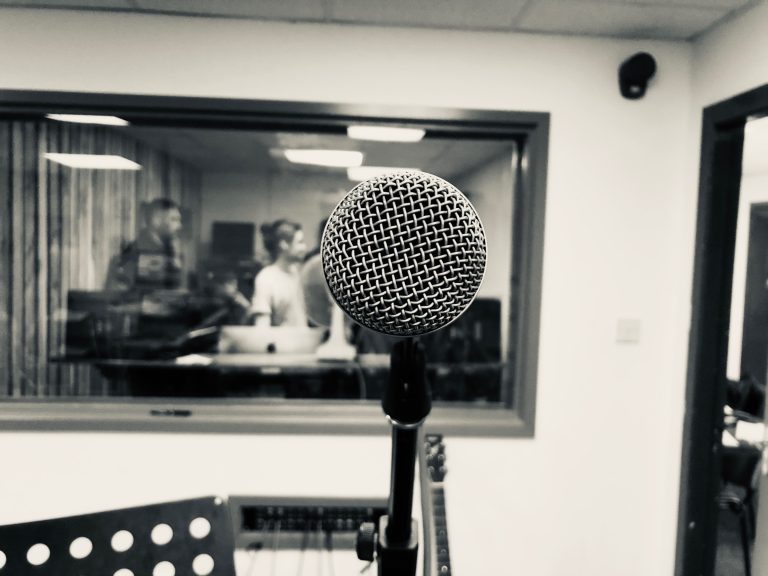
This has been my view for the last few days. I’m on a music production course at the Academy of Music and Sound in Glasgow. The course is free, and I’d thoroughly recommend it; you can also study composition and songwriting, and the Academy also runs seminars on subjects such as Women in the Music Business.
I’m loving it. I love faffing around with music anyway, but the course has been really helpful. I find with a lot of things I’m really good on the theory and terrible at the practical stuff: I could write you thousands of words on how to use a hammer, but I’d still end up smacking my thumb. Courses like the one I’m on are brilliant because they’re full of a-ha moments: the tutor does X, Y and Z and you think “a-ha! That’s how you do it!”
It’s been interesting for other reasons too. There are nine of us, and we’re all very different: different ages, different backgrounds, different interests. But we’re all united by one thing.
The knowledge that I’m the greatest human who’s ever lived.
Not really.
Only seven of them think that.
It’s music, of course. People who wouldn’t normally know one another have been happily bonding over our shared love of making a racket, and while any creative enterprise is ego central we’ve all got along very well without any diva tantrums (although there’s one more day to go, so it’s possible I’ll kick off later).
It’s been interesting for me personally. When we were dividing up the tasks – we need to write, perform and produce a song – I’d normally try and avoid anything; this time out I was jumping up and down, demanding to write and sing the vocal part. And it’s a bloody hard vocal part, which I’ve had to do repeatedly while everybody has been looking at me. Until fairly recently that would have been a terrifying prospect. Now, I’m loving it.
I’ve joked before that my terrible stage fright hid my terrifying egomania, but I’m not really joking. I love singing, and when I know I’m good – which I am, sometimes – I love singing in front of other people. I love the focus of it, the physicality of it, the feeling that for the next two and a half minutes there is nothing else in the world other than these words, this melody and the beats I’m jiggling around to.
That’s the thing about music. It gives you superpowers. It gives you the confidence to come out of your shell a bit, to use and develop your skills in a collaborate environment, to make connections with people you might normally be too shy to talk to. Music can make us better people.
That’s one of the reasons the squeeze on children’s music lessons is so awful. It’s awful because music is something worth studying, but also because the study of music is about so much more than mere music. To make or appreciate music isn’t just about art, but about science too – whether you realise it or not, you’re playing with hertz and kilohertz, resonant frequencies and all kinds of numbers I barely understand. It’s about exploring, about pushing boundaries, about discovering things about yourself and about the universe.
It’s magic.
And it’s magic that shouldn’t be limited to the children of rich parents, or of musicians.
If music goes from schools, my kids will be okay: they’re surrounded by all kinds of musical instruments and musical apps. My son plonks away on my piano or hits my drums while my daughter uses the iPad to make dubstep.
But if their peers’ parents don’t value music and/or can’t afford lessons, then making music is something they’ll be deprived of until they’re much older.
That’s not just a shame. That’s a robbery. Children’s brains are much more malleable than adult ones (as an aside, neuroplasticity in musicians is fascinating and well worth Googling), and it’s much easier to learn an instrument when you’re seven than when you’re 17 or 27. From Mozart to Paul McCartney, the most important musicians of all time were immersed in music from a very young age. Â Prince wrote his first song, “Funk Machine”, when he was seven.
If children with musical ability  lose access to music in schools, they’ll spend the rest of their lives playing catch-up. They might never achieve what they’re capable of.
This week, SNP MP Joan McAlpine is hosting the Canadian anti-trans activist Meghan Murphy. Murphy, who has been given a lifetime ban from Twitter for the targeted harassment of trans people, says she is not transphobic; she just wants to “ensure the safety of women in places like female prisons, women’s refuges, and changing rooms”. [BBC]
McAlpine says she’s an important voice in the gender recognition debate, even though the so-called debate is over a specific piece of legislation, the Gender Recognition Act, which has nothing to do with the issues McAlpine and her anti-trans pals claim to be concerned about.
As I’ve written endlessly, the Gender Recognition Act is not about access to anything. It’s about paperwork, what the taxman calls us, whether we can get married in our correct gender and whether we get buried with dignity.
Claiming it affects the definition of male and female or who can access what is untrue: both the UK and Scottish governments have said so flatly, but the howling mob refuses to listen.
The legislation that covers “prisons, women’s refuges and changing rooms” is the Equality Act 2010. That act is not under review. It enables same-sex services to exclude trans people if such exclusion is proportionate and necessary; that is not under review either.
McAlpine’s move is a deliberate act of trolling, a move to inject more anger and intolerance into an already overheated and one-sided “debate” that features far too much fiction and far too few facts and which has led to a marked increase in anti-trans sentiment and anti-trans hate crimes across the UK.
The Trump administration announced plans Wednesday to let shelters and other recipients of federal housing money discriminate against transgender people by turning them away or placing them alongside others of their birth sex — refusing to let them share facilities with people of the same gender identity.
Critics warn the proposal, which guts protections created during the Obama administration, could put transgender people at a higher risk for homelessness and abuse. The rule would allow shelters to reject transgender applicants entirely or require trans women to share bathing and sleeping facilities with men.
Why does the US need this legislation? Has there been a rash of trans women attacking women since equality legislation was introduced? No. Have men been pretending to be women to attack women in shelters? No.
Are trans kids more likely to be made homeless by family rejection than cisgender kids? Yes. Are trans adults more likely to be made homeless by being fired than cisgender adults? Yes. Does the proposed legislation mean more trans people will be attacked or left to fend for themselves on the streets? Yes.
The people behind the legislation are well aware of this, and they don’t care. The cruelty is the point.
At 19 I was fired from my job for being trans & became homeless. Women’s shelters rejected me because of my assigned gender at birth. Men’s shelters denied me for reading female. I ended up on the streets & encountered several near death experiences.
This is why the Obama administration introduced protection for trans people. Homelessness is humiliating and dangerous. It’s even more so for trans people.
Preston again:
Trump knows what he’s doing.
He does. This legislation is not the solution to a problem. Or rather, it’s not the solution to anything it purports to be a solution to. It’s designed to address something very different: the protection of transgender people and LGBT people generally.
The Obama administration introduced legislation that made it much more difficult for religious zealots to discriminate against and endanger LGBT people. The Trump administration wants to roll that back, to make America hate again.
This legislation isn’t cruel by accident. The cruelty is the point.