Can we all agree now that trans people and our allies aren’t “overreactingâ€, “misunderstanding†or “making stuff up†about the true intentions of those ranged against us? Making laws to prohibit doctors from providing evidence-based treatment is not normal and people will die.
Ellie Mae O’Hagan writes about the “anti-woke backlash”. She argues that in the 1990s and 2000s socially liberal values became the “new normal”, with even the Conservative party becoming nicer and introducing legislation such as equal marriage. It seemed unimaginable at the time, but that consensus is unravelling very quickly.
…as the tide of 90s social liberalism has ebbed, it has also revealed another group of people (primarily older, white homeowners and pensioners) who had never bought into the consensus in the first place, and are aggressively hostile to its newer, more radical iteration.
We all know a member of this demographic: alienated by the modern world and displeased by change, they are fond of complaining that “You can’t say anything any more!†– even as their opinions are widely reproduced in the nation’s print media.
And the nation’s print media are happy to pander to them, not least because they’re the demographic that still buys the nation’s print media and that advertisers most want to reach.
Having spent so long feeling silenced by the liberal consensus, people in this group have been given a new lease of life by the right’s new insurgents. Not only were they correct all along; they were actually victims, zealously persecuted by an oversensitive and censorious society. It is this righteous indignation that lends their antipathy to wokeness a defiant and almost celebratory quality. As a friend of mine puts it, we are living in “bigot Christmasâ€.
As O’Hagan points out, if this group’s claims of persecution were really true the country and the world would look very different. But just because something isn’t true doesn’t mean people don’t believe it.
O’Hagan’s piece isn’t an attack on those people. It’s a warning to the rest of us, because the so-called anti-woke are often “parroting arguments that are largely advanced by the far right”. And they’re winning.
Progressives need to wise up to the fact that they are losing this argument and decide what they are going to do in response. If they don’t, they may soon find that the future they always assumed was theirs is being made without them.
Katelyn Burns reports on the coordinated assault on trans kids’ healthcare by right-wing US lawmakers.
eight state legislatures — including Missouri, Florida, Illinois, Oklahoma, Colorado, South Carolina, Kentucky, and South Dakota — have already introduced bills this year that would criminally punish doctors who follow best practices for treating adolescents with gender dysphoria. In South Dakota, for example, doctors who prescribe puberty blockers or cross-sex hormones could face a $2,000 fine and a year in prison under the proposed law. South Dakota’s version of the bill was even prioritized and became the very first bill of the decade to pass out of committee… should any of the bills become law, they would effectively cut off many adolescents from medically necessary and, often, life-saving treatment for gender dysphoria.
…Bills banning trans care for kids are the new bathroom bills, part of conservatives’ larger culture war against trans people. Conservative media and politicians have been fanning the flames for this fight for years in hopes of rallying the base over a non-existent threat — a threat that only puts trans lives in danger.
Whenever the religious right realises a tactic isn’t working, it finds a new one. When it lost its war on equal marriage, it changed tactics and started attacking trans people – it’s no coincidence that the current media obsession with trans people began after 2017, when various evangelical groups agreed and began to implement their new focus on demonising trans women.
At first, they tried to make people scared of trans women in public places, but the public is well aware that you’re more likely to be sexually assaulted by a Republican politician or evangelical rabble-rouser than a trans person. So they refined that one and started to say that predatory men would pretend to be trans so that they could start acting like Republican politicians.
That didn’t fly either, so it’s time to kill some kids.
Puberty blockers are rarely prescribed. When they are, they save lives.
But of course, bigots don’t really do facts – especially when there are votes to be won.  “Your children are under threat from minority X and only I can protect them” may be one of the oldest and most despicable political tactics in the book, but it works so it’s being rolled out again. Under the pretence of protecting children, these yahoos are quite happy at the prospect of killing quite a few of them. What’s a few more dead trans kids to people who wish trans people didn’t exist at all?
We’re starting to see exactly the same thing shift in strategy happening here in the UK, although not from openly evangelical and/or right-wing groups: from the same anti-trans activists who previously parroted the evangelical right’s previous attack lines and whose suspiciously well funded pressure groups didn’t exist before the evangelicals started their war on trans people in 2017. Many of those groups have overt or covert links to the US evangelical group The Heritage Foundation, which plays a key role in the US bills.
What conservative lawmakers are doing with their legislation is removing parents’ and kids’ choices altogether, forcing their own political ideology on the medical choices of private citizens.
This is a murderous ideology that chants “think of the children!” while trying to ban healthcare that keeps some of them alive.
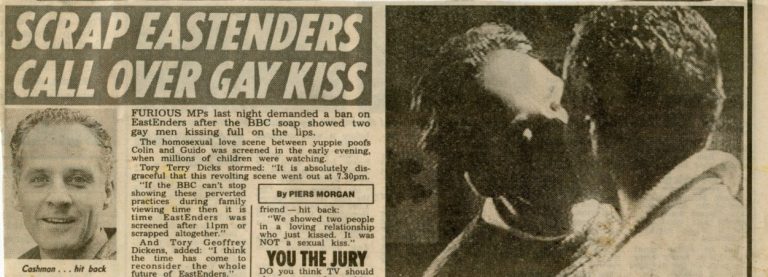
Remember the tabloid outrage about the first gay kiss in EastEnders? Cashman was the man they were demonising. The clipping above, incidentally, is by Piers Morgan. Morgan would also write article such as “the poofs of pop”, a regular feature speculating on whether particular pop stars were gay in which he called up stars’ agents and demanded to know what their sexual orientation was.
Cashman was nervous at the thought of the press scrutiny that could follow, but agreed. Even before his character was announced, the Sun ran a story about the role under the headline “Eastbendersâ€.
“What made it worse,†says Cashman, now 69 and sitting in his fourth-floor Limehouse apartment overlooking the Thames, “was the information was leaked from inside.†The Sunday Mirror, meanwhile, claimed that he had had an HIV test in the US and was dying. The News of the World ran a double-page spread, headlined “Secret Gay Love of Aids Scare EastEnderâ€, which outed his partner and printed the couple’s photos and address.
There was even an attempt to orchestrate “sinister†stories about him.
…When news broke that Cashman’s character would share the first gay kiss in a British soap (a peck on the forehead), the backlash only intensified. Campaigners such as Mary Whitehouse railed against it; the BBC was besieged by angry letters and phone calls; on more than one occasion a brick was thrown through Cashman’s window.
It’s a fascinating read and I’m sure Cashman’s autobiography is even more so. It’s a powerful reminder of how far we’ve come in a relatively short period of time as well as a shocking story of how badly and sometimes violently gay men have been treated in this country.
Stonewall, the charity Cashman founded, was created in response to the hateful Section 28 legislation and the lack of action to battle HIV, then routinely described as a “gay plague” and dismissed as a fiction by the Sunday Times under the editorship of Andrew Neil. The Sun ran one editorial claiming that “Straight Sex Cannot Give You AIDS – Official”.
Stonewall didn’t initially include trans people in its campaigning – that changed in 2015 when then-chief Ruth Hunt described that lack of inclusion as a mistake – but Cashman can see the parallels between how trans people are treated now and how gay men and women were treated in Stonewall’s early days.
“To bring in section 28 against a group of people who should have been supported and nurtured and loved. To do that was viciousness beyond imagining.â€
Throughout the 80s and 90s, gay people were often portrayed as predators by media organisations supportive of section 28. Cashman sees similarities in the way the trans community is treated today. And he is concerned that some lesbian, gay and bisexual people are joining in.
“If I don’t stand up for the rights of others, how can my own rights ever be defended?†he says. “The fact that lesbian and gay people are willing to sacrifice trans people …we’re rolling back the clock.â€
Cashman’s autobiography, One of Them, will be published in February.
My Twitter feed is full of concert announcements today. Edinburgh’s hosting shows in August by the likes of The 1975 and Tom Jones. Glasgow Green has concerts including the TRNSMT festival, Guns N Roses and Green Day. Kelvingrove bandstand has Belinda Carlisle, KT Tunstall, Richard Hawley and even Rick Astley.
As much as I love live music I can’t help noticing that these are all taking place not in concert venues but in public spaces: Princes Street Gardens, Glasgow Green, Kelvingrove. The latter is the least disruptive because it’s in a dedicated bandstand section, but the others involve putting fences around huge parts of our public spaces so people paying £177 for a VIP ticket can see Guns’N’Roses.
It does seem that for the very biggest shows, public parks are being used rather than stadiums – and while that’s good news for gig-goers because stadium acoustics are always awful, it’s bad news for the people who can’t access huge parts of our parks for most of the summer (and in the case of Edinburgh, for most of the festive period too). Parks are a crucial part of our cities, especially in the better weather.
I’m not suggesting we stop doing the shows. I’ve been to some really great gigs in Kelvingrove, and I’ve seen a few decent acts on Glasgow Green. But I really don’t recall seeing so many gigs booked so close together for so much of the summer in so many of our public spaces.
It feels as if our councils are taking the places that belong to all of us and putting up No Entry signs for anyone who isn’t affluent.
Yomi Adegoke writes about the increasing use of polarised, gladiatorial “debates” to try and get social media attention.
The BBC has said it will no longer have climate change deniers in debate with climate change activists, as it’s a “false balanceâ€. Yet the topic of racism is handled in the same way a TV programme might treat the topic of extraterrestrials; punctuated with a large question mark.
Lecturers, authors and professors for whom this is their life’s work and personal experience, are pit against talking-heads whose qualifications to discuss racism appear to be the fact that they’re white, pissed off, and more often than not, perpetrators of the very racism they’re discussing.
It’s not just race. I can very much relate to this:
as the conversation surrounding race in the UK becomes more toxic, I’ve received more requests to partake in this type of debate on TV more than ever. And like several other black journalists I know, I have been immediately sceptical about the motivation behind this newfound eagerness to debate topics the media has historically sidelined.
The UK media had absolutely no interest in trans people until 2017. We’ve had so-called self-ID in law since the 1970s and in practice since the 1940s. The original Gender Recognition Act, which enables us to change our birth certificates and HMRC details, passed without fuss in 2004. The Equality Act, which gives us protection from discrimination and legislates about access to single-sex spaces, has been law for a decade.
And yet again and again we’re seeing trans people and allies being put up against people who are the gender equivalents of anti-vaxxers or climate change deniers: denying science, demonstrating profound ignorance of the law, claiming that the medical establishment is part of a conspiracy and that trans people are some kind of sinister lobby hell-bent on destroying civilisation and stealing your children. Repeatedly platforming them is either due to incompetence – there’s a distinct lack of fact-checking around these so-called debates, with complete fabrications often being aired unchallenged – cynical traffic-chasing or malice.
There are not always two sides to a story; differing positions do not always have equal weight. To pretend otherwise in the hope of generating social media traffic is despicable and dangerous.
NHS Greater Glasgow and NHS Lothian have teamed up to research the experiences and health needs of LGBT+ people in Scotland. The full report is here. It’s part of a wider study that includes a literature review and that will help inform future planning.
It’s a long and often very saddening report, with people sharing some often very traumatic experiences.
A couple of bits that jumped out for me:
A common theme in the interviews and group discussions was the change in recent years to society in general becoming more accepting of LGBT+ people, particularly people with gay and lesbian identities. This was in part attributed to equality legislation. Societal attitudes towards trans, non-binary and bisexual people were felt not to have become as accepting to the same degree. Indeed, many felt that attitudes towards trans people, particularly trans women, had taken a ‘backward step’ in recent times, largely attributed to a very negative narrative around trans identities widely reported in the media and particularly social media, often in reference to the campaign around the Gender Reform Act. Many felt that inflammatory media reporting had a measurable impact on how trans and non-binary people were treated in public.
Despite the progress, almost every participant had experienced homophobia, biphobia or transphobia in a wide variety of settings.
Many LGBT+ people who participated in the research recounted incidents where they had been threatened or intimidated because of their identity – but they rarely viewed incidents such as being shouted at in the street or name calling as ‘hate crime’, and did not report them to the police.
…Exposure to negative opinions and stories in the media, particularly social media had an effect particularly on how safe trans women felt. Many trans women spoke about how media reports affected their anxiety and feelings of safety.
…There was much discussion from all LGBT+ groups about the current discourse on social media against trans people, particularly trans women.
Depression and isolation were common.
A common theme for all LGBT+ identities was the struggle to work out their sexual orientation and/or their gender identity, and the toll which their period preceding their self-discovery took on their mental health. Usually, there was a period where they fought against their identity or did not want to accept it. This was more pronounced in environments and circumstances where having an LGBT+ identity would be more difficult (e.g. more deprived areas, rural areas, certain faith and cultural groups), and could lead to internalised homophobia/transphobia which could prevail after coming out.
…Trans men and women and non- binary people were particularly likely to speak about suicidal thoughts, although these tended to subside after transition.
LGBT+ people of all kinds reported being unable to take part in certain forms of physical activity. Trans men and women reported no longer being comfortable in swimming pools or gyms, while gay men often felt excluded by the “laddish culture” in many sports.
Many trans and non-binary people spoke about doing exercises such as yoga alone at home rather than in a class setting because they did not feel they could participate with others. One trans woman described how she went to the gym at 2am because the gym was almost empty at that time and she was also able to use the disabled changing cubicle. A trans man said he could only use the gym if he changed at home.
There is much, much more – GPs lacking crucial knowledge, lesbian and bisexual women being treated terribly by healthcare providers, horrific waiting lists for pretty much everything, people being scared to talk about mental health issues for fear it would be used against them. The report also explores the experiences of people of various faiths, of people with disabilities and of asylum seekers.
The research isn’t entirely negative, but the picture that emerges again and again is of LGBT+ people struggling against multiple issues including severely underfunded health provision, social isolation and other people’s prejudices – and of social and mainstream media actively fuelling those prejudices.
Writing in The Guardian, august journalism commentator Roy Greenslade writes about a crisis that never existed: the supposed immigration crisis facing the UK.
“It never was news. It was a wholly media-manufactured ‘crisis’,” he writes. Editors “readily published evidence of individual misbehaviour as if it was a universal problem”, published “dodgy figures, as if plucked from mid-air” and ignored facts “in favour of appealing to public prejudice.” They published endless streams of thinly-veiled bigotry from their columnists. They were guilty of “ignoring rational arguments that exposed their distorted agenda” to inflame their readers against a group that in reality is a persecuted minority.
And it worked, because these papers also drive the wider news agenda: what they print is then picked up by the likes of the Today Programme and discussed on Question Time. It gets circulated on social media and regurgitated on talk radio.
At the peak of the anti-immigrant newspaper scare, 60% of people thought immigration was the most important issue affecting the country. Now the papers have largely stopped their scaremongering, that figure has dropped to 20%.
As Greenslade put it, the newspapers manufactured the so-called crisis “through repetition, disinformation, misinformation… and the omission of any positive material.”
The papers stopped demonising immigrants because it no longer sold copies. That has created a vacuum – when your newspaper’s editorial policy is to scare your readers every day, you still need an enemy.
The papers haven’t stopped trying to scare their readers or abandoned their dirty tricks. They’ve just chosen a different minority to demonise.
This week, various outlets gave yet more publicity to the LGB Alliance, a single-issue anti-trans hate group that purports to be about LGB people’s rights but has no policies about, er, LGB people’s rights. This hasn’t stopped Scotland’s press and BBC Radio Scotland giving them uncritical coverage and endless opportunities to scaremonger about trans people.
It’s incredibly one-sided. The LGB Alliance’s co-founder and director got to rabbit on about supposedly dangerous trans people all week – BBC Radio Scotland’s John Beattie programme even had him on as an expert in biology to question whether trans women were “women or (merely) trans women”, because who better to talk about the complexity of biology than a film director? – but when he also claimed that predatory gay teachers would show children gay pornography and prey on them in LGBT school groups not a single mainstream news outlet picked up on it. They don’t seem interested in the LGB Alliance’s full-page newspaper ads promoting organisations that are against life-saving treatment for gay men and organisations that were founded by anti-semitic conspiracy theorists, or the fact that they are linked to the US right-wing heritage foundation which campaigns against women’s rights and LGB people’s rights.
As far as the Scottish media is concerned, if the LGB Alliance says they represent the views of the LGB community, then they must clearly represent the views of the LGB community.
They don’t, and Scotland’s LGB people are getting pretty sick of it. So today, over 70 Scots LGBT groups large and small and their allies have published an open letter stating their support for trans people and gender recognition reform.
Signed by sports groups, health charities, independence-supporting groups, Pride organisations and police-affiliated LGBT groups, the letter goes on: “We have been concerned by attempts by some to isolate the trans community from the wider LGBT community; this goes against everything we stand for. Trans people are the women, men, and non-binary people that they say they are.â€
I don’t expect this to change the uncritical support our press is giving the LGB Alliance. Our press continues to pretend gender recognition reform is not supported by women’s groups, even though every major women’s group in Scotland supports GRA reform; they continue to misrepresent anti-trans hate groups as representative of feminists or women generally.
But it’s important to realise that when the LGB Alliance claim to be speaking on behalf of LGB people, the Aberdeen LGBTQ+ Forum, Amazing Gracies, Auld Reekie Roller Derby, Ayrshire LGBT+ Education Network, Ayrshire LGBTQ, Ayrshire Pride, Bute LGBT+, Bute Pride, Caledonian Thebans RFC, Colinton Squashers, ConnexONS Fife, Dumfries & Galloway LGBT Plus, Dundee Frontrunners, Dundee Pride, Dundee University LGBT+ Society, Dunoon Pride, Edinburgh Frontrunners, Edinburgh Racqueteers, Edinburgh STRIDE, Edinburgh University Staff Pride Network, Equality Network, Four Pillars, Free Pride Glasgow, Glasgow Alphas RFC, Grampian Pride, Hebridean Pride, Highland LGBT Forum, Highland Pride, HIV Scotland, HotScots FC, LEAP Sports Scotland, LGBT Health and Wellbeing, LGBT Unity, LGBT Youth Scotland, LGBT+ Conservatives, LGBT+ Labour Scotland, Moray LGBT, NetworQ Orkney, Oban Pride, Orkney Pride, Out for Independence, Out On Sundays, PCS Proud, Perth Parrots Floorball Club, Perthshire Pride, Pink Saltire, Pride East Kilbride, Pride Edinburgh, Pride Glasgow, Pride in the Borders, Pride Proms Project, Pride Saltire – East Lothian, Queer Ephemera, Queer Napier, Rainbow Glasgaroos, Rainbow Greens, Saltire Thistle FC, Scene Alba Magazine, Scene Radio, Scottish Borders LGBT Equality, Scottish LGBTI Police Association, Sisters Scotland, SQIFF, Stirling University LGBTQ+ Society, Stonewall Scotland, SX Health, Terrence Higgins Trust Scotland, Time For Inclusive Education, Vale Pride, Waverley Care, West Lothian Pride and Winter Pride Scotland have made it very clear that they do not.
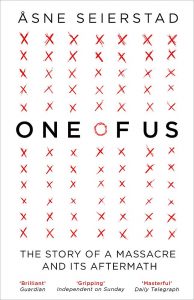
I’ve just finished One Of Us by Ã…sne Seierstad. It’s very similar to Dave Cullen’s Columbine in that it’s an incredibly powerful piece of non-fiction about a massacre largely inspired by white supremacist rhetoric. In this case, the massacre is the 2011 bombing and subsequent gun massacre by Anders Brevik, who slaughtered 77 people.
It’s an extraordinary, shocking and upsetting book that tells the stories of the victims as well as the story of the massacre and the utter incompetence that enabled Breivik to kill so many people; as a piece of journalism it’s an incredible work.
It’s also deeply chilling. Breivik is seen as a hero in some right-wing circles and has been the inspiration for subsequent shootings, and the beliefs that radicalised him are commonplace in our mainstream and social media today.
Breivik was particularly enamoured of the UK writer Melanie Phillips, who he quoted multiple times in his poisonous manifesto. Phillips is famous for writing guff like this:
The traditional family […] has been relentlessly attacked by an alliance of feminists, gay rights activists, divorce lawyers and cultural Marxists who grasped that this was the surest way to destroy Western society.
Cultural marxism is an anti-semitic term based on an anti-semitic conspiracy theory dating back to the 1920s. Breivik used it over 600 times in his manifesto. It appears with similar frequency in the Daily Mail.
The Guardian:
The theory of cultural Marxism is also blatantly antisemitic, drawing on the idea of Jews as a fifth column bringing down western civilisation from within, a racist trope that has a longer history than Marxism. Like the Protocols of the Elders of Zion, the theory was fabricated to order, for a special purpose: the institution and perpetuation of culture war.
…It allows those smarting from a loss of privilege to be offered the shroud of victimhood, by pointing to a shadowy, omnipresent, quasi-foreign elite who are attempting to destroy all that is good in the world. It offers an explanation for the decline of families, small towns, patriarchal authority, and unchallenged white power: a vast, century-long left wing conspiracy.
Breivik was an islamophobe, but his targets were not Muslims: they were left-wing kids he believed were “cultural Marxists”.
The bulk of the document constitutes a compilation of texts mainly copied from US far-Right websites… These writers are paranoid conspiracy theorists who claim Islam is a totalitarian political ideology that aims at infiltrating national institutions in order to enact sharia law. Like Breivik, they blame Western elites for pandering to multiculturalism and enabling “Islamic colonisation of Europe†through “demographic warfareâ€.
…It would be easy to dismiss Breivik’s beliefs as the ramblings of a man gone insane. But that would be to ignore the danger they represent. His case demonstrates that the new “anti-Islamist†far-Right is as compatible with terrorist violence as older forms of neo-Nazism. And, whereas neo-Nazism is a fringe phenomenon, anti-Islamism attracts wide support, including among mainstream politicians, newspaper columnists and well-funded think-tanks.
…what about the ideas that inspired Breivik? To be sure, the likes of Spencer, Wilders or Bawer do not preach violent revolution. They never told anyone to kill a Muslim, let alone a “cultural Marxistâ€. But their talk of war, of a Muslim threat to our civilisation, “Eurabia†and of the complicity of cultural elites in our imminent downfall, does create a toxic climate in which fantasists such as Breivik can find a justification for their horrible deeds.
Breivik may or may not be a madman. The court psychiatrists in Oslo differed on this. In the end it was decided that he was not. But that ideas have consequences cannot be denied. This book throws a great deal of light on the life and times of a miserable killer. That he had a sick imagination is clear. More is to be said about the ideas that fed it.
Ideas that have continued to inspire murderer after murderer after murderer.
The pattern is becoming frighteningly familiar: A white man, radicalized online at alt-right media websites and through social media into hateful white nationalist beliefs built around the anti-Semitic conspiracy theories about “cultural Marxism,†walks into a mass gathering of his selected targets (which can be any of the perceived participants in the conspiracy, including liberals, Jews, Muslims, Latinos, any nonwhite person, LGBTQ folk, even moviegoers) and opens fire.
Neiwert describes what he calls “chain terrorism”, where murderers such as Breivik and the people who inspired them go on to inspire the next generation of mass murderers.
Brian Levin of the Center for the Study of Extremism and Hate at California State University, San Bernadino, says the newer dynamic replicates the old content, but everything happens with much greater speed. “In pre-Internet days, the violent extremist act itself of neo-Nazis and white supremacists was considered messaging and labeled ‘propaganda of the deed,’†he told Daily Kos. “Today, sociopaths, particularly ideological ones, are seeing social media not just as a radicalizing and messaging tool, but also as an archive of a folkloric warrior narrative,†he continued. “Once they too act out, they have a link to notorious killers of the past, where their new manifestos are inscribed in a continuing perverse online subculture of scripted violence.â€
This is a narrative Donald Trump has long echoed, especially with his attacks on “political correctness.†For potential terrorists, it’s also embedded in a very specific, dynamically evolving matrix of right-wing political activity and institutions that marks out a wide range of other targets for retribution, up to and including mass murder.
Anyone who’s traditionally of lower status — women, minorities, non-Christians, immigrants, LGBTQ individuals, etc. — is a potential target.

 I’ve just finished One Of Us by Ã…sne Seierstad. It’s very similar to Dave Cullen’s Columbine in that it’s an incredibly powerful piece of non-fiction about a massacre largely inspired by white supremacist rhetoric. In this case, the massacre is the 2011 bombing and subsequent gun massacre by Anders Brevik, who slaughtered 77 people.