The amount of column inches that have been devoted to abusing trans people. The amount of energy and money! It’s like there are these endless resources to do this and yet there is no evidence that trans people are causing problems.
…We’re less than 1% of the population. For all the talk of a “trans lobbyâ€, the truth is we don’t have any MPs. I think we have one high court judge. We don’t have royalty or pop stars or chat show hosts.
…We need help – we can’t do this on our own. We need people to be real allies and show up in solidarity.
I had an appointment at the Sandyford clinic the other week. It’s where you go to get your official trans membership badge, where you learn the secret trans handshake and where you’re issued with your copy of the sinister transgender agenda. If you go often enough you get a free Richard Littlejohn voodoo doll.
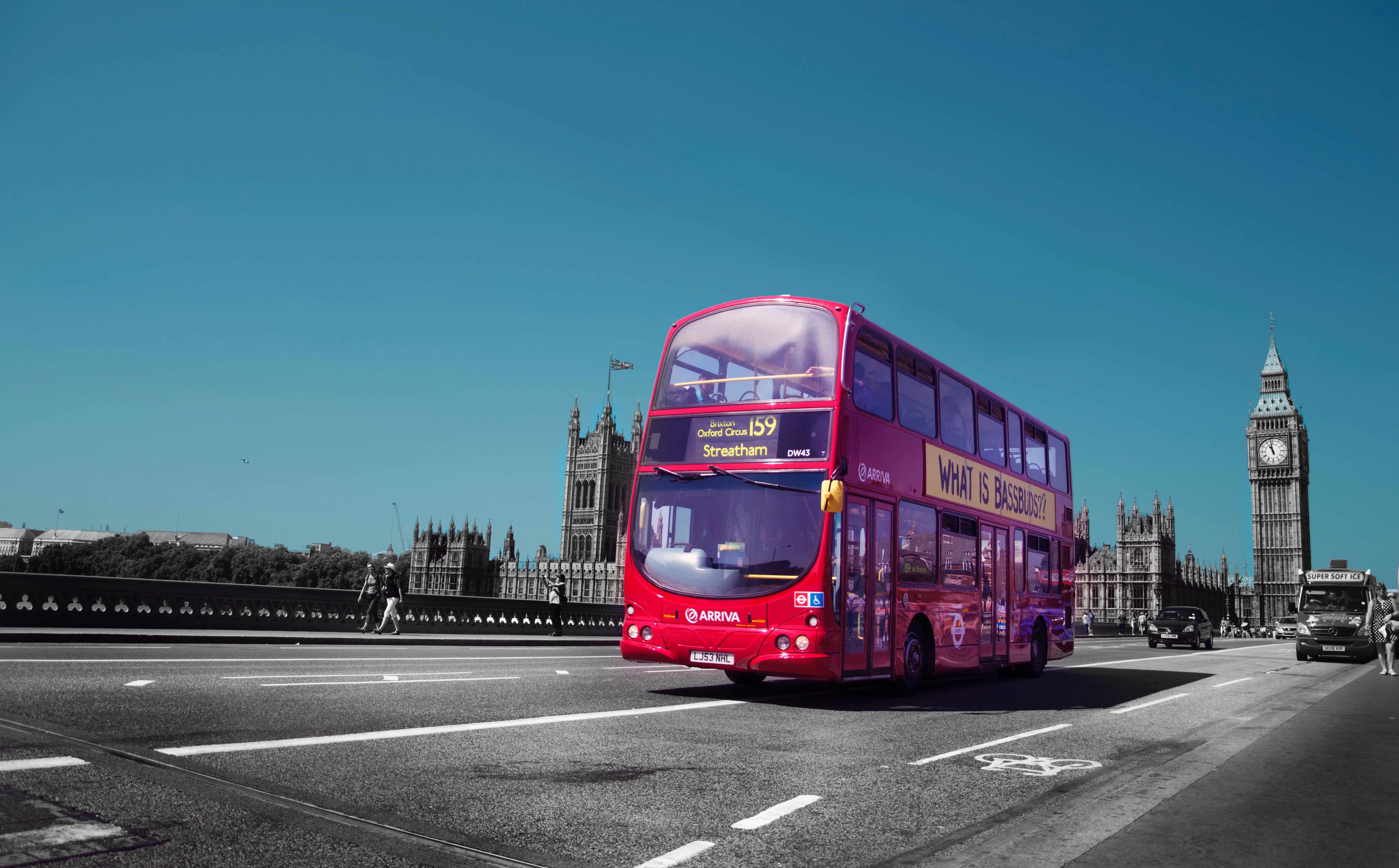
Gallows humour aside, it’s a place many trans people go because it’s the only gender identity clinic in the West of Scotland. The likelihood that you’ll be there at the same time as several other trans women is very high; the likelihood that you’ll be heading there at the same time as other trans women is high too. So it was hardly a huge surprise when I got on the bus and an older trans woman got on after me.
If she’s reading this, I hope I’m wrong about you. I hope your life is full of joy and wonder, that the days are just packed and that everything I assumed about you was wrong. Because when I looked at you, I jumped to conclusions, all of them negative.
You looked miserable in a shapeless coat and a dated wig. You avoided making eye contact with anybody, spent the short trip staring at the floor, your body language submissive. Don’t look at me.Â
You looked like somebody who’s learned that to be noticed is to attract the wrong kind of attention.Â
What I should have done when we got off the bus was to smile in recognition. Not in a “you’re busted!†way or to strike up a conversation; nobody feels particularly chatty on the way to a doctor’s appointment. Just an friendly acknowledgement from one marginalised person to another: I see you.
What I actually did was to distance myself.
I distanced myself because there were three young men hanging around the traffic lights and I was scared they’d notice me; notice you; notice us. Two trans women, ripe for mockery, maybe more. So I walked a little faster, the clip-clop of my heels faster than your footsteps in your flats. I chose self-preservation over solidarity, and of course the danger was entirely imagined. The men looked right through me, and right through you too.Â
I distanced myself because I was scared you’re a mirror. In my head I see two futures. In one, I’m happy. Still young, ish; fun and funny and fashionable and fulfilled with a loving family and a really hot girlfriend. That’s who I was trying to be that day in my skinny jeans, tunic top, Primark boots and take-no-shit swagger.
And in the other I’m one of the transsexuals I remember from 1980s documentaries, miserable in unflattering florals, mooching round a tatty C&A while security guards stare.Â
Dowdy. Downtrodden.Â
I don’t fear much any more, but I fear that.
You looked downtrodden, and God help me I acted like that was contagious.
I distanced myself because like many people of my age and older, I grew up in a culture where trans women (and it’s always the women) were portrayed as pitiful or perverts or both. Some of that stuck. You can’t swim in polluted water and come out clean. It’s why it took me so long to be proud of who I am, and why I wasn’t proud enough to walk too close to you.
I’m deeply ashamed of that. It’s not who I want to be, who I strive to be. Everybody has the voice urging them to throw others under the bus to save their own skin, but I try not to listen to it: I don’t want to be the one with Anne Frank in the attic shouting “she’s in the loft!†whenever I hear footsteps on the path outside. And yet all I needed to do was smile, and I didn’t do it.
If you’re reading this, I’m sorry. You deserve better. We all do.Â
So if we use a house as a metaphor: your genes are the blueprints, your epigentics are the engineers that read the blueprints and tell contractors how to build it, and your phenotype is the finished structure.
Your epigenetics read your DNA, and switches certain genes on and off as needed. For example: Every cell in your body has the DNA to be a liver cell. The only thing preventing you from being a mass of liver cells is your epigenetics saying “lets maybe build some nerve cells”
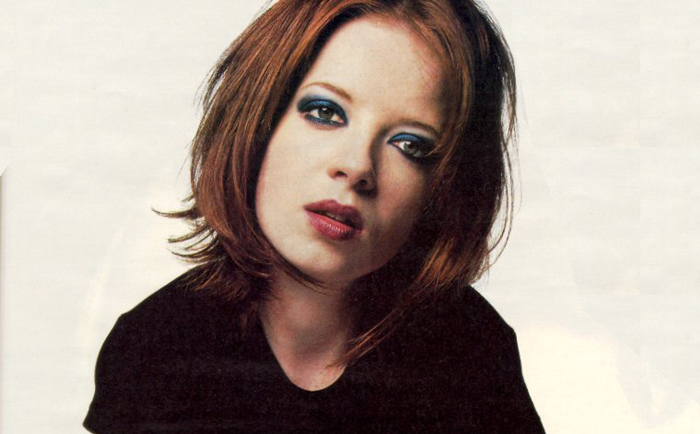
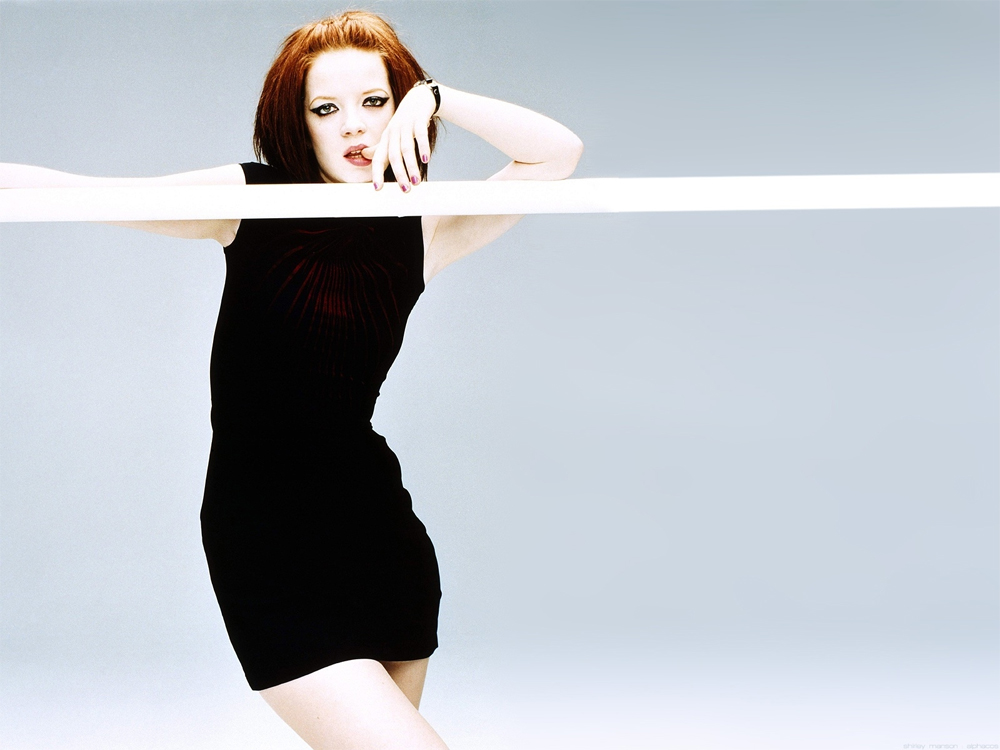
I’ve had a massive crush on Shirley Manson for more than 20 years.
To be honest, I’m suspicious of anybody who doesn’t have a massive crush on Shirley Manson. Fierce, funny, impossibly talented, Scottish, ginger and drop-dead gorgeous, the Garbage singer is one of rock’s great personalities, and the way she rocked her combination of cute dress, black tights, clumpy boots and fuck-you attitude did all kinds of things to me back in the day. She’s just as amazing now, and I’m absolutely convinced that if I were to meet her I’d be incapable of speech.
There’s a saying about rock stars that the fans of your own gender want to be you and the ones of the other gender want to be with you. With Manson I always felt both: if I could have magically transformed myself into somebody else it would have been Shirley every time. Especially Shirley in the Only Happy When It Rains video.
I still feel like that today. When I discovered by accident that I had bought a dress very similar to one Shirley wore recently, I damn near exploded with delight.
I think that’s something she’d approve of. She’s long spoken out on behalf of the outsiders, the “queerest of the queerâ€, and it’s a recurring motif in her music. The first time I saw the Androgyny video – Manson blurring gender roles while singing “boys in the girl’s room, girls in the men’s room, you free your mind with your androgynyâ€, her lascivious, lusty “boyyyyyyys†and “girrrrrrrrls†punctuating the chorus – I had to have smelling salts and a lie down.
I never tried to be Shirley Manson in real life. The look and the attitude were for my imagination, not my everyday: androgyny wasn’t the kind of thing you could get away with in my town, and I’d never pass as a woman.
Before I transitioned, I had a very palpable sense of the “tooâ€: I was too tall, too fat, too bald to ever be a “real†woman, so what would be the point of even trying to transition? It’s a common sentiment among trans woman and a direct result of the impossibly narrow box within which society confines women’s appearances. For many trans women, male puberty puts cisnormative beauty permanently out of reach; for others, the idea that the world could see them the same way that they see themselves is the stuff of fantasy.
And that’s a great shame, because that fear holds us back from being ourselves, from experiencing the world as it should be.
This is something I’ve been thinking about a lot of late because I’m still in the transitioning trenches, trying to work out my identity and how I want to exist in the world. The judging Katelyn writes about makes me feel pretty crappy quite a lot of the time, but sometimes the heavens align and I feel pretty damn good about myself.
It happened the other night. I was going to see an avowedly trans-inclusive punk rock band, so instead of my more usual androgyny I decided to let my inner Garbage fan come out. I chose a dress I really, really love, teamed it with thick black tights, got my make-up just right and spent a bit of time sorting my hair out. And I looked bloody amazing.
I’m under no illusions about what I look like: I’m very tall, very big, overweight. But when my presentation gets close to looking like the person I want to be, there’s a joy I find really hard to describe, a feeling that everything has magically clicked into place.
And sometimes other people validate that. I’ve been chatted up by strangers at gigs, complimented by women in bars, received throwaway comments that have kept me walking on air for days. Before I went to my punk gig, I popped into my local to see some friendly faces: I might have felt amazing, but the prospect of going into town wearing a dress for the very first time was still frightening, not least because I was going to meet a friend who had never seen me presenting as Carrie before. So I needed to do it in stages: go to a familiar place first, and then go on into town when the fear had subsided a bit.
I’m glad I did, because when I walked in one of my women friends was there. “You look really pretty!†she said, grinning delightedly before adding “Is it okay for me to say that?†When I reassured her that not only was it okay, but it’d be even more okay if she could just say it a few hundred more times and maybe put it in writing too, she laughed and told me that “seriously, you look really hotâ€.
Before I came out I never dreamed I would ever be told I was pretty, let alone hot. One of the great sadnesses of not coming out until later in life is that you’re stuck with a body that’s developed in all the wrong ways. But while I’ll never be mistaken for a pretty young anything that doesn’t mean I can’t be proudly, unapologetically, confidently me. Whoever you are, whatever you identify as, being true to yourself is pretty damn hot.
I’m going to see Garbage on tour later this year. I’ll be the one dancing really badly in a cute dress.
This is powerful and wonderful. It’s from BBC’s The Social, the bit where Auntie Beeb gives a platform to voices you don’t necessarily hear very often on the main channels’ output. Its comedy output is consistently hilarious, but it’s in the serious stuff where it really shines.
This one’s about something simple: being in love.
The video’s made it to the excellently intelligent discussion site MetaFilter, which has resulted in a really interesting discussion.
Here’s Mudpuppie, on how LGBT people police their own behaviour in public:
Be careful who you touch in public, and how, and be mindful of who’s watching. Be careful how you refer to your partner, and be mindful of who’s listening. Constrain your public hellos and goodbyes. Be careful how you present yourself, lest you offend someone who reacts to that offense with violence, either physical or verbal or metaphorical: Something less than a punch, maybe, but not nothing.
Sciatrix agrees, but adds a positive that I’ve definitely experienced:
…there’s a world of difference between a straight person’s enthusiastic grin and the quiet chin jerk from the dapper gentleman on the bus, the particular pleased crinkle of eyes from the woman on my walk to work when I’ve buzzed my hair again, the slouching, tow-headed tilt of recognition in the kid in the back, the lit eyes of the student on the edge of the room… There’s a quiet kind of seeing each other that’s totally unrelated to the straight, cis world except inasmuch as none of us fit inside it. For all that we don’t always speak the same languages or the same community concepts, we all speak the lingua franca of hello, I see you and can you believe it?
There’s something lovely about that, too.
I’ve only experienced a little of it, but Sciatrix is right. There’s something really lovely about it.
Among the positive outcomes of gender transition and related medical treatments for transgender individuals are improved quality of life, greater relationship satisfaction, higher self-esteem and confidence, and reductions in anxiety, depression, suicidality, and substance use.
…regrets following gender transition are extremely rare and have become even rarer as both surgical techniques and social support have improved.
The Caledonian Sleeper train is in the news after the latest concerted “pile-on” (their words) by anti-trans activists who organise on Mumsnet: they don’t want trans people on sleeper trains.
(It’s interesting to see people with hateful views, many of whom advocate violence against minorities, hiding behind the label “mumsnet user” and abusing the stereotype of mums as nice, unthreatening and sensible people who can’t possibly be vicious bigots. The US religious right trades in similar tropes.)
Later this year, the service is changing so that people won’t be sharing with strangers at all, so the risk of feeling “uncomfortable” will be removed entirely. But even now it’s a non-issue, as Dr Brooke Magnanti explained on Twitter:
A lot of people piling on @CalSleeper about gender clearly have never used the service; they can if they wish select single occupancy and sleep by themselves; alternatively, there are sleeper seats in an open carriage where anyone can sit next to anyone.
You can also travel with friends and family and share your cabin with them.
As someone who has travelled these routes regularly, it is in fact only seldom that you actually end up sharing with a stranger. And most people use the Sleeper for its intended purpose: TO SLEEP.
If you feel uncomfortable with your assigned berthmate, you can change when you arrive (the old Sleeper system used to designate anyone with ‘Dr’ as male, so I had to do this on the platform a couple of times)
Every carriage has an attendant, and every berth has an emergency and attendant call button if anything happens. You can change once the journey is underway; I was reassigned an empty cabin due to noisy/drunk person in the top bunk once.
I fully support trans people.@CalSleeper, the folks piling on you now are doing it for publicity and headlines. They aren’t even your customers.
This is something I’ve had to think about. I’m going to a concert in That London in the summer and considered the Sleeper, because it’s by far the most convenient and cost-effective option. But I decided against it: on the one hand my fear of sharing with a bloke (the same fear women have, plus the extra risk of abuse that LGBT people face), on the other my concern about making someone uncomfortable by my mere presence.
So instead, I’m flying and staying in a hotel. It’s going to cost considerably more money and it’s considerably less convenient but I’m fortunate in that I can choose that option.
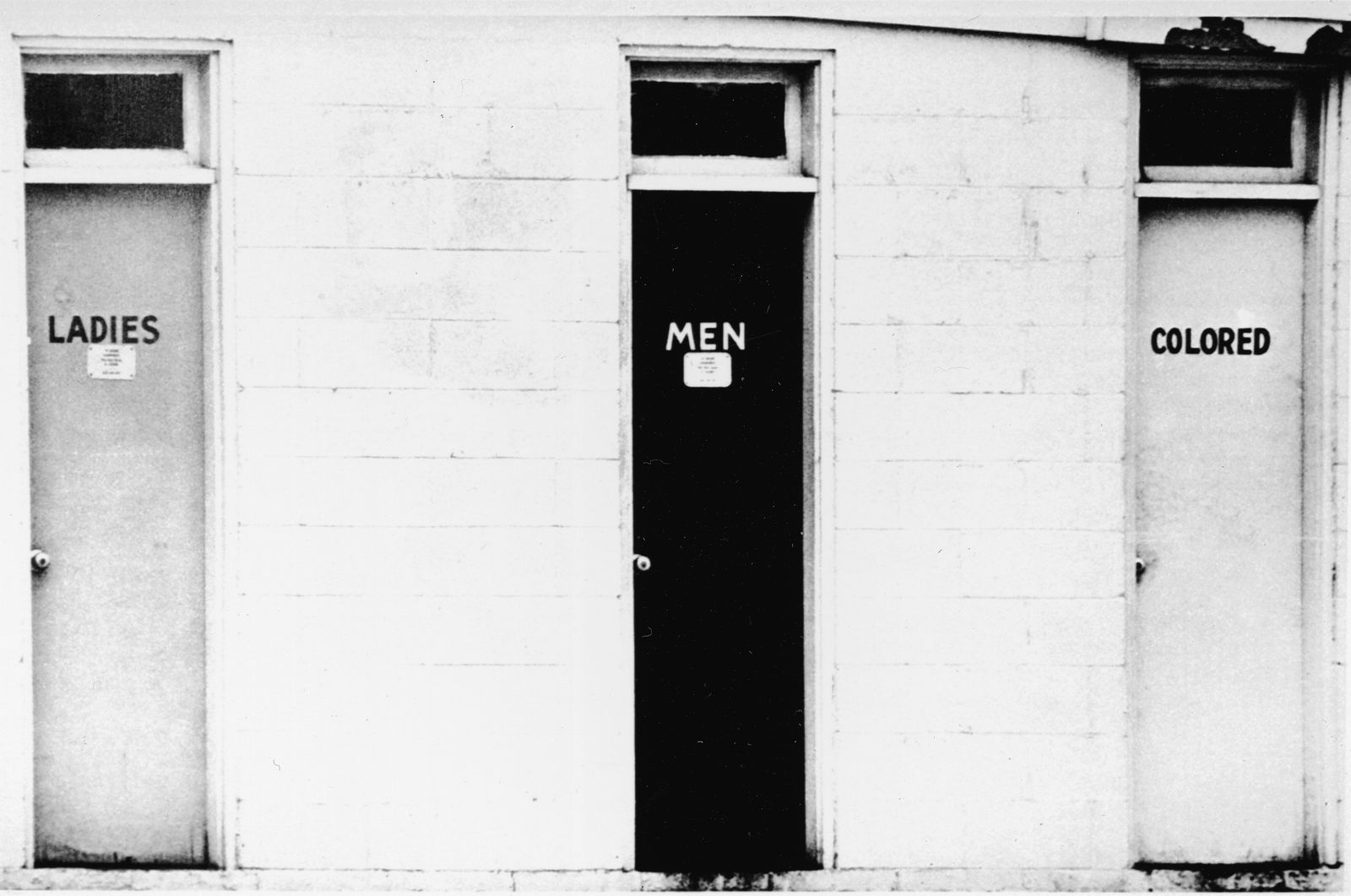
Not everybody can. And that’s the problem with the current wave of anti-trans bile coming from Mumsnet and being parroted, unquestioned, in the media and on social media. It’s about policing where we can go, about limiting our ability to live normally. We’ve even got supposedly sensible newspaper columnists advocating segregated bathrooms, an idea that we’ve seen somewhere before:
What extremists did then, and what their spiritual heirs are doing now, is weaponising people’s fear of the other, of the unknown. Their goal isn’t to protect anybody. It’s to erase a victimised minority, to prevent them from living normally, to exclude them from public spaces and public life.
Don’t let the labels fool you: what bigots are doing on Mumsnet is the same radicalisation the alt-right racists and anti-semites have been doing on Reddit and other social media.
They’re not protecting women. They’re grooming them.
Here’s a happy story: Jake and Hannah got married this week. Jake’s an actor, Hannah’s an army officer and the photos show a clearly delighted couple in love. I don’t know Hannah but I’m connected to Jake on Facebook and he strikes me as a thoroughly excellent human being, so it’s really lovely to see the wedding pics.
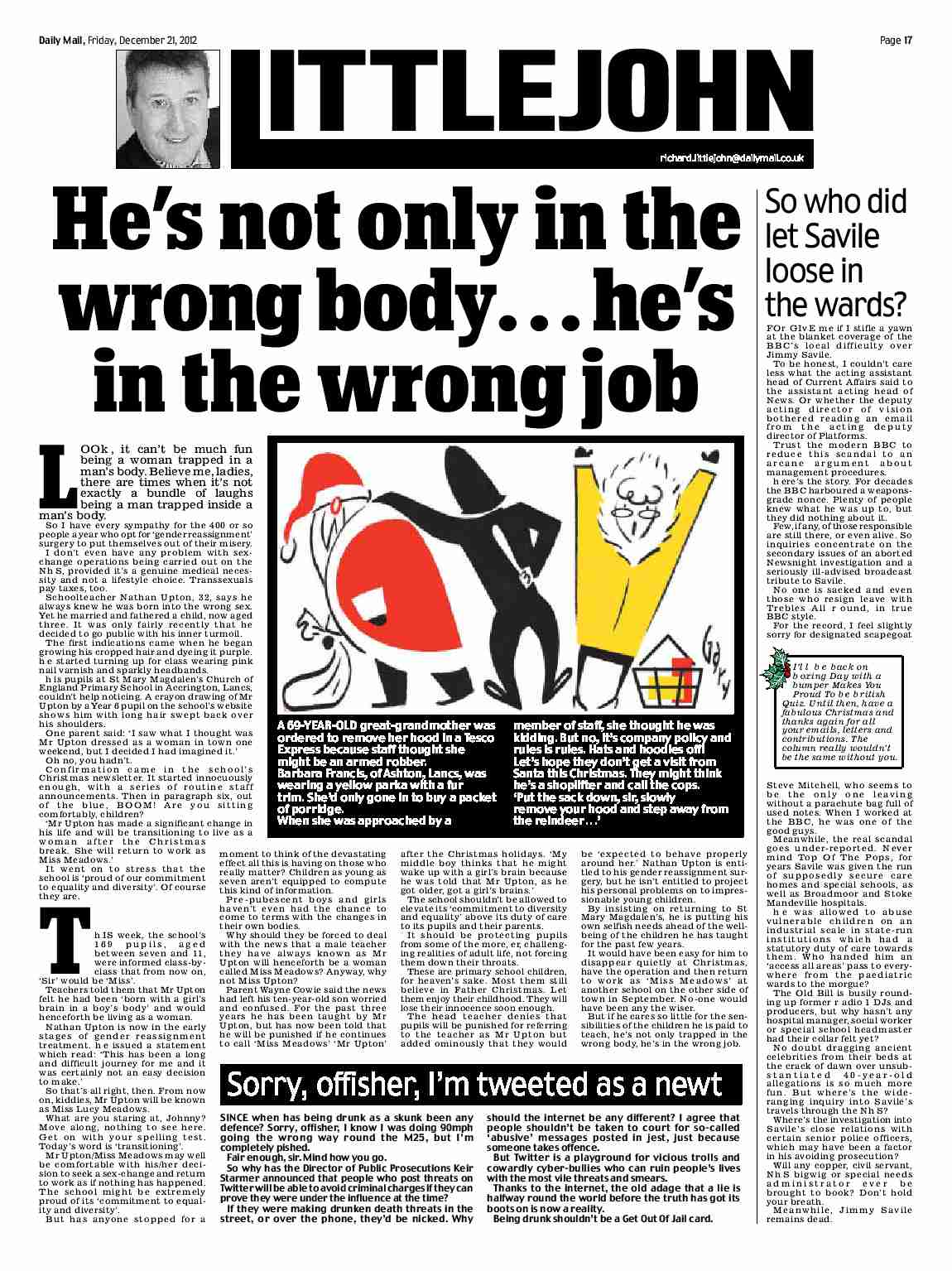
The thoroughly repellent Richard Littlejohn has written yet another anti-trans piece in the papers. It’s not significant in itself; it’s the usual bile from a man who rails against “vicious trolls” while being a vicious troll.
But it’s significant because it’s been published five years since another Littlejohn column was implicated in the death of a trans woman.
Lucy Meadows was 32. She taught year six, pupils aged 10-11, at the St Mary Magdalen’s Church of England Primary School in Accrington, in England. She had a young son.
And in March 2013 she killed herself.
Lucy left a note, which said:
I try to do things the right way to make people feel more comfortable with it. I have simply had enough of living. I have no regrets other than leaving behind those who are dear to me and of causing them pain in doing so. I would like to thank everyone who has had an impact in my life.
Lucy had left another note, this one at the front door. Warning, it said. The house is full of carbon monoxide. Don’t come in.
By all accounts, that was typical of her. Thoughtful. Caring about other people, even at the very end.
The coroner confirmed the cause of death: cardio respiratory failure due to carbon monoxide toxicity. But while he said that Lucy had taken her own life, he had another message to share.
Lucy hadn’t been born Lucy, and she transitioned to live as a woman full-time in Christmas 2012. Her school was very supportive. Head teacher Karen Hardman spoke to each primary school class about the change their teacher would be going through, and it was mentioned as an aside in the school’s Christmas newsletter: “[Name] has recently made a significant change in his life and will be transitioning to live as a woman.”
One parent wasn’t happy and contacted the local newspaper, the Accrington Observer. The story went national. Meadows’ transition was “inappropriate” and children were “too young” to be “dealing with that.”
What should have been a private matter was front page news. The press argued that because the school had written parents a letter, the story was in the public domain. And because of that, they made Meadows’ life hell.
The first and most visible consequence of “press interest” is the press pack turning up on your doorstep. They appeared, en masse, to besiege Lucy in her home. Reporters. Photographers. Camera crew. You name it.
…It might have been less bad if the press could have been relied on to report honestly. But as Lucy noted at the time, they weren’t interested in the many, many positive comments that parents gave out in her support. No: they cared only about the man with the confused child and his petition.
Nor was it just biased reporting. Some columnists – the Daily Mail’s Richard Littlejohn led the way –simply used their columns, read by millions of people, to attack a woman who wanted only to live her life in peace.
The Mail is so proud of this column they removed it from their online archive.
Deliberately misgendering Meadows as “he” throughout the piece and deadnaming her – that is, using her given name rather than her female name – Littlejohn’s piece began with the headline “He’s not only in the wrong body”¦ he’s in the wrong job” and became more offensive as it went on.
“The school shouldn’t be allowed to elevate its ‘commitment to diversity and equality’ above its duty of care to its pupils and their parents,” Littlejohn wrote. “It should be protecting pupils from some of the more, er, challenging realities of adult life, not forcing them down their throats. These are primary school children, for heaven’s sake. Most them still believe in Father Christmas. Let them enjoy their childhood. They will lose their innocence soon enough.”
He continued: “[Deadname] is entitled to his gender reassignment surgery, but he isn’t entitled to project his personal problems on to impressionable young children. By insisting on returning to St Mary Magdalen’s, he is putting his own selfish needs ahead of the well-being of the children he has taught for the past few years.”
That’s not just a dog whistle. That’s a whole pet shop.
And in March 2013, Lucy Meadows was dead.
There were petitions to have Littlejohn fired and complaints to the press complaints commission, but the Daily Mail stood by its star columnist, as newspapers do unless the libel bills get too much. A spokesman said: “Richard Littlejohn’s column emphatically defended the rights of people to have sex change operations but echoed some parents’ concerns about whether it was right to for children to have to confront such complex gender problems at such a vulnerable young age.”
The Mail is so proud of the article that it has quietly deleted it from its online archive. But it was never censured for it. If you’ve ever complained about newspaper articles to the regulator IPSO, you’ll know that their definitions of unacceptable behaviour are so narrow it seems that no publication is ever guilty of anything.
The coroner didn’t agree that the coverage was fair. It “sought to humiliate and ridicule” Meadows, he said.
Lucy Meadows was not somebody who had thrust herself into the public limelight. She was not a celebrity. She had done nothing wrong. Her only crime was to be different. Not by choice but by some trick of nature. And yet the press saw fit to treat her in the way that they did.

 Here’s a happy story: Jake and Hannah got married this week. Jake’s an actor, Hannah’s an army officer and the photos show a clearly delighted couple in love. I don’t know Hannah but I’m connected to Jake on Facebook and he strikes me as a thoroughly excellent human being, so it’s really lovely to see the wedding pics.