Category: LGBTQ+

  • Every day’s a school day

    I got a taxi home last night. I think it’s safe to assume that there aren’t many openly trans people getting taxis from that Glasgow suburb: when the driver clocked that my appearance was rather different from my voice he had a lot of questions, all of them deeply personal and inappropriate.

    I could have been offended, but I thought it was really funny.

    Don’t get me wrong. I absolutely understand people who don’t see why it’s up to them to educate the wider world, and who think it’s exceptionally rude to ask a stranger what’s in their pants and whether they’re planning to change that – because of course, it is exceptionally rude. But I also think that if somebody’s intent is genuine, if they’re asking because they want to understand, then it’s okay to have a conversation.

    I was talking about this with a friend shortly afterwards, and she said that she didn’t think it was fair: people who aren’t LGBT don’t have to endure deeply personal questioning from LGBT people when they’re out and about. And I agree with her. In an ideal world people wouldn’t need to ask those kinds of questions, because trans people wouldn’t be “other”.

    Unfortunately, though, it isn’t an ideal world. There’s no shortage of bad actors peddling bad information about people like me. So which is better: telling the driver it’s none of his damned business and leaving him with a negative impression of trans people, or being open and funny and  busting a few myths?

    There are days I don’t feel like that, days where just being noticed is too much. But on other days I’d rather have the conversation, because in a very small way I think it helps.

    I’ve said before that most people probably don’t know any openly trans men or women: the best guesstimate is that we’re around 1% of the population, and an awful lot of us are in the closet. That means the information most people have about trans folk is about us but not from us, and as a result that information is often wrong. That means you can see these conversations not as negatives, but positives: they’re an opportunity to correct misinformation, to be seen rather than read about.

    For some of us, every day is a school day. Most days, I think that’s okay.
  • Cake day

    There’s a thing some trans people do on social media to mark “Cake Day”, the anniversary of them starting transition: it’s usually (but not always) the anniversary of them starting HRT. It’s my first Cake Day today.

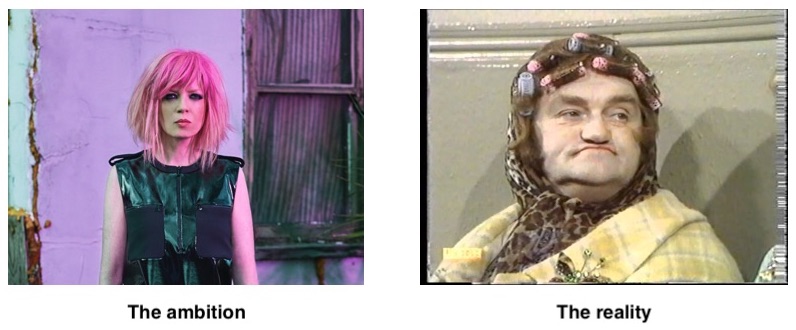
    Cake Day is often celebrated by posting before and after photos, usually showing a really miserable person in the before and a really cute and happy person in the after. Unfortunately for me I can’t do that because (a) I’m much older than most of the people who post pics and (b) I look exactly the same except fatter. So here’s my version.

    Messing around aside, Cake Day photos can be really valuable when you’re still in the closet. I wrote about them a while back:

    I’d spent endless hours looking at trans women’s HRT transition timelines, the photographic evidence of the cumulative effects of hormone treatment and improving make-up skills. I actively searched for timelines of middle-aged MTF trans women, trying to see what was the result of HRT and what was just better lighting, good makeup and a cute smile.

    Looking at such images wasn’t new, nor was the strong yearning I felt to be one of the people in the pictures. I’ve had those things since I’ve had internet access. But something was different now. I no longer saw the photos as pictures of transformations that, for me, would be impossible and unattainable.

    I started to see them as maps of the possible.

    What struck me wasn’t the physical transformation; it was the difference in the way they looked at the camera, the smiles reaching their eyes. Even relatively minor physical transformations looked spectacular because of the difference in the way people held themselves and looked at the camera.

    Each timeline was the same story: unhappy people finally becoming happy in their own skin. I wanted that too.

    I might not look like Shirley Manson, and I never will. But a year on, I’m becoming happy in my own skin.

  • Identity and community

    I was reading a lot of blogs over the weekend, and one comment in particular really stood out for me:

    We don’t choose to be LGBTQ, but we choose whether to be part of the LGBTQ community.

    I think that’s very true. I didn’t choose to be trans, but I can choose whether to see myself as part of a wider community of people.

    That doesn’t mean uncritical support of everybody else, or even being nice to people I don’t like, or making placards and marching around the place (although all of those things can of course be really positive).

    It means understanding that you’re part of something bigger, that while your personal experiences and circumstances are different from other people’s you have common struggles and often, common enemies.

    Not everybody believes that, or believes it’s important enough to overcome their own self-interest. Wherever there’s a minority you’ll find a minority in that minority that doesn’t want to be associated with the wider group. In some cases they’ll even act in ways that are damaging to the wider group.

    For example, among gay men there’s a schism between “masc” – hyper-masculine – gay men and  their less macho peers. Some lesbian women have a real problem with bisexual women. And in trans circles there’s the long-running schism between what some call the TTT (Trannier Than Thou) brigade and trans people who haven’t had any medical treatment. In some cases TTT people actively campaign against rights for trans people in much the same way turkeys vote for Christmas.

    These schisms are all different, but they all have the same thing in common. Members of a group are demanding to be considered separately from other members of the same group.

    Sometimes it’s naked careerism: there’s money to be made by throwing your peers under the bus, especially in right-wing publications. Sometimes it’s neediness, the same thing that sometimes encourages the bullied to suck up to bullies in the hope that they might be spared and which lends legitimacy to bigots. If you want to be the equivalent of the only black person in UKIP, there’s always a vacancy.

    But a big part of it, I’m sure, is self hatred and internalised phobia. I’ve experienced it myself. “I don’t want people to think I’m like THOSE people.”

    And of course there’s self-interest too. If you’re in a group that’s under attack, there’s a concern that THOSE people are going to attract unwanted attention and that you’ll be caught up in it.

    I think there are two kinds of responses to that. The first is to say “fuck those people”, to run for the lifeboats while pushing women and children out of the way.

    You can see it in the famous attitude expressed by some affluent, conservative gay men who argue that “the battle for equality has been won”: they have equal marriage. The wholesale dismantling of LGBT people’s rights is of no concern to them, because it does not affect them. You can see it in op-eds by superannuated post-op transsexuals who transitioned a hundred years ago and who don’t appreciate young trans people demanding change. You see it in gay politicians who share sob stories about their teenage mental health traumas while leading a party that’s done terrible damage to mental health services.

    They’re all right, Jack. Fuck you.

    The other response is to say: I’m one of those people.

    I’m one of those people.

    I joked the other day that I’m a “real” trans person now: I have a medical diagnosis, and that means to some of the TTT brigade I’m valid in a way I wasn’t the day before I had the piece of paper with “transsexualism” written on it (although to some that still isn’t enough: if you haven’t had surgery, you’re faking it). It’s official. I’m not one of THOSE people any more.

    But in the wider world, I’m still one of those people.

    No matter how many fawning Facebook friends you have or how impressive your Twitter impressions or how many column inches you scrapbook, if you’re LGBT then it doesn’t matter if you’re gay, lesbian or bi, non-op, post-op or non-conforming. To many, you are one of those people, and you’ll be treated like those people, and demonised like those people, and discriminated against like those people, and hated like those people.

    Every one of us is one of THOSE people to somebody.

  • Real, real, real

    I got a letter from the NHS yesterday. I’ve been waiting for it for a long time.

    I’ve been waiting a long time because while it was dictated on the 9th of July, it wasn’t typed until the 2nd of August and didn’t get here until the 14th of September. It had been sent by mistake to my previous GP (NHS systems are not joined up, it turns out: just because my GP has the right details doesn’t mean other bits of the NHS do), and as my previous GP is an arse he didn’t let the sender know that I’m not his patient any more.

    Trans people are used to waiting, though. The letter is from the Sandyford gender identity service, to which I self-referred in October 2016. It’s taken 23 months to get a written diagnosis.

    This is it.

    The codes are from the World Health Organisation, and they’re out of date: as of June 2018, being trans is no longer considered to be a mental disorder and has been removed from the International Classification of Diseases, as homosexuality was in the 1970s. It takes a while for the medical establishment to catch up, though, so at the moment trans stuff still comes under the umbrella of mental health.

    So this is a bit of a double-edged sword, because on the one hand it’s confirmation that I’m not making this shit up – but on the other it gives me a pathology, a label of ‘disorder’ for something that the medical and psychiatric consensus agrees is not a disorder. There is nothing wrong with me, because being trans is just part of the infinite variety of human brains and bodies.

    But that’s a rant for another day. What difference does having a diagnosis actually make?

    The short answer is “not much”. It means the end of having to go to and pay for a private GP for my supervised hormone treatment, and it means all my healthcare is now in the hands of my (great!) local GP surgery. Although the savings I’ll make from not paying for prescriptions are dwarfed by the costs of electrolysis now my NHS funding has run out: I’m saving about £50 a month and paying out around £150 a week.

    The bigger picture? It makes no difference whatsoever. Being a “real” trans woman, ie someone who’s gone through the various gatekeepers, doesn’t impress the trannier-than-thou brigade for whom the only “real” trans people are the ones who’ve had bottom surgery. And it doesn’t make me any more acceptable to the bigots who lie and say they have no issues with “real” trans people.

    Mainly, though, it’s no big deal because it’s already in the rear view mirror. I know I’m trans. This is just the admin finally catching up.

  • “Why now, after all this time?”

    I’m a big fan of the writer Jenny Boylan, and about a month back I posted a link to a Twitter thread where she talked about being a late transitioning trans woman. She’s now turned it into a column for the New York Times.

    People often ask late transitioners, why now, after all this time? What kind of woman do you think you can be, after missing your girlhood and your adolescence? But those aren’t the questions one should ask.

    The question is, how did you manage to go so long? What enabled you to keep carrying your burden in secret, walking around with a shard of glass in your foot, for all those years?

    This story may be less about what it is like to come out as trans than it is about finding the courage to do a difficult thing, even if you are no longer young, even if you do not know how. Trans people are surely not the only ones who wonder how to close the gap between the people they feel they have to pretend to be and their authentic selves.

  • Think of the children

    This is Maddie. She’s 12.

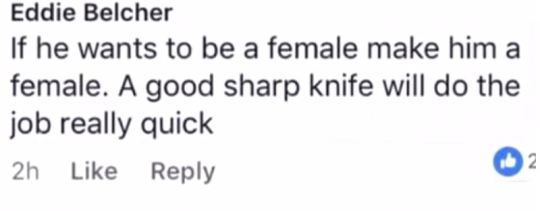
    She’s “the transgender”, “the thing”, the “lil half baked maggot” that parents of other kids think should be sorted out with “a good sharp knife”.

    Maddie’s story went viral. I thought it was upsetting enough, but then I watched the Vice News video report. Seeing a wee girl pretending to be braver than she feels made the whole thing even more heartbreaking.

    Please watch it. One of the reasons anti-trans sentiment still spreads is because many of us don’t know any trans people. It’s easy to mistrust and even hate people you don’t know, people you’re told are different, and some of the worst people exploit that. But it’s a lot harder to hate when you see someone who’s just like your own kids (Maddie is only slightly older than my daughter. The thought of anybody, let alone parents, ganging up on her…), because of course trans people are just people.

    It’s not a long film, but there are plenty of moments to break your heart, to make you angry and sad. The police not so subtly implying that the filmmakers should get out of town or expect violence from the locals. The school board discussing everything but the case. The town mayor, who’s gay, having obvious difficulty defending bigotry. But the moment that really jumped out for me was an almost throwaway remark: when Maddie came to town, nobody knew she was trans until a teacher pulled the old records and told others.

    Teachers are supposed to be the protectors of our children.

    This particular case went viral, and strangers’ fundraising has enabled Maddie’s family to move to somewhere less backward. But there have been and will be many more Maddies whose stories you won’t hear, and for whom nobody will crowdfund anything.

  • “Self-knowledge rarely comes packaged in a single coherent narrative”

    Stock photo. Inclusion does not imply any model's gender identity or orientation.

    There’s a good piece in The Conversation by Tey Meadow, assistant professor of sociology at Columbia University, on the hot-button topic of gender non-conforming kids.

    I know the language around this stuff can be confusing if you’re not steeped in it. By gender non-conforming we mean rejecting stereotypical gendered things, so for example a girl who refuses to grow her hair long or wear dresses is gender non-conforming, or GNC for short. A boy who’d rather play with Barbie than Action Man is GNC, and so on.

    Gender non-conforming doesn’t mean transgender. The overwhelming majority of GNC kids just have finely tuned bullshit detectors and a whole bunch of individuality.

    I can understand why parents might panic over gender non-conforming behaviour. For some, it’s the terror of having a gay kid, which still persists. But for others it’s the knowledge that to have a trans kid means dealing with a whole bunch of shit that parents of cisgender kids don’t have to deal with.

    In the current climate it’s to know that your child will face abuse from all kinds: not just arseholes in the street but school run mums on messageboards and middle-class women in newspapers. It’s to know that your child may have to make agonising decisions about their body and their place in the world that their peers won’t have to make. It’s to know that your child will be discriminated against, and demonised.

    But, again: most gender non-conforming kids aren’t trans.

    More importantly, they’re not being pressured to identify as trans.

    Quite the opposite. The few kids who are persistent, insistent and consistent about their gender identity have to spend months and sometimes years being assessed before even something as simple as puberty blockers may be prescribed.

    The media really doesn’t help when it flatly lies about the treatment offered to gender non-conforming kids, publishing propaganda from pressure groups claiming that the entire system is fast-tracking vulnerable kids on a high-speed conveyor towards surgery. It isn’t (and congratulations if you spotted the “they are coming for our children!” trope as used by every bigoted group since the beginning of time).

    A tiny, tiny proportion of gender non-conforming kids are trans; most aren’t, and those kids aren’t fast-tracked to anything.

    Meadow:

    [the] model doesn’t push kids toward a transgender outcome or even a linear narrative. Instead, clinicians teach parents to pause, absorb the messages their children are sending and then articulate what they are seeing back to their children. Parents and psychologists help children express their genders in authentic ways, and then work to understand the significance of the things they are saying and doing. It takes times and practice.

    The constant misinformation in the media and on social media is letting gender non-conforming kids, trans kids and their parents down.

    Meadow again:

    Gender-nonconforming children who are supported by their parents in expressing their identities by and large thrive. In fact, recent studies show that trans youth who are affirmed and supported by their families to transition are psychologically healthier than children who are gender-nonconforming but receive no such encouragement.

    The emerging consensus is about educating and supporting parents to help their kids thrive, not forcing kids into boxes they don’t fit into.

    The last thing any trans adult wants is for a cisgender kid to be wrongly diagnosed as trans. We know all too painfully what it’s like to be forced to be somebody you’re not.

  • Face off

    One of the many joys of being a late transitioning trans woman is that you have a choice: you can be a bearded lady, you can get used to shaving two or three times a day, or you can have facial electrolysis to remove your stubble. If you’re younger or darker-haired there’s another option, laser hair removal, but it doesn’t work on grey, blonde or ginger hair so that rules me out.

    As much as I’m in favour of breaking gender norms the Conchita Wurst beard-blue-eyeshadow-and-blusher combination doesn’t work for me, and I hate bloody shaving. So electrolysis it is.

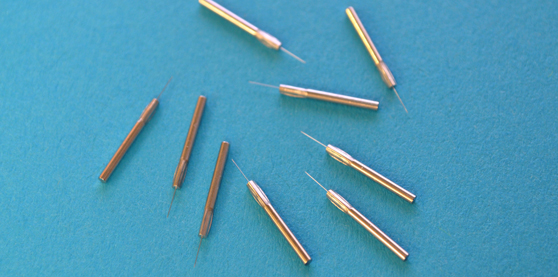
    Electrolysis is a process where a highly skilled technician uses a tiny probe to remove all the money from your bank account.

    I’m not kidding. I’ve been approved for 15 hours of NHS-funded treatment. Unfortunately the typical born-male face has around 30,000 follicles, each of which has to be treated individually, and the process takes between 100 and 200 hours over a year or two. For some trans women who have thicker or darker hair than me that number can be as high as 400 hours.

    Once you’ve used up your NHS funding you then have to pay for the rest yourself. The clinic recommended by the NHS in Glasgow charges £72 per hour, although there’s a 10% discount if you block-book ten sessions. That brings the price down to £64.80 per hour.

    Let’s assume I’ll need 150 hours. Less my 15 hours of NHS funding that’s just 135 more hours: 130 at £64.80 per hour and the remaining 5 at £72 per hour.

    That’s 130 x 64.80, which works out as £8,424, plus 5 x 72, which is a further £360.

    As a conservative estimate, then, this is going to cost me £8,784.

    I’m sure it’ll be worth it in the long run, because stubble is the ticking clock in my Cinderella story: if I’m going to be out for more than a few hours I need to decide what I’m going to do about shaving. I currently shave twice a day, sometimes three times if it’s going to be a late night. But in the medium term it’s awful.

    It’s awful for several reasons. The first and most obvious reason is that it’s bloody sore.

    Lying on a table for two hours as individual follicles are electrocuted and heated before the hair is yanked out with tweezers isn’t a great deal of fun. It’s particularly awful on bits where there isn’t much fat, such as close to the jawline, and when it’s done anywhere that bit of my face doesn’t calm down for about two days afterwards. For the first 24 hours I look like I’ve been stung by angry wasps.

    The literature tells you that most patients find electrolysis mildly uncomfortable rather than sore, but those patients are women and their hair is easier and less painful to remove. Whenever you see electrolysis illustrated it’s always a shot of a serene-looking young woman with porcelain skin, not a middle-aged trans woman shouting JESUS FUCKING CHRIST I FELT THAT IN MY TEETH.

    The main reason it’s awful, though, is that in order to remove stubble there needs to be some stubble to remove. And while I’m glad I don’t have the kind of Desperate Dan chin that gives a five o’clock shadow fifteen minutes after shaving, it means I can’t shave for the days running up to each electrolysis appointment – or immediately after the appointment, when the skin is angry.

    What that means is that to keep a weekly schedule, I have to spend most of my week presenting male: if I’m getting stubble yanked out of my face on Thursday, I can’t shave after Monday morning and can’t shave again until Saturday. If I do a really good job on Monday morning I can get away with being me into Monday evening, but Tuesday through Friday means presenting male. That’s four days a week of people double-taking at my name, four days a week of trying not to see my own reflection, four days a week that feel like the biggest backwards step imaginable.

    I’m sure it’ll get easier once the most obvious bits of stubble are gone and I no longer need to shave them. But for now the prospect of doing this for another year and a half isn’t exactly filling my soul with joy.


  • Nothing’s shocking

    A US school district has cancelled classes after parents made multiple violent threats against a 12-year-old trans girl.

    The only thing I find shocking about this is that it’s made headlines. There are plenty of examples of parents bullying young trans people online.

    This case began with a mum stirring up hatred. If you think that’s unusual or that it  only happens in small town America, you’d be very much mistaken.

  • “It is never too late to live your life”

    Jenny Boylan, novelist, columnist and author of the excellent memoir She’s Not There, posted a really worthwhile thread on Twitter today. I’ll give you a flavour:

    People often ask late-transitioners, Why now? After all this time? What kind of woman do you think you can be, after missing your girlhood and your adolescence? But those aren’t the questions.

    The question is, How did you manage to go so long? What enabled you to keep carrying your burden in secret, walking around with a shard of glass in your foot, for all those years?