Category: LGBTQ+

  • A simple message

    Liberty:

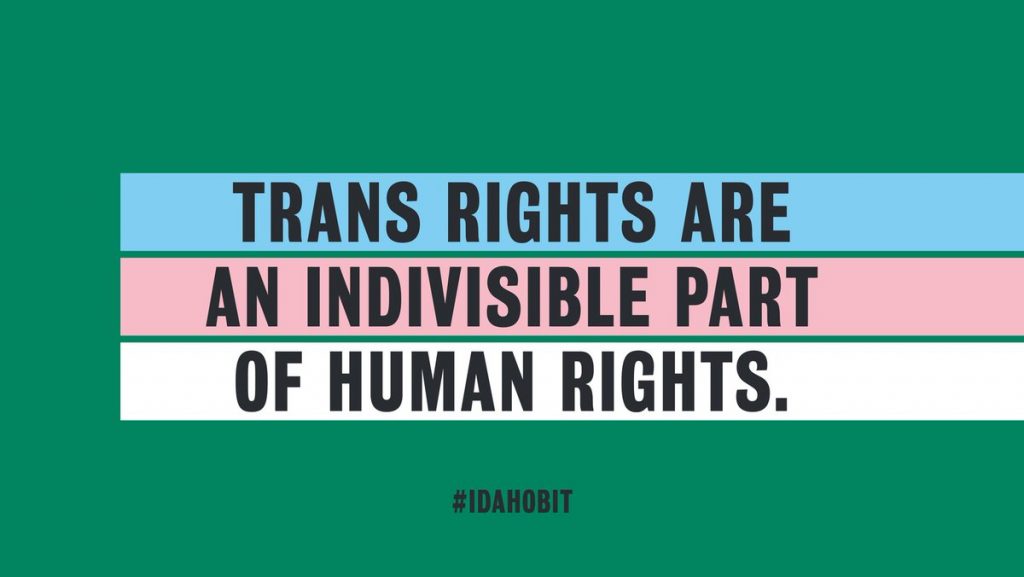
    Liberty joins other UK human rights organisations to say: trans rights are human rights.

    In a joint statement with Amnesty International UK and Human Rights Watch it says:

    “Human rights are universal and belong to everyone. Yet too often in the UK trans people are spoken about and treated as though their rights don’t matter.

    The toxic media coverage about trans people has recently spiked. At times of crisis and political change, marginalised groups are often singled out for abuse and hate. History has shown us time and time again the dangers of setting the rights of one marginalised group up for debate. But we know that our rights and freedoms are bound together.

    What’s more, this isn’t an equal conversation or level playing field. Key voices are missing – trans and non-binary people, and in particular young trans people. They are so often spoken about, not listened to. As a society, we need to make space so they can be finally heard without having to defend who they are.

    We need to do this because denying rights leads to dehumanisation.

    This is already happening in Hungary, Russia and the US, where trans people are facing serious human rights abuses, and new and vicious attacks on their fundamental rights.

    We cannot allow this to happen here. Today, as we mark the International Day Against Homophobia, Biphobia and Transphobia (IDAHOBIT), our collective of UK human rights organisations wants to remind people that trans rights are an indivisible part of human rights.”

    Benjamin Ward, UK Director of Human Rights Watch said: “For too long now, trans people in the UK have been dehumanised and their voices silenced.” said Benjamin Ward, UK Director at Human Rights Watch. “It’s time for people in the UK to stand together with trans people and for the human rights and humanity we all share.”

    Kate Allen, Director of Amnesty International UK, said: “Trans people often face extreme discrimination, and right now we’re seeing growing threats to their human rights in the UK and abroad. But the biggest human rights organisations are united by their side – we won’t rest until trans people can live freely as themselves, without inequality or abuse.”

    Martha Spurrier, Director of Liberty, said: “We must, as a human rights movement, demonstrate that we will forever stand by the side of trans people and I’m proud to join others to spread this message on International Day Against Homophobia, Biphobia and Transphobia.”

  • What is transphobia, anyway?

    I mentioned that today is the international day against homophobia, biphobia and transphobia but I don’t think I’ve ever explained what transphobia actually is. The Trans Actual website has put together a comprehensive explanation.

    Transphobia, like homophobia and biphobia, is an umbrella term to describe various negative attitudes towards people based on a single characteristic: who they love, or who they are.

    You can be perfectly pleasant to trans, gay or bi people and still be transphobic, homophobic or biphobic; you can vote for equal marriage but feel uncomfortable around gay people, use trans people’s pronouns but think they’re mentally ill, accept that bisexual people exist but believe that bisexuality means promiscuity or sexual greed. And while that’s not ideal, you’re not directly hurting anybody. But unfortunately some people with transphobic, homophobic or biphobic beliefs do hurt people – not necessarily physically, although god knows there’s plenty of that, but also by discriminating against them or making their lives more difficult or dangerous.

    And just as people who are racists don’t like being called racist, people who are transphobic (or homophobic, or biphobic) get very upset when people point it out. Some of the most transphobic people around are adamant that they don’t have a bigoted bone in their body.

    Like many of their strategies, that one has been nicked wholesale from the religious right and the far right: racists aren’t racists, they’re race realists who just want to protect white people’s civil rights; religious conservatives don’t hate LGBT+ people, they just believe in family values. The transphobes’ equivalent is to claim to be protecting “sex-based rights” or battling “gender ideology”, terms that come from right-wing religious fundamentalism. The term “gender ideology” was barely used before 2016.

    Most people who say they aren’t -phobic truly believe it: in the movie of their life, they’re certain that they are Luke Skywalker, not Darth Vader. Few of us want to believe we’re the baddies. So to protect that, they attempt to define what homophobia, transphobia or biphobia is or isn’t. That definition always, always, finds in their favour. They are the judge and the jury of their own prejudice, and they always find the defendant not guilty.

    The thinking goes like this. Transphobia, homophobia and biphobia are traits that bad people have. I am not a bad person, therefore what I do cannot be transphobic, homophobic or biphobic.

    Racists do this too. My favourite (and I say that with bleak humour) example is the Ku Klux Klan, some of whose chapters recently claimed that because they no longer go around wearing pointy hoods and burning crosses on people’s lawns, they can’t possibly be racist. But of course, they are.

    Transphobia, like racism, doesn’t just mean acts of violence. It can be pushing a narrative that human rights for trans people are in conflict with human rights for others. It can be trying to limit trans people’s access to healthcare, or demanding that charities do not help trans people. It can be misrepresenting the actions of a few as representative of the many, or misrepresenting science and medical opinion to cast doubt on trans people’s very legitimacy. It can be choosing not to hire trans people, or to give them a platform you offer to others. And most dangerously, it can be about stochastic terrorism: demonising a particular group of people in the knowledge that such demonisation may lead others to commit violence against them while your own hands remain clean.

    Today, like every day, LGBT+ people are on the receiving end of all of those things. It’s terrible everywhere, but in some parts of the world it is also exceptionally dangerous.

    Graeme Reid in Advocate.com:

    The annual celebration  is an opportune moment to reflect on the advances made in LGBTQ+ rights, and the challenges that remain.

    …At a time when access to health care is a global concern, LGBT people remain vulnerable to discrimination, driven by health workers’ personal prejudice or government policy.

    …Access to appropriate health care is a struggle for transgender people in many parts of the world. Coercive medical requirements can foster abuse.

    …LGBTQ+ people are often cast as a threat to traditional notions of the family, society and the nation. Stigma and hate speech are even more threatening in a pandemic, when vulnerable groups are blamed and targeted.

    …As IDAHOBIT is celebrated throughout the world, as an aspect of  “breaking the silence,” challenges to  equal access to healthcare, education, protection from discrimination and violence, and rights to association, expression and privacy remain pressing in many parts of the world. Even in a crisis of staggering proportions, the advances that have been made in human rights, including for LGBTQ+ people, need to be protected.

  • “I am proud of the progress I intend to reverse”

    Equalities minister Liz Truss has marked international day against homophobia, biphobia and transphobia with a feel-good Twitter message:

    It’s a shame that that progress is threatened by, er, Liz Truss.

  • What was won can be lost

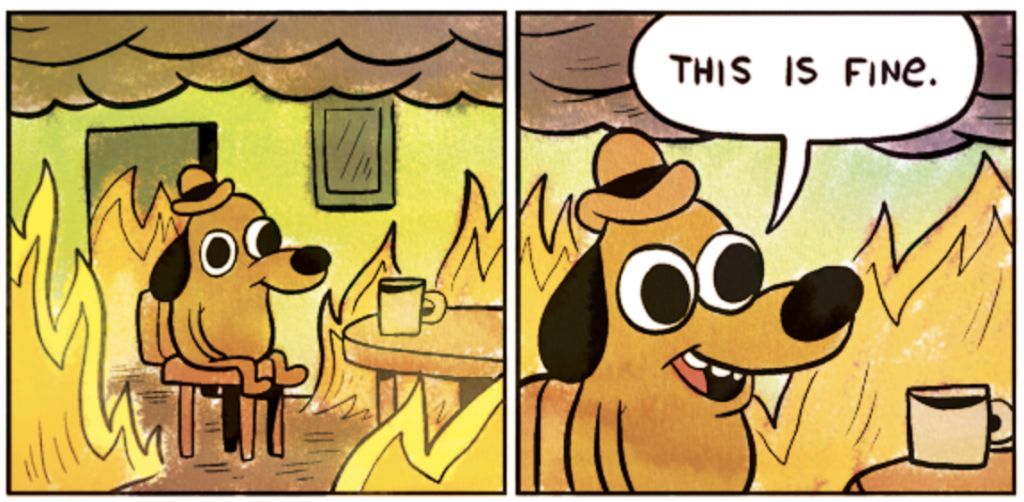
    There’s a famous cartoon by artist KC Green:

    As Green told The Verge, it’s popular because:

    it’s a feeling we all have, apparently. It’s a feeling we all get of, just like, “Things are burning down around me, but you got to have smile sometimes.” It’s a basic human [feeling], “Well, what are you going to do?”

    The version you see online is usually just the two panels I’ve shown here, but the full version shows the dog continuing to ignore the fire. Green:

    it is kind of grotesque at the end. It’s easier to sell the first two than the entire panel where the dog melts into nothingness.

    As a two-panel strip, it’s a funny “hey, what can you do?” thing. The full version shows the problem of doing nothing.

    You’ll find the “this is fine” attitude in all kinds of places, about issues large and small: faced with a mountain of evidence that the room is very much on fire, many people choose to ignore it and tell themselves “this is fine”.

    LGBT+ people are not immune to this – particularly older, more conservative LGBT+ people who tell others not to worry about their countries’ lurch to the right, about the well-funded campaigns against equality legislation, about the campaigns against inclusive education, about the return of blatantly homophobic and transphobic rhetoric in politics and in the media. This, they tell us, is fine.

    It isn’t fine.

    Progress can be reversed all too easily. The latest Rainbow Map of Europe shows that: the map tracks European countries’ LGBT+ rights and protections, and it shows that some countries are sliding backwards.

    The UK is one of them. In 2015, it was rated the best place in Europe for LGBT+ rights; this year, it’s ninth. And that’s before we see the effects of having an equalities minister who doesn’t see protecting LGBT+ rights as part of her portfolio.

    Other countries are worse. Hungary is going after LGBT+ people (and inevitably, protections for women and girls generally). Poland has declared “LGBT-free” zones. As many countries lurch to the right, LGBT+ people make for easy scapegoats for both politicians and the church.

    That’s likely to get worse. Buzzfeed News reports that there is “an emerging global trend during the COVID-19 pandemic: the scapegoating of LGBTQ people.”

    reports across the world reveal a parallel phenomenon: Institutions of power — from governments and churches to police and media — are blaming sexual or gender minorities for the spread of the virus.

    It forms part of a wider campaign against LGBTQ people, the resonance of which stretches back decades. With the world’s attention elsewhere, administrations are capitalising on the crisis by removing LGBTQ rights, weaponising lockdown restrictions against members of this community, and neglecting those who cannot access government support because of their identity — with many left destitute and in danger.

    Human rights defenders are calling for help, warning of the collateral damage within and beyond this minority. But in the chaos of a pandemic, the message is going largely unheard.

    As ILGA-Europe executive director Evelyne Paradis says: “History shows that those who are vulnerable before a crisis only become more vulnerable after a crisis, so we have every reason to worry that political complacency, increased repression and socio-economic hardship will create a perfect storm for many LGBTI people in Europe in the next few years.”

    This is not fine.

  • The ministry of bigotry

    Many people believe that the Conservative MP Liz Truss is stupid. She may have said many stupid things in her career, but she isn’t thick. She’s much worse than that.

    Truss was previously the UK’s Lord Chancellor and Secretary of State for Justice, where she was responsible for defending the independence of the judiciary and the rule of law. So when the right-wing press began demonising judges and calling them “enemies of the people”, she did… nothing.

    As The Secret Barrister wrote at the time, calling for her resignation:

    A starker, more blatant attack on judicial independence is hard to conceive. It is one thing to criticise court rulings. Or to draw attention to judicial decisions where they fall into error. But when the legislature and executive join forces with the media to launch rocket after rocket of personal, unwarranted abuse that is intended not to criticise or inform, but to demean, undermine, unnerve, terrify and intimidate independent judges who cannot answer back, we have a genuine constitutional crisis. The separation of powers is not just breached but scorched to the ground.

    …so what we have is the Rule of Law being roundly trounced and judges being threatened for having had the audacity to apply UK law to a UK legal question and conclude that the UK Parliament was supreme.

    And our cowardly, charlatan Lord Chancellor, cowering in the good graces of her Prime Minister and a rampant, ugly tabloid media, sitting meekly by and watching the world burn.

    This time last year, The Guardian’s Zoe Williams described her as a “self-aggrandising, sub-Thatcherite, Ayn Randophile Tory” who “represents the new Westminster at its Trumpian worst.”

    It’s hard to imagine a worse candidate for the job of equalities minister, a role that’s supposed to be about protecting society’s most vulnerable people. Naturally, that means Truss was appointed the UK’s equality minister in September.

    One of her first announcements was to dismiss so-called “identity politics” – minority groups asking for equal rights – and to suggest renaming her ministry to the “Ministry for Freedom”. That’s “freedom” as in “freedom fries” and “religious freedom”, not “freedom from discrimination.”

    You can tell a lot about a politician by the individuals and organisations they follow on social media. Truss doesn’t follow any of the key human rights organisations, organisations representing disabled people, organisations representing muslim people, organisations representing Jewish people, organisations representing Black people and other members of ethnic minorities. She follows just one LGBT+ organisation, the LGBT+ conservatives account; no LGBT+ charities or advocacy groups, no charities representing LGBT+ kids.

    She does, however, follow some of the most rabidly anti-trans organisations and individuals – organisations and individuals roundly rejected by the LGBT+ community; organisations and individuals who campaign against equality, who promote dangerous and discredited conversion therapy and who orchestrate campaigns against gay and lesbian people who dare criticise them.

    Yesterday, Truss’s office removed government support for schools anti-bullying guidance because it included protecting trans kids. The guidance was designed to protect all LGBT+ kids, not just trans ones; the anti-trans groups are celebrating because to them, gay and lesbian kids are simply collateral damage in their obsessive campaign against trans people.

    Truss isn’t stupid. She’s much worse and much more dangerous than that.

  • LGB Alliance fundraisers closed after campaign of abuse against gay MP

    PinkNews:

    The anti-trans lobby group LGB Alliance has had not one but two fundraising pages taken down, following an abusive campaign against gay MP John Nicolson and “violent and abusive” language from its supporters.

    Fundraising platforms JustGiving and GoFundMe have both permanently removed pages set up by the pressure group.

    This follows weeks of targeted harassment and abuse from its supporters against gay SNP politician John Nicolson, who attracted the attention of the fringe group when he began publicly voicing support for the trans community.

    …The funds from its supporters – which include neo-Nazis who the LGB Alliance has refused to denounce – have paid for newspaper adverts opposing trans rights and calling trans women “predators”, as well as a much-derided logo redesign, a pop song and a February conference in Scotland to which it invited a confirmed homophobe to speak about how LGBT+ clubs in schools are dangerous to girls.

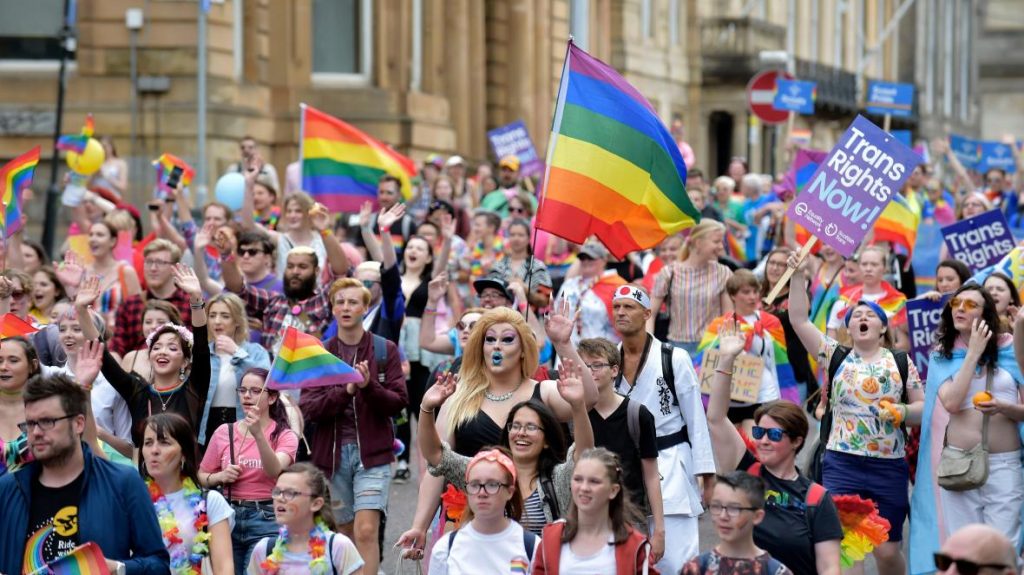
  • A matter of Pride

    If you’re straight and cisgender, you probably don’t give Pride events much thought: they’re just parties, right? But if you’re LGBT+ you know that they’re much, much more than that. They’re places where, however briefly, you know you’re not alone; places where you aren’t hated or tolerated, but celebrated.

    Pride events are among the many casualties of coronavirus this year. Spiller of Tea explains why that’s sad for LGBT+ people.

    I’ve read a lot recently about how straight people are missing pubs and restaurants and cafes. This is entirely understandable, and I do sympathise, but imagine if your pubs were the only places in which you could safely relax your mannerisms, speak freely about your home life, or hold your partner’s hand. Then imagine that you lived in a city that only had one pub. Maybe go on to imagine that this single establishment only opened two nights a week, from 10 pm until 6 am, when the majority of old bastards like me are tucked up in bed. One place in the entire locality where, if you don’t like sticky floors, banging music and drinking until it’s light, you’re basically excluded anyway. That is the reality for huge numbers of LGBTQ people in the UK, and Pride is one of the few precious moments of relief we are allowed from this frustrating, constrained existence.

    The outside world may have stopped, but homophobia, biphobia and transphobia haven’t. The trolls have more time on their hands, so they’re more vicious than ever. The newspapers continue their assault on trans people (just yesterday The Scotsman ran a column claiming that it was “a biological fact” that trans women are men) and politicians continue to court the bigot demographic. As I was reminded yesterday, people still stare and glare at you in the street.

    You may well be bored and lonely, but you probably don’t have people wishing you dead on social media or calling you a deviant in the press.

    …in these most difficult of times, when LGBTQ people are facing all of the physical, emotional and financial issues cis-het people are facing, they present an added burden to people who, like the rest of you, are already fast-approaching breaking point.

    …This crisis has, distressingly, not even begun to put an end to the attacks our community is so often forced to endure, but what it has achieved is to rob us of one of our most vital coping mechanisms in the face of those attacks. And for that, I will unashamedly mourn its loss.

  • “How discriminatory do you have to be before you’re called out?”

    Helen Belcher of Trans Media Watch explains why UK trans people are really scared right now.

    For some time trans people have understood the current media debate in the UK isn’t actually about the Gender Recognition Act. Instead, it is about our basic rights to live and move as full members of our society.

    …Most trans people I know in the UK are now absolutely terrified.

    They understand an arcane procedure for changing legal gender is probably going to be maintained in some form.

    But they realize their ability to function in any meaningful way as members of our society is about to be removed

  • Hormone treatment for Covid-19

    I’ve mentioned before that coronavirus appears to be deadlier to men than to women, and that because of that difference some anti-trans bigots have been deliberately hounding trans people with the virus and wishing them dead.

    The trans women may get the last laugh, because it’s possible that the hormones they take are helping them battle the virus. Here’s the New York Times.

    Men are more likely than women to die of the coronavirus, so scientists are treating them with something women have more of: female sex hormones.

    …Last week, doctors on Long Island in New York started treating Covid-19 patients with estrogen in an effort to increase their immune systems, and next week, physicians in Los Angeles will start treating male patients with another hormone that is predominantly found in women, progesterone, which has anti-inflammatory properties and can potentially prevent harmful overreactions of the immune system.

    Nobody’s suggesting that estrogen and progesterone are the only factors here. Men take more risks, are more likely to smoke, wash their hands less, and so on. And as the article points out, the difference is also evident among women who are decades past menopause. But it’s interesting nevertheless.

  • Never trust a Tory

    The UK government’s new equality minister, Liz Truss, has set out her priorities for the coming months. It isn’t good news for trans people.

    This isn’t a surprise. In 2019 Andrew Gilligan, the journalist who spearheaded The Sunday Times’ scaremongering about trans people, was appointed as a key advisor for No. 10. The conservatives have long discussed demonising trans people as a culture war strategy. It’s entirely on brand for the party of Section 28 to want to roll back trans people’s rights.

    Truss says the UK government will respond to the Gender Recognition Act “by the summer, and there are three very important principles that I will be putting in place.”

    First of all, the protection of single-sex spaces, which is extremely important.

    Secondly making sure that transgender adults are free to live their lives as they wish without fear of persecution, whilst maintaining the proper checks and balances in the system.

    Finally, which is not a direct issue concerning the Gender Recognition Act, but is relevant, making sure that the under 18s are protected from decisions that they could make, that are irreversible in the future.

    The announcement is already being misreported by the right-wing press, so for example the Telegraph claims that “trans children [are] to be banned from surgery”. Surgery isn’t given to under-18s. The announcement clearly means puberty blockers, which it seems the government wants to withhold from teenagers until after puberty.

    “Single-sex spaces” is a dogwhistle. They are not affected by the Gender Recognition Act. The equalities minister of all people should know that.

    The second point suggests that letting trans people live free from persecution is conditional rather than universal.

    That third point is a direct threat to Gillick competence, which says that you do not have to be an adult to get essential healthcare without parental consent: it’s what enables teenage girls to get contraception. By saying that under-18s lack “decision-making capabilities” even though they are old enough to legally become parents, get married or join the army, it paves the ground for an assault on young women’s reproductive rights.

    I hope I’m wrong, but I’ve said previously that I think the government will do something with gender recognition that they can pitch as progressive but that actually removes trans people’s rights: I think it’s highly likely that they will make the existing gender recognition system very slightly more accessible but change the role of the Gender Recognition Certificate so that if you don’t have one, you are not protected from discrimination.

    As the Labour Campaign for Trans Rights put it:

    In her speech she says there must be “checks and balances” before trans people can live freely; an ominous admission that we will not be allowed to live without special restrictions, because of the “danger” of us being trans. This is not equality.