Category: LGBTQ+

  • Many things we know are wrong

    If you’ve read this blog for a while you’ll know I’m fascinated by Internet Facts, things that everybody believes but that aren’t true – such as the story claiming singer Mariah Carey, when asked about famine, said “I’d like to be that thin, but without all the flies and death and stuff”.

    Another good example of that is Queen Victoria and lesbians. According to legend, she refused to sign a bill criminalising same-sex relationships until references to women were removed; according to the monarch, “women do not do that sort of thing.”

    It isn’t true. The law in question was the Criminal Law Amendment Act 1885, and it never referred to women: it didn’t initially mention gay people at all until an amendment by a liberal MP criminalised “gross indecency” between two men.

    Another, similar legend about the Victorians claimed that they were so prudish that they covered up table and piano legs for fear of accidental arousal. That one isn’t true either: it was a very dubious claim by writer Frederick Marryat in the mid-1800s.

    I like Knowledgenuts.com’s explanation:

    Marryat visited a girls’ seminary where he discovered the piano’s legs were shrouded in little ruffled pantaloons. The headmistress told him she’d covered the legs to “preserve in their utmost purity the ideas of the young ladies under her charge.”

    Either the headmistress was something of a kook or Marryat got punked. There’s no evidence in the historic record that this supposed custom was widespread. In fact, the pretty pantaloons were most likely dust covers, concealing damage, or mere decoration.

    The British press at the time picked up Marryat’s story and ran with it, since American society and its straight-laced, puritanical, overly fastidious, ludicrous manners were considered gauche and far inferior to their cousins across the Pond.

    The British press printing bullshit because it enabled them to perpetuate prejudices? Pass the smelling salts! I feel all giddy!

    One of the reasons these things endure is because they feel true: they chime with what we know, or think we know, about the era or people concerned. So the fake quote from Mariah fits the image of a callous, air-headed diva; lesbians and sexy piano legs chime with our image of sexually repressed Victorians.

    But of course, what we think we know is wrong. Mariah Carey is much smarter and apparently much nicer than we think she is; many Victorians were off their face on hard drugs and going at it like knives.

    The comedian Stephen Colbert coined the term “truthiness” to describe something that may feel true, but that isn’t. As Wikipedia puts it:

    Truthiness is the belief or assertion that a particular statement is true based on the intuition or perceptions of some individual or individuals, without regard to evidence, logic, intellectual examination, or facts. Truthiness can range from ignorant assertions of falsehoods to deliberate duplicity or propaganda intended to sway opinions.

    There’s a good example of that doing the rounds on social media right now. “I never knew of any trans kids when I was young, just old trans people” the post says. “So where are all these trans kids coming from now?”

    Same place the old trans people came from. But now, people are less likely to wait their whole bloody life before coming out.

    When I was a teenager, to the best of my knowledge there were no gay, lesbian, non-binary or trans people in my town. But of course there were. They kept their identities very secret because they didn’t want their heads kicked in.

    This was the era of the Sunday Times claiming AIDS was a gay plague, of Piers Morgan outing pop stars as “poofs”, of the Murdoch press demanding lesbians be banned from girls’ changing rooms because they were dangerous predators.

    Plus ça change, plus c’est la même chose.

    I’ve mentioned before the response of one anti-trans activist to the idea that trans people have existed since long before she was born. “But I’m 42!” she said.

    We were always here. You just didn’t see us, because for many of us being seen meant being targeted. So we stayed hidden.

    I was talking to someone a few days ago about their aunt, who’d  tried her whole life not to be trans. She did the hyper-masculine stuff that many trans people did: the military career, the body building, the hard drinking and risk-taking. But you can’t outrun yourself, and when she finally came out very late in her life she was transformed: happy at long last.

    Cancer claimed her two years later.

    There are many sad stories like that one. She was trans her whole life and spent almost all of that life fighting it, too scared to let anyone know until so late in her life that she didn’t get to spend much time being herself.

    She was a trans kid. So was I. So was every late-transitioning adult. You didn’t know about us because we didn’t know it was okay to be us, because it wasn’t safe to be us.

    We were always here. You’re only seeing us now because more of us feel that it’s safe, or at least safer, to be out. Information we were denied when we were younger is freely available. Support exists that didn’t before. There are communities that will welcome us when family or friends reject us. We can see that there are many others like us.

    If people really cared about the wellbeing of kids, they’d be pushing for better trans and non-binary healthcare, for counselling services that don’t have years-long waiting lists, for people to be given the help they need to discover who they are – whether cis, trans or non-binary: the only outcome that should matter is whether the child is happy and supported, irrespective of how they identify. But these people don’t campaign for that. They campaign to remove the little healthcare that’s available. To remove hard-won rights. To make everyday life so difficult that trans and non-binary people stay in the closet. Better a miserable, repressed, self-hating kid than a trans or non-binary one.

    As the banner (pictured) puts it: “we don’t want your cis kids to be trans. We want your trans kids to survive.”

    It’s sad that even that low bar is too much for some. I don’t just want your kids and my kids to survive. I want them to thrive, however they may identify.
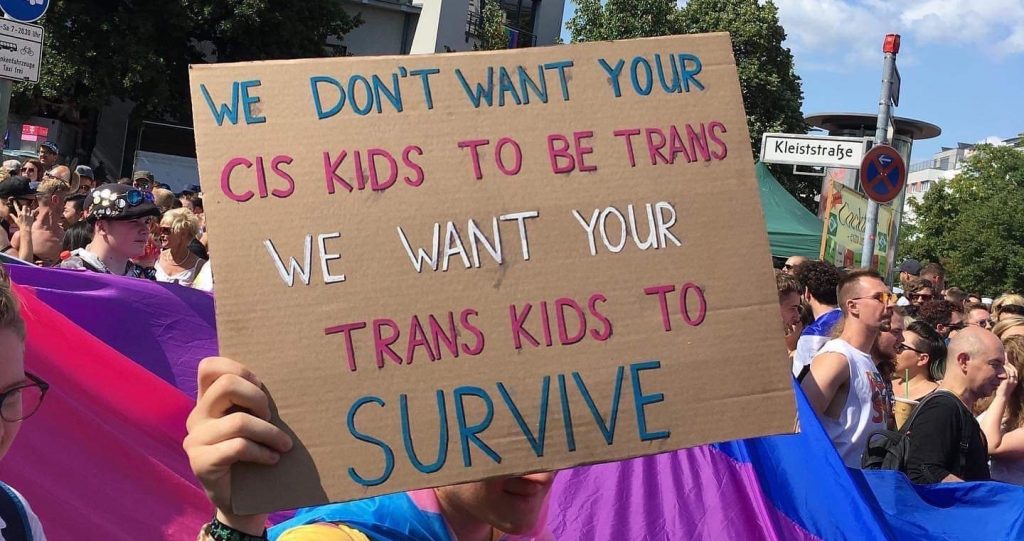

    Photo of a placard: We don't want your cis kids to be trans. We want your trans kids to survive.

  • Happiness is not a cold scalpel

    Last night I read a post by a trans woman that made me sad. It was intended to be supportive – it was written as a kind of open letter to trans women who compare their appearance to other women and find themselves lacking – which is why I didn’t give it a kicking in the place where it was posted. But I think it’s worth talking about here.

    The poster wanted to tell trans women that happiness and self-acceptance are possible. All you need to do is “pass as cis” – that is, look like a particular kind of cisgender woman. And to do that, all you need to do is lose a ton of weight, take a ton of hormones, have facial feminisation surgery and undergo three rounds of vocal feminisation surgery.

    That might have been the route to happiness for the poster, but it might not be for anybody else.

    Take facial feminisation surgery, aka FFS. The poster had a well paid job and was able to pull together around £15K for their FFS (which suggests they didn’t have many treatments; you can easily spend many times more than that). Some people will never be able to afford that.

    And of the people that can afford it, some of them will not get spectacular results because the surgeons can only work with what they’ve got. If you look like me, a chin reshape or a brow reduction is not going to make you look like Audrey Hepburn.

    It’s the same with hormones. For some people HRT’s effects are minimal; their effectiveness depends on a whole host of factors, particularly genetics and age. Age is a big one, so telling late-transitioning trans people that HRT will definitely have magical effects is untrue. And even minimal effects may be many years in the future: not only do hormones work slowly but the wait to even start treatment can be very long. In some parts of the UK you can expect a wait of around five years between being referred to a gender clinic and getting a hormone prescription.

    Last but not least, there’s weight. The poster asserted that losing weight has a massive feminising effect, but again that depends on the face and body you have. Some people find that losing weight makes them look more masculine, not less.

    Of course if that’s the case they could always have facial feminisation surgery… and we’re back to the start again. There’s always one more thing you need to do before happiness is yours.

    Let’s pretend I have the desire and the resources for facial feminisation surgery (spoiler: I don’t). What if after a brow reduction, or chin recontouring, or a hair transplant, or a nose job, or a tracheal shave, or a lip lift, or cheek augmentation, I still don’t look or feel pretty?

    What if I’m still clocked because of the things surgery and hormones can’t change: the width of my shoulders, the breadth of my ribcage, the length of my torso, my centre of gravity?

    What if something goes wrong with the surgery – many FFS providers specifically advertise their ability to fix other surgeons’ mistakes – and I can’t afford to get it corrected?

    What then?

    I’m not suggesting that FFS, HRT and other things can’t have positive effects on how you feel about how you look. Of course they can. Some people have these things, look amazing and feel fantastic. I don’t endure two hours of painful facial electrolysis every week for a laugh: I do it because having a stubble-free face is important to me.

    But the idea that there is a particular standard of beauty (thin, pretty, usually white) and that if you just starve and carve yourself enough to meet it then happiness will surely be yours is a pernicious myth that has caused a great deal of harm to very many women.

    Cosmetic surgeries will not necessarily make you any happier or deliver the results you want, and nobody should be telling anyone that they will.

  • The fast track

    NHS England:

    The maximum waiting time for non-urgent, consultant-led treatments is 18 weeks

    PinkNews:

    Trans and non-binary patients in the UK’s south west are waiting more than 193 weeks to see an NHS specialist – more than 10 times the NHS legal guideline of 18 weeks.

    Waiting times vary across the UK but they’re years-long everywhere. For example the Sandyford clinic in Glasgow is currently making initial appointments for people who registered in January 2018. That’s 31 months; around 135 weeks. And that wait is for an initial assessment, not a consultation on any treatment.

    Update

    I think it’s worth pointing out that these times are for people who were in the system two to four years ago, not people who are joining the waiting list today. Their waiting times are going to be even longer.

    I joined the Sandyford waiting list in late 2016 and was seen 11 months later. People who joined in early 2018 are now being seen 31 months later. How long will the class of 2020 have to wait?

  • Spaghetti straps

    The inside of my head often looks like this.

    You’ve probably heard of gender dysphoria, which is when someone’s gender identity doesn’t match the sex they were assigned at birth. But you may not be aware of the converse, gender euphoria. Where dysphoria is the feeling that something is terribly wrong, euphoria is the feeling that something is very right.

    There’s a lot of discussion about the dysphoria many trans people experience, but there’s a lot less about their euphoria: it often seems that we only hear about the sad stuff. I think that’s partly because so much of the discussion about us focuses on trauma and tragedy – something that’s inevitable if the narrative is centred on legal protections such as protection from hate crimes or the horrifically long waiting times trans people endure for basic healthcare. Of course we’re going to talk about the awful things many trans people experience.

    But I also think part of it is that what can seem really profound to you might seem really trivial to someone else – and when there are bad actors looking for anything to take out of context, screenshot and share with their fellow bigots, you become very wary of what you’ll post.

    So other people only get part of the picture: the sad part. But the reality is that there’s a great deal of happiness too, and sometimes that happiness comes from the tiniest of things.

    For example, the other day I wore a nice dress.

    It had spaghetti straps.

    That’s it.

    That’s the story.

    Exciting? No. Profound? Maybe not to you. But it’s not so much about the dress as what wearing it represented.

    Progress.

    Sitting with your shoulders visible isn’t going to be a big deal for a lot of women, but it is for me: since I came out clothes have been primarily about hiding my body, not making bits of it visible. I love dresses and wear lots, but if you’re looking for someone showing skin you’d have more luck with an Egyptian mummy.

    So something as simple as wearing something spaghetti-strapped or having legs that aren’t covered in 10,000-denier tights may not be a big deal for others, but it is quite a big deal for me – especially when it brings compliments from friends, not angry mobs with burning torches. It’s a sign of growing confidence and of self-acceptance.

    It’s also a sign of physical progress, because the dress fits in a way it wouldn’t have before I started transition. So there’s a euphoria there from having a tangible indication of your progress: when hormones work their magic ever so slowly, sometimes it’s nice to notice a milestone.

    I said earlier that the things I experience as gender euphoria may seem really trivial to other people. And that’s because they often are. They’re mundane things. Normal things. Things most people take for granted.

    But for me, they’re not mundane, not normal, not things I can take for granted. It sometimes feels like I’m an ingenue in the big city, constantly open-mouthed in surprise at the things the locals don’t even notice. “You mean you just, like, put on a dress, and go out, and nobody scowls at you? Ever?”

    They’re often little things. But they’re little victories too.

  • You’re not a bigot

    Or at least, it’s highly likely that you aren’t. That’s according to the latest survey of UK people’s attitudes to trans people. While there’s clear evidence that three years of anti-trans scaremongering have had an effect, there’s also clear evidence that the scaremongers do not reflect wider public opinion.

    Stonewall:

    When the public is asked to choose words that describe their feelings towards trans people, we see a really striking picture.

    Overall, positive feelings dominate, particularly for women – half of us feel ‘respect’ and more than a quarter ‘admiration’ for trans people. We can also see that women are much more likely to feel respect and admiration for trans people, while also being less likely to feel disgust, pity, fear or resentment. This is important to bear in mind, as it undermines the common narrative which seeks to turns cis women and trans women against each other.

    But alongside these positive feelings, quite a lot of us aren’t sure and that’s OK. Some of these people may not be comfortable expressing negative feelings, many of these people are likely to be those who genuinely don’t know how they feel, or simply see trans people as … people.

    However, the people who hate us really hate us.

    Very few people indeed selected negative feelings such as disgust, fear or resentment. But when we look at the views of the minority who describe themselves as prejudiced (16% of us), this transphobic minority feels very strongly: a third said they felt disgust (33%) and one-quarter said that they felt resentment (25%). This means that while the group of people who are transphobic, and would describe themselves as such isn’t large – 16% is in line with other forms of discriminatory attitudes to oppressed groups – the views of that minority are much stronger.

    Those are the views most often platformed by UK newspapers, current affairs magazines and broadcasters, and they are the views most commonly expressed on social media.

    The British public in general, and British women in particular, feel pretty positive about trans people. If our media coverage and social media discussions simply reflected this reality, the lives of trans people would be immeasurably improved overnight. Instead of this, the drip, drip of negative and distorted media coverage may be manufacturing a creeping sense of discomfort around shared spaces.

    …[the survey] shows that we have a small, but vocal group of people with extreme anti-trans views in Britain, and that should worry us all.

    If the majority of us simply sit by while the transphobic minority shout their harmful views from the rooftops, our warm feelings mean nothing, and we are part of a problem that is ruining trans folks lives.

    Please, don’t be part of the problem.

  • False flags

    Here’s a great example of how anti-trans activism works.

    On social media, some anti-trans activists are posting about stickers that prove how evil trans people are. The stickers, which were first spotted in Torquay, have the phrase “genital preferences are transphobic” over a rainbow flag.

    The stickers were made and posted by an anti-trans activist trying to discredit trans people.

    The phrase on them is an anti-trans trope: in much the same way homophobes want you to think that gay men want to have sex with your children, transphobes want you to think that trans women want to force you to have sex with them even, or especially, if you aren’t into trans people. It’s a vicious libel, and I’ve written more about where it comes from here.

    Some of the better known anti-trans groups have condemned the stunt, so for example the LGB Alliance has said “if it is true that agents provocateurs are posting these stickers in an attempt to exacerbate our divisions, we certainly condemn it.”

    But really, the arsehole making the stickers is just doing a crude version of what the anti-trans groups and activists do every day. They make false allegations about what trans people think, who trans people are or what healthcare trans people get, and they then call on everybody to condemn trans people (and often, to demand the removal of their rights) based on those false allegations.

    How many articles have you read about the supposed prescription of cross-sex hormones to children, which doesn’t happen? About children being given gender reassignment surgery, which doesn’t happen? About trans women being predators, which the religious right made up? That’s much more deserving of your condemnation than a couple of stickers at the seaside.

  • Deliberately making safe spaces dangerous

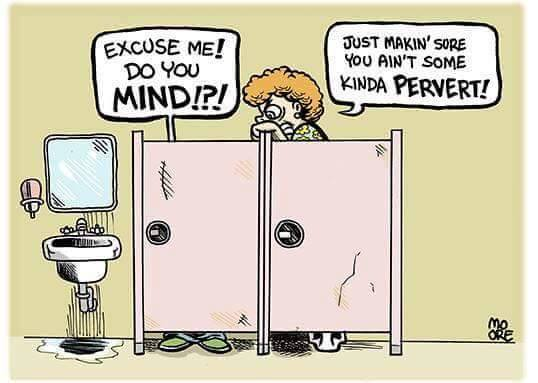
    If you’d like to understand the “debate” over trans people’s use of toilets, the academic paper “The toilet debate: Stalling trans possibilities and defending ‘women’s protected spaces’” by Charlotte Jones and Jen Slater is worth your time.

    whether naive, ignorant or explicitly transphobic, trans-exclusionary positions do little to improve toilet access for the majority, instead putting trans people, and others with visible markers of gender difference, at a greater risk of violence, and participating in the dangerous homogenisation of womanhood.

    …‘Gender-critical’ feminists prioritise the demonisation and exclusion of trans people, even when this comes at the expense of improving toilets for all.

    …the fight is not so much ‘about toilets’ but about the contested boundaries of womanhood, tightening the reins on gender, and making trans lives impossible.

    This, I think, is the key takeaway:

    Toilets become dangerous to make trans identities impossible.

    By pushing the false narrative of trans women being dangerous predators, activists – whether faux-feminist or religious right – encourage the policing of women’s appearance. And as we’ve seen again and again, that policing affects Black women, big women, tall women, women with short hair, lesbian women, gender non-conforming women and any other women whose femininity is considered lacking by strangers.

    There was an example of this yesterday when on Twitter, a self-appointed toilet cop boasted proudly of hanging around outside toilets to catch and humiliate anyone they suspected of being trans. Given that the people who claim they can “always tell” have variously claimed that Taylor Swift, Meghan Markle, Holly Willoughby, Jodie Whittaker, David and Victoria Beckham, Keira Knightley, and all of Prince Harry’s ex-girlfriends are clearly transgender, such self-appointed bathroom police are a threat to all women.

    Some of them know this, and don’t care: when asked about the lesbian women abused in toilets for the crime of looking like they might be trans, they responded that such cases, while regrettable, were collateral damage. If making toilets dangerous for all women is the price of making them dangerous for trans women, so be it.

    The cruelty is the point.

  • Understanding the “TERF wars”

    There’s a new and important academic work about the current anti-trans moral panic: TERF Wars, The Fight For Transgender Futures.  TERF is an acronym used to describe people who identify as feminists but whose feminism explicitly excludes trans women and non-binary people.

    The book exists because:

    Analyses of trans-exclusionary rhetoric provide an important contribution to sociology. This is not only because they offer an insight into the production of ideologically ossified, anti-evidential politics (including within academic environments), but also because of what can be learned about power relations. Questions of whose voices are heard, who is found to be convincing, what is considered a ‘reasonable concern’ and by who, and how these discourses impact marginalised groups are key elements of sociological enquiry.

    If you have institutional access to SAGE you can read it online for free; if not, the paperback is £10 (and at the time of writing, using the code UK20AUTHOR gets you another £2.50 off).

    The introduction is online and free to read here. It provides a good overview of the very significant rise in anti-trans activism in the UK, identifies the key attack lines of those activists and makes their connections to religious evangelism and the far right very clear.

    The language of ‘gender ideology’ originates in anti-feminist and anti-trans discourses among right-wing Christians, with the Catholic Church acting as a major nucleating agent (Careaga-Pérez, 2016; Kuhar & Paternotte, 2017). In the last decade the concept has been increasingly adopted by far-right organisations and politicians in numerous American, European and African states. They position gender egalitarianism, sexual liberation and LGBTQ+ rights as an attack on traditional values by ‘global elites’, as represented by multinational corporations and international bodies such as the United Nations (Korolczuk & Graff, 2018).

    …Ultimately, the growing social acceptance of trans and non-binary people has challenged immutable, biologically derived conceptualisations of both ‘femaleness’ and ‘womanhood’. ‘Gender critical’ opposition to this can be understood as an emotionally loaded, reactionary response to reassert essentialism, resulting in interventions such as the ‘Declaration of Women’s Sex-Based Rights’ (see Hines, this collection) which effectively echo the demands of far-right, anti-feminist actors.

    …a growing number of anti-trans campaigners associated with radical feminist movements have openly aligned themselves with anti-feminist organisations. For instance, from 2017 US group the Women’s Liberation Front (WoLF) have partnered with conservative organisations The Heritage Foundation and Family Policy Alliance, both known for supporting traditional gender roles and opposing abortion rights, comprehensive sex education and same-sex marriage.

  • “It’s time to stop this silliness”

    When it comes to covering trans-related issues the difference between the UK and US versions of The Guardian is dramatic, with the latter demonstrating just how parochial, insular and reactionary the UK edition is. While the UK repeatedly commissions the same handful of writers to write the same column (variations on “someone told me / my friend / a celebrity to fuck off on Twitter and therefore trans people shouldn’t have human rights”), the US edition commissions writers like Rebecca Solnit.

    Rebecca Solnit: Dear transphobic feminists: it’s time to stop this silliness.

    …trans women do not pose a threat to cis-gender women, and feminism is a subcategory of human rights advocacy, which means, sorry, you can’t be a feminist if you’re not for everyone’s human rights, notably other women’s rights.

    Second wave feminism produced the classic 1972 children’s album Free to Be You and Me, which I’d like to point out was not titled Free to Be Me But I Get to Define You. Back then we thought gender really was kind of binary and defined by genitals; science has gotten smarter in the decades since and we now know it’s a complex interplay of chromosomes, hormones, primary and secondary sexual characteristics and other stuff, some of which is in the brain, not the pants, and also that quite a significant number of people are born intersex, and some are misgendered at birth, and male and female never were airtight categories anyway. Cultures from Native America to India have long recognized that there are other ways to be gendered. This complexity and fluidity can be a blessing and it’s something feminism embraced when it demanded that “woman” not be a category be so tightly defined by roles, relationships, appearances and limits set upon our options.

    …When there is so much real violence against women, it’s a sad waste of time to focus on imaginary maybe presumably it-could-theoretically-happen violence. Trans women pose no threat to cis-women, but we pose a threat to them if we make them outcasts and pariahs (and insisting they use men’s bathrooms endangered them horribly). Trans women live dangerous lives, because gender nonconformity is punished in innumerable ways, speaking of patriarchy, and black trans women are murdered at a horrific rate, generally by cis-gender men.

    …there are about 4 billion women and girls on Earth, and we are not in danger of being erased.

  • Hearts

    Someone posted this to Reddit last night:

    There are boys without penises
    Girls without vaginas
    And transphobes without hearts.