Category: Hell in a handcart

We’re all doomed

  • Why aren’t we talking about the dangers of YouTube?

    Buckey Wolfe is a follower of the QAnon conspiracy theory. He’s a supporter of the far-right Proud Boys, and he’s been charged with the murder of his brother.

    Buckey Wolfe called 911 on Sunday evening and admitted killing his brother, saying that “God told me he was a lizard” and telling the dispatcher, “Kill me, kill me, I can’t live in this reality,” according to court documents.

    In a fascinating Twitter thread, Travis View follows Wolfe’s online journey by tracking the YouTube videos he liked. The journey begins with fitness, motivation and music videos but then YouTube does what YouTube does. When Wolfe liked some videos by the YouTuber Hunter Avallone, who rails against “social justice warriors”, he started watching increasingly extreme right-wing content.

    As View reports, while Wolfer was “getting into fringe political stuff” he still wasn’t “in QAnon or explicit white nationalism territory.”

    And then he discovered “Rebel Media, Proud Boys founder Gavin McInnes, and English far right activist Tommy Robinson.”

    View:

    After this, Wolfe starts getting into the real hard stuff.

    We’re into muslim gangs and shapeshifting lizards, anti-semitism and paranoid racism.

    Nobody is suggesting that YouTube caused Wolfe to murder his brother. But as View says, “the trajectory of Buckey Wolfe’s likes is suggestive of someone who was gradually pulled down the rabbit hole into deranged conspiratorial thinking over time.”

    YouTube is fuelling the far right in two key ways. It hosts what the Guardian calls an “alternative influence network” of pundits and propagandists pushing extreme-right rhetoric, and it acts as one of the most effective and frightening radicalisation engines imaginable.

    It’s part of a wider problem, of course: if Hitler were around today, he’d be on Radio 4 or Question Time with his “controversial views”. But it’s a very big part of the problem. YouTube has become a monster – a monster that’s creating many more monsters.

  • Green sheep, bendy bananas and boys having periods

    It’s Sunday, the day when the UK press likes to post multiple anti-trans articles. I want to look at one from last week. It’s the story that virulently anti-trans MP David Davies described on Twitter as the “latest example of barking mad trans-activism”: the idea that eight-year-old boys will be told they can have periods.

    The story has legs: I’ve seen it turn up in Sky News Australia and the Monserrat Reporter. Talk radio hosts have used it as evidence that “the world’s gone mad” and of “bonkers Britain” and the usual columnists have weighed in to moan about the excesses of trans activism.

    Is it true?

    Here’s the document the coverage refers to (pdf). It’s a presentation by the neighbourhoods, inclusion communities and equalities committee of Brighton & Hove council on the subject of period poverty, the horrible situation where some students don’t have access to sanitary products because their parents are broke. This has an effect on their education because some of those students stay home when they have their period instead of attending school.

    In the 3,000 word document, trans people are mentioned exactly once, in a description of the period positive educational approach. The document notes that:

    • Trans boys and men and non-binary people may have periods.

    This is undeniably true: irrespective of how you identify, if you have the appropriate plumbing then you may have periods. And that means you can be affected by period poverty.

    This has got nothing to do with any sinister agenda: it’s an attempt at inclusivity. And yet what seems to me like a perfectly rational and humane point – that period poverty can affect students who do not necessarily identify as female – has been used once again to attack trans people, and young trans people specifically. Scoring a political point is more important than any child’s welfare.

    What we’re seeing here is an old trick with a new target.

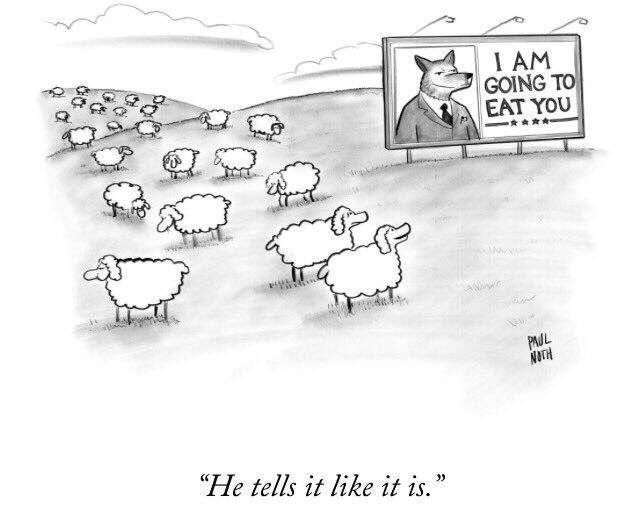
    It’s sheep we’re up against

    Exaggeration and falsification have long been used by newspapers to attack people they don’t like and anything that’s happened since 1953. For example, in 2014 Mail Online readers in Australia finally got a story we Britons have known about since 1986: the evils of politically correct forces demanding children sing alternatives to “baa baa black sheep “because the black bit might be racist. 1

    It was a real story – a couple of Australian kindergartens had indeed changed the lyrics for fear of causing offence – but it was an isolated incident, just as it was in 1986 when a single nursery (Beevers Nursery in Hackney, London; a private nursery, not a council-controlled one) rewrote the song as an exercise for children and the newspapers went mad.

    The English story made the Daily Star and then The Sun and the Sunday World, and then the Daily Mail embellished it by claiming Haringey council, not Hackney, had ordered playgroup leaders to attend racial awareness courses where they were ordered to make children sing “baa baa green sheep” instead. 2

    As the saying goes, never let the facts get in the way of a good story. It was completely untrue, and Haringey council attempted to sue the newspaper but had to drop the legal proceedings for lack of funds. The Mail version of the story made it to the Birmingham Evening Mail, the Liverpool Echo, the Yorkshire Evening Press, the Birmingham Post, the Sunday People, the News of the World, the Sunday Mercury, the Carlisle Evening News and Star, the Yorkshire Evening Courier, the Ipswich Evening Star, the Sunday Times letters page, the Hendon Times and the Sunday Telegraph.

    The story continued to spread, this time with Islington council being blamed, and it turned up in the Economist, the Daily Telegraph, the Daily Express, the Daily Mirror and the Sun. The story was used in political broadcasts by the Social Democratic Party, and it came back from the dead in 1998 in the Sunday Times. Over the next five years it would pop up from time to time in various newspapers. In the two decades since it began, only two newspapers have printed corrections admitting that it isn’t true.

    Sheep weren’t the only fabrication. Stories about manhole covers being renamed were invented by the newspapers, as were supposed bans on black bin bags. Other stories about “super-loos for gypsies” or special treatment for gay people were pretty dodgy too.

    According to the Media Research Group of Goldsmith’s College in the University of London, British tabloids ran some 3,000 news stories about such “loony left” ideas between 1981 and 1987; the vast majority were either partially or wholly fabricated and were targeted against the handful of London councils under Labour control. 3

    Very similar stories were fabricated about the European Union too, most notably by a young journalist called Boris Johnson. Between 1989 and 1994 the Telegraph’s Brussels correspondent filed knowingly exaggerated and sometimes entirely invented stories about supposed EU madness, creating a whole new genre of Europhobic scare stories. Other journalists were appalled, but the stories were very successful and ultimately helped pave the way for 2016’s Brexit vote to leave the EU.4

    It’s not reporting. It’s propaganda. And it works.

    It works because most people remember just the headline – and that headline can have tremendous power. In a series of studies published in the Journal of Experimental Psychology: Applied, Ullrich Ecker of the University of Western Australia tested the effect of misleading headlines on people’s perceptions on hot issues such as genetically modified crops. As The New Yorker reports:

    In the case of the factual articles, a misleading headline hurt a reader’s ability to recall the article’s details. In the case of opinion articles, a misleading headline, like the one suggesting that genetically modified foods are dangerous, impaired a reader’s ability to make accurate inferences. For instance, when asked to predict the future public-health costs of genetically modified foods, people who had read the misleading headline predicted a far greater cost than the evidence had warranted. 1

    Everybody remembers the headlines about the EU’s bonkers ban on bendy bananas. It was completely invented, but the stories were a key part of a long campaign against the EU that ultimately resulted in the UK voting for Brexit.

    Most tabloid stories about trans activists or the sinister trans lobby are fictional too, but by the time they’re fact-checked – if they’re fact-checked at all; there are so many of them few people have the time – the damage is done. Throughout the land, breakfast tables vibrate to the sound of readers harrumphing about political correctness gone mad.

    anImage_2.tiff

    1 http://www.dailymail.co.uk/news/article-2796447/lyrics-baa-baa-black-sheep-changed-kindergarten-teachers-racial-overtones.html

    2 Curran, J.; Petley, J.; Gaber, I. (2005). Culture wars: the media and the British left. Edinburgh: Edinburgh University Press. pp. 85–107. ISBN 0-7486-1917-8

    3 John Gyford; Steve Leach & Chris Game (1989). “Political change since Widdicombe”. The changing politics of local government. Routledge. pp. 310–313. ISBN 9780044452997.

    4 https://www.theguardian.com/commentisfree/2016/jul/15/brexit-boris-johnson-euromyths-telegraph-brussels

  • The best of all possible worlds

    One of the biggest things I’ve learnt over the last couple of years is that there is often a very big difference between the world as it is and the world as you perceive it to be. For example, on a personal level the world is a lot less scary, a lot more inclusive and a lot more fun than I imagined it was before I came out.

    It’s true on a bigger scale, too. It’s easy to believe that the world is in deep shit and that everything is terrible, but while there are of course terrible things happening the truth is that for most of us, this is the greatest time to be alive in the history of the human race.

    Here, Future Crunch details 99 good news stories you probably didn’t hear about in 2018. It’s an interesting counterpoint to Frankie Boyle’s review of the year, which is acerbic and funny and of course, incredibly negative.

    The piece is by Angus Hervey, who recently wrote about the “fear virus”:

    Fear can be transmitted digitally as easily as it can physically—and that’s a problem because digital technologies reach everyone. It’s not a few thousand people in a crowd anymore. Three-quarters of adults on earth now have a smartphone, which means we’re getting 24-hour access to all the worst stories happening everywhere to 7.6 billion people—all the time.

    Bad, alarming or frightening news isn’t a new phenomenon: good news doesn’t sell papers. But what’s different now is the speed and scale of it. One of the reasons I massively cut down my Twitter usage is because the constant flood of terrifying stories was harming my mental health.

    Hervey again:

    Every day terrifying stories sweep through the global village, in articles, tweets, and evening broadcasts, and they are amplified a million times over until there’s nowhere to hide. Algorithmic bias, mental illness, foreign infidels, chronic pain, hooded extremists, robots coming to take our jobs, burning forests, warlike naval maneuvers, marching racists, rising waters, surveillance regimes, trade wars, toxic chemicals, predatory capitalism, roaming gangs of criminal youths, drug overdoses, benefit-devouring migrant caravans massing at the border… the list goes on and on. The fear virus takes hundreds of forms and mutates and spreads every time we click or watch or mutter darkly about the future at family dinner.

    The world as we see it can be a terrifying and brutal place, and of course in some parts of the world and for some groups of people it us. But there is a chasm between the world as 24/7 media and social media paints it and the world as it actually is.

    By almost any measure, the world is becoming a better place. The large scale evidence for this has already been well documented by people such as Max Roser, Steven Pinker, and the late, great Hans Rosling. Poverty is disappearing, battle deaths are falling, violence is less common, suicide is decreasing, life expectancy is increasing, literacy is on the rise, child mortality is declining, we’re making great strides in battling diseases like AIDS, cancer, and malaria.

    The internet has democratized information, education, and business; it’s given voice to the silenced, helped to erode outdated taboos, and advanced human rights. Of course, it’s not all perfect and there are always setbacks, but every day, the human species is making incredible progress.

    …We’ve never had it so good, and yet we’ve never been more scared.

    That doesn’t mean we should all become Polyannas, ignoring the very real threats of climate change, right wing populism, economic inequality and other horrors. We shouldn’t be gaily skipping over homeless people on our way to the theatre.

    But we can and we should reject the fear that tells us everything is terrible, that other people want what we have, that everything is hopeless and there’s nothing we can do about it.

    Fear is a terrible thing, and a useful weapon for the very worst people in the world.

    A terrified populace is far more susceptible to the appeals of people who want to make countries great again and demagogues who see politics as a zero-sum game. A terrified populace is less willing to stand up and fight for an economy that doesn’t cost the earth.

    Fear is not inevitable. It’s the result of our choices: what we choose to read, what we choose to watch, what we choose to listen to, what we choose to believe, what we choose to fear.

    If we choose to believe that the world is a dark and scary place, that people who are very slightly different from us are an existential threat, we will see the world that way – and by action or inaction, we’ll help make that perception the reality.

    Whereas if we choose to believe in the opposite, we can find the energy and the optimism and the connections we need to ensure that not only is the world better than it has ever been in human history, but that it stays that way and gets better still.

    We can choose hope, not hate. Love, not fear.

    It’s Christmas time. There’s no need to be afraid.

  • “We” didn’t miss anything

    This week, The New York Times made a podcast called “The Rise of Right-Wing Extremism, and How We Missed It”. Esquire’s Charles P Pierce is not amused: who, exactly, does the NYT mean by “we”?

    To take the simplest argument first, “we,” of course, did no such thing, unless “we” is a very limited—and very white—plural pronoun. The violence on the right certainly made itself obvious in Oklahoma City, and at the Atlanta Olympics, and at various gay bars and women’s health clinics, and in Barrett Slepian’s kitchen, and in the hills of North Carolina, where Eric Rudolph stayed on the lam for five years and in which he had stashed 250 pounds of explosives for future escapades.

    Pierce – rightly, I think – argues that the problem isn’t that these things aren’t noticed, or flagged up. It’s that the people who warn about them are ignored by a largely urban, white, straight media class.

    One of the best examples of that is the rise of the hard right in online spaces, where women and minorities have been yelling about the problems for many years now. Because the abuse didn’t affect people who weren’t women or minorities, media didn’t give a shit. This has been going on for a long time, and its reach is enormous.

    Here’s Matt Miller, also in Esquire, on how online trolls have poisoned Star Wars fandom.

    These “trolls” are the anonymous, despicable beating heart of America. They are holding up a mirror to our society. They are insuring that the worst of us have a voice to incite real change. They elected an amoral, racist golden toilet for a president. And that same sickness has bled into something once as harmless as a children’s space movie.

    Something that’d be funny if it weren’t so serious is the way anti-trans people so frequently follow the same script: starting off by being hateful towards us before – surprise! – being hateful to other groups too. So the anti-trans legislators in the US start with us and then target cisgender women and trans men’s reproductive freedom. Anti-trans cultural commentators turn out to be misogynist. Anti-trans voices variously include domestic abusers, racists and anti-Semites.

    It’s become a bleak running joke in some trans circles when yet another vicious bigot turns out to be viciously bigoted against more than one minority. That’s the thing about bigotries. They tend to travel together.

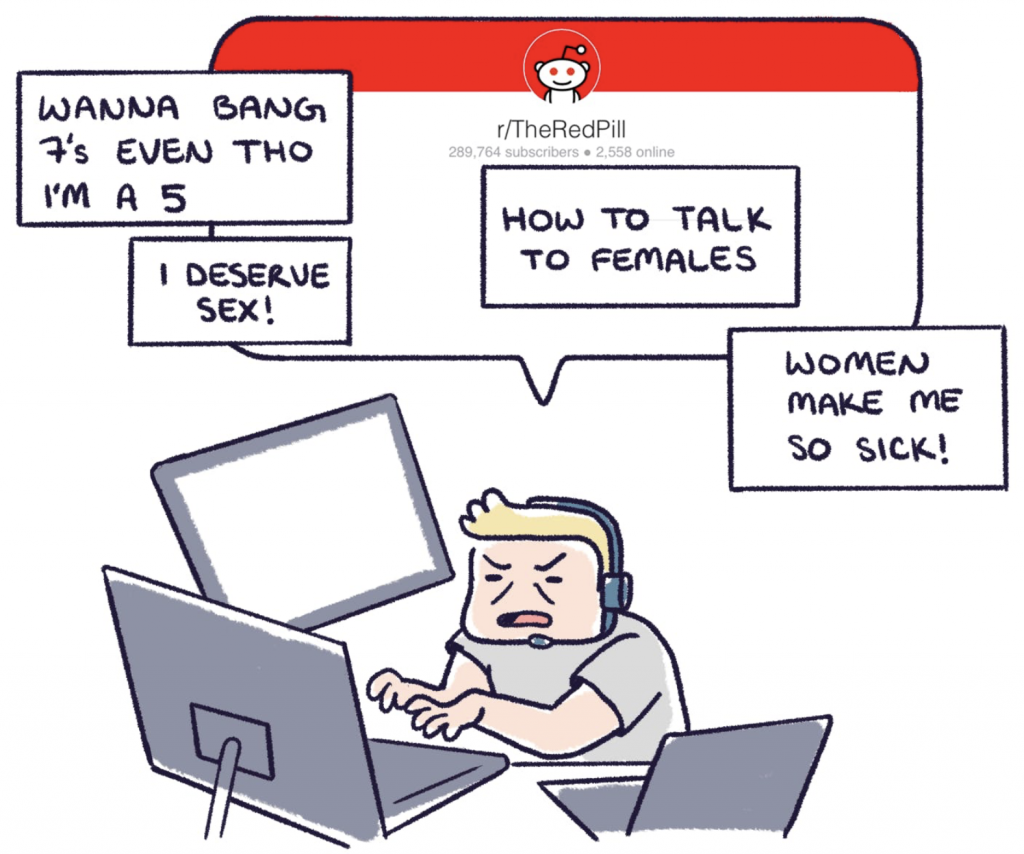
    I wrote about neo-Nazi ideology yesterday, and that’s a good example of the kind of thing that gets completely ignored until it explodes into real-world violence. It’s of particular interest to me because neo-nazis online are very specifically and openly attempting to groom “gender critical” – ie anti-trans – women because they believe these women are very close to being “red pilled” and becoming “tradwives”.

    Red pilling, if you’re not down with idiots, is an idea from the film The Matrix: if you take the red pill you will see the world as it really is. The fact that The Matrix was directed by two trans women, the red pill is based on estrogen tablets and the whole sodding film is quite probably a trans allegory escapes these dolts, because neo-Nazis aren’t very clever.

    And “tradwife”? A tradwife is a woman who rejects feminism and embodies “wifely” qualities of submission, chastity and domestic servitude.

    The idea that any self-respecting feminist would be in cahoots with these woman-hating tools is mind-boggling, and yet here we are.

    Again and again the most vocal anti-trans voices echo the tropes of the religious right and the alt-right, shaming women for supposedly inappropriate behaviour. reinforcing the biological essentialism that feminism fought so hard against and supporting serial abusers of women because their enemy’s enemy is their friend. To see feminist groups in open alliance with evangelical, anti-women groups is quite something to behold.

    This isn’t just happening in anti-trans circles. Neo-nazis have deliberately targeted anywhere they think they can find vulnerable, angry people: not just forums of angry women but for young, angry men who can’t get laid, forums for people with mental health issues, forums where people are lost and desperately need somebody coming along to take them under their wing.

    The problem with hate is not that nobody’s talking about it. It’s that by and large, the media isn’t listening to the people who are desperately trying to sound the alarm: women, ethnic minorities, LGBTI people, disabled people. And when rhetoric becomes reality, when online radicalisation makes a Christian shoot up a synagogue or a straight guy shoot up a gay bar or an “incel” drive a truck into a crowd of shoppers, they wail “how did this happen? How did we miss this?”

    You missed it because you weren’t listening.

  • The roots of rage

    A fascinating (and long) piece in The Atlantic by Charles Duhigg on rage: where it comes from and what it’s doing to America. Much of it applies on this side of the ocean too.

    When we scrutinize the sources of our anger, we should see clearly that our rage is often being stoked not for our benefit but for someone else’s. If we can stop and see the anger merchants’ self-serving motives, we can perhaps start to loosen their grip on us.

  • Local journalism isn’t working

    We’ve known for some time that local journalism is in crisis, partly because people don’t want to pay for news and largely because media owners are trying to extract as much money as possible from their titles, accelerating their inevitable closure by sacrificing quality.

    This is a problem because local journalism is about the only thing that can hold local councils to account. The nationals simply aren’t interested, even when they do local sites: for example Trinity Mirror’s Glasgow Live is very good at telling you if there’s a crash on the M8, but much of what it produces is rewritten press releases from property developers and restaurants.

    In an attempt to address that, the BBC’s Local Democracy Reporters funds local journalism specifically to cover local politics. In Glasgow and its surrounding areas, the money goes to the publishers of the Herald and the Evening Times.

    Let’s see how that’s going, shall we? In a piece promoted with the exciting news that Glasgow will get a new tree-lined avenue, The Evening Times reports on a new, sizeable development that’s just been given planning permission.

    Get Living have approval for the development on derelict land to the east of High Street close to the train station, in a historic part of Glasgow.

    It will create a new city centre residential community with a new public square.

    Work will also involve a new tree lined avenue through the development connecting the Merchant City out towards the east end.

    Exciting! And yet, as the excellent A Thousand Flowers blog points out, not so excellent. The development deals a fatal blow to the Crossrail project, which hoped to solve significant problems with Glasgow’s public transport.

    …any future proposals to develop Crossrail have today been dealt a fatal blow after Glasgow City Council approved a major mixed-use development on the “High street curve” site that would be vital for creating the link. The £200m high rise plans – from Get Living Group (Glasgow) Limited – are for 727 build-to-rent homes, 99 student studios and more than 3,000 square metres of retail, leisure and business space on a former goods yard site.

    The blog also points out the shady financial status of the developer, whose Glaswegian-sounding company is registered in one tax haven and has a parent company registered in another tax haven.

    Still, a development of this size will include affordable housing, won’t it?

    Won’t it?

    Unsurprisingly, the Section 75 planning agreement between Get Living Group and the council makes no reference to affordable housing provision nor rent levels in the flats being developed. Get Living Group currently operate two similar build-to-rent schemes in London where flats are on offer for between £1,650 and £3,856 per calendar month, which provides an indication of the market segment that they will be aiming for.

    This story represents a failure on multiple levels, and it’s exactly the sort of thing we need local journalism to report on. But what we’re getting isn’t journalism. It’s churnalism.

    Update, 12 Dec: The ET has returned to the story, quoting one MP’s criticisms. Credit where credit’s due – but the time to question planning is before the applications are approved, not afterwards.

  • There’s something rotten in Auchtermuchty

    This, from the Daily Record and Sunday Mail, is really alarming: the UK government is running a “psyops” propaganda programme from a mill just outside Auchtermuchty. The stated aim is to fight terrorism and Russian political interference, but it appears to be fighting the UK government’s local political enemies too.

    On the surface, the cryptically named Institute for Statecraft is a small charity operating from an old Victorian mill in Fife.

    But explosive leaked documents passed to the Sunday Mail reveal the organisation’s Integrity Initiative is funded with £2million of Foreign Office cash and run by military intelligence specialists.

    The “think tank” is supposed to counter Russian online propaganda by forming “clusters” of friendly journalists and “key influencers” throughout Europe who use social media to hit back against disinformation.

    But our investigation has found worrying evidence the shadowy programme’s official Twitter account has been used to attack Corbyn, the Labour Party and their officials.

    …David Miller, a professor of political sociology in the School for Policy Studies at the University of Bristol, added: “It’s extraordinary that the Foreign Office would be funding a Scottish charity to counter Russian propaganda which ends up attacking Her Majesty’s opposition and soft-pedalling far-right politicians in the Ukraine.

    Update: on social media, allegations are flying that the newspaper has been hoodwinked by shady propagandists. More will no doubt follow…

  • Comforting the comfortable, afflicting the afflicted

    I’ve had the misfortune to share airtime with writers from Spiked magazine on a few occasions now. I’m not a fan: the magazine is reliably on the wrong side of any issue you care to think of, rushing to the defence of the world’s worst people. I fear that giving them airtime helps legitimise often appalling views, and I now refuse to go on a programme if they’re part of the so-called debate.

    It’s the kind of publication that regularly churns out nonsense of the “surely the real racists here are the people calling racists racists?” variety.

    Spiked writers variously argue that climate change is scaremongering, that feminism has gone too far, that women being abused on the internet need to grow a thicker skin, that trans people are dangerous to society and that Tommy Robinson is a true hero. It appears to have a very similar agenda to thinktanks such as the Taxpayer’s Alliance and the Institute of Economic Affairs, organisations with opaque funding  pushing what can best be described as a hard-right agenda.

    They remind me of the Sirius Corporation imagined by the late Douglas Adams: “a bunch of mindless jerks who’ll be the first against the wall when the revolution comes.”

    If like me you’ve ever wondered how a publication that began as Living Marxism became a mouthpiece and apologist for the hard right, a friend of climate change deniers and an enemy of equality, the answer appears to be simple.

    Money.

    Lots and lots of money.

    I’ve always thought Spiked was a shill for somebody, but I didn’t know who that somebody was. Enter George Monbiot, who Spiked really, really hates. Writing in The Guardian, he notes that Spiked has received at least $300,000 from the Koch brothers. As he explains, the Koch brothers are:

    …co-owners of Koch Industries, a vast private conglomerate of oil pipelines and refineries, chemicals, timber and paper companies, commodity trading firms and cattle ranches. If their two fortunes were rolled into one, Charles David Koch, with $120bn, would be the richest man on Earth.

    If you were making a story about corporate villainy, it’d be hard to invent a better pair of bad guys. And these particular guys are using their money to try and change the world through a three-stage model of social change.

    Universities would produce “the intellectual raw materials”. Thinktanks would transform them into “a more practical or usable form”. Then “citizen activist” groups would “press for the implementation of policy change”… They have poured hundreds of millions of dollars into a network of academic departments, thinktanks, journals and movements.

    Spiked’s editorial stance fits very well inside that: it fights for the implementation of policy change, change that just happens to be entirely in line with the objectives of its funders. Again and again it supports policies that would benefit rich industrialists and rails against policies that might inhibit their ability to make enormous sums of money.

    Monbiot:

    Above all, its positions are justified with the claim to support free speech. But the freedom all seems to tend in one direction: freedom to lambast vulnerable people.

    And its political stance is consistent with that: if it’s good for vulnerable people, then Spiked is against it.

    $300K is the figure Spiked has admitted to, but dark money gets its name because it’s hard to trace: it’s highly likely that there are other sums from other organisations that just happen to share the same agenda.

    This isn’t just about a bunch of mindless jerks who’ll be first against the wall when the revolution comes. It’s about the growing use of dark money to pervert media and politics. Dark money appears to be helping fund Spiked, and it appears to be funding the parade of think tanks that get so much airtime. It funds far-right rabble-rousers and social media astroturfing. Enormous sums of money are being spent to advance the interest of a tiny group of exceptionally wealthy people.

    As Monbiot puts it:

    Dark money is among the greatest current threats to democracy. It means money spent below the public radar, that seeks to change political outcomes. It enables very rich people and corporations to influence politics without showing their hands.

    As Finley Peter Dunne famously said, journalism’s job is “to afflict the comfortable and comfort the afflicted”. Dark money turns that on its head.

    That’s not to say journalism shouldn’t have a viewpoint. I like John Harris’s argument:

    Even partisan commentary can be rooted in the principles of good journalism, so long as it does not ignore uncomfortable facts, blindly offer support to parties or leaders, or distort actuality to score political points.

    But that’s exactly what dark money wants to pollute. As soon as you accept dark money, all of your output becomes suspect.

    This is important, and incredibly dangerous. We call the media “the fourth estate” after Thomas Carlyle, who wrote in 1787 that “Burke said there were Three Estates in Parliament; but, in the Reporters’ Gallery yonder, there sat a Fourth Estate more important far than they all.”

    In a civilised society the media is there to hold power accountable, not to act as its apologist or its cheerleader.

  • Everybody thinks they’re the good guys

    Speaking at the Hollywood Reporter Women in Entertainment gala this week, comedian Hannah Gadsby spoke about her problem with “good men”.

    “My problem is that, according to the ‘Jimmys,’ there are only two types of bad men. There’s the [Harvey] Weinstein/Bill Cosby types who are so utterly horrible that they might as well be different species to the Jimmys,” Gadsby said.

    “And then there are the FOJs. The friends of Jimmys. These are apparently good men who simply misread the rules. Garden variety consent dyslexics. They have the rule book, but they just skimmed it, you know?”

    Gadsby said it was critical to talk about “good men” because they are the ones who draw “the line in the sand” when talking about “bad men.” The problem, she said, was that men were constantly moving the goal posts to place themselves on the excusable side of that line to distance themselves from bad behavior.

    This is something I wrote about a few weeks back when I overheard two guys in the pub damning the likes of Harvey Weinstein but claiming that all men were being tarred with the same misogynist brush. The conversations around this and around the whole #metoo thing are illuminating: talk to men and you’ll hear fears of good men being demonised; talk to women and you’ll hear endless tales of good men who weren’t good men.

    “Guess what happens when only good men get to draw that line? This world,” Gadsby said. “A world full of good men who do very bad things and still believe in their heart of hearts that they are good men because they have not crossed the line. Because they moved the line for their own good. Women should be in control of that line, no question.”

    It’s like the attitudes to rape I blogged about yesterday. You can’t be a terrible person for doing X if you don’t believe X is wrong. So if you believe rape isn’t rape if the woman is drunk, or asleep, or if she was a bit flirty during your date, then you aren’t like Harvey Weinstein if you force yourself on her.

    Except, of course, you are.

    But this wouldn’t be a Hannah Gadsby speech if it just ended there.

    “Now take everything I have said up unto this point and replace ‘men’ with ‘white person,’ ” Gadsby continued, to tepid laughter. “And know that if you are a white woman you have no place drawing lines in the sand between good white people and bad white people.”

    The same, she said, could be said for those who are “straight,” “cis,” “able-bodied” or “neurotypical.”

    It wouldn’t take long for me to collate endless examples of people who consider themselves to be good people being abusive towards gay people, or trans people, or disabled people, or people with mental illnesses, or to any other vulnerable group.

    In many cases, these people measure their goodness in relation to the very people they’re abusive to: I’m a good person because I’m fighting against the gays, the transgender agenda, against political correctness gone mad. I’m protecting our children, or my country, or my race.

    As a species we’re very good at rewriting stories to ensure we’re always the hero and never the villain.

    Gadsby:

    Everybody believes they are fundamentally good, and we all need to believe we are fundamentally good because believing you are fundamentally good is part of the human condition. But if you have to believe someone else is bad in order to believe you are good, you are drawing a very dangerous line.


  • No platform, no problem

    To borrow from Oscar Wilde, it would take a heart of stone to read about the fall of Milo without laughing.

    Milo, if you’re lucky enough to be unaware of him, is a vicious right-wing troll (and former Telegraph journalist) who managed to build a very lucrative empire by saying and doing hateful things. “Feminism is cancer” was one of his hits.

    Milo discovered that the more hateful your views, the bigger your profile becomes – and the bigger your profile, the more money you can make.

    His rise demonstrated that despite what people in the media may have you believe, terrible views don’t die when you expose them; the people with those views just gain some more followers and make the world a slightly worse place. The same trick is working for the stupid man’s philosopher Jordan Peterson, and for former Trump strategist and human bin fire Steve Bannon.

    For example, this week Holyrood magazine did its bit to fight the rise of neo-fascism by, er, giving Bannon multiple pages to spout his awful opinions without challenge. This is the same Bannon who the BBC recently invited as the honoured guest at a conference. In a sane world Bannon would be a sad, lonely character whose only audience is a long-suffering pet. But this isn’t a sane world.

    We’ve seen again and again that giving vile populists a platform just makes everything worse. But what if we don’t give them a platform?

    Milo knows. He built much of his notoriety on Twitter, and when Twitter finally booted him off the platform – for encouraging his followers to abuse a black actress, the last of many awful things he did on the service – his empire began to shrink.

    What started as a slow decline became a rapid one when he made awful but hardly untypical comments about underage boys, comments so bad that Breitbart let him go. They also played a part in the cancellation of his book deal with Simon & Schuster, although I suspect it was more to do with the fact that his book was bloody awful. Racist, misogynist, and every kind of -phobic you might imagine, it should never have been commissioned in the first place. Being filmed singing karaoke in a bar with infamous white supremacists didn’t help much either.

    What happens to a public figure who is no longer so public?

    The answer appears to be imminent bankruptcy. A few days ago, leaked emails and documents indicated that Milo is more than 2 million dollars in debt and that his creditors are running out of patience.

    Yesterday, Milo turned to social media to help fund his “comeback” – despite claiming he was pulling in $40,000 per week and financially stable.

    The comeback lasted one day.

    As a spokesperson for the funding site Patreon explained: “we don’t allow association with or supporting hate groups on Patreon.” Milo’s crowdfunding campaign was removed from the site.

    Just to rub salt in the wound, the former enfant terrible of the internet managed to attract just 250 supporters before the site shut him down.

    Milo deserves schadenfreude, not sympathy. He’s a toxic troll, a man of no importance. But he became a public figure largely because of a media that’s desperate for controversy and desperate for clicks. His rise and demise should be a warning to commissioning editors and programme producers everywhere: when you’re presented with a trash fire, don’t give it oxygen.