Category: Hell in a handcart

We’re all doomed

  • “I Wish I Could Tell You It’s Gotten Better. It Hasn’t.”

    The New York Times has put together a comprehensive series of reports on Gamergate, the poisonous movement that’s transformed politics for the worse. What began as misogyny would soon incorporate white nationalism; what began in video gaming circles would become a mass movement affecting everything.

    It’s impressive, powerful and frightening stuff, and the reverberations continue today: what we first saw in Gamergate continues in the US and the UK. It’s in Brexit and in US and New Zealand gun massacres, in the culture wars against LGBT+ people and other minorities, in the lurch to the far right we’re seeing in Europe and both North and South America. It was fuelled by Breitbart, whose Steve Bannon became close to Donald Trump, to Nigel Farage and to Boris Johnson, and  it made stars of unprincipled opportunists such as Milo (whose courting of dangerous extremists has since been copied by other right-wingers in the US and beyond). Its tactics became the playbook of the alt-right and the far right; over here, publications such as Spiked clearly take some inspiration from Breitbart (as well as money from the US right).

    Gamergate wasn’t the first time white male rage was weaponised online – that goes back at least to the early 2000s, if not before; as the NYT notes, some of the tactics were first used against black women on social media  – but it was the first time it became a mass movement.

    Slate.com:

    there is a clear and obvious connection between video games, white nationalist terrorism, and the image board where the El Paso shooter posted his manifesto. That connection is Gamergate, the campaign of misogynistic harassment by aggrieved gamers that began in 2014, and which moved to 8chan from 4chan when the latter refused to allow Gamergaters to use that board for coordinated harassment campaigns and doxing.

  • How YouTube perverts politics and spreads fear and rage

    This, the result of a months-long investigation by the New York Times, is terrifying: How YouTube radicalised Brazil.

    A New York Times investigation in Brazil found that, time and again, videos promoted by the site have upended central elements of daily life.

    Teachers describe classrooms made unruly by students who quote from YouTube conspiracy videos or who, encouraged by right-wing YouTube stars, secretly record their instructors.

    Some parents look to “Dr. YouTube” for health advice but get dangerous misinformation instead, hampering the nation’s efforts to fight diseases like Zika. Viral videos have incited death threats against public health advocates.

    And in politics, a wave of right-wing YouTube stars ran for office alongside Mr. Bolsonaro, some winning by historic margins. Most still use the platform, governing the world’s fourth-largest democracy through internet-honed trolling and provocation.

    YouTube continues to deny what’s obvious to everyone: its algorithms prioritise conspiracy theories, right-wing bullshit and any other content that purports to tell you the truth that others are trying to conceal. And that has horrific real-world consequences – to the point where we need to warn parents of the signs that their boys are being radicalised by YouTube gaming commentators.

    YouTube’s recommendation of awful content isn’t a bug. It’s feature. The entire system is built to prioritise attention, and what gets the most attention is the most inflammatory, fear-mongering, hateful content.

    When even the far right are crediting YouTube with their political successes, it’s clear that YouTube’s protestations mean nothing. Whether it’s spreading anti-vaccine fear or right-wing conspiracies, YouTube has become a cancer at the very heart of modern life.

  • “They have a product they want to sell and that product is hate”

    (Content warning: violent misogyny)

    This piece by Andrea Stanley in Cosmopolitan is astonishing. It’s about a woman, identified only as K, whose job is to stare into the abyss.

    She infiltrates the places mass murders come from, the places where angry men start their journey to actual killing.

    K’s focus has been pulled toward the alt-right, a younger, more misogynistic version of the white supremacist movement that’s converting a new generation on message boards and social media. She is tracking the men who hate women. And they’re so dangerous that most of her family and friends don’t even know what she does.

    It’s one of the most frightening features I’ve ever read.

    these guys aren’t just trolls in basements—they’re people you probably know. Beirich calls them “millennial misogynists.” K says many are college-educated and articulate. They have day jobs and Tinder accounts.

    …Many of today’s extremists hide their radical views under the guise of boy-next-door preppy looks and organize activities, like all-male hikes, to appear mainstream. “They have a product they want to sell and that product is hate,” says K. “When you see a bunch of normal-looking guys, you think, How bad could it be? But violent men don’t have to look any different from kind men.” Some of the ones K tracks post pictures with their kids and pets amid their calls for mass violence.

    …She tells me about one of the deeply troubling guys she’s been following lately, who posts rants about how he won’t let his wife watch television because it makes her too “feminist.” He shares degrading photos of naked women and fantasizes about electrocuting them—and seriously hurting others too. He recently hinted that these don’t need to stay fantasies.

  • “We still occupy a Cold War headspace”

    This, by Jonathan Lis, is an interesting column about the problem with media coverage of modern despots.

    Across the so-called ‘advanced’ democracies, leaders are no longer playing by the old rules. Our media still is.

    Lis argues that the media is failing in its coverage of one despot in particular. The one in the White House.

    Perhaps the first thing we must do is shake off our ingrained awe and terror of the United States.

    We still occupy a Cold War headspace in which the US is on the side of good. The world oppresses; America liberates.

    The mainstream British media has no compunction in labelling Marine Le Pen in France or Matteo Salvini in Italy as far-right – because they are. These figures are safe targets for objective reporting.

    But there is not a cigarette paper between those leaders and Trump. Indeed, Trump’s rhetoric frequently exceeds theirs in obscenity. If we label them as far-right, why not also him?

    His point about Le Pen and Salvini is one I hadn’t thought of. If they do something racist, it’s reported here as such. But if Trump does it, we reach for the euphemisms: “racially charged” or “controversial.”

    Journalism cannot operate in a climate of either fear or deference. If something must be named, we must name it.

  • How you tell a story tells a story

    This week, Scottish universities unveiled an important new initiative: people who’ve been in the care system will be guaranteed the offer of a university place if they meet new minimum entry requirements. It should double the number of care-experienced students to around 600 people.

    It’s designed to address some of the issues that don’t affect those of us who haven’t been in the care system. As The BBC puts it:

    For example, their education may have been disrupted as they moved between carers.

    It’s clearly a positive, progressive move that’ll benefit some disadvantaged people – which is how most of the press has reported it. Most of the press apart from The Times.

    People with straight As face losing out on a university place under a pledge to widen access for disadvantaged people.

    That’s the opener. The next paragraph adds that the pupils will be “potentially displacing a better qualified candidate with a more fortunate background.” It also chooses to provide its readers with different figures: instead of telling them that the number of students from care backgrounds may increase from 300 to 600, it says that “there are 15,000 ‘looked after’ children in Scotland”.

    Look at the word choice there. “Displacing”. Displacing means moving something from its proper or usual position. It’s often used to describe natural disasters forcing people to abandon their homes, and it’s a favourite of racists too. It’s a very loaded word, which should never be used lightly when talking about people.

    It’s a good example of how you can twist a narrative to suit a particular agenda, in this case to make your readers frightened that horrible poor people might prevent Tarquin or Jocinda from getting that place at university. It won’t, of course, and The Times knows it. But the story The Times wants to tell its primarily white, affluent, middle class to upper class readers is that the other – in this case, children from disadvantaged backgrounds – are coming to take away what you have.

    Possibly the worst, most telling example of this was a few weeks ago when a stowaway fell from an aeroplane in London. The man, from Kenya, died horribly. As one neighbour told the press, “there was blood all over the walls of the garden.”

    The Times ran this headline.
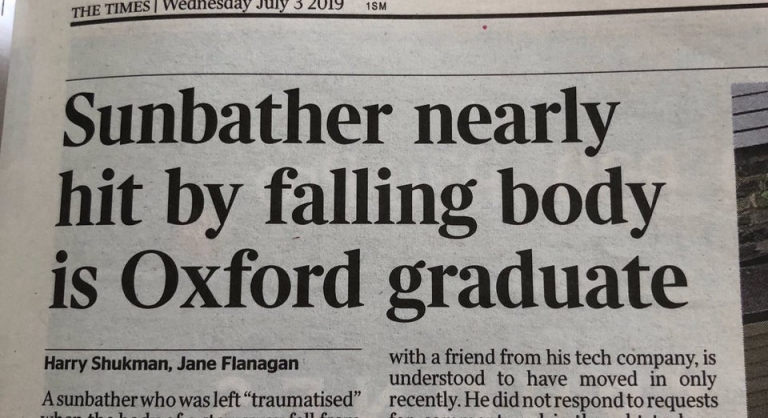
    Bloody foreigners coming over here, dying in our gardens, leaving us to clean up their shattered corpses.

    Once you’re aware of it, you’ll see it everywhere. Telling readers that some group of others is coming for their children is a Times (and right-wing media generally)  staple, whether it’s Muslims, LGBT people, foreign people (especially European people or brown people), poor people or women people.

    That’s because the Times is the house organ for privileged people, and what it’s serving them is “privileged distress.” Here’s Doug Muder to explain what that means.

    As the culture evolves, people who benefitted from the old ways invariably see themselves as victims of change. The world used to fit them like a glove, but it no longer does. Increasingly, they find themselves in unfamiliar situations that feel unfair or even unsafe. Their concerns used to take center stage, but now they must compete with the formerly invisible concerns of others.

    There’s another word for it.

    Supremacy.

    Here’s activist and playwright Wayne Self.

    I know that the word “supremacist” makes you think of “White Supremacists,” which makes you think of the KKK and cross-burning and lynching. We think of supremacist as a Southern thing, a rural thing, a racial thing, a militia thing, a hate thing.

    …Supremacy is the habit of believing or acting as if your life, your love, your culture, your self has more intrinsic worth than those of people who differ from you.

    …You don’t have to hate people to feel innately superior to them. After all, what kind of threat are your inferiors to you? You may be annoyed by them, from time to time, or you may even like them. You can even have so much affection for them that you might call that affection love.

    When the school a witness went to is more important than the dead man in his garden, that’s supremacy. When your right to offend is more important than others’ right to life free from harassment, that’s supremacy. When the university places of the most privileged in society are considered more important than those of students who don’t come from the right families, that’s supremacy. When tax cuts for the rich matter more than funding services for the poor, that’s supremacy. When men’s right to behave how they damn well please is more important than women’s safety, that’s supremacy.

    That’s not to say that Times readers are supremacists. Most of them, I’m sure, are decent and kind. But the thing about privilege is that you don’t notice it when you have it, so any attempt to improve equality can look like you’re being picked on, discriminated against. That’s why some people genuinely believe that cisgender, heterosexual, affluent white men face more discrimination than other minority groups. It isn’t remotely true, but to some it feels true.

    Telling people that their inferiors are coming for what they have is one of the oldest, most malicious tricks in the book. But it works, and it provides an opportunity for bad actors to weaponise it. Bigots of every stripe, the far right, disaster capitalists, billionaire media moguls.

    There’s a joke that I’ve seen circulate in various guises, but the basic point remains in each version.

    A billionaire, a Times reader and a Polish cleaner are sitting at a table with a plate of twelve biscuits in front of them.

    Slowly and deliberately, the billionaire eats eleven of the biscuits.

    His mouth covered in crumbs, the billionaire turns to the Times reader.

    “Watch out!” he says. “That cleaner’s going to steal your biscuit!”
  • I’m hacked off with it too

    I’ve written before about the toothless press regulator IPSO, which was set up by the press specifically for the purpose of not regulating the press. To take just one recent example, IPSO found that when The Times makes up quotes, doing so doesn’t breach the rules on accuracy.

    The ruling was on a story about transgender people, who have been subjected to an astonishing hate campaign for some time now. Newspapers have become adept at sticking to the letter of the rules rather than the spirit: all the rules on discrimination and demonisation apply to individuals, not to groups. So if a paper were to publish a column claiming that trans person X is a predator, that’s against the rules (as well as defamatory). If the column claims that all trans people are predators, that’s fine.

    In other words, it’s not okay to incite hatred against one person. But it’s fine if you want to do it against an entire minority group.

    The Hacked Off campaign is attempting to highlight this in its latest report, “The denigration, abuse and misrepresentation of the movement for transgender equality in the press”. It focuses on two dozen high profile and often very abusive articles that appeared in the mainstream press in recent months. As Hacked Off put it on Twitter: “Some newspapers have resorted to distortions, inaccuracies and explicit transphobic abuse.” Over this period, UK hate crimes against trans people have increased by 81%.

    The problem is specific to newspapers. We don’t have endless abuse of trans people on TV because Ofcom regulates broadcast media. There’s no such regulation for print.

    Despite the 2013 Cameron Government legislating for an independent system of media regulation, the current Government have not brought it into
    force. This has left one independent regulator operational – but membership is entirely optional. As a result, none of the major websites or newspapers have signed up.

    Instead, most publishers are members of IPSO, which is a newspaper association and complaints-handler under the control of newspaper executives. I

    In other words, the people being asked to decide whether content breaks the rules are the people who publish the content that breaks the rules.

    I used to be against press regulation, because many journalists are fine people who do important work. But some of the biggest publishers in the country have turned their platforms into bully pulpits, repeatedly, mendaciously publishing malicious content designed to hurt the most vulnerable people in our society: not just trans people but minorities of all kinds. We’ve seen exactly the same maliciousness directed at muslim people, for example, and the same rubber-stamping by IPSO.

    IPSO is not fit for purpose and sectors of the UK press are out of control. What they do is not journalism, and it does not deserve protection.

    There’s a petition demanding change here. Please sign it. Every name helps.

  • Not going for gold

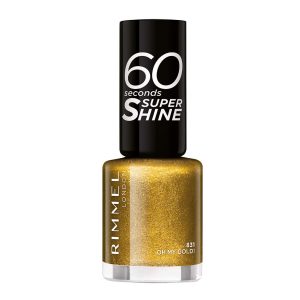
    This is a bottle of Rimmel’s Oh My Gold nail polish, which I’m currently sporting. My five-year-old son likes it too, because nail polish is fun and fun is important. So when he asked for some on his own nails last night I was happy to oblige.
    This morning, he asked me to take it off again because he’s going to a sports camp where “the big boys will notice and say ‘what are you wearing nail polish for? That’s for girls!’ and pick on me.” So we got the nail polish remover and scrubbed every last bit off again.

    Five years old and he already knows the rules, and that he’ll be punished for breaking them.

    It makes me sad, as it did when my daughter was told aged four that history and dinosaurs are not for girls, and as it did a year later when she was told that girls couldn’t play with dragons because unicorns, not dragons, are for girls. We’re policing the gender of imaginary creatures now, it seems.

    These attitudes are learnt, of course. They’re passed down from other children, and from parents. So at an age when children should be expressing themselves more, experiencing more, exploring more, learning more, we’re already trying to put limits on all of those things.

    In a world of infinite colours, we’re telling them to choose just one.

  • What have we become?

    Frances Ryan, in The Guardian:

    Medics often use life expectancy as a barometer of the health of a nation and by official measures, Britain is getting sicker. For the first time in 100 years, Britons are dying earlier, leading a team of specialists to meet at University College London this month to investigate it.

    The UK now has the worst health trends in western Europe, with experts stating that austerity is a major factor. This is no coincidence considering that consecutive Conservative-led governments chose far deeper cuts in the wake of the 2008 global crash than many other European countries, opting for dramatic reductions in funding for anything from meals on wheels, to NHS spending and social security.

    Even babies are not immune to such political failings. The infant mortality rate in England and Wales is rising after more than a century of continuous improvement. As child poverty grows, the Royal College of Paediatrics and Child Health estimates infant mortality rates could be 140% higher here than in comparable wealthy countries by 2030.

  • Birds of a feather

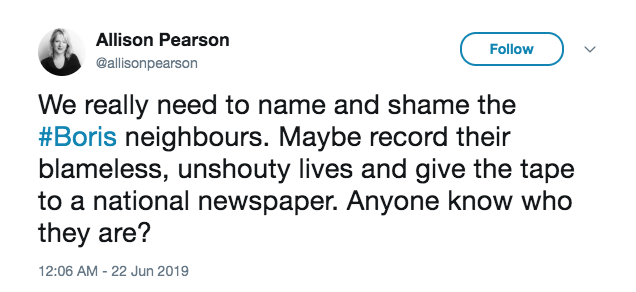
    Allison Pearson, novelist and Telegraph columnist, is a big fan of Boris Johnson – a man who you’ll recall once discussed a conspiracy to have a journalist beaten up.

    It seems Pearson has come very close to having people beaten up too. When Johnson’s neighbours called the police about what sounded like domestic violence, she tweeted this to her 38,000 followers:

    The neighbours were duly named and shamed. And now they’ve had to leave their flat because of “a series of grim threats” to their safety.

  • We are not 81% touchier than we were last year

    BBC News:

    The number of transgender hate crimes recorded by police forces in England, Scotland and Wales has risen by 81%, latest figures suggest.

    Data obtained by the BBC showed there were 1,944 crimes across 36 forces in the last financial year compared with 1,073 in 2016-17.

    The figures here are based on freedom of information requests to police forces.

    As the BBC analysis notes, part of the explanation may be that more trans people are coming forward. But increasing awareness of hate crime legislation and reporting applies to all LGBT+ people, not just trans people. Hate crimes against all of us are on the increase, and hate crimes against trans people are increasing disproportionately.

    For example, a recent Stonewall/YouGov poll of more than 5,000 LGBT people found that 1/5 of LGBT people have experienced a hate crime or incident in the last 12 months, rising to 2 in 5 trans people. Where 1 in 10 LGBT people have experienced online abuse, that rises to 1 in 4 for trans people.

    If only there were some kind of explanation for the increasing attacks on people who are constantly portrayed as deviants and predators in national, local and social media.

    Incidentally, the BBC figures only reflect what gets reported to the police, not how many incidents take place or how many crimes are committed. Many of us don’t believe the police will take us seriously, or that there’s any reasonable prospect of the offender(s) being caught, let alone punished. I’m not the only trans person who’s experienced hateful incidents and decided not to report them.

    Whenever trans rights are discussed on social media, someone will come along within the first few comments and demand to know “what rights don’t trans people have already?” The right to go through life without experiencing verbal and physical abuse would be a start.