Category: Hell in a handcart

We’re all doomed

  • Being led by donkeys would be an improvement

    There’s a cartoon I love by Stephen Collins about Michael Gove. It riffs on the film Independence Day, and features the MP volunteering to fly a plane to defeat an alien invasion.

    When quizzed about his unsuitability – “you’ve never flown a fighter plane in your life!” – Gove is adamant that he’s the right man for the job.

    “I used to be a journalist,” the fictional Gove says. “for The Times. I wrote two articles about planes [and] I’ve got strong opinions about aliens.”

    The cartoon’s ending is one of my very favourite things.

    Unfortunately it’s not so funny when the threat isn’t fictional and the strong opinions are about ventilators for coronavirus patients.

    Earlier today, Financial Times public policy editor Peter Foster wrote about the “Ventilator Challenge”, where the UK government decided to specify a whole bunch of ventilators that aren’t suitable for coronavirus patients. His Twitter thread tells the story. It isn’t a happy one.

    The short version, as Foster puts it:

    What this speaks to is the deeply worrying tendency of this crop of politicians to think they know best.

    The ‘cut-the-crap’ ‘how-hard-can-it-be?’ attitudes that leads to headless decision making. It’s embarrassing.

    …Expert people TEARING their hair out at the willful numbskullery of the people at the top.

    If it weren’t for a combination of medical skill and sheer good luck, this fiasco would have killed people.

  • “A gamble that became an embarrassment”

    This is the kind of article that you read from behind your fingers. From the NYT: UK Paid $20 Million for New Coronavirus Tests. They Didn’t Work.

    The two Chinese companies were offering a risky proposition: two million home test kits said to detect antibodies for the coronavirus for at least $20 million, take it or leave it.

    The asking price was high, the technology was unproven and the money had to be paid upfront. And the buyer would be required to pick up the crate loads of test kits from a facility in China.

    Yet British officials took the deal, according to a senior civil servant involved, then confidently promised tests would be available at pharmacies in as little as two weeks. “As simple as a pregnancy test,” gushed Prime Minister Boris Johnson. “It has the potential to be a total game changer.”

    There was one problem, however. The tests did not work.

  • Make America Sick Again

    I fear that this extraordinary photo will become a tragedy in hindsight. It’s of protesters in Michigan, many of them armed, demanding the government lifts lockdown because “we’re tired of not being able to buy the things that we need, go to the hairdressers.” Some protesters’ cars blocked the entrances to a hospital, preventing ambulances from getting through.

    This potentially lethal idiocy is being inflamed by – of course – Fox News. Earlier this week, Fox’s Bill Bennet told Americans once again that the coronavirus isn’t a pandemic and that social distancing isn’t necessary. Protesters’ claims that the virus was less dangerous than the flu are just echoing what Fox has been telling them, and their president, for the last five weeks.

  • The virus isn’t a leveller. It’s an amplifier

    The Duke and Duchess of Cambridge have appeared in a video about mental health during the coronavirus crisis. “We’re in this together,” they say.

    I’ve deliberately chosen an extreme example of the sentiment, but it’s everywhere in mainstream and social media right now. Coronavirus is the great leveller, we’re told. We’re in this together.

    It isn’t, and we aren’t. Your experience of the crisis and your ability to survive it depend to a great extent on how privileged you already are.

    You might not be spending lockdown in Anmer Hall, the Cambridges’ ten-bedroom holiday home (pictured below). But you’re probably in a better place than many.

    Let’s say you’re a homeowner with a job you can do from home and a nice big garden. Your experience of this crisis will be vastly different than if you were stuck in a cramped flat, or if you still had to take the tube to work every day, or if you were in an institution or a care home.

    Even something as simple as where you live matters. Afua Hirsch in The Guardian:

    How do you self-isolate when you live in cramped or shared accommodation? How do you reduce shopping trips to once a week when you have little or no storage space? And if you do want to go to the park or do an extra shop, you now risk not only infection, but coming into contact with the police, some of whom are zealously taking advantage of their new social control powers.

    This goes far beyond mere comfort. The poorer you are, the more danger you’re in. And because people from ethnic minorities are more likely to be poor, they’re more likely to become ill.

    Hirsch:

    Ethnic minority people are becoming victims of this frightening illness at an alarming rate. A study of more than 2,000 patients critically ill with the virus in England, Wales and Northern Ireland has found that 35% are black, Asian or other ethnic minority. This is more than double the representation in the wider population.

    …To see the scary reality of racial inequality taken to extreme proportions during this pandemic, look to the United States. The tragic consequences have reached all parts of the nation. In Michigan, 15% of the population but 40% of the deaths are black. Chicago has a 30% African American population, and a 70% African American death rate. The picture from Louisiana is very similar: a 32% black population, with a 70% death rate.

    This isn’t about biology: white people don’t have special DNA that protects them from COVID-19. It’s about inequality.

    Rebecca Solnit, also in The Guardian:

    …health disparities due to racism increased the chances of becoming severely ill or dying. From New Orleans to Chicago, black people were at disproportionate risk of death. Higher levels of diabetes and hypertension can be linked to the stress of racism; asthma and respiratory problems are tied to the polluted air of many urban and industrial areas; and lack of long-term access to good medical care and food sources (due to poverty and discrimination) play their part.

    Coronavirus isn’t the great leveller some people believe it to be. It’s an amplifier. The more vulnerable you were, the more vulnerable you are.

  • Shifting the narrative

    The Conservatives are working on their exit strategy. Not how we’ll exit the lockdown; how they’ll shift the blame for their failures onto others, such as the NHS. For example:

    Care homes are not run by the NHS.

    Care homes used to be run by councils, but years of funding cuts have seen that provision almost disappear. Today, care homes are primarily for-profit private businesses.

    84% of English care home beds are owned and operated by private companies, 13% are run by voluntary organisations and 3% are run by councils. As the authors of a recent report into the sector put it:

    The state has abdicated its responsibility for providing care over recent decades. The private sector may have filled this gap but it consistently puts profits before people.

    …The fact that private equity-backed firms have taken over a significant share of the UK’s care provision, fuelled by debt and driven by the prospect of rising property prices and ever-lower care costs, puts our vital social care system at ever-increasing risk.

    One of my best friends is a care home worker. Like many in the sector they are on a zero hours contract and paid a pittance by a private and very profitable company; they have not been given PPE because the company doesn’t want to pay for PPE. Care homes can do, or in this case not do, whatever they want. Which is why so many people are dying in them.

    The government doesn’t want to be on the hook for those deaths, or for the growing death toll among front-line NHS staff. Hence the emerging narrative that it’s all the NHS’s fault. But it isn’t. The lack of PPE for front-line workers and other key equipment is the result of government decisions and indecision going back to January.

    The dread hand of news management has already kicked in: the allegation is now that key workers aren’t getting PPE because the lumbering, inefficient NHS isn’t allocating resources properly, not that the resources weren’t there in the first place. There are a lot of carefully worded claims doing the rounds, so for example the government is keen to talk about the overall number of items of PPE that have been distributed rather than the details of which items have gone where and in what quantities: there’s a big difference between a gown (which is inappropriate for aerosol-generating procedures) and an FFP2 surgical mask. If there were enough PPE, everyone in the country with a 3D printer wouldn’t be making making visors for NHS staff and nurses wouldn’t be making their own PPE from bin bags.

    Still, we can count on our fearless, non-partisan press ensuring they don’t get away with it. Can’t we?

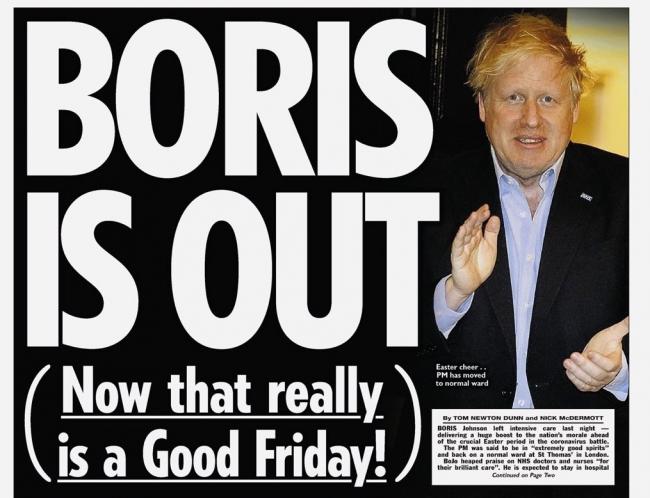
    Image by Liz Gerard on Twitter. It shows the Sun’s reporting of the COVID-19 death toll last week.
  • Lethal stupidity on a truly horrific scale

    The Sun’s front page after nearly 1,000 people died in a single day.

    The official UK coronavirus death toll will crack 10,000 today. The real death toll, which unlike the official figures includes those who died in care homes, those who died at home and those who had not already been tested positive for COVID-19, is much higher.

    The Centre for Evidence Based Medicine has published a good explanation of why the official figures are inaccurate, complete with spreadsheets so you can see for yourself. The figures we’re given in the daily briefings do not tell us how many people died on a particular day. They tell us how many deaths in hospitals were reported that day. There is often a delay between the death occurring and the death being reported.

    Here’s an example. The figure for 8 April was 828 deaths, but none of the 828 deaths happened on the 8th of April. They happened on the 4th of March, and the 5th of March, and the 31st of March, and the 4th of April, up to the 7th of April. Some of the people who died on the 8th will be reported in the figures for the 9th, and the 10th, and so on.

    What that means is that there’s a big lag between people dying and their deaths being counted, and that lag can be dramatic: the officially announced death toll for 31 March was 679, but NHS England’s statistics now say it was 1,710. The difference isn’t usually that dramatic, but it does mean that the figures are at best a guide to what’s been happening rather than an accurate picture.

    [Update: that means you should prepare for very bad news in the early part of next week: there will be a lag due to the Easter holiday, so we’re likely to see a spike in numbers when those reports come in.]

    However you count it, we’re now on track to have the highest death toll of any country in Western Europe, despite having had more time to prepare than the rest of Western Europe.

    If you can bear to read it, there’s a timeline of the lethal arrogance that’s already killed thousands of people here.

    Nesrine Malik in The Guardian:

    It is a jarring experience to wake up to a British death toll that is almost a thousand a day, and not see that number on every front page, being put to every politician in every single interview, with a demand for an explanation. It is as if those who should be asking these questions, from the media to opposition politicians, have been subjected to a mass memory-erasing exercise. Every report showing the scale of the crisis should be framed in the language of accountability and anchored in the premise of preventability. With all the benefits of hindsight, the government dragged its feet, wasted precious time and infused the issue with a sense of British exceptionalism: drastic measures need not be taken because in the UK things will somehow be different.

    … It’s hard, as we lock down, to nurture an outrage that is based on decisions in the past when the loss of life is happening today – more so when the government has stealthily removed itself from the picture and shifted the responsibility entirely on to the public

    …Relocate the pain and recall that this need not have happened. Ten thousand people, in UK hospitals alone, have now died.

  • One in ten

    At the time of writing:

    101,000 – total global deaths from Covid-19

    8,958 – total UK deaths from the same virus, excluding hundreds more in care homes

    The UK has nearly one in ten of the global deaths from this virus despite being one of the most recent countries to get it.

    Today’s daily death toll, 980, means for two days running the UK has had more daily deaths than the worst days in Italy or France.

    That’s despite having the benefit of time to see how the virus has spread in other countries, time to order protective equipment and ventilators, time to plan an effective response. Time other countries didn’t have.

    Things could have been even worse. If the football authorities hadn’t become fed up with government inaction and decided to cancel multiple big games in March, the numbers  would be even higher.

    This is a political failure on a truly horrific scale.

    It’s time for the press to do its job and hold the government to account.

  • Beware bored police officers

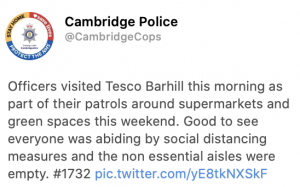
    Here’s Cambridge Police on Twitter this morning.

    Let’s play a little game. It’s called “show us which specific part of the emergency coronavirus legislation details which supermarket aisles are essential and which ones are non-essential”.

    There isn’t one, of course. Shops are allowed to sell anything they have in stock, and you are allowed to buy it.

    And it’s not just the Cambridge plod. Yesterday we had suggestions that police would check the contents of people’s shopping carts to make sure they weren’t buying anything frivolous. Last week, police were deciding that cigarettes and alcohol weren’t permitted.

    So far at least this is a fairly innocuous example of something much more serious: whenever new powers are made available to people, some of those people will deliberately or accidentally overestimate the powers they have.

    Whenever new powers are being considered, even in an emergency, one question should always be paramount: what could the worst person in the world do with those powers? Because once the powers have been made available, you’ll find out.

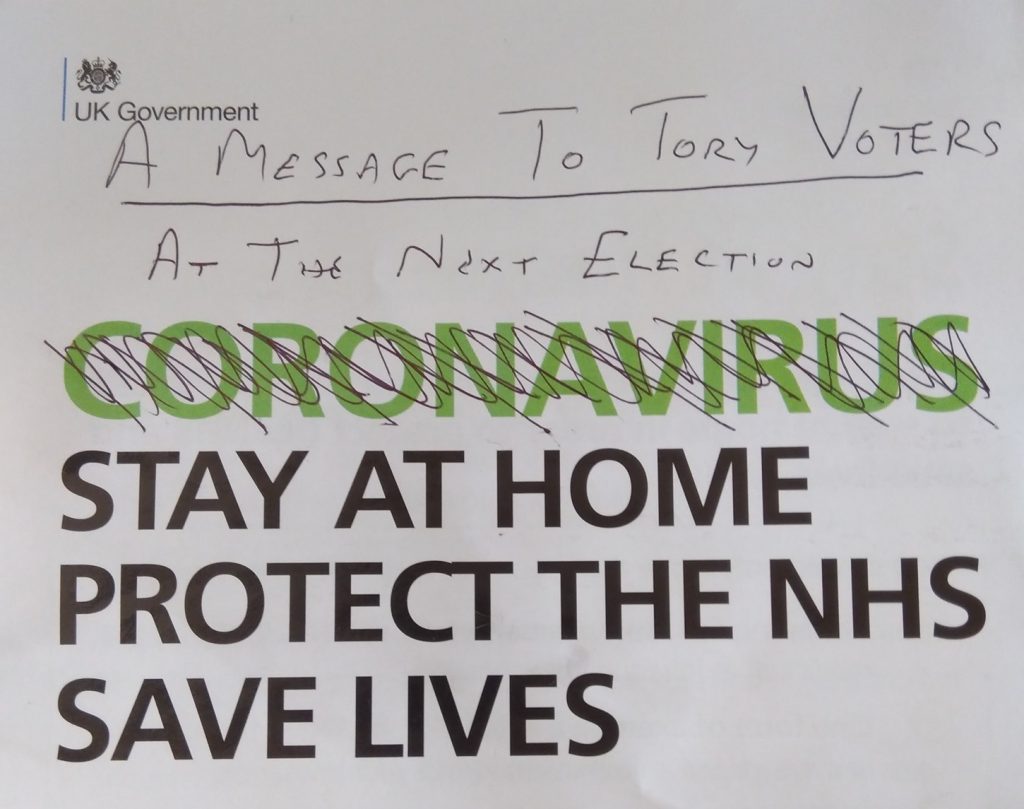
  • To protect the NHS, stay home (at elections)

    This is doing the rounds on social media right now.

    It’s funny, but like the best political jokes it has sharp teeth. How many of the people standing outside clapping for the NHS on a Thursday evening voted for a party that’s stripped the NHS bare, refused to pay staff properly, refused to consider its workers key staff when deciding who can live in the UK, refused to stockpile adequate protective equipment, refused to take part in a ventilator purchase scheme for ideological reasons and conducted ongoing privatisation by stealth?

    How many of the people demanding footballers pay some extra cash are making similar demands of the UK’s super-rich?

    How many of the newspapers calling NHS nurses and doctors angels and promoting NHS fundraisers are owned by billionaires and published by companies carefully structured to avoid paying tax?

    NHS underfunding is not an act of God. It’s an act of politicians. And no amount of charity campaigning will fill the gap between what the NHS needs and what the government has been willing to give it – especially once the coronavirus crisis is over and the government can get back to business as usual.

    The NHS is desperately underfunded, its staff underpaid and its recruitment hampered by our immigration and Brexit policies. That didn’t start with this coronavirus, and if we don’t demand real change those problems will continue long after COVID-19 is beaten. And when the next pandemic strikes, we’ll be just as unprepared.

  • 5G, Coronavirus and clickbait

    The mainstream media has been quick to point the finger at social media for the conspiracy theory that 5G mobile phone signals spread Coronavirus. But the mainstream media played its part too.

    Here’s the Daily Star, just before people started arson attacks on mobile phone masts.

    Coronavirus: Fears 5G wifi networks could be acting as ‘accelerator’ for disease

    You may be getting flashbacks to when the likes of The Independent, the Daily Mail and the Telegraph covered “fears” that wi-fi and mobile phones caused “electrosmog”. Or perhaps you’d like a more damaging example, such as the “fears” that vaccines could cause autism.

    The headline is important, because many people read it and don’t read further. In this case, that means they’ll go away with the impression that 5G networks (not WiFi, that’s a different thing and a different conspiracy theory) affect Coronavirus.

    They do not.

    They can not.

    There is no possible way in which they could*.

    5G signals are just radio waves. They have the same effect on viral spread as the shipping forecast from Radio 4.

    Now, I know the Daily Star hardly counts as the quality press. But it’s a newspaper nevertheless, and people believe what it prints. And from the headline down, this article is constructed in exactly the same way newspapers have covered other baseless scares from the MMR vaccine and electrosmog to trans healthcare, creating the impression of a danger that does not exist.

    I’ve grown to detest newspaper stories with “Fears” in the headline because they’re so frequently baseless. People may fear that if we go beyond 30mph in a train, our faces will fall off (a genuine fear from the early days of rail travel) or that if we sail our ships too far we’ll fall off the end of the world (an old favourite that’s back! Back! BACK!), but fears are not facts.

    Fears also require context: is this fear credible? Is the person expressing this fear credible? Does this person have any expertise that means we should take their fears seriously? For example, if the chief medical officer fears that a particular behaviour will put people at risk of a particular virus, that’s an informed fear. Whereas if a man who lives in a bin fears that if he ventures out before midnight a magical space owl will steal his eyes, that’s a slightly different proposition.

    Unfortunately in these clickbait days it’s more important for something to be popular than for it to be accurate, informed or useful; if my imaginary man-in-a-bin actually existed, you just know he’d get 15 minutes on Newsnight, a column in The Spectator and a regular guest spot on Question Time.

    Back to the Star. Since publication, the original story has been been rewritten to make it clear that the “fears” are really fact-free claims by “conspiracists”. But the original gave them hundreds of words to spout gibberish, which it didn’t try very hard to correct. For example:

    The theory has been met with scepticism from experts, who have pointed out that coronavirus cases have been identified in many areas with no 5G networks.

    “Scepticism” means doubt and implies that there’s a debate here. There is no debate here. Experts have called the claims “crackpot”, “rubbish” and “dangerous nonsense” because there is no conceivable way in which mobile phone signals can spread coronavirus. You might as well say that “the theory that putting custard in your ear cures cancer has been met with scepticism from experts”.

    Activist Louise Thomas, based in Somerset, told Daily Star Online: “We can’t say 5G has caused the coronavirus, but it might be exacerbating it.”

    Is Louise a credible person to base a news story on? Does she have expertise in virology or radiobiology?

    Let’s look at her Facebook. She describes herself as:

    Yoga, pilates, fitness, meditation teacher Truth advocate, mother.

    But Louise is the warm-up act for another activist:

    Tanja Rebel, another activist and philosophy lecturer at the Isle of Wight College, told us:

    What is it with philosophy lecturers and science denial? They’re all over trans medicine too, shouting LA LA LA I CAN’T HEAR YOU at doctors and the WHO. She says:

    “Many studies show that Electro-Magnetic Radiation (EMR) suppresses the immune system and that it helps viruses and bacteria thrive.”

    Did someone mention the WHO? Yes. Me, just a moment ago. Here they are:

    In the area of biological effects and medical applications of non-ionizing radiation approximately 25,000 articles have been published over the past 30 years. Despite the feeling of some people that more research needs to be done, scientific knowledge in this area is now more extensive than for most chemicals. Based on a recent in-depth review of the scientific literature, the WHO concluded that current evidence does not confirm the existence of any health consequences from exposure to low level electromagnetic fields.

    Back to our philosopher.

    “So EMR and in particular 5G could act as an accelerator for the disease.”

    That’s not how this works. That’s not how any of this works.

    The article goes on:

    Italy, now the country with the highest coronavirus death toll, had 5G networks installed in five cities in 2019 with plans to extend coverage throughout 2020.

    You can see what the writer is trying to do here: she’s implying causation from correlation. But there is no correlation – the map of coronavirus cases in Italy bears no relation to the 5G coverage map; the technology is still only available to a handful of people – and of course there is no causation. The Italian death toll is multifactorial: an ageing population, an overloaded medical system in specific areas (notably Lombardy), inadequate testing, people not taking the danger seriously enough until it was too late.

    As if that wasn’t enough of a reach:

    A 2011 study from Northeastern University in Boston indicated that some single-celled bacteria, such as E.coli, may communicate with each other using “radio waves”.

    First of all, bacteria aren’t viruses, so this has nothing to do with the story. Bacteria are living organisms; viruses are particles. Bacteria could be setting up video chats on Houseparty for all we know; it still has no bearing on viruses.

    And secondly, oh no it didn’t. It wasn’t a study, it was a still-controversial hypothesis by theoretical physicists about a possible mechanism in which some bacteria may generate detectable radio signals.

    Very little is known about COVID-19, the novel coronavirus at the heart of the current pandemic, but research has shown that viruses “talk to each other” when making decisions about infecting a host.

    That’s a very misleading way to put it. Here’s Nature on that research:

    when a phage infects a cell, it releases a tiny protein — a peptide just six amino acids long — that serves as a message to its brethren: “I’ve taken a victim”. As the phages infect more cells, the message gets louder, signalling that uninfected hosts are becoming scarce. Phages then put a halt to lysis — the process of replicating and breaking out of their hosts — instead staying hidden in a sluggish state called lysogeny.

    That’s what we mean when we describe viruses “talking to one another”. They’re not sending each other messages on WhatsApp.

    This particular monstrosity may have been in the Daily Star, but there are articles like it in all the press with increasing regularity on all kinds of subjects.  The topics and mastheads may vary, but at heart the problem is universal: all too often, mainstream media tells us to ignore the experts and listen to cranks instead. The consequences of that go far beyond a few blackened phone masts.

    * Radio is a spectrum. In much the same way that there’s a difference between your lover’s breath and a hurricane, some radio waves are harmless and some are harmful. For example, X-rays and UV-A light are known to damage us.

    That kind of radiation is called ionising radiation, and it lives in the petahertz and exahertz frequencies. Mobile phone signals are not ionising radiation. They are much, much lower frequencies. It’s like the difference between the sun and a light bulb. The sun emits high levels of ionising radiation. The light bulb in your kitchen doesn’t.

    You can still be damaged by lower frequency radio waves, but that requires a lot of power because it works in a different way. Ionising radiation breaks cells; non-ionising radiation heats them up but only if you give it a lot of power.

    Think of your microwave: it uses radio waves to generate heat, and it does that by using a lot of power at a short distance. So your ready meal is being hit with 900 watts for four minutes at a distance of ten centimetres of so in a closed and reflective compartment. The result of so much power over such a short distance is that the water molecules in the food get hot. If you climbed inside a microwave and switched it on it would do the same to the water molecules inside you. This is why you shouldn’t dry small wet dogs in the microwave.

    Back to the difference between your lover’s breath and a hurricane: they’re both moving air, but only one of them can throw a cow through the front of your house.  It’s the same with mobile phones. Where your microwave is 900W, a 5G cell is around 2W to 5W; where your microwave is right next to your dinner, the 5G cell is many metres – often hundreds of metres – away.Â