Author: Carrie

  • “Irish dancing has fallen”

    Is there any sport that trans women won’t dominate with their superhuman strength, laser vision and ability to fly without wings? Apparently not: the latest news out of Bigot Central is that, and this is a direct quote, “Irish dancing has fallen”. Which is astonishing language considering the news item the post is sharing: in next year’s Irish Dancing World Championships in Glasgow, one of approximately 5,000 contestants will be a 13-year-old trans girl.

    “Fallen” is being used deliberately: it’s language usually used in war reporting to describe when a place is captured by the enemy, and it’s a favourite of the far- and religious right in their attempts to portray oppression as victimisation.

    This, like the attempts to remove trans women from snooker, darts and chess, is saying the quiet part out loud: the bans on trans people have never been about protecting women or protecting women’s sports from some supposed biological advantage. The motivation is identical to the moves to ban any books by or about trans people from schools and libraries: these people do not want trans people to exist in society in any way, shape or form.

  • Throw a block party

    As we once again move to new social networks, an old and very boring trope raises its head once again: is it okay to block people? And the answer, of course, is: no. It’s more than okay. It’s essential. Block early, block often, block the bigots and the blowhards and their fans and their followers, block for any reason you choose or for no reason whatsoever.

    Your social media feed is yours to control, and that includes deciding whose voices you want to hear.

    The “it’s bad to block” trope has been around at least since the 1990s when I first ventured online, and it’s the same bad faith argument it’s always been: usually deliberately, people pretend that the US first amendment applies worldwide and protects their right to be an absolute arsehole on the internet. It doesn’t, and it doesn’t. Your right to free speech doesn’t trump my right to completely ignore you.

    Here’s Joan Westenberg:

    There’s a crucial difference between silencing someone and choosing not to engage with them. Blocking someone isn’t about denying them their right to speak. It’s about asserting your right not to listen.

    Some of the very worst people online believe that they have the right to your attention whenever they demand it, and that alone is an excellent reason to block them. Because as Westenberg says, they are the weeds of your online garden. Time spent reading their unsolicited shit is time better spent on more beautiful things.

  • Ignorance is strength

    The Tory government have confirmed that they intend to ban conversion therapy but not for trans people: according to equalities minister Kemi Badenoch, providing a safe space for kids to explore their feelings about gender rather than mentally torturing them is the real conversion therapy.

    It’s egregious bullshit, of course, but it’s entirely in keeping with Badenoch’s war on trans people, a war she and Liz Truss have been waging for several years now.

    The idea that gender-affirming care is really conversation therapy is a fiction concocted by the evangelicals and parroted widely by their useful idiots. Once again, our politicians are happily dancing to the evangelical right’s tune.

  • “Walk a mile in her shoes”

    Bigots like to pretend that being trans is easy, that it’s something people do on a whim to make themselves more interesting and popular. The reality, of course, is very different, as this piece in Byline Times points out: “Call me Chloe”: the reality of life for my transgender daughter.

    I bristle when I hear people talk of the ‘trans debate’ as if my daughter’s right to exist peacefully and safely in the world is somehow up for discussion. But I do wish that all those who think this is a process any young person would ‘choose’ would walk one day in her shoes. It’s not a walk they’d want to repeat.

    Being trans is hard. Being young and trans is harder still, and requires a bravery far beyond anything the bigots possess. Culture-war cowards run in packs; trans people often walk the world alone.

  • Moles whacked

    Bath Moles, one of the UK’s endangered grassroots music venues, is no more. And Mark Davyd knows why.

    Bath Moles is closing because right now, in 2023, it simply isn’t possible to present original live music in a 220-capacity venue without losing money.

    He’s right, and he’s also right that by ignoring what’s going on at the grassroots level the music industry is letting those roots rot. Without venues like Moles (and similar venues, such as Glasgow’s King Tuts and recently closed 13th Note) the British arena-fillers of recent years would never have become famous. No Moles no Radiohead, no Oasis, no Massive Attack, no Ed Sheeran, no Blur.

    While arena shows and stadium shows break financial record after financial record, smaller venues are dying.

    The Music Venue Trust has been trying to change this for years. As Davyd explains:

    The truth is that the solution to stopping any more iconic venues closing is simple. It’s achievable, it’s easy, it can be done, and it will have to be done… For five years now Music Venue Trust has been trying to get the live music industry itself to act on these challenges. We have proposed a simple £1 charge on every arena and stadium ticket sold should be put into a fund to financially support venues like Moles so they can afford to programme and develop the artists of the future. We’ve laid out exactly how such a fund would work and demonstrated that it can be done. 

    This isn’t wishful thinking. It’s exactly what happens in France.

    Every British promoter operating in France, every British artist performing in France, every British agency booking acts into France, accommodates this levy within their costing of every show.

    The loss of key venues is part of a wider issue we have with the arts in the UK, where participation – as an artist or as an enjoyer of art – is becoming increasingly reserved for the rich and those willing to get into huge debt to see stadium shows with three-figure ticket prices. With successive governments uninterested in changing that – the Tories have previously described large-scale ticket touting as entrepreneurship – it’s up to the music industry to fix what’s left of the roof while the sun shines. The best time to introduce a ticket fund was five years ago. The next best time is now.

  • An admission

    It’s yet another week in the ongoing demonisation of trans women; former prime minister Liz Truss wants to introduce a member’s bill that would ban healthcare for trans teens and make it illegal for trans women to use women’s spaces, and a bunch of bigoted right-wing shits have made a film mocking trans women in sports. The coverage of both has been dreadful – for example most reports of Truss’s bill use the sense-free dog-whistle “biological males” instead of trans women, while the bigots’ film has been described as a comedy – and in the case of the movie, the coverage has missed a crucial point.

    According to risible bigot Ben Shapiro, the film was not originally intended as a scripted movie. It was supposed to be a documentary. His intention was to get men to join women’s sports teams by claiming they were women, but when the men tried to do that they were told (politely, I assume) to fuck off – because you can’t just join women’s sports teams by claiming to be a woman. As Shapiro has admitted, the men “weren’t willing to go the full distance in terms of, you know, the actual hormone treatments and everything to play in some of the ladies’ leagues.”

    Right-wing bigots in “making shit up to demonise minorities” shocker? This is my surprised face.

    As is so often the case, writer and academic Julia Serano has been talking about this for years: as she wrote in her book Whipping Girl, if changing gender were that simple, that easy, far more people would do it. Actors would do it for roles, criminals would do it to go undercover, reality show contestants would do it for fame, women would do it to escape the glass ceiling and other discrimination, struggling gay or lesbian people would do it for an easier life. And right-wing assholes would do it to get on women’s sports teams.

    The reason they don’t is because deep down, they understand that gender transition is not something anybody does lightly, that hormones have a profound effect on your brain and on your body. To be blunt, they weren’t willing to risk feeling for even a few weeks what many trans people have to feel for years or even decades.

  • Hate, speech

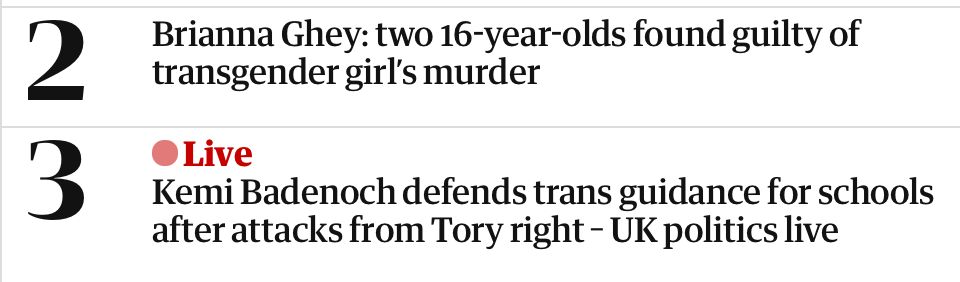
    The trial of the teenage killers of Brianna Ghey, the young trans girl murdered in broad daylight earlier this year, has begun. And I’d strongly advise you not to read about it, because the details are horrific – a lesson I learnt the hard way. But on the basis of the prosecution’s evidence so far, her murder was in large part because she was trans. That makes the decision not to prosecute this as a hate crime all the more baffling.

    The Daily Mail, which has spent years fuelling anti-trans hatred in the UK, is delighted by the horror: it’s titillating readers with the gruesome details and it’s now promoting a podcast promising “every twist and turn” in the “Brianna Ghey trial”, as if the murdered girl were the suspect and the trial a celebrity court case rather than a brutal and squalid tragedy. It’s a horrific reminder that as far as much of the press is concerned, trans lives don’t matter unless they can be used for profit.

  • Selling sadness

    I was thinking some more about yesterday’s idiotic Washington Post editorial that attempted to blame women for men’s loneliness. Posting on Bluesky, writer Ian Boudreau made an excellent point:

    If guys are suddenly very lonely it’s probably worth asking what they expected by following the advice of influencers who tell them to be maximally selfish, and who sneer at thoughtfulness, kindness, generosity, and genuine courtesy as weakness and wokeness.

    He’s right. What these influencers offer – and it’s not just men’s rights activists but also various other anti-woke grifters preying on the unhappy – is isolation, because that’s what their business depends on. The lonelier you are, the sadder you are, the more isolated you become, the more of a hold they can have on you. It’s cult programming for profit, and it’s doing enormous damage to so many people.

  • Wedding hell

    There’s an astonishing editorial in the Washington Post today about a looming marriage crisis – its framing, not mine – in which it highlights an apparent problem: increasing numbers of single women don’t want to marry whiny fascist man-babies who get their life advice from misogynists such as Andrew Tate. And rather than come to the obvious conclusion, which is that said men should stop being whiny fascist man-babies who get their life advice from misogynists such as Andrew Tate, the editorial says:

    This mismatch means that someone will need to compromise.

    That someone does not, you’ll be amazed to discover, mean the men.

    The article is quite rightly being destroyed in its own comments section, but it’s yet another sign of a problem that newspapers don’t like to cover: the homogeneity of newsrooms and their reliance on content written by external sources with agendas, in this case a blog by the right-wing American Enterprise Institute. It’s yet another attempt to paint right-wing men as victims of a censorious society rather than victims of their own bad behaviour and poor choices, incel rhetoric made palatable by the columnist class.

  • Ad nausea

    Twitter informs me that it’s 15 years today since I first posted on the service. I don’t post there at all now; I’ve unfollowed everybody and locked my account, and unless there’s a change of ownership and a huge change in culture I don’t anticipate returning.

    It’s sad. For its first decade or so, Twitter was net positive: for all its flaws – and I’ve been reporting on and giving talks about the misinformation and disinformation on the service for many years now – it was an incredible communications platform for everything from breaking news to ridiculous flights of fancy. What Elon Musk has done to it in just one year is as tragic as it was predictable.

    Over the last few days big brands such as Apple, IBM, Sony Pictures, NBC Universal and many more (but not, so far, the BBC) have pulled their advertising from the service in response to Musk endorsing a blatantly antisemitic tweet. It’s a welcome move, but it’s also an overdue one: Musk has been endorsing, amplifying and paying money to the worst bigots on Twitter for a long time now, and these brands were quite happy to have their advertising dollars used to finance that.

    There are two things worth pointing out here. The first is that despite widespread publicity around Twitter’s lurch into bigotry the brands seemed perfectly happy with Twitter as recently as Friday, before a Media Matters investigation highlighted specific examples of the brands’ ads being positioned next to pro-Nazi content and even tweets praising Hitler. And secondly, the brands have not said they’re cancelling their advertising; they’re just pausing it. What we’re seeing here isn’t brands developing a backbone; it’s brands trying to ride out what they hope will be a short-lived PR storm.