“Gary Marshall,” writes Amazon.com, “are you looking for something in our Tablets department? If so, you might be interested in these items.”
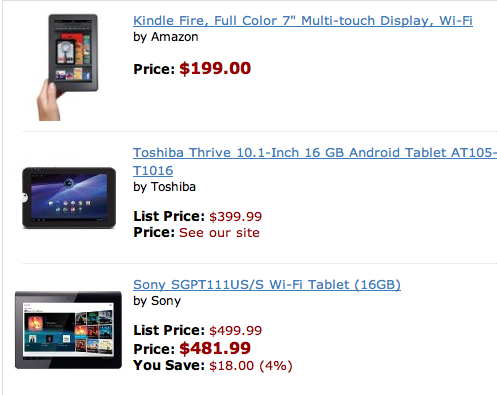
It’s almost as if Amazon wants you to look at one tablet in particular, isn’t it?
Shiny gadgets and clever computers
“Gary Marshall,” writes Amazon.com, “are you looking for something in our Tablets department? If so, you might be interested in these items.”
It’s almost as if Amazon wants you to look at one tablet in particular, isn’t it?
My friends at Techradar like the iPhone 4S, it seems, and they’ve put together a typically exhaustive review.
Executive summary: if you have an iPhone 4, there’s no real need to upgrade once you’ve installed iOS. If you’ve got an older iPhone, however, the 4GS is a huge upgrade.
I’d like to get my hands on one to play with the Siri voice recognition and see how it copes with my accent, but my car needs an MOT and service. Damn you, reality!
I hadn’t seen this before: the famous “here’s to the crazy ones” Apple ad with a different voiceover artist. The version that aired was narrated by Richard Dreyfuss, but this version was voiced by Steve Jobs. Naturally it’s all the more poignant now.
Steve Jobs’ obituary on Techradar. I was getting a bit teary as I was writing the end of it. We’ve lost a giant.
It’s Apple’s new iPhone event tomorrow, and we know what that means: most of the internet is publishing “ten things Apple will announce tomorrow” articles, most of them split into eleventy-nine pages to rip off advertisers.
In times of great excitement, I like to paraphrase Noddy Holder – and today is one of those times. Ready?
So here it is, Merry Christmas
Everybody’s Having Fun
Apart from all the Android firms
Who are probably chucking themselves off bridges right now
I’ve got two cameras, a wee Sony Cyber-Shot and a big Sony DSLR. The former’s a great wee camera but a bit rubbish in low light, especially as I have RSI-induced shaky hands, while the latter’s far too big and bulky for casual use. Could a single camera ever offer the best of both worlds?
It turns out that the answer is yes, sort of.
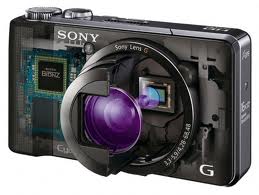
The Sony Cyber-Shot HX9V comes with the usual blah about sensors and intelligent this and that, but it boils down to this: it’s good in low light and it’s good if you have shaky hands.
Here’s a marketing pic:
I’ve only been playing with it for a couple of days, but so far I’ve discovered that it’s really good in Intelligent Auto mode and its image stabilisation is really, really good – it’s got an enormous zoom lens but the stabiliser does a superb job of keeping things steady. If it can do that with my shaky hands, it can cope with anything. Its HD video recording is pretty impressive, easily as good as my dedicated HD camcorder, and like other Sonys it has a very clever panorama mode that works flawlessly.
The bad? It’s pricey – about £299, although Currys is currently doing £30 off compact cameras and Sony’s offering £40 cashback on this one until the end of October – and some features can be slow, with a noticeable delay between pressing buttons and anything happening. It has some gimmicky stuff (3D, despite only having one lens; really annoying beeps that, thankfully, you can turn off), the pop-up flash is in a really weird place and it’s big and heavy in compact camera terms. But so far, so good.
I’ll do some proper shooting with it when I get the chance and report back.иконииконопис
They reckon that we’ll never have another Beatles or another Rolling Stones: the world is too different, too fragmented, and the perfect storm that created them will not happen again. Jobs and Bill Gates are tech’s Beatles and Stones. I’ll let you decide which one’s which.
There’s an interesting post on The Guardian books blog today: The true price of publishing.
Most people instinctively feel that ebooks should be substantially cheaper than paper books, because an ebook is not physically “made”: there are no printing costs. But if, says Levine, the real value of a book resides in the “text itself”, then the delivery method shouldn’t much matter. The fixed costs – acquiring, editing, marketing – remain unchanged.
That’s a tough argument to get across, I think, because Amazon in particular has been very aggressive with ebook pricing. Because ebooks are cheap, Joe and Jane Public expect future ebooks to be cheap too. They neither know nor care that VAT wipes out most of the production cost difference (VAT is levied on ebooks but not printed ones).
Aggressive pricing isn’t new, of course. Amazon has been doing it with print for ages – when did you last pay the RRP for *anything* on Amazon? – and supermarkets often use books as loss-leaders. In most cases the winners aren’t the publishers or the authors; they’re Amazon, and the supermarkets. You don’t really have a business without them, but their demands for discounts mean that it’s not much of a business with them.
This is something I want to come back to when I have a bit of time to do the subject justice: I think the aggressive pricing of ebooks by name authors with backlists to shift, and the rush to undercut their prices by almost every new ebook author out there, could be a form of collective career suicide. Once something’s devalued, it’s hard to change people’s perspectives of what constitutes fair pricing. Just ask the developers getting slagged on iTunes for daring to charge more than 79p for their apps.
According to The Times, most books don’t sell:
Last month [in 2008] Nielsen Bookscan, which tracks book sales nationwide, showing that, of 200,000 books on sale last year, 190,000 titles sold fewer than 3,500 copies. More devastating still, of 85,933 new books, as many as 58,325 sold an average of just 18 copies. And things aren’t much better over the pond: I read recently that, of the 1.2million titles sold in the United States in 2004, only 2 per cent sold more than 5,000 copies.
If the public comes to expect professional cover design, production and editing at amateur-hour prices, I suspect there’s going to be precious little profit for the overwhelming majority of ebook authors. Even if you do 3,500 copies, if you’re doing them on the Kindle store at 99p a pop then your entire take is £1,050 before tax.
Most writers will be lucky to do one tenth of those sales: in 2007, the Guardian reported that “the average sale of a hardback book by a first-time writer is 400 copies”. That’s £120 in Kindle money. If you’re doing things the DIY way and paying for a cover designer and an editor, you’re going to make a significant loss.
I’m not arguing that nobody can make money from ebooks. Of course they can. Some are shifting tens of thousands of books, and making tidy sums out of it. But it’s important to remember that they’re the exceptions.
I’ll come back to this soon, I’m sure.
A while back, I wrote that iCab mobile was one of the best browsers on iOS – and it was. It isn’t any more. I don’t know if it’s iCab or iOS, both of which have been updated since I first started using it, but it’s become borderline unusable: desperately slow, refusing to let me enter text into some sites’ form fields, crashing very frequently and so on. Anyone know why, or know of a decent alternative I can use until iOS 5 turns up? I’ve tried Opera and a few others, but sites such as Facebook think they’re phone browsers and bounce me to the crappy mobile versions of their pages.