Category: Media

Journalism, radio and stuff like that

  • The right to swing arms

    There were two trans-related court verdicts yesterday, although only one of them has received significant coverage.

    In the one you’ve probably read about, Harry Miller had a partial victory in his case against Humberside Police, who turned up at his work to quiz him about his anti-trans tweets.

    The verdict chimes with what most people (cis and trans) I’ve seen discuss the case think: the police were too heavy-handed in dealing with someone who’s deeply unpleasant – as one learned commentator put it yesterday, “most people who test the limits of free speech are going to be wankers, but Harry Miller is really pushing it” – but who wasn’t committing a crime.

    Fans of irony were amused by the post-verdict photo shoot where Miller was photographed with various odious supporters calling themselves free speech defenders. One of those supporters loves free speech so much that has spent the last week threatening to sue various people on Twitter for calling him names. A few days ago he threatened one legendary feminist with a defamation suit because she told him to “fuck off”.

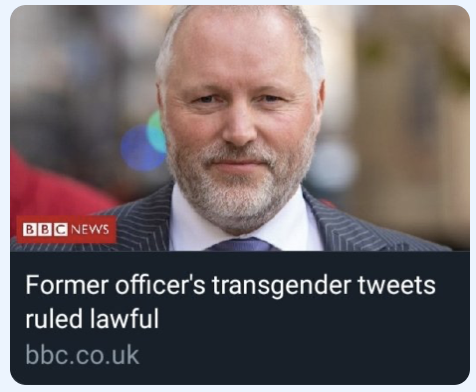
    What the verdict didn’t do was say it’s legal to abuse people on the internet, although that’s how many people have chosen to interpret it. What chance have we got when even the BBC can’t report it properly?

    No they weren’t. The case wasn’t about the lawfulness of the “opaque, profane and unsophisticated” posts; it was about whether police correctly followed guidelines. 

    Which leads us to the second case, which hasn’t attracted as much coverage (apart from a really nasty piece of victim-blaming by the Daily Mail; in one section, now removed, it accused the victim of “brandishing her GRC” as if a gender recognition certificate were some kind of weapon rather than a bit of official paperwork).

    In the second case, Kate Scottow was found guilty of “persistently making use of a public communications network” by setting up multiple social media accounts to attack, defame and harass one person.

    As her victim, Stephanie Hayden, said in a statement:

    The media-led obsession and campaign of hate is encouraging people like Katherine Scottow to think they can target transgender people online with impunity.

    And it continues to do so.

    The law’s pretty clear on all of this. It’s perfectly legal to have racist, misogynist, homophobic, anti-semitic or transphobic views, but it’s not legal to harass, abuse or assault people because of those views.

    Unfortunately a lot of the reporting hasn’t quite grasped that, and journalist Jane Fae was quick to notice. As she writes on Twitter in a thread that’s well worth your time:

    two different cases, two verdicts. In the first, dealing with the process of recording a hate incident, a court took issue with how the police had done it. In the second, hateful harassment was treated as a crime.

    …This was crying out for analysis that juxtaposed the two cases. But most coverage,starting with the @bbcnews focussed on the hate incident case and just ignored the scottow one

    As Fae notes, press reports claiming that the judge in the Miller case said it was legal to be nasty to trans people simply aren’t true. The case was about police procedures, not the content of messages. And the Scottow case was about a deliberate and sustained campaign of harassment, not the beliefs behind it.

    It’s perfectly legal to believe even the most horrible things. It’s not legal to act on those beliefs if doing so harms other people. That’s hardly a new concept. As US politician John B Finch said in 1882: “your right to swing your arm leaves off where my right not to have my nose struck begins.”

  • “Hot takes and salacious hate-reads”

    There’s an interesting piece in The Guardian by Andrew Marantz about trolls, technology companies and how both have helped to fuel the resurgence of the far right. He argues that part of the rise is because journalism and traditional media was spectacularly unequipped to deal with it: the desire to remain neutral that’s appropriate for writing about tariffs and treaties can be exploited by “a racist movement full of creeps and liars”. You see a similar dynamic in bigotry, climate change denial, anti-vaccination and so on where extremist views are presented as one perfectly valid side of an equally balanced argument.

    Neutrality has never been a universal good, even in the simplest of times. In unusual times – say, when the press has been drafted, without its consent or comprehension, into a dirty culture war – neutrality might not always be possible. Some questions aren’t really questions at all. Should Muslim Americans be treated as real Americans? Should women be welcome in the workplace? To treat these as legitimate topics of debate is to be not neutral, but complicit. Sometimes, even for a journalist, there is no such thing as not picking a side.

  • If the Starbucks Mermaids advert was real

    Starbucks’ lovely and groundbreaking advert, which features a young trans man summoning up the courage to ask for his new name on his coffee cup, is important: as I’ve written before, representation matters. Seeing someone like you in mainstream media, in this case on a major TV channel, can help you feel that you’re not alone. I had a good cry when I saw it.

    There’s been a somewhat mixed response online (discounting the obvious fury of the Prosecco Stormfront mob on Mumsnet) because of course, Starbucks is a big company that’s hardly known for its positive effects on the world around it. But if it’s going to be throwing its money around on advertising anyway, I’d much rather it threw its money at adverts like this one and at charities such as Mermaids, which this campaign is supporting.

    My own reaction is amusement, because when I first used my new name in a Starbucks things didn’t happen quite like they did in the advert.

    Barista: What’s the name?
    Me: Carrie.
    Them: Gary?
    Me: No, Carrie.
    Them. Sorry, Karen.
    Me: No, sorry, it’s Carrie.
    Them: Kerry?
    ME: No. Carrie. With a C.
    Them: Ciara?
    Me: No. Carrie. C-A-R-R-I-E.
    Them. Carrie?
    Me: Yes, Carrie. Like Carrie Fisher. Yes.
    Them: OK. (Writes “Harry” on cup)

  • What doesn’t hit print

    I linked to a Roy Greenslade piece the other day about the way UK newspapers invented a so-called immigration crisis. In it he wrote:

    If you want to understand the populist media’s underlying agenda then you have to look not only at what gets published, but what doesn’t.

    Here’s a great example of that. Every single time an anti-trans pressure group or disgruntled axe-grinder makes unsubstantiated claims about the supposed dangers and alleged overprescription of puberty blockers, it gets printed in the Daily Mail, The Sunday Times and other print publications.

    Last week, a massive, reputable study with a huge sample size reported that puberty blockers are safe, reversible and in many cases life-saving. They have proven positive effects on teens’ mental health.

    Not a single UK newspaper has mentioned it.

  • “We are living in Bigot Christmas”

    Ellie Mae O’Hagan writes about the “anti-woke backlash”. She argues that in the 1990s and 2000s socially liberal values became the “new normal”, with even the Conservative party becoming nicer and introducing legislation such as equal marriage. It seemed unimaginable at the time, but that consensus is unravelling very quickly.

    …as the tide of 90s social liberalism has ebbed, it has also revealed another group of people (primarily older, white homeowners and pensioners) who had never bought into the consensus in the first place, and are aggressively hostile to its newer, more radical iteration.

    We all know a member of this demographic: alienated by the modern world and displeased by change, they are fond of complaining that “You can’t say anything any more!” – even as their opinions are widely reproduced in the nation’s print media.

    And the nation’s print media are happy to pander to them, not least because they’re the demographic that still buys the nation’s print media and that advertisers most want to reach.

    Having spent so long feeling silenced by the liberal consensus, people in this group have been given a new lease of life by the right’s new insurgents. Not only were they correct all along; they were actually victims, zealously persecuted by an oversensitive and censorious society. It is this righteous indignation that lends their antipathy to wokeness a defiant and almost celebratory quality. As a friend of mine puts it, we are living in “bigot Christmas”.

    As O’Hagan points out, if this group’s claims of persecution were really true the country and the world would look very different. But just because something isn’t true doesn’t mean people don’t believe it.

    O’Hagan’s piece isn’t an attack on those people. It’s a warning to the rest of us, because the so-called anti-woke are often “parroting arguments that are largely advanced by the far right”. And they’re winning.

    Progressives need to wise up to the fact that they are losing this argument and decide what they are going to do in response. If they don’t, they may soon find that the future they always assumed was theirs is being made without them.

  • “Who is this all for?”

    Yomi Adegoke writes about the increasing use of polarised, gladiatorial “debates” to try and get social media attention.

    The BBC has said it will no longer have climate change deniers in debate with climate change activists, as it’s a “false balance”. Yet the topic of racism is handled in the same way a TV programme might treat the topic of extraterrestrials; punctuated with a large question mark.

    Lecturers, authors and professors for whom this is their life’s work and personal experience, are pit against talking-heads whose qualifications to discuss racism appear to be the fact that they’re white, pissed off, and more often than not, perpetrators of the very racism they’re discussing.

    It’s not just race. I can very much relate to this:

    as the conversation surrounding race in the UK becomes more toxic, I’ve received more requests to partake in this type of debate on TV more than ever. And like several other black journalists I know, I have been immediately sceptical about the motivation behind this newfound eagerness to debate topics the media has historically sidelined.

    The UK media had absolutely no interest in trans people until 2017. We’ve had so-called self-ID in law since the 1970s and in practice since the 1940s. The original Gender Recognition Act, which enables us to change our birth certificates and HMRC details, passed without fuss in 2004. The Equality Act, which gives us protection from discrimination and legislates about access to single-sex spaces, has been law for a decade.

    And yet again and again we’re seeing trans people and allies being put up against people who are the gender equivalents of anti-vaxxers or climate change deniers: denying science, demonstrating profound ignorance of the law, claiming that the medical establishment is part of a conspiracy and that trans people are some kind of sinister lobby hell-bent on destroying civilisation and stealing your children. Repeatedly platforming them is either due to incompetence – there’s a distinct lack of fact-checking around these so-called debates, with complete fabrications often being aired unchallenged – cynical traffic-chasing or malice.

    There are not always two sides to a story; differing positions do not always have equal weight. To pretend otherwise in the hope of generating social media traffic is despicable and dangerous.

  • Faking the news

    Writing in The Guardian, august journalism commentator Roy Greenslade writes about a crisis that never existed: the supposed immigration crisis facing the UK.

    “It never was news. It was a wholly media-manufactured ‘crisis’,” he writes. Editors “readily published evidence of individual misbehaviour as if it was a universal problem”, published “dodgy figures, as if plucked from mid-air” and ignored facts “in favour of appealing to public prejudice.” They published endless streams of thinly-veiled bigotry from their columnists. They were guilty of “ignoring rational arguments that exposed their distorted agenda” to inflame their readers against a group that in reality is a persecuted minority.

    And it worked, because these papers also drive the wider news agenda: what they print is then picked up by the likes of the Today Programme and discussed on Question Time. It gets circulated on social media and regurgitated on talk radio.

    At the peak of the anti-immigrant newspaper scare, 60% of people thought immigration was the most important issue affecting the country. Now the papers have largely stopped their scaremongering, that figure has dropped to 20%.

    As Greenslade put it, the newspapers manufactured the so-called crisis “through repetition, disinformation, misinformation… and the omission of any positive material.”

    The papers stopped demonising immigrants because it no longer sold copies. That has created a vacuum – when your newspaper’s editorial policy is to scare your readers every day, you still need an enemy.

    The papers haven’t stopped trying to scare their readers or abandoned their dirty tricks. They’ve just chosen a different minority to demonise.

  • The tedious mediocrity of the “anti-woke”

    Novelist and journalist Huw Lemmey asks why the UK media is so obsessed with demonising the “woke”.

    The English media is in the middle of a full-throated culture war, from bendy bananas to woke snowflakes, Stormzy to burqas, trans rights to free speech on campus. It seems like over the past decade the intensification of that journalism, combined with the exaggerating effect of social media on editorial choice, has created a print and TV comment culture dedicated to creating a popular spook or ogre, then to ripping it apart. The English press has developed into a unique combination of bullying and blackmail, where a relentlessly vicious tone of mockery and enforced conformity is policed with the justification that either the enemy is at the school gates, or that their furious mockery is “only banter”. In the process, from sheer incuriosity, a whole generation of journalists have confused disagreement with taking offence, criticism with trolling.

    …if you want to know what “woke” means, and why a “woke elite” are trying to shut down all criticism, why not read Andrew Doyle’s new book, ‘Woke’, in character as Titania McGrath, with glowing reviews from Rod Liddle, Sarah Vine and Ricky Gervais? Why not read Brendan O’Neill’s spiked editorial on Markle, “A woke Wallis Simpson”? Why not read Rod Liddle’s latest on the “wokeplace romance”? Why not check out Toby Young on how the Labour Party got woke and broke? Why not see what Sarah Vine likes so much about Ricky Gervais, “the Wokefinder General”? Why not read Helen Lewis on the superwoke elite, or listen to Helen Lewis on the News Quiz, supposedly the country’s leading news satire radio programme, where the assassination of Soleimani revolved around a joke that the Left wouldn’t have criticised the attack if the Iranian general had misgendered someone.

    As Lemmey points out, the attack lines and tropes are so lazy that last week, Rod Liddle and Giles Coren wrote almost identical articles with almost identically unfunny jokes. I guess it makes a change from using pseudonymous social media accounts to post racist or antisemitic messages.

    I thought this bit was interesting.

    We are reaching the culture war singularity. To all intents and purposes, in terms of England, the right have won the culture war on most fronts. But now they’re left with a problem — they need an enemy. After we leave, and Francois has had his bongs, what replaces the narrative of EU tyranny that has driven English Euroscepticism?

    We’re starting to see the answer to that. It’s the blacks, and the gays, and the trans, and the young, and the feminists, and anyone else who can be dismissed as “woke”. It’s no coincidence that the people spearheading this backlash are white, straight, cisgender, middle-aged and largely male; the people who applaud them on social media are from the same demographic.

    The thing about being “woke” is that being woke is a good thing. It means being aware of injustice in society, particularly racism.

    The Guardian:

    Criticising “woke culture” has become a way of claiming victim status for yourself rather than acknowledging that more deserving others hold that status. It has gone from a virtue signal to a dog whistle.

    What we’re seeing here is exactly what happened with political correctness: the perversion of a term by right-wingers in an attempt to claim that the real victims are the people who have all the power.

    Comedian Stewart Lee skewered that one a decade ago.

    The only time you ever see PC mentioned is when people are complaining about PC. For money. And usually on the very publicly funded radio stations that these dicks believe are involved in a politically correct conspiracy to silence them.

  • Harry Potter and the Chamber of Bigots

    Today’s story of JK Rowling and an anti-trans tweet is a good example of how lazy reporting reinforces bullshit.

    If you missed it (and you probably didn’t; it’s been all over the media today): last night, the author tweeted in support of the anti-trans activist Maya Forstater, claiming that her defeat in a tribunal was an attempt to “force women out of their jobs for stating that sex is real”. #IStandWithMaya, she wrote.

    That’s been reported as Rowling supporting free speech, but it isn’t.

    It’s Rowling telling her 14 million followers to support a bully.

    Forstater wasn’t forced out of her job; her employer chose not to renew her fixed term contract. She wasn’t told she couldn’t state that “sex is real”; she was told that she didn’t have the legal right to create a hostile and humiliating environment for her co-workers.

    Forstater has said publicly that her case was intended to establish a legal precedent: the precedent she wanted would give anti-trans activists the legal right to be as abusive as they liked towards trans colleagues without consequences.

    That isn’t how this is being reported. It’s being reported as “cancel culture”, the sinister “woke mafia” picking on a national treasure.

    But Rowling has form for this. She was an unapologetic follower of anti-trans activist Magdalen Berns, who claimed that there was a Jewish-funded conspiracy to turn the world trans and that trans women are “fucking blackface actors” who “aren’t women” but “get sexual kicks from being treated like women. Fuck you and your dirty fucking perversions… you pathetic, sick fuck”. She’s publicly liked anti-trans tweets claiming trans people are “men in dresses” and when called out on it, she had her PR team claim that it was a “clumsy and middle-aged moment” because she doesn’t want to upset her significant LGBT+ fanbase.

    By misrepresenting what the Forstater case was actually about, Rowling is fuelling anti-trans sentiment. The reporting over this is perpetuating the myth that women are being silenced by the sinister trans lobby while giving those women global press coverage for their supposedly silenced views.

    Here’s journalist Laurie Penny.

    Trans people, and trans women in particular, have for years been under attack by dedicated cohort of the British press, egged on by a small group of transphobic extremists. Transphobic views have been normalised in Britain. That’s the context for JK’s comments today.

  • When the media promotes conspiracy theories

    Conspiracy theories aren’t just the preserve of cranks. The Sunday Times ran a long campaign claiming that AIDS was the invention of a “gay lobby”; as recently as 2009 The Spectator’s Fraser Nelson claimed that the link between HIV and AIDS was contentious and that “debate” on the subject was being silenced by a “strong and vociferous lobby”.

    In the late 1990s and early 2000s, much of the UK press chastised those who sought to “silence” Andrew Wakefield’s discredited and dangerous claims about the safety of the MMR vaccine, coverage that brought a fatal, preventable disease back into our classrooms.

    Just this weekend, The Sun published a far-right conspiracy theory claiming Jeremy Corbyn was part of a shadowy network of hard-left extremists – an article it quickly and quietly unpublished.

    So we’re hardly in uncharted territory if sections of the media promote conspiracy theories today. They do, particularly around trans people. This week, they’re claiming that Big Pharma is paying the Liberal Democrats to force gender recognition reform into law, thereby turning all our children trans, because reasons.

    This isn’t just cranks on social media. It’s Radio 4’s Today Programme and the Murdoch Press.

    Here’s the Sunday Times’ explanation.

    Ferring Pharmaceuticals donates to the Lib Dems.

    True. It’s done so for years, to the tune of about £1.5m.

    It markets the drug Triptorelin

    Also true.

    “which is used to block puberty among adolescents”.

    That’s a deliberate distortion. Triptorelin is not primarily prescribed as a puberty blocker. It is a cancer drug, and it’s used overwhelmingly for cancer patients – thousands of them, compared to the few dozen for whom it’s used to treat precocious puberty or as a puberty blocker.

    Now, Ferring doesn’t appear to be a very nice company. Pharmaceutical firms rarely are. But it’s not mainly in the puberty blocking business. It’s in the cancer business, which is much more profitable. The entire market for puberty blockers in the NHS is worth around £90,000 a year, but it spends more than £2 billion on cancer treatments.

    Let’s think for a moment. Which is more likely: a corporation that makes cancer drugs spending £1.5m as an insurance policy for a market sector worth £2,000,000,000 per year, or a corporation that makes cancer drugs spending £1.5m to make all the children transgender so it can bring in £90,000 a year?

    Aha, the anti-trans lot say. But the market will grow. There are so many people trying to access gender clinics that the market for puberty blockers will soon be worth, like, lots and lots and lots. Maybe eleventy billion pounds a week.

    More referrals does not mean more prescriptions. In 2014-2015, the number of under-15s referred to the UK’s only gender clinic for adolescents rose from 46 to 52 – but the number of people prescribed hormone blockers dropped from 41 to 32. Puberty blocking remains exceptionally rare. These drugs aren’t and won’t be handed out like sweets.

    And remember, the alleged plot here is that the money from Big Pharma is going on lobbying for reform of the Gender Recognition Act, which has no connection with trans healthcare of any kind, let alone adolescent healthcare.

    The argument, then, goes something like this.

    • Cancer drugs firm donates not to the political parties that will win the election, but to one that won’t
    • Political party that won’t win the election will somehow force the other parties to make paperwork slightly easier for trans adults, which they’d promised to do anyway
    • Something something something think of the children

    Not mad enough? On social media, high profile figures with tens of thousands of followers decided to add yet more skulduggery to the equation.

    • Vladimir Putin wants all UK children turned trans, because reasons
    • Putin gives a gong to the boss of a cancer drugs firm, possibly with mind control technology inside it
    • Cancer firm donates not to the political parties that will win the election, but to one that won’t
    • Political party that won’t win the election will somehow force the other parties to make paperwork slightly easier for trans adults, which they’d promised to do anyway
    • Something something something think of the children

    How did we end up with Vladimir Putin? Well, the boss of Ferring, Frederick Paulsen, has been awarded the Order of Friendship of the Russian Federation. What more proof do you need?

    Of course, Paulsen has been given some other honours. Maybe if we looked into that we could see just how big this international conspiracy really is.

    Paulsen’s honours include:

    • The French legion of honour.
    • The Order of the Druk Gyalpo of Bhutan.
    • The Order of Merit Class I by Germany.
    • The Cross of the Order of Chivalry by Denmark.
    • The OBE, the Order of St John Service Medal and Freeman of the City of London.
    • The Scottish Geographical Medal.
    • The Companion of the Royal Aero Club of the UK.
    • An honorary professorship of the University of Dundee.

    Now, I don’t want to alarm you, but clearly it isn’t just Putin. The international transgender conspiracy goes much deeper and includes President Macron of France, Angela Merkel of Germany, Queen Margarethe II of Denmark, King Wangchuck of Bhutan, The Queen of England, the Scottish Geographical Society, The Royal Aero Club of the United Kingdom and the entire University of Dundee. Together they are united with a single goal: to get the Lib Dems into power to turn all your children trans.

    Either that, or sections of the mainstream media will happily promote unhinged conspiracy theories that help create fear and distrust of trans people.

    One of these possibilities is much more likely, and much more frightening, than the other.