Journalism is not supposed to be a fluffy PR machine for the government (unless you’re working in North Korea, or, I don’t know, the Sunday Telegraph news desk), ready to boost your mood on a less than jolly day with an uplifting story of a dog who saved a duck from traffic, or a picture of a waving seal. It is a tool to interrogate power structures and inequality, serve the public interest and, occasionally, provide readers with something funny to read. Unfortunately, spiralling death tolls, falling stock markets and government failures – as depressing as it might be – are news, and need to be reported on.
…the media has never existed to provide a soothing mood-booster or cheerlead the government. Now is exactly the time we need challenging, difficult questions asked, even if they’re hard to hear. The waving seals can wait.
Category: Media
Journalism, radio and stuff like that
-
News isn’t about making you feel better
-
“How discriminatory do you have to be before you’re called out?”
Helen Belcher of Trans Media Watch explains why UK trans people are really scared right now.
For some time trans people have understood the current media debate in the UK isn’t actually about the Gender Recognition Act. Instead, it is about our basic rights to live and move as full members of our society.
…Most trans people I know in the UK are now absolutely terrified.
They understand an arcane procedure for changing legal gender is probably going to be maintained in some form.
But they realize their ability to function in any meaningful way as members of our society is about to be removed
-
Using coronavirus for a culture war
the key issue in the right’s current culture war is the lockdown, which is being presented as a freedom-sucking con – much like the EU. Mirroring the dynamics of climate denialism, those challenging the overwhelming consensus of global expertise cast themselves as lockdown “scepticsâ€. And cleaving to a rightwing populist script, these sceptics say their legitimate concerns are being silenced.
-
What’s wrong with this picture.
This is the Daily Express, apparently showing crowds of “selfish rule breakers” during lockdown.
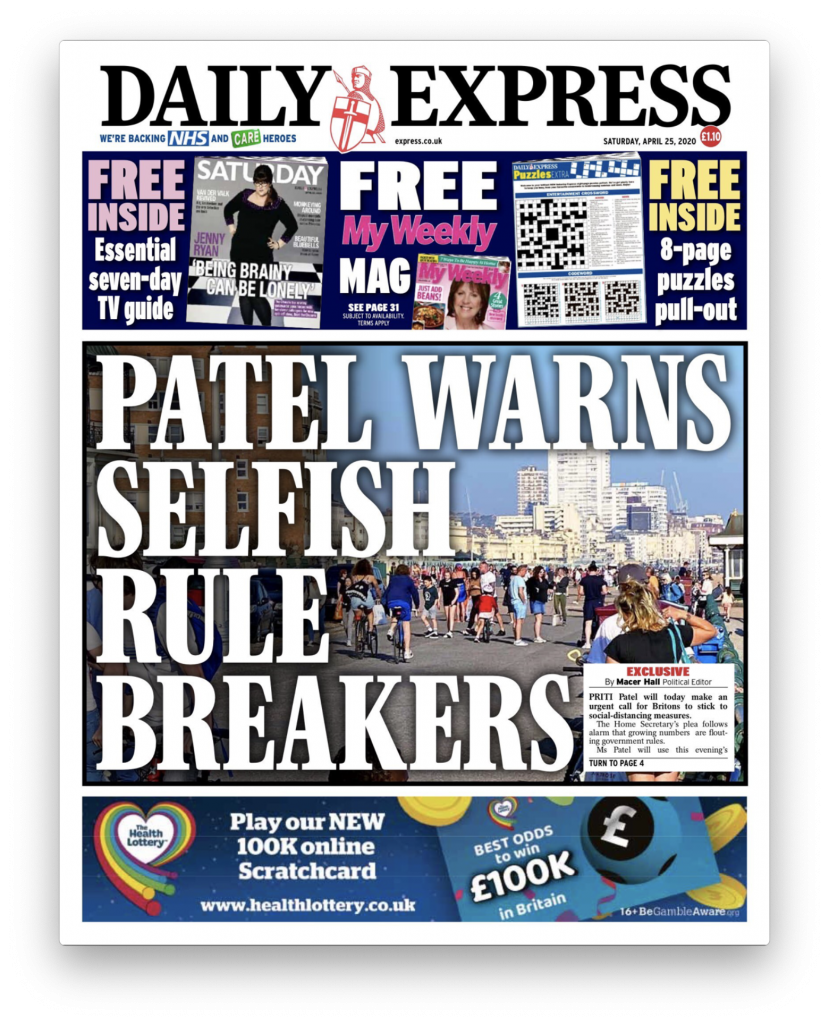
The photo is of Brighton and Hove seafront. Rob Shepherd lives there. See the cranes in the background? As Rob demonstrates, they aren’t there any more and haven’t been for some time.
-
Priorities
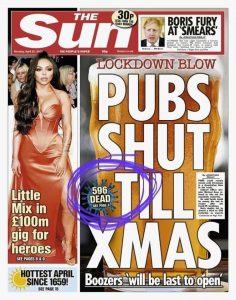
To add insult to fatal injury, the headline that dominates the front page isn’t even true.
-
Amazon: bastards in “bastards” shocker
Something that you might not be aware of is how much newspaper, magazine and website publishers rely on affiliate marketing: if they link to a shop selling product X and you buy product X via that link, they get a small fee. Those revenues are particularly important during this coronavirus lockdown: the other big revenue drivers, print advertising and branded events, are effectively dead right now.
So naturally Amazon has decided to kick the publishing industry while it’s down. Starting next week, it’s slashing the rates it pays its affiliates, in some cases by more than half.
It’s terrible news for the industry, of course, but it’s also an indication of a wider problem: as print sales have continued their inevitable decline, publishers have repeatedly put their business eggs into single baskets – only to discover that by doing so they’re vulnerable to the whims of companies that see them as expendable. The giant tech brands have demonstrated again and again how ruthless they are. That’s how they became giant tech brands.
There are lots of examples. Many businesses find that when Google changes its search engine rankings, their traffic disappears overnight. YouTubers find that rule changes or arbitrary decisions leave them unable to monetise their channels any more. The most awful example is Facebook, which lobbied media firms to “pivot to video” to reach huge audiences; its figures were falsified – in some case viewing figures were inflated by as much as 900%. Media firms fired their journalists to embrace the new world of video; when it turned out that the new world was fraudulent and the promised money wasn’t there, they fired their video people too.
Whether you’re a publisher or an Amazon marketplace seller, a musician on Spotify, an artist on Etsy or a small business selling on social media, you’re ultimately trying to pretend that a furious, hungry tiger is a sweet little pussy cat. It’s not a question of if it’ll turn on you. It’s a question of when.
-
One in ten
At the time of writing:
101,000 – total global deaths from Covid-19
8,958 – total UK deaths from the same virus, excluding hundreds more in care homes
The UK has nearly one in ten of the global deaths from this virus despite being one of the most recent countries to get it.
Today’s daily death toll, 980, means for two days running the UK has had more daily deaths than the worst days in Italy or France.
That’s despite having the benefit of time to see how the virus has spread in other countries, time to order protective equipment and ventilators, time to plan an effective response. Time other countries didn’t have.
Things could have been even worse. If the football authorities hadn’t become fed up with government inaction and decided to cancel multiple big games in March, the numbers  would be even higher.
This is a political failure on a truly horrific scale.
It’s time for the press to do its job and hold the government to account.
-
Murdoch and the Mail want your money
There is a campaign just now asking people to save newspapers. The gist: many are threatened by coronavirus-related advertising collapse; without them, especially plucky local ones, democracy will be under threat. The first stage is to ask the public to support them; the second, to demand government help.
We need to remember that the biggest titles – the Sun, the Mail, the Telegraph and the Times – have proprietors who are genuine billionaires; that they are individuals and come from families worth thousands of millions of pounds. And those billionaires and their companies pay their taxes only where it suits them, which means that they pay the least they can manage in the UK.
Before we hand them any money that has been paid as taxes by nurses and bus drivers in this country, we need to be certain that (a) none of the cash will swell the personal coffers of the Murdochs, Rothermeres and Barclays, (b) they themselves have spent everything they can afford to keep their newspapers going, and (c) in the future, they will pay all the tax that they should in this country – no more Channel Islands, no more Bermuda, no more Delaware.
The piece also makes a good point about local newspapers. While there are some genuinely wonderful local newspapers – the Yorkshire Post springs to mind – many local papers are nothing of the sort. They are centrally produced, low-quality publications run by firms who’ve sacked most of the journalists and asset-stripped the businesses.
when the industry talks about the ‘local press’, it wants you to think of a heroic little outfit in a small town with a hard-working staff who are in tune with the needs and habits of the community and who deliver, not just information, but also social cohesion and identity.
In reality, the press industry has been furiously trashing that entire culture for decades. Three rapacious multi-million-pound corporations – Reach, Newsquest and JPMedia – have been rolling through the local and regional press industry like asset strippers, sacking journalists by the thousand and closing titles by the hundred.
Year after year, these three have banked handsome operating profits which, to a striking degree, they have spent outside the local and regional newspaper industry.
The article suggests that any help should be conditional, and should be designed to protect journalism rather than bad and broken businesses.
as these newspapers are always quick to insist in the context of other benefit claimants – we must weed out the scroungers from those genuinely deserving of support. And we must do so with a clear eye on the future.
…Let the billionaires exhaust their own funds and pay their own taxes first. Let them make their practices and finances accessible and transparent to taxpayers. Let them make their journalism properly accountable.
-
The end of an era: .net RIP

Net magazine, originally know as .net, is closing after 25 years.
I cried at the news. Not just because it’s putting some lovely, talented people out of a job, but also because .net has a special place in my heart. It’s the magazine that gave me my break into journalism nearly 22 years ago, the magazine that taught me how to be a writer and the magazine that introduced me to some of my very favourite people. It literally changed my life.
Bye, .net. I’m heartbroken to see you go.
-
Save the magazines you love
If you can afford it, this would be a very good time to subscribe to your favourite magazines. If you don’t, they might not be around when this crisis is over. One of the publishers I work for has already closed three titles. They won’t be coming back, and the industry as a whole is already in crisis.
A representative survey of PPA members taken last week showed an “extremely concerning†picture that advertising revenues are expected to drop by an average of 60 per cent in the next quarter, ranging between 20 and 95 per cent per publisher.
Events, upon which many B2B publishers have relied for years and which consumer brands had increasingly focused on as ad revenues declined, are down 90 per cent this quarter.
I understand that times are hard but many publishers are offering really great deals, and if you’re really skint you can still help the magazines you love by subscribing to their online editions or to digital services such as Readly or Apple News+. I use both: they’re really good on computers and absolutely fantastic on tablets, where they come very close to the feel of a real magazine.