Category: Media

Journalism, radio and stuff like that

  • Some people never learn

    One of the reasons so many left-leaning people were shocked by the election of Donald Trump was because to much of the left-leaning media, Trump was simply a figure of fun; not somebody worth taking seriously, let alone doing anything to try and stop.

    I think they’re taking him a lot more seriously now. But they haven’t learnt their lesson. Boris Johnson was a national joke; now he’s a disastrous PM. Nigel Farage was a national joke who became one of the most significant political figures of recent times despite being almost unelectable. And now we have a new national joke, the deeply loathsome Lawrence Fox. The left-leaning press’s dismissal of him as a figure of fun is arguably just as dangerous as the right-wing press’s lionising of him. He may be a ludicrous, pathetic twat, but he’s a ludicrous, pathetic twat with influential backers and an increasingly large platform.

    Journalist Mic Wright:

    The right-wing media channels — not just papers but their talk radio counterparts and forthcoming TV channels — will give Fox acres and hours of coverage. He will be heard and he will be heard seriously by those outlets and the people who consume their output.

    I take Fox seriously because he is a narcissist who wants desperately to keep getting the attention that acting has brought him and he will say anything to keep that spotlight on him. Fox, in the same way that mouthpieces like Darren Grimes have done, is allowing himself to be used as a megaphone by more publicity-shy bastards. In interviews, he has referred to his ‘policy people’… I wonder who they might be?

    Fox is ludicrous and ludicrously stupid, but he has money, he has support, and he has a platform. That combination is a dangerous one.

  • Nine questions you might have about trans stuff

    Katelyn Burns has written an excellent piece for Vox: 9 questions about trans issues you were too embarrassed to ask.

    The questions are:

    1. What does it mean to be trans?
    2. Why should I care about trans issues?
    3. What about the pronouns thing?
    4. What issues are trans people fighting for?
    5. Why are we always talking about trans issues?
    6. What’s the deal with bathrooms?
    7. What’s with the panic over trans women with penises and trans men who menstruate?
    8. What about trans women playing women’s sports?
    9. What about trans kids?

    I think the question “why are we always talking about trans issues” is particularly apt today because it’s Sunday, when the right-wing press likes to run its anti-trans hit pieces and scaremonger about trans kids, trans women and trans athletes.

    “The right has worked to make it an electoral issue…  We see this across the board — they try to posture trans rights as extreme and a danger particularly to children,” Brennan Suen, LGBTQ program director at Media Matters, told Vox. This is why, he said, conservatives have focused so much on legislation regarding transition care for trans minors, bathrooms, and trans athletes in sports. “They are able to reach those voters who might not know a trans person and give them misinformation and bigoted information that honestly scares them.”

    …as trans people have really been more visible in the media … we’ve seen the right really ramp up their attacks.”

  • “Ctrl-F for ‘cancel culture’ to get to the worst part”

    I do love it when writers have some fun. This, by Drew Magary, is in defence of skimming articles on the internet.

    skimming is a way to help me glean the thrust of a story without having to eat my vegetables in the process. EVERYONE WINS. If I read a movie or album review, I skim right past the intro and hunt for the graf that tells me if the thing is good or not. If I read a recipe, I skip right past the storybook intro like everyone else does. If I’m hate-reading a bad column, I’ll Ctrl-F for “cancel culture” to get right to the worst part. I have s—t to do, man. I can’t go humoring the rest of you by reading all of your tedious bulls—t.

    And this, by R Eric Thomas, is about US politician Katie Porter’s whiteboard.

    My friend, if you ever find yourself sitting in front of the House Oversight Committee and Rep. Katie Porter pulls out her Whiteboard of Justice, please know that it is truly and deeply over for you. My friend, the truth is it never began. The minute her staff put that portable Porter board onto the little hand truck they use to cart Instruments of Truth through the halls of justice it was a wrap on you, those you associate with, and everything you’ve ever done. As the Good Book says, “And lo, a pale board! And the name of your overpriced prescription drug was upon it. And hell followed.”

    It’s a really fun piece.

  • “The world is better for having you in it”

    Over 200 1,512 writers and publishing professionals have written an open letter in support of trans and non-binary people.

    This is a message of love and solidarity for the trans and non-binary community. Culture is, and should always be, at the forefront of societal change, and as writers, editors, agents, journalists, and publishing professionals, we recognise the vital role our industry has in advancing and supporting the wellbeing and rights of trans and non-binary people. We stand with you, we hear you, we see you, we accept you, we love you. The world is better for having you in it.

  • Hating for ratings

    How’s this for a TV show? We get a racist – a proper racist, ideally a knuckle-dragger from a really racist organisation such as the EDL or Britain First, someone who’s really loudly and proudly racist and spends loads of time being really racist to people on Twitter – and we pair him up with a nice middle-class Black woman. Then we get the two of them to sit down for a nice dinner and a chat and we film the whole thing.

    Good, right? It’s a social experiment!

    I haven’t even got to the best bit yet. It’s not just a chat. We give the racist guy a script of really racist things to say to the Black woman over dinner and we film her response. Maybe she’ll cry!  Maybe she’ll walk out! Maybe it’ll go viral!

    No? How about we pair a neo-nazi with a nice Jewish lady?

    Of course not. Trying to get a fight for ratings is disgusting, as we saw with the Jerry Springer and Jeremy Kyle shows. But that doesn’t mean TV production companies don’t keep trying to bring back the formula, which is essentially hating for ratings. For example, an Irish TV company is currently sending this to various trans women (and to other marginalised groups, such as members of the travelling community).
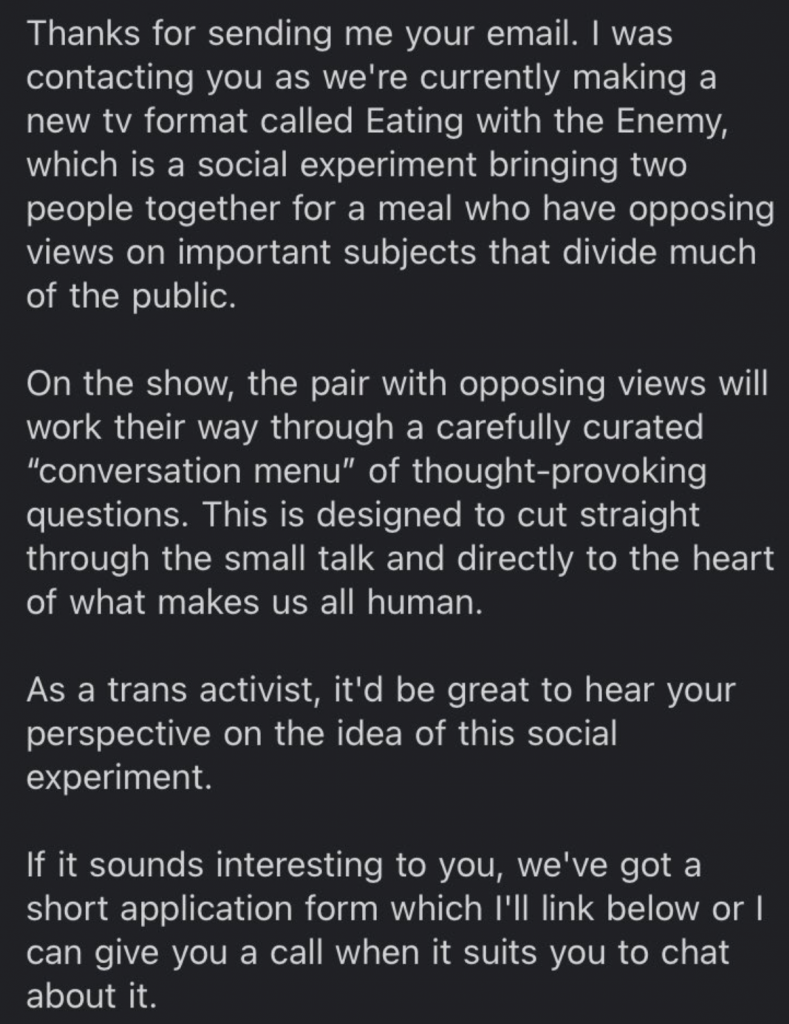
    As one commenter on Twitter translated: “We’re making a show where we have members of marginalised groups sit down with people who think they shouldn’t exist, for entertainment purposes. Also we’re suggesting that marginalised people are the enemy, in the title.”

    Earlier this year Evgeny Shtorn wrote about the importance of storytelling in regards to minority and marginalised people.

    Considering how powerful storytelling is, we cannot pretend that the infrastructure built around it by media and researchers is always ethical and respectful towards those who constitute those stories… journalists were rude to me, disrespectful and abusive. Using my words or ideas without quotes, giving erroneous interpretations and false promises. Trans and non-binary people, homeless people, other migrants, people of colour, people with disabilities and a lot of others who I shared my concerns with, told me that they often experienced similar treatment from journalists, but also from artists, researchers and other ‘supporters’. It is called ‘cognitive exploitation’, and this is exactly the opposite to the idea of the empowerment of the community through storytelling.

    …The problem is that after such an interaction most people retreat into their closet and don’t want to tell their stories anymore, despite those stories being so important to tell.

    There was an example of this in England the other day: trans person and poet Jay Hulme was invited on BBC TV to discuss the government’s response to GRA reform.

    I was going to be on the BBC today having a chat about the GRA – but I pulled out yesterday, having been informed that it’s BBC policy to have a cis woman invited to speak on any segment about trans ppl – I’m not going on TV to be yelled at by a transphobe from the Daily Mail.

    By “cis woman” the policy doesn’t mean a cisgender woman who’s supportive of trans people, even though such women are the majority (and were the majority in the GRA reform consultation too). It means the kind of woman trans commentator Shon Faye was expected to go on air with this week. Faye was one of several trans people invited on BBC Woman’s Hour to discuss gender recognition. At the last minute, the panel was expanded to include an anti-trans activist who has taken great delight in publicly misgendering her and who Faye says even shared a now-deleted defamatory petition implying she groomed children. Faye declined the invitation.

    I have some experience of this. I’ve refused to go on multiple programmes because the approach was clearly going to be gladiatorial, not editorial; other contributors were not people with concerns about specific bits of legalese but members of groups who peddle hatred on social media. Taking part is therefore a trap for marginalised people: if you don’t robustly challenge the other contributors they get to lie, lie and lie some more; if you do, and worse still if you also dare correct the presenter, you’re dismissed as unreasonable and aggressive. And even the most innocuous appearance will have bigots descending on your social media.

    It’s clear that the people commissioning and structuring these programmes are thinking about ratings, not the damage these narratives can do to marginalised groups. And they are doing damage. By presenting extreme views as mainstream, such as perpetuating the myth that the two sides of the trans debate are “trans activists vs feminists” rather than “most of the country vs a few well-connected bigots”, they’re fanning the flames of intolerance and positioning extreme views as if they’re mainstream. We’ve seen this before with the platforming of far-right views, of anti-vaxxers and of climate change denial.

    The problem yet again is that the people making these programmes have no skin in the game. Their human rights are not under attack. Their safety is not threatened by the rise in hate crimes. Their ability to participate in society is not something producers think should be up for debate. To them, it’s just another item. To marginalised and demonised minorities, it’s our lives.

  • “The out-group must be crushed”

    There’s a really good piece about QAnon in The New Republic.

    The “nocturnal ritual fantasy”—a term coined by the historian Norman Cohn in his landmark study of European witch trials, Europe’s Inner Demons—is a recurring trope in Western history. And it is often a politically useful one. Deployed by the Romans against early Christians, by Christians against Jews, by Christians against witches, by Catholics against “heretics,” it is a malleable set of accusations that posit that a social out-group is engaged in perverse, ritualistic behaviors that target innocents—and that the out-group and all its enablers must be crushed.

    …Q adherents are perfervid Trump supporters by necessity, as Trump’s valiant battle against ultimate evil forms the spine from which the many limbs of the conspiracy grow. But a recent wave of émigrés into the Q landscape consists of New Age moms and influencers with previously vaguer politics, whose interests, during the strained days of the Covid-19 pandemic, have migrated from crystals and wellness to taking down a world-straddling cabal of demonic pedophiles.

    The section on the “satanic panic” of the 1980s is particularly apt.

    It was gospel belief in the media and among ordinary citizens that rings of sex abusers were everywhere. Satan and his blood-drinking minions were peripheral players, but the panic is usually referred to now, through the mocking lens of self-assurance, as the “Satanic Panic.” We in the twenty-first century could never be so naïve.

  • Trans freedom fighters: a series

    The US edition of The Guardian continues to show how pathetic the UK edition’s coverage of trans people and trans-related issues has become. While the UK edition is still unsure about whether we actually deserve human rights, the US edition is running series telling stories like this one: ‘Our love is radical’: why trans activists lead the way in protest movements.

    Though their legacies have often been overlooked, trans Americans have been central to the country’s battles for justice, from racial equality to anti-fascism.

  • History reheated

    The Sun, 1984. Three decades later and it’s still singing the same song.

  • How social media makes people evil

    There’s an interesting piece in The Walrus about the radicalisation of “incels”, celibate men who increasingly turn to violence. Frustratingly the reporting of these men as mentally ill lone wolves disguises the fact that there’s something much more serious going on: the online radicalisation of angry young men on a very large scale.

    There are three pillars of radicalisation: needs, narratives and networks.  These are the critical drivers that can turn perfectly nice, normal people into something much more dangerous. And social media brings them together more effectively than ever before.

    Needs are people’s motivations: what drives them. That could be a need to feel special, or a need to feel part of something, or it could be a negative such as having experienced trauma.

    Narratives are the stories these people can become part of, and many of those narratives are conspiracy theories. They’re incredibly appealing because they tell you that you’re special, that you have knowledge that the wider population is too stupid, too brainwashed or too evil to see.

    And finally there are networks, which are the people who will give you the approval and status you crave and who will constantly reinforce the narrative of your particular group. These networks have always existed to some extent but social media has supercharged them and brought them into every home. As a result the time between someone, say, expressing doubts about the government’s COVID strategy and attending anti-mask, anti-5G marches because the Coronavirus is a global conspiracy can be measured in weeks.

    The Guardian:

    “QAnon feeds on widespread conspiracy theories, new age, and occult belief systems,”said Chamila Liyanage of the Centre for the Analysis of the Radical Right. “QAnon will not be able to influence UK politics right away, but it will first gain a foothold among the enthusiasts of fringe belief systems and conspiracy theories. This is metapolitics, changing minds, then cultures can be changed in the long run.”

    QAnon is still relatively small in the UK, but we shouldn’t be complacent. In a few years we’ve gone from laughing at American cranks to waving QAnon banners outside Buckingham Palace. From incels to anti-trans conspiracy theories to QAnon, social media is radicalising people like never before. It’s truly terrifying.

  • Breaking the news

    You’ve got to feel sorry for ageing conservative men who believe, despite all evidence to the contrary, that while they have all the power in this country they are nevertheless an oppressed minority. The latest media outlet pandering to their victim narrative is the soon to be launched GB News, which has poached the loathsome Andrew Neil from the BBC to broadcast to people who feel “underserved and unheard by their media.”

    Not people who are unheard; people who feel unheard. People whose only representation is in The Times, The Telegraph, The Daily Mail, The Express, The Spectator, The Sun, The Economist, Spiked, LBC, The Herald, The Scotsman, most of the BBC’s current affairs output, every bloody phone-in in the country, all the right-wing US news sites that dominate news sharing on Facebook and so on.

    I think it’s safe to predict that the dominant skin colour on GB News will be white and that its representation of minorities will largely be Eton alumni talking about how these days, right, if you say you’re English, they’ll arrest you and put you in jail.

    The New York Times famously promised “All The News That’s Fit To Print”. Perhaps GB News should adapt it: all the news that’s fit for pricks.

    GB News is the latest attempt to bring more Fox News-style partisan bullshit to UK broadcasting, and in a sane world OFCOM would make that very difficult. But this isn’t a sane world and the UK government has told The Sunday Times that it’s going to make Paul Dacre the chair of OFCOM. That’s Dacre of Daily Mail fame. If you haven’t already read it, this foul-mouthed evisceration of him in the London Review of Books by Andrew O’Hagan is masterful.

    As many people on Twitter have noted, putting Dacre at the top of OFCOM is like appointing Harold Shipman as chair of Help The Aged.

    But there’s more. The government also apparently intends to appoint former Telegraph and Spectator editor Charles Moore as head of the BBC. Moore is another loathsome figure with right-wing views; he has claimed for a long time that the BBC is packed to the gills with leftie agitators and he was famously fined in 2010 for not paying his BBC licence fee. It’s hard to imagine a worse candidate for the job except perhaps Paul Dacre.

    It’s possible that with these leaks the UK government is throwing two dead cats on the table to distract us from its woeful performance over COVID and the increasing evidence of corruption and incompetence on a truly epic scale; maybe the leak is to soften us up so when two slightly less appalling people are put in place we’ll feel we dodged a bullet. But it does seem to fit with the wider movement within the UK government to take us further to the right.

    For example, just this week it announced new guidance for schools that prohibited the use of resources “produced by organisations that take extreme political stances on matters”. One such stance is a desire to overthrow capitalism, something a certain Jesus of Nazareth had a few opinions on.

    The most chilling bit for me was in the section on knowing the importance of respecting others “even when they are very different… for example physically, in character, personality or background), or make different choices or have different preferences or beliefs”. That’s clearly intended to foster a climate of mutual respect for people of other religions and none, of people of different backgrounds, genders and sexual orientation, but the UK government has turned it into a Spectator editorial.

    Here’s the new guidance:

    Our entire democracy is based on seeking to have people removed from their position of authority because we disagree with them. It’s called voting.

    In that context, I’m disinclined to believe that Dacre and Moore are dead cats; I worry that instead, they’re dead certs.