Category: LGBTQ+

  • This is why trans people self-medicate

    Sometimes Murdoch-owned news outlets manage to do something amazing: they publish something about trans people that isn’t untrue, isn’t malicious and doesn’t show us in a terrible light. In the same week The Sun is banging on about predators in changing rooms, The Australian is calling us dangerous extremists and The Sunday Times is no doubt accusing us of child sacrifice again, Sky News asked and answered a simple question: why do so many trans people self-medicate?

    Self-medication is when you go on the internet and source hormones: estrogen for trans women, testosterone for trans men (incidentally, it’s much more difficult for trans men because testosterone’s use as a performance-enhancing drug means it’s a controlled substance). Like many people I self-medicated before moving to an (almost identical) NHS-approved regime.

    Why do we do it? Because if we don’t, we have to wait years and not all of us can do that.

    Sky asked the GICs how long people have to wait for an initial appointment. These are the results.
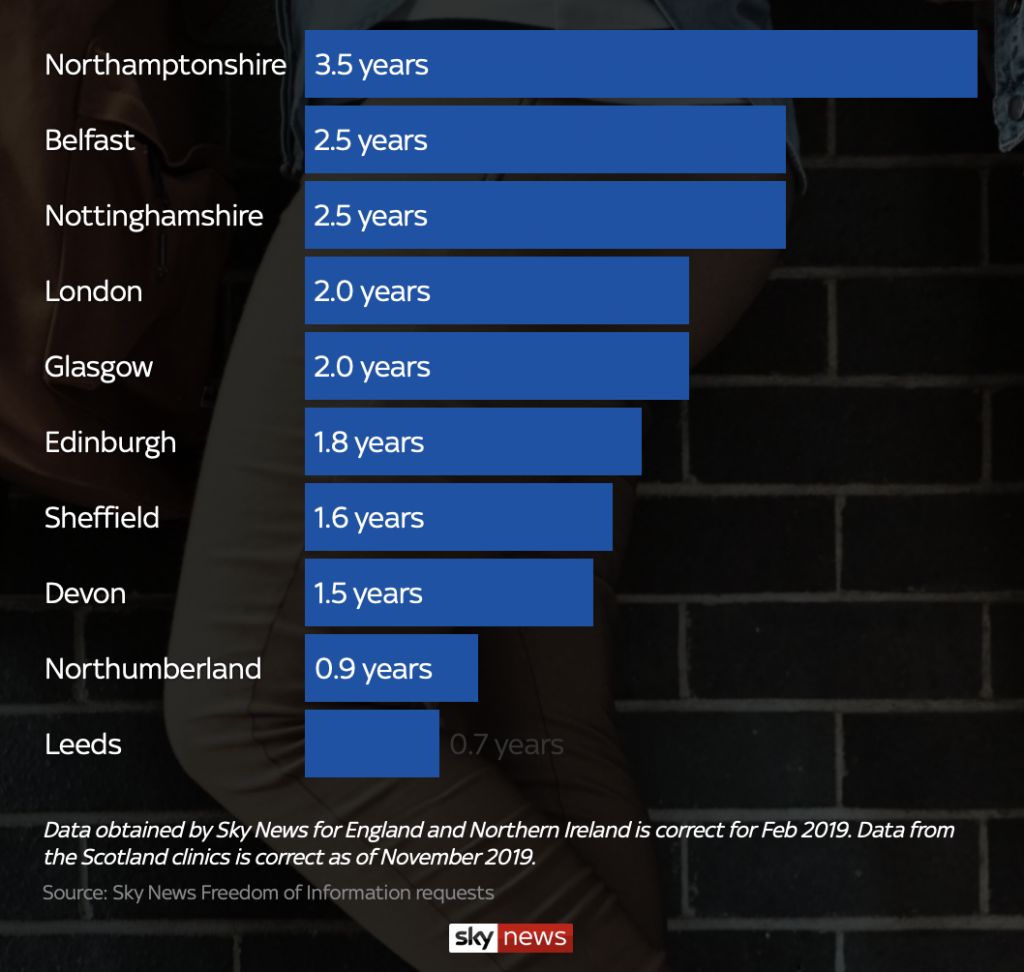
    This graph shows the average waiting times for a first appointment with gender clinics (GICs) in the UK. Awful, isn’t it? And the reality is even worse, because the clinics have clearly provided figures that show them in a comparatively positive light. For example, Belfast isn’t accepting any new patients; Wales didn’t have a clinic at all until two months ago.

    As trans health expert Dr Ruth Pearce notes on Twitter, the GIC’s figures aren’t accurate. For example in Leeds the figures (0.7 years – the number isn’t on the graph here for some tedious technical reason) appear to refer to pre-appointment screenings; the wait after that for an initial appointment is three years.

    Another Twitter poster, MichaelT, goes into detail. Leeds’ own website reports a 30 month wait for a first appointment. He also notes that while Devon claims an 18 month wait it’s currently keeping people on hold who were referred 40 months ago and who do not have any current indication of when anybody will see them. That’s over three years. The Northumberland figures are wrong too. They told Sky 0.9 years, but their website says 26 months.

    The waiting times Sky has published are not the waiting times to get hormones. These are the waiting times for an initial assessment, which is followed by a second assessment, which is followed by a decision on hormones.

    For me, the gap between initial referral and being prescribed hormones was three years. For others it’s even longer.

    In Newcastle, the waiting list for the first appointment is two years; you’ll then wait up to two years for your second appointment. In Northumberland it’s 30 months for an initial appointment then at least 30 months more before a hormone clinic appointment, a total of five years.

    As MichaelT says:

    The GICs know perfectly well that in the context of questions about the impact of waiting times on patients, the relevant time period, certainly at all adult English services is 2.5 years plus.

    But they’re not talking to trans people. They’re talking to the wider public, so this is really PR.

    They know patients know this. They know the trans community knows this. So in giving this kind of nonsense to media enquiries, they’re actively speaking to cis people, not trans people.

    The Sky piece is pushing back against the “fast track” nonsense, which is good. But (many) GICs still prioritise trying to make themselves look good over accurately representing the situation for the patients they’re supposed to serve.

    Here’s a pretty realistic description of the process by writer Ed Davies in response to a “hilarious” tabloid prediction that Prince Harry would have a “sex change” and become Harriet by 2027. The short version: if you’re being referred in 2019, 2027 is incredibly optimistic.

    Many, many people experience obstacles that aren’t accounted for here — from being held back until they “fix” their mental health after crises caused by these very wait times, to being “lost in the system” repeatedly, to being discharged for spurious reasons. People of colour, gender nonconforming trans people, trans lesbians, trans men perceived as confused lesbians, those too young to be believed at their word about their experiences, transfeminine people, those from other countries and cultures, disabled people, autistic people… many groups tend to struggle more than “average”, too.

    Self-medication can be dangerous, but so can doing nothing: some people die on waiting lists. As Edinburgh GP Jo Gardiner told the BBC earlier this year, trans patients:

    …often don’t have the same support as other patients. Family and relationships break down when they transition so it can be quite distressing for them.

    Some patients are very isolated and alone and at high risk for things like suicide.

    These problems are not unique to trans healthcare; they’re the symptoms of ongoing lack of investment into the NHS by successive governments. But because trans healthcare is such a niche area, it’s suffered particularly badly: the gender clinic I use is desperately understaffed, with even simple admin tasks like typing letters taking three months.

    But there are two things that make the current trans healthcare crisis particularly galling.

    The first is that the government and the NHS were told that it was going to happen and did nothing; the Gender Identity Research Society, GIRES, provided the Home Office with extensive data in 2009 demonstrating the increasing demand for gender clinic services – particularly among younger patients who are coming of age in a world where trans existences are subject to less shame and stigma than in previous generations.

    As the report noted:

    The only safe assumption for commissioners and providers is that the present growth rate in the incidence of new people requiring medical and other care is likely to continue, which is usually the basis on which service provision is planned. At a growth rate of 15 % per annum compound, the number of new cases will approximately double every 5 years.

    …the mounting requirement for services has serious implications for resources, especially for specialised adult surgery and adolescent endocrinology.

    The report predicted pretty much everything the press is scaremongering about now: an increase in referrals from people assigned female at birth (it’s been a 50/50 balance in Europe for many years, but in the UK there were more trans women than trans men accessing services); the growth in adolescent referrals; the increasing number of people transitioning as the world becomes (slightly) more accepting.

    That was ten years ago.

    And the second thing that’s happened is of course the press, which continually lies about the supposed fast-tracking of trans people and which has made the issue politically toxic: fixing the trans healthcare crisis may be necessary, but which politician is going to risk the wrath of The Sun, The Daily Mail, The Times and The Spectator, who will frame it as evil trans cult members stealing resources from kids with cancer?

    So we self-medicate, and the people who come after us will self-medicate, and we’ll continue to do so for as long as the UK system fails to meet its own waiting list targets, let alone internationally agreed standards of best practice. The system isn’t fit for purpose – it’s overly medicalised, far too complicated and desperately underfunded – but right now it’s the only system we have.

    Trans people know that self-medication is dangerous, and that in some cases it’s illegal. But sometimes doing nothing is even worse.

  • I can’t tell you that I like you

    Have you ever wanted to swipe right on a dating app, or tell someone who makes your heart beat faster that you like them, but stopped yourself because you’re too scared of being rejected – not because of how you look, act or think but because of what you are? I have, and I think quite a few other trans people have too.

    This tweet, by YouTuber Mia Mulder, struck a chord with me and many others: it’s been liked more than 3,500 times.

    Any other trans women out there feel scared of expressing any form of attraction ever, even to actual current partners, for fear of seeming predatory or seem “male aggressive” to the point of absurdity?

    My answer, like many other trans women’s answers, was “all the time.”

    Here’s the writer and playwright Harry Josephine.

    yeah sex is good but have u tried being a transfem n thus so fundamentally alienated from your desires n so relentlessly problematised in all social space that instead you just stay at home and read a book???

    If you think a trans woman likes you, you may be right. But she may be far too scared to tell you. I certainly am.

    Here’s why.

    I’m under no illusions about who I am: I’m a giant, excitable puppy in a dress, an overweight, middle-aged trans woman who likes women and who hates her body.

    But I’m scared that you see something very different. Someone who’s a deceiver. Delusional. Mentally ill. A mutilated man. A pervert. A predator. A fetishist. A fraud. A wolf in sheep’s clothing. A fox in the hen house.

    I could go on.

    I worry you’ll think that because that’s what we’ve been told since childhood, and because you’re still being told it today in the newspapers you read and the social networks you use. Again and again very vocal and often vicious people, many of them with high profile media jobs and/or thousands of social media followers, tell us that trans women cannot be trusted. They tell us that trans women are predatory, damaged, dangerous men full of male entitlement and male aggression, that we go through what we go through purely so we can prey on vulnerable women. The decades of mocking and shaming our appearance weren’t enough. They want you to be scared of us too.

    So we’re scared of you.

    And if we’re not scared of you, we’re scared of the people you know. I worry that even if you don’t think that I’m a fake, a fraud, a fetishist, your friends or your colleagues or your family members will.

    So I don’t swipe right. I don’t tell you that I like you. I stay home and read a book.

    I don’t swipe right or tell you that I like you because I believe that if I do you’ll be horrified, that you’ll think I’m just being predatory. And if I’m wrong about that, if you’re not horrified when we match in an app, you’ll be horrified when  you hear my voice or see what I really look like compared to my carefully chosen, better-makeup-than-usual selfies. And if you’re not horrified then, you’ll be horrified when you see me without my makeup, or when the question of what bits I do or do not have comes up. And if you’re not horrified by that and we see each other again, your friends, your family or the people who just see us talking in a restaurant will make it clear just how horrified they are on your behalf.

    Better not to swipe right in the first place.

    Don’t worry, I’m fine. This isn’t a cry for help. But on this, the last day of trans awareness week, I wanted to write about this because it’s something I don’t think many cisgender people are aware of – probably because we don’t like to admit to any kind of weakness in case bigots try to weaponise it against us. But you’d have to be pretty tough to survive decades of being mocked and shamed and demonised without internalising any of it. I’m neither pretty nor tough.

    This will change. It’s already changing. Young people’s attitudes are completely different than my generation’s were; the bigots are on the wrong side of history, which is one of the reasons they’ve become so vicious. But while I’m happy to see progress, I’m sad that it came late for me. The lake is being drained of poison, but I spent forty years swimming in it.

  • Money for Mermaids

    Mermaids, the charity for trans kids and their families, is trying to raise money to better help people. The video above does a really good job of demonstrating just how toxic things are at the moment: I thought I was pretty much desensitised to the constant barrage of anti-trans articles, but it turns out I’m not – to see the onslaught on-screen is still horrifying, especially when it only represents a tiny, tiny proportion of the newspaper scaremongering and online abuse.

    The Mermaids crowdfunder is here. I don’t agree with everything they’re raising money for – I think their planned billboards, which they hope will raise positive awareness of trans kids, are going to be completely ineffective; when you’re up against the overwhelming majority of the UK media and much of the political class too, having a couple of billboards is like taking a pea-shooter to a nuclear war – but they’re also raising money to fund more helpline volunteers and improve the information on their website, practical steps that will genuinely help people.

    And while they’re hopelessly outgunned, the point they’re making with their #IfIHadAVoice campaign is an important one. What’s missing from the so-called debate about trans kids is the voices of the children and of their families (and the medical professionals who are active in this field), all of which are drowned out by ill-informed, self-proclaimed experts. For example, the right-wing press’s favourite  “expert” on trans kids is a former religious cult member whose expertise is in sculpture, not medicine; their go-to anti-trans transsexual “Dr” isn’t a medical doctor but a physics teacher; many of the voices given airtime are simply bigots.

    Mermaids:

    the amount of negative coverage of transgender kids over the last 8 years has grown massively. The press and a small group of anti-trans campaigners have decided to make transgender children – and the few organisations supporting them – the target of deliberate misrepresentation.

    While transgender children and their families feel increasingly afraid to speak out, some of the country’s most influential speakers are content to speak about them, speak for them and speak over them.

  • “The biggest threat to single-sex services is insufficient funding from the Government”

    I hadn’t seen this before: a Q&A on gender recognition by the Fawcett Society, a leading feminist charity campaigning for women’s rights. It strikes me as nuanced and fair-minded, so for example:

    The tone of the debate in some quarters, and on extremes of both sides, has been a problem. Amplified by social media, a small minority whom we believe do not represent the views of most people have gone far outside legitimate debate and strayed into violence, or aggressive, intimidating, or dehumanising language. We believe there is no place for that in this discussion.

    Events appear to have overtaken this bit:

    It is notable that in Scotland, where there has been an ongoing dialogue for some time between women’s and trans organisations, that mutual understanding and respect is stronger and there is a common agenda. We think this is valuable and needed in the rest of the country too.

    That was written in February, but while it’s an accurate description of women’s groups and single-sex services it sadly doesn’t apply to the majority of Scots media and the most vocal parts of social media. Our newspapers and current affairs magazines are relentlessly one-sided; they frequently go “far outside legitimate debate” and do nothing about comments pages full of aggressive, intimidating and dehumanising language.

  • Trigger happy

    One of the things I’m really interested in is where words come from and how they’re used. For example, I’ll happily bore you senseless about how “shambles” has changed meaning several times. In the 15th century what originally meant a stool or money changer’s table became used to label the table butchers used to display the meat they had for sale. Shambles then became synonymous with slaughterhouse, before arriving at its current meaning – a state of great disorder and confusion – in the early 20th century.

    Sometimes that evolution just happens, but sometimes meanings are changed deliberately. Take “politically correct” for example. It began as a left-wing in-joke, sarcastic and satirical, with left-leaning people taking the mickey out of their own tendency to go a little too far sometimes. It didn’t develop its current pejorative meaning – “political correctness” as a supposedly malign force to be resisted by right-thinking people – until 1987, when the book The Closing of the American Mind told its readers that the real bigotry was telling bigots to stop being bigoted. Since then it’s been used almost exclusively by right-wing politicians and pundits to rail against feminism, LGBT+ rights, anti-racism and anything else that stops them being awful to people.

    If you’re a UK newspaper reader, you’ll recall a very similar process occurring with “Health and Safety”. The Health and Safety Executive aims to stop factory workers having their arms ripped off by faulty machinery, agricultural workers from suffocating in grain silos and miners from contracting fatal lung diseases. According to the right-wing press in stories that often turn out to be exaggerated or completely fabricated, what they call “elf’n’safety” has, like political correctness, “gone mad”.

    It’s no coincidence that the pundits who rail against “elf’n’safety” also rail against “political correctness”. They are, after all, two cheeks of the same arse: how dare the proles demand safe workspaces and protection from discrimination? Whether it’s railing against red tape or LGBT+ rights, the pundits are firmly on the side of, and punching down on behalf of, the people who have all the power.

    Something similar has happened more recently with “triggered”. “Trigger warnings” began in discussions of male violence towards women, particularly sexual violence. Because victims often experienced the symptoms of post-traumatic stress, potential triggers would be flagged up in advance of discussions or presentations so that vulnerable women wouldn’t find themselves mentally reliving their ordeals. There’s some debate over whether the tactic actually works, but clearly it comes from good intentions: it doesn’t want to add to the trauma of sexual abuse survivors.

    It’s worth bearing that in mind when you see boorish men – right-wing, anti-feminist pundits, politicians and comedians, some of whom have very dubious attitudes towards women – using “triggered” to assert their superiority over whichever minority they want to abuse.

    It’s particularly galling when you see the son of the pussy-grabber-in-Chief using a term originally designed to help the victims of people like his dad as the title for his book. Donald Trump Jr is currently touring the usual right-wing outlets to promote Triggered: how the left thrives on hate and wants to silence us. 

    This week he was heckled off stage – silenced, you might say – at one of his readings.

    Here’s Arwa Mahdawi writing in the Guardian.

    One of the big themes of Triggered is, to quote Trump Jr: “A victimhood complex has taken root in the American left”. But let’s recap the situation shall we? Trump Jr (who describes himself as “hyper-rational” and “stoic”) has just published a book complaining that he is being silenced by the left. He is touring the US talking about how he is being silenced. He has been invited on primetime TV to talk about being silenced. And he is complaining about being silenced to his 4 million followers on Twitter. Maybe I am missing something, but that doesn’t exactly sound like being silenced to me.

    What’s interesting about this particular event is that the people who actually did silence Trump Minor weren’t from the left. They were from the far right.

    Mahdawi:

    …the Trump administration has emboldened so many bigots that Maga-hat-wearing supporters are now coming after Jr for not being extreme enough. There has been a 30% increase in the number of US hate groups over the past four years, according to the Southern Poverty Law Center – a trend the civil rights organisation blames on Trump’s radicalising influence. Dangerous fringe groups have crept out of the shadows and are shouting at the top of their lungs.

    The column articulates something I’ve been thinking for a while: there’s a common thread that unites the people who call their books or TV shows “triggered”, who delight in “triggering” audiences on social media, in print or in their shows, and those opposed to workers’ rights, LGBT+ rights, women’s rights and vegan sausage rolls. They genuinely believe that they are an oppressed minority.

    A delusional victimhood complex is at the very heart of rightwing ideology. Immigrants are invading and stealing all the jobs. Jews are taking over the world. #MeToo is intent on destroying innocent men’s lives. Gays are destroying family values. The right never see themselves as racists or bigots; they see themselves as victims who are fighting back against the imminent extinction of western civilisation. Forget being stoic or silenced; they are constantly triggered and they never shut up.

  • “You invited us here to celebrate genitals, Karen”

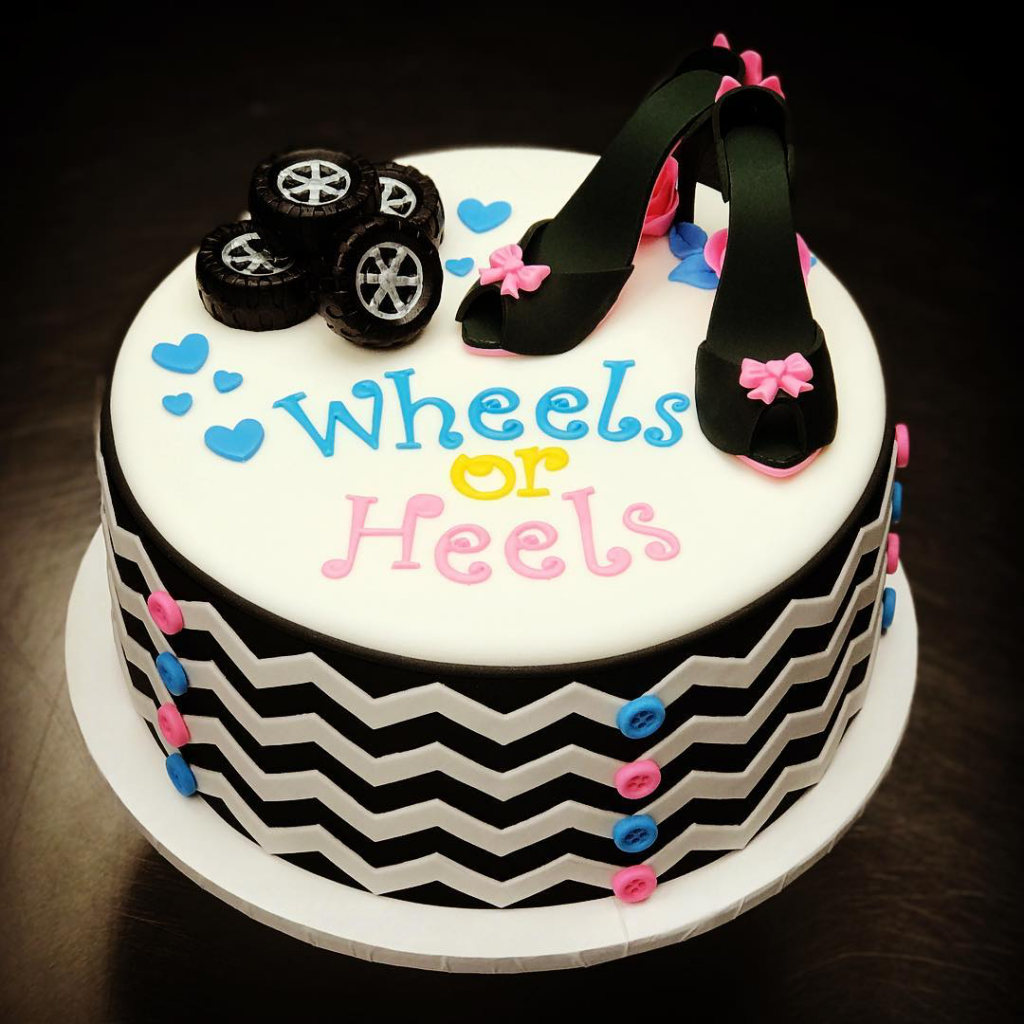
    The blurb for this cake says: “Wheels for boys or heels for girls?…boys love cars and girls love heels”.

    Here’s a fun question for you. Which group of people is so obsessed with enforcing regressive gender stereotypes that they’ve killed a woman, injured several others and set fire to various bits of land?

    Is it:

    (a) LGBT+ people?
    (b) The straights?

    It is of course (b), thanks to one of the most awful facets of modern culture: the gender reveal event. Because a baby shower isn’t enough, some parents are trying to get others excited about the genitals of their imminent children in increasingly elaborate ways. And those ways are dangerous and sometimes lethal.

    Julie Beck in The Atlantic:

    At least one human life has already been lost as a direct result of the widespread obsession with turning the sex of one’s unborn child into an explosive (often literally) spectacle. In October, an Iowa woman was killed when her family inadvertently built a pipe bomb as part of their gender-reveal party—a gathering at which expectant parents dramatically and colorfully announce the sex of their baby.

    What started off with blue or pink cakes has become much more elaborate and dangerous. In recent months we’ve seen gender reveal plane crashes, gender reveal pipe bombs, gender reveal wildfires and many other examples of sheer genital-obsessed idiocy.

    Jenna Karvunidis, the blogger credited with starting the craze more than a decade ago deeply regrets it, not least because her own child is gender non-conforming. “I started to realize that nonbinary people and trans people were feeling affected by this, and I started to feel bad that I had released something bad into the world”, she said this year.

    That’s because you don’t need to blow up grandma or crash a crop-duster for gender reveals to be idiotic and regressive. There’s a distinct whiff of sexism to the whole thing. Beck:

    Not only does the very idea of gender-reveal conflate gender with biological sex, but many parties reinforce masculine and feminine stereotypes with themes like “touchdowns or tutus?” and “guns or glitter?” [CM: there are many more, such as “wheels or heels?” and “riffles or rifles?”] (These regressive overtones have made hating on gender reveals just as commonplace as the parties themselves.) Trouble can also ensue if a parent was hoping for one sex and their disappointment ends up immortalized online.

    The sheer wrongness of the whole thing is best summed up in a single tweet.

    If you’re gonna do a gender reveal party, don’t play coy with colored smoke or whatever. When you blow up that cake, I expect to see a giant sign saying “IT’S A PENIS!” Showers of dicks raining down like confetti. You invited us here to celebrate genitals, Karen. You wanted this.

  • The sin of omission

    Something that’s puzzled me for a while is how so many people believe that Donald Trump and his administration are pro-LGBT+ when they’ve been so viciously anti-LGBT+: from the transgender military ban onwards, they have mounted a sustained attack on the basic rights of LGBT+ people in an ongoing campaign to remove the most basic human rights such as protection from discrimination in housing, healthcare and employment.

    The most recent example of that is the November 1 rule that will allow adoption agencies to discriminate against LGBT+ parents. Agencies that receive federal grants will no longer have to abide by non-discrimination guidelines thanks to new “religious freedom” exemptions, exemptions that also apply to sexual health education, youth homelessness programmes, drug and alcohol recovery programmes and other key services.

    It’s a horrible backwards step that’s going to have terrible effects on some of the most vulnerable people, so why aren’t more people up in arms about it?

    Because they don’t know about it.

    A study by MediaMatters found that the majority of America’s top newspapers didn’t report it. Of the top 50 titles, 28 didn’t publish a single item in print or online about the new rule.

    Of the papers that did report it, many uncritically quoted extremist anti-LGBT+ evangelical groups including the Alliance Defending Freedom and the Family Research Council. Only one paper, the New York Daily News, reminded its readers that these organisations have spent decades inciting hatred of LGBT+ people.

    The lack of context means that people are incredibly ill-informed.

    It is also crucial for media to cover individual actions like the new rule as one piece of the Trump-Pence administration’s broader, vehemently anti-LGBTQ record. The New York Daily News and The Washington Post provided two good examples of this in their reporting, as both contextualized the rule as part of the larger attack and rollback of LGBTQ rights. Most coverage unfortunately failed to do this, which may mislead readers into thinking the administration’s attacks on LGBTQ rights could be a one-off occurrence.

    As MediaMatters explains, the mainstream US press was keen to portray Trump as pro-LGBT+ during his presidential campaign on his say-so, and it has conspicuously failed to report on anti-LGBT+ actions by his administration since he took power. That has left a vacuum the right-wing press and social media have been only too keen to fill with propaganda.

    In the absence of meaningful mainstream reporting on Trump’s anti-LGBTQ onslaught, right-wing and evangelical media often dominate coverage of the issue and twist the attacks on basic LGBTQ rights into a fight for “religious freedom.”

    The news media’s job is to report and contextualise, to educate and inform, to speak truth to power. When it fails to do that, whether by bias or omission, it becomes part of the problem rather than part of the solution.

  • Daddy doesn’t know best

    Writing in Vox, Katelyn Burns’ piece about Luna Younger demonstrates why media outlets should have trans people covering trans issues: unlike pretty much every piece about the poor kid I’ve read so far, it eschews ill-informed scaremongering.

    If you’re not familiar with the story, it’s about a horrible battle in the US between two estranged parents over their 7-year-old child after the mum took out a restraining order against the father. The child has been consistent about her gender identity since she was three, and her mum has let her present as she wishes – as a girl. Her dad disagrees vehemently, and has taken to the courts and to the right-wing media, culminating in a judge’s decision to overrule the jury that granted the mother sole custody. It has become a cause celebre among US conservatives, with Donald Trump and Ted Cruz suggesting that letting Luna be herself is “child abuse”.

    As Burns notes:

    The case has hit a boiling point where lives feel threatened and trans families inside and outside of Texas feel unsafe — all over whether a child should be allowed to wear a dress and be called “she” and “her.”

    Much of the reporting over the Younger case has claimed that her mother, Anne Georgulas, wants to “chemically castrate” her and force her into medical transition because “she wants a girl”. But as Burns points out, Georgulas already has daughters from a previous relationship; and at age 7 there is no medical involvement whatsoever. Social transition for this kid is wearing her hair long and donning the odd frock, things that are completely superficial and reversible (albeit important to the child).

    Burns’ report paints a very different picture than the right-wing press, which has gone with the father’s side of the story and portrayed him as a saint battling political correctness and “gender ideology” gone mad. The court documents are considerably less favourable, suggesting a serial liar whose main concern is how to make money from demonising his estranged partner and bullying one of his children.

    According to court documents of the annulment of his and Georgulas’s marriage, the court found that Younger lied about multiple aspects of his life: his career, his previous marriages, his income, his education, and even his military service. It was enough for a Texas court to annul their six-year marriage because it was entered into under fraudulent terms.

    Judge Cooks also called out Younger for profiting off a violation of his family’s privacy. “The father finds comfort in public controversy and attention surrounded by his use of unfounded facts and is thus motivated by financial gain of approximately $139,000 which he has received at the cost of the protection and privacy of his children,” she wrote in her judgment, referring to a crowdfunding and merchandising scheme launched last year by Younger.

    Even conservative pundit Glenn Beck expressed concern over Younger’s past. On his radio show, he read the court’s findings of fact showing that Younger acted aggressively toward Georgulas’s older daughters, withholding their possessions, locking them in their rooms, and forcing them to do “plank push-ups” until they agreed to follow house rules.

    That aggressiveness was also directed at Luna

    There are of course two sides to every story, but the picture that emerges from the court documents hardly makes it sound like a case of fatherly love denied.

    The child’s father wasn’t particularly keen to exercise his custody rights, refuses to accept the recommendations of any of the professionals involved in his daughter’s care, does not attend appointments or seek the second opinions he claims to want, and treats his daughter in an aggressive and arguably malicious way: where her twin brother’s hair is left long, her father deliberately shaves her head.

    Burns:

    Luna’s hair figures so prominently in this case because at age 7, hair is often the only differentiating physical indicator of a child’s gender. Clothed, boys’ and girls’ bodies at that age are essentially the same, having not yet undergone any effects from puberty. A trans child at age 7 does not make permanent changes to their body, despite what Younger claims Georgulas wants to do.

    Ultimately, the dispute at this current stage — and several years into the future — is over Luna’s social transition: how she wears her hair, what clothes she wears, her name, and pronouns.

    Luna is not taking any medication, let alone undergoing any surgical intervention. Her care is in accordance with international best practice.  Those details are missing from almost all of the reporting.

    But then, the reporting isn’t concerned about the welfare of the child. The people who scream “think of the children!” rarely do.

  • Money for nothing

    Interesting developments at the LGB Alliance, the newly launched anti-trans group. It’s managed to raise over £25,000 in largely anonymous donations in just 11 days of existence, largely due to support from right-wing media here and in the US.

    The right-wing press and the US religious right like the Alliance because while it advances the same argument as the most hateful religious conservatives – trans people’s rights are at odds with LGB people’s rights, even though the majority of trans people are themselves LGB; trans people aren’t really people and don’t deserve human rights; trans people are icky – its figureheads are a black woman and a gay man. That means unlike straight white guys, they can’t be criticised because there have been no wicked, misinformed or bigoted black or gay people in the history of the world ever.

    The right-wing support has no doubt helped the fundraising, as it’s helped other anti-trans fundraisers in the past. But it’s interesting to look at this particular one, because this is very specifically claiming to be an alliance of lesbian, gay and bisexual people in the UK.

    So why are so many of the supporters straight people from North America?

    Don’t get me wrong. It’s lovely to see so many straight people such keen allies of LGB people and putting their money where their mouths are.

    But it’s also rather strange.

    There are lots of fundraisers online for LGBT things. And almost all of them are struggling to meet their targets, whether that’s a few hundred quid for a poster campaign or a few grand to do up an LGBT+ community centre.

    What all those fundraisers have in common is the distinct lack of straight Americans and Canadians offering solidarity and throwing their money at them.

    But when a couple of people in the UK start a group designed to destabilise Stonewall, the trans-inclusive LGBT+ charity named after the Stonewall riots that were in part started by trans people, it’s a different story.

    Why would straight people from the US and Canada be so passionate about destabilising the UK’s main LGBT+ charity?

    If only there were some kind of explanation.

    Anyway. £25K and counting. That’s a lot of money. Where’s it going? It isn’t a charity yet so it doesn’t need to tell you.

    Here’s where it isn’t going. It isn’t going to help homeless LGB people, who – including trans kids – account for 24% of the UK’s under-25 homeless population. It isn’t going to lobby for proper funding of live-saving PReP medication for gay and bi men (and some trans women). It isn’t going anywhere near any cash-strapped LGBT organisations at all. It’s going on marketing, and on salaries, and on a launch event that will no doubt scaremonger about trans people.

    It’s possible that the £25, 257 and counting is being donated by people who are also donating to other organisations – real ones that are registered charities. But it’s unlikely. Anti-trans crowdfunders consistently attract a very different funding pattern from other charity crowdfunders, and this appears to be no exception.

    For two years now the crowdfunders of anti-trans organisations have all followed the same pattern: supposedly grassroots organisations raising five-figure sums within days of going online, with promotional support from the US Christian and conservative right on social media and sometimes in major publications too.

    The LGB Alliance has now raised its funding target from the initial £25,000 to £50,000. How much of that money will go to provide practical assistance for LGB people rather than demonising trans women? The answer, I suspect, is none.

    We know how this will play out. We know this because we saw endless “protect women!” crowdfunders raising five-figure sums incredibly quickly over the last few years. That money didn’t go to fight for Northern Irish women’s reproductive freedom or marriage rights. It didn’t go to fight FGM, or fund rape crisis charities, or help women’s refuges, or go to any vulnerable women or girls.

    At least a quarter of a million pounds was raised by a handful of anti-trans groups, and much of it was spent on newspaper adverts that lied about the law, on packs urging schools to break the Equality Act and bully children, and on providing a good living for people whose previous careers had ended in failure. In one case it even bought a bigot some bedding.

    Some crowdfunders didn’t even pretend to be about protecting women. One prominent anti-trans activist crowdfunded £2,000 for her own living expenses because being a bigot is so time-consuming; another, claiming to have lost their job for speaking out about trans people, raised a barely believable £64,000 for nothing in particular.

    Others raised money for specific purposes and then changed their remit, so for example one activist raised a five-figure sum to pay for legal representation in a case that didn’t then go to court. In one particularly egregious example, activists set up a crowdfunder as a thank you to a notorious anti-trans bigot; when the bigot declined to accept the money, much of it was spent on a new mattress for an anti-trans activist.

    Not all of the people running crowdfunders are grifters. But as a rule of thumb, when the first thing someone does to “protect group X” is to ask for your money, it means they’re only interested in helping one very specific group of people.

    Themselves.