Category: LGBTQ+

  • “Take a long hard look at your bullshit shock jokes”

    [Content note: suicide]

    Last night I stepped off a stage and ended up in 1971.

    My brother and I were the featured act at an open mic night I’ve played at many times before, a mix of musicians and comedians. It’s fun, although inevitably you have to put up with the odd person whose pub pals have told him he’s hilarious and who really isn’t. Last night’s example of that was the old man who got up on stage after our (fantastic, if I say so myself) performance.

    I’ve seen him before. He’s a peddler of seventies-variety “take my wife, please” jokes with a whiff of misogyny to them. Last night the whiff became a stench. His new material is about lap dancing, his horror of women who groom their pubic hair, and in a piece he’s clearly very proud of, a horrible nightmare in which a beautiful woman turns out to be “a ladyboy”.

    He isn’t the only stand-up to decide trans jokes are where it’s at. Last night, popular US stand-up Dan Telfer wrote on Twitter:

    I am so fucking sick of transphobic jokes at stand-up open mics. It is absolutely everywhere and comedians who pretend it‘s not are in denial. There is nothing awkward or yucky to joke about here, cis folks. Take a long hard look at your bullshit shock jokes, for fucking serious.

    it clearly touched a nerve: the post has been liked by 31.4 thousand people so far. Lots of comedians are doing the same stale jokes like it’s 1971.

    Nobody’s saying you can’t make trans jokes. I did last night, on the very same stage between songs, and got some big laughs. But if your punchline is “Ugh! Trans!” then you’re a hack.

    Last night’s hack didn’t have any new spin to offer, no hilarious take: his joke was that he had a dream, there was a sexy woman in it, she was trans. The expectation was that the room would share his disgust, but it didn’t and he died on his arse. Judging by the daggers he was looking at me later, he blamed me for that.

    Good. I usually hate seeing comics die on stage, no matter how bad they are, but this was thoroughly deserved. I had to sit ten feet away – our table was at the very front – from a man who hoped to mine laughs from sharing his horror of bodies like mine. Imagine how it feels to sit through that, to feel every pair of eyes in the room turn to look at you as it becomes clear what the punchline is going to be. Those feelings linger long after the hack has come off stage.

    “Ugh, trans” isn’t a punchline. It’s a punch down. The idea of trans people deceiving straight men is so commonly used as an excuse for violence and sexual violence against us that there’s a name for it: the trans panic defence. The idea that trans people are disgusting, horrific, worthy of nothing but contempt – a trope that is still very common, especially in comedy – keeps many of us in the closet and continues to harm us when we’re out of it. If the world keeps telling you you’re a monster, it’s hard not to believe it.

    When I got home from the gig last night, I read a long blog post by another Scottish trans woman, Becca, roughly the same age as me. “After six years of being on hormones and presenting completely female, I am still getting misgendered far too frequently and as the years have gone by, the sheer hopelessness of it all has finally sunk in,” she wrote. “I would honestly rather be dead than seen as a ‘man in a dress’.”

    It was a scheduled post, timed to go live hours after it has been written. By the time it was published, Becca had stepped in front of a train.
  • Stuck in the Middle with You is warm, wise and sad

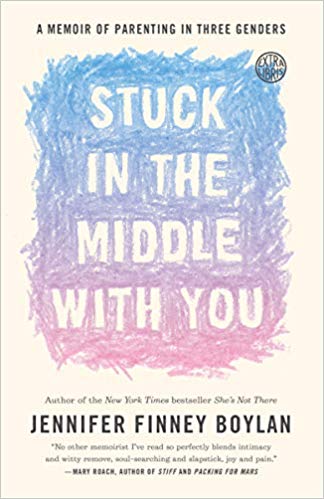
    I’ve written before about my admiration for the writer Jenny Boylan, aka Jennifer Finney Boylan: her memoir, She’s Not There, is warm, witty and often desperately sad. I didn’t realise she’d written another memoir, but when I found out about it I suspected it might also be warm, witty and desperately sad. It is.

    Stuck In The Middle With You is “a memoir of parenting in three genders” and focuses on parenthood before, during and after transition as a father of babies becomes a mother of teenagers. Like She’s Not There it’s a powerful and often difficult book to read if you’ve experienced similar upheavals, and it’s very honest about the doubts and darkness that are part and parcel of being a trans parent.

    I thought this, on trans people who marry before they work out who they are, was very true.


    In addition to her memoir, Boylan also interviews a range of other people about parenthood. I found those sections a mixed bag; while the people Boylan interviews are all interesting in different ways, I felt the interviews detracted from the momentum of the memoir itself. Boylan’s own story and thoughts are interesting enough not to need the company, and Stuck In The Middle With You is a considered and often unbearably honest book about trying to be a good person and a good parent in often very difficult circumstances.

  • The right to swing arms

    There were two trans-related court verdicts yesterday, although only one of them has received significant coverage.

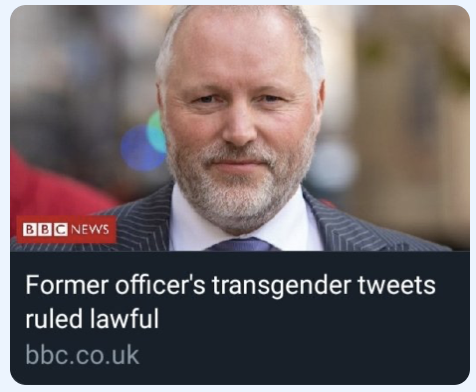
    In the one you’ve probably read about, Harry Miller had a partial victory in his case against Humberside Police, who turned up at his work to quiz him about his anti-trans tweets.

    The verdict chimes with what most people (cis and trans) I’ve seen discuss the case think: the police were too heavy-handed in dealing with someone who’s deeply unpleasant – as one learned commentator put it yesterday, “most people who test the limits of free speech are going to be wankers, but Harry Miller is really pushing it” – but who wasn’t committing a crime.

    Fans of irony were amused by the post-verdict photo shoot where Miller was photographed with various odious supporters calling themselves free speech defenders. One of those supporters loves free speech so much that has spent the last week threatening to sue various people on Twitter for calling him names. A few days ago he threatened one legendary feminist with a defamation suit because she told him to “fuck off”.

    What the verdict didn’t do was say it’s legal to abuse people on the internet, although that’s how many people have chosen to interpret it. What chance have we got when even the BBC can’t report it properly?

    No they weren’t. The case wasn’t about the lawfulness of the “opaque, profane and unsophisticated” posts; it was about whether police correctly followed guidelines. 

    Which leads us to the second case, which hasn’t attracted as much coverage (apart from a really nasty piece of victim-blaming by the Daily Mail; in one section, now removed, it accused the victim of “brandishing her GRC” as if a gender recognition certificate were some kind of weapon rather than a bit of official paperwork).

    In the second case, Kate Scottow was found guilty of “persistently making use of a public communications network” by setting up multiple social media accounts to attack, defame and harass one person.

    As her victim, Stephanie Hayden, said in a statement:

    The media-led obsession and campaign of hate is encouraging people like Katherine Scottow to think they can target transgender people online with impunity.

    And it continues to do so.

    The law’s pretty clear on all of this. It’s perfectly legal to have racist, misogynist, homophobic, anti-semitic or transphobic views, but it’s not legal to harass, abuse or assault people because of those views.

    Unfortunately a lot of the reporting hasn’t quite grasped that, and journalist Jane Fae was quick to notice. As she writes on Twitter in a thread that’s well worth your time:

    two different cases, two verdicts. In the first, dealing with the process of recording a hate incident, a court took issue with how the police had done it. In the second, hateful harassment was treated as a crime.

    …This was crying out for analysis that juxtaposed the two cases. But most coverage,starting with the @bbcnews focussed on the hate incident case and just ignored the scottow one

    As Fae notes, press reports claiming that the judge in the Miller case said it was legal to be nasty to trans people simply aren’t true. The case was about police procedures, not the content of messages. And the Scottow case was about a deliberate and sustained campaign of harassment, not the beliefs behind it.

    It’s perfectly legal to believe even the most horrible things. It’s not legal to act on those beliefs if doing so harms other people. That’s hardly a new concept. As US politician John B Finch said in 1882: “your right to swing your arm leaves off where my right not to have my nose struck begins.”

  • “Death threats to gay people didn’t breach their guidelines”

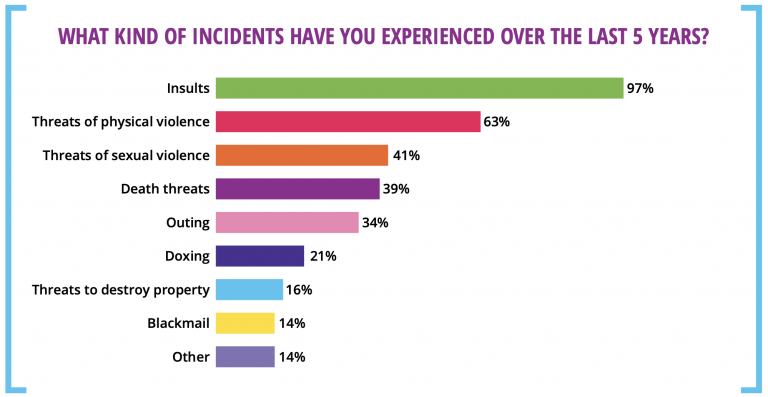
    The anti-violence charity GALOP has published its latest online hate report, based on a sample of 700 LGBT+ people. It makes for grim reading, with social networks and newspaper website comment sections leaving even clearly illegal abuse untouched.

    As you’d expect, almost all of us are used to being insulted online. But the prevalence of serious threats is really alarming.

    And the majority of incidents involved multiple perpetrators.

    More than one in every ten incidents involved more than 20 perpetrators. That’s not surprising: key tactics of anti-trans people on social media include dogpiling (multiple people piling on to reply to a post) or mobbing, where a large group of people are directed towards a single target. Washed-up comedy writers and insecure comedians are particularly fond of the latter.

    The effect on many of us is to silence us. Nearly half of us say we’re using social media less because of online abuse, with over a fifth of us removing any LGBT-related information from our profiles. 15% of respondents have quit social networks altogether.

    Respondents also stated that they were reluctant to voice opinions online, join online conversations, and share content. Many also tightened controls on their profiles, and blocked large numbers of users, to limit the abuse they could receive.

    If it weren’t for blocking, Twitter would be unusable for many trans folks.

    As with real-life hate crimes, people generally don’t report online abuse. Only 42% of people report abuse to social media providers (who rarely act on such reports) and only 7% have reported online victimisation to the police, where again action was rarely taken.

    The picture that emerges is very familiar: being abused online is so commonplace it’s become normalised, and social media firms and newspaper websites aren’t enforcing their own rules.

  • “An increasingly hostile environment”

    Hate crimes against trans people in Scotland have doubled since 2015, the Daily Record reports. It’s almost as if having almost all of your country’s newspapers and high-profile social media users constantly portraying you as perverts, paedophiles and rapists has an effect.

    I’ve written before about the false claim that the rise in numbers is fuelled by “snowflakes” reporting arseholes misgendering them on Twitter. It isn’t, because being an arsehole isn’t a crime (although there are laws about malicious communications such as harassment and threatening behaviour online). Hate crimes are crimes that are aggravated by hatred towards particular groups; if something isn’t a crime, it can’t be a hate crime and won’t be recorded as such.

    Most hate crimes happen in the street, in public spaces or in the workplace. For trans people they tend to be verbal abuse, physical attacks or sexual assault. Stonewall’s investigation into trans people’s lives is full of saddening statistics and horrific experiences.

    We aren’t rushing to report fabricated hate crimes; quite the opposite. I haven’t reported the various incidents I’ve experienced, which have been humiliating and sometimes frightening; I know I should but I also know that the people who did it won’t be caught. Four-fifths of trans people feel the same: according to Stonewall, 79% of us haven’t reported hate crimes we’ve experienced.

    What happens instead is that we become more afraid. Many trans people won’t come out at work for fear of trouble, fear that’s entirely justified: one in twelve trans people has been physically attacked at work by a colleague or customer. Two in five of us adjust how we dress to try and avoid attracting the wrong kind of attention; nearly half of us avoid certain streets altogether because we don’t feel safe there.

    The constant drumbeat of anti-trans bullshit in the media and on social media fuels that. We’ve seen the same pattern in all kinds of bigotry: when racists, homophobes or transphobes believe that they’re “thinking what everybody else is thinking”, it emboldens them.

    Here’s Esme, from Scotland, as quoted by Stonewall.

    We are constantly questioned on our existence, treated hostilely and ridiculed in the name of debate. We are constantly exposed to hate and criticism in media and daily life as the public respond to the media’s attitudes.

    It’s exhausting, and there’s no end in sight.

  • “It is an aged strategy, pitting one disadvantaged group against another”

    Dr Rebecca Crowther writes in the Scottish Review about Scotland’s women’s movement and the vocal attempts by a tiny minority to turn back the clock.

    Opposition to trans people is voiced almost daily in many newspapers and online. It is frequently featured on the radio and on television. It is an illusion that there are a majority of women against trans rights. An illusion ironically perpetuated by the very loud voices of the supposedly ‘silenced’.

    …It is absurd for opponents of trans rights to say that the majority of our population would be on their side.

  • Deception

    The reaction to 57-year-old TV presenter Philip Schofield coming out as gay has been interesting. Interesting because it’s been a very different and much more positive reaction than the reaction to Jameela Jamil coming out as queer the day before, which says a lot about the racism, misogyny and intolerance queer women of colour have to endure.

    And it’s interesting because despite the relative positivity there’s nevertheless been a really nasty outbreak of homophobia among some commentators and on social media.
    Max Morgan puts it very well:

    The main issue I want to address is the repeated portrayal of Schofield (and ergo other men who come out after years of marriage to a woman) as a liar and a deceiver, as someone who used his wife to cover his dirty little secret before ditching her when it was expedient for him to do so. I’m obviously not privy to the inner workings of the Schofields’ marriage, but I do know that in a great many cases this grubby insinuation couldn’t be further from the truth.
    …For me, and so many others, the closet wasn’t a place where I said, “I’m gay, but I’m going to hide it in here,” it was a place in which I fought tooth and nail, at great psychological cost, to convince myself I wasn’t gay at all. I knew I liked boys when I was about 6 or 7. And I knew very shortly after that that a boy who likes other boys was the very worst thing you could possibly be. So I convinced myself I wasn’t that.

    I’m older than Morgan and younger than Schofield, but we all grew up during a time when just to admit that LGBT+ people existed could cost people their jobs, when vicious homophobia was in the daily papers, when people like us were only ever portrayed as sick, perverted, predatory.

    LGBT people who grew up in the 70s, 80s and 90s did so at a time where every aspect of the public discourse was awash with a particularly nasty and virulent brand of homophobia. The press, the media, even the government – fuck, especially the government – displayed an unflinching commitment to hammering home the message that being gay was wrong, shameful, disgusting.

    We were perverts. We were predators. We were mentally ill. We were spreaders of disease. We were paedophiles, hell bent on corrupting children for our own nefarious ends. We were incapable of fidelity, or of love. We were a powerful lobby, to be feared and mistrusted. We were poofs, faggots and queers, dykes, rug-munchers and trannies. We were less than human and fair game for whatever violence came our way.

    So many of us did exactly what the advocates of lethal conversion therapy want people like us to do: we tried with all our might not to be gay, or trans, or whichever part of the rainbow we are. We fought to try and make ourselves “normal”, to deny what our own brains and bodies were trying to tell us, to refuse to see any signs that we were who we were trying so hard not to be. Many of us managed to keep that fight going for decades.

    I didn’t marry to deceive. I married because I was in love, and because I thought that love had cured me of my sadness. I genuinely believed that I could be Mr Right, and for a while I was.

    Morgan:

    I took those vows because I loved my wife, and that remains the case to this day. I would never knowingly have misled her, or undertaken any conscious act that would have hurt her in any way. Sure, there was a deception taking place, but it was a tangled and intricate web of self-deception, from which it would take me a further 13 years to extricate myself.

    And the more people depend on you, the more awful the consequences of untangling that web.

    I’m currently reading Stuck In The Middle With You, by Jennifer Finney Boylan – like me, a trans woman who came out after years of marriage and after becoming a parent. She writes:

    I still believed, on some fundamental level, that love would cure me. That if only I were loved deeply by someone else, I would be content to stay a man… Of course, nobody really gets cured by love, but transsexuals are hardly the only people who believe romance will lead them outside of themselves. You can’t fault a person for hoping that love will make her into someone else, someone better. The world is full of false hopes, many of them dumber than the hope of being transformed by love.

    But of course, understanding any of this requires compassion and empathy, something sorely lacking among the tedious contrarians and twitter trolls.

    It’s no coincidence that many of the people condemning Schofield for his supposed “deception” are the same people calling Jameela Jamil a fake, a liar who‘s pretending to be queer in order to get “woke points”. As ever, the pejorative use of “woke” is the battle cry of the intolerant and privileged.

    Many of them are also so-called “gender critical” activists who claim teenage trans kids aren’t old enough to know who they are (in many cases advocating dangerous and discredited conversion therapy, which converts many perfectly healthy LGBT kids into damaged or even dead ones) while telling trans women of my age that if we had really been suffering we’d have come out in our teens.

    The truth is that it doesn’t matter to these people if we come out in our teens when we’re single, in our thirties when we’re in a relationship, or in married middle age. They don’t want us to come out at all. Not today, not tomorrow, not ever.

  • Adult kids say the funniest things

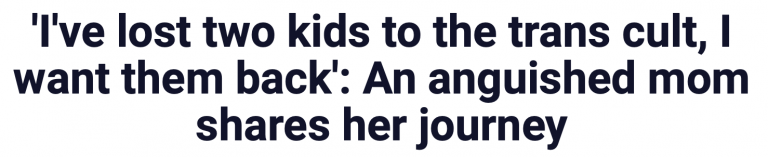
    I’ve written before about dubious “the sinister trans cult stole my children” articles: all too often they turn out to demonstrate that some parents find it easier to blame sinister, shadowy forces than their own shortcomings when their grown-up children cut all contact. But I’ve rarely seen an example as downright awful as this one.

    This is from The Christian Post last year, and it’s being widely circulated again by anti-trans types. I’m not linking to it because it’s just hateful and packed with some really, really unpleasant stuff.

    The “kids” are in their twenties and thirties. The “anguished mom” is “tormented Lynn Meagher”.

    Meagher lost contact with her son for nearly a decade after he came out as transgender. She reconnected with him in 2013, which was a struggle because she didn’t feel she could call him “she” or a woman, and use his preferred female name while remaining true to her beliefs — particularly that sex cannot be changed and no amount of cosmetic surgery can alter biology.

    “I did the best I could to have a relationship with him where I just loved him for himself, and was hoping that we could just disagree on what we disagreed with and love each other anyway,” Meagher said.

    Got that? I just want to love you for who you are, except for the “who you are” stuff. Incidentally, did you count the deliberate misgenderings in those two paragraphs? I make it eight.

    The thing about grown-up children is that they can speak for themselves. Here’s Meagher’s daughter, posting in November in a discussion about the article.

    She didn’t lose me to a cult. She lost me to her racism (she’s a Proud Boy). She lost me to her abuse (she threw me against the wall so I would stop crying). She lost me to her transphobia (she collected signatures for the anti-trans bathroom petition). She lost me to her greed (she stole survivors’ benefits the federal gov’t gave me to buy herself fur coats and a car). She lost me to her cruelty…

    The Proud Boys are a US far-right group. If they’re not actually neo-Nazis, they’re incredibly good friends with many people who are.

    Just in case you had any doubts about this woman’s eligibility for the Mother of The Year award, here’s a message from her son, responding to an article critical of his mother.

    thank you thank you thank you for addressing her, her hateful rhetoric, and the article she wrote (which was originally uploaded with mine and my siblings full names, and was found when a friend of mine had searched my name for my top surgery fundraiser, basically outing me as trans to future employers. it makes my situation more manageable to know that people see through her BS, even without knowing about the emotional/religious abuse and physical violence she inflicted on all of her children and husband for years. thank you.

    The article notes that our anguished mom has made lots of new friends, not just from far-right groups but also some of the leading lights of the UK anti-trans movement. They gave her “lots of hugs.” Which sounds like more love than she ever gave her children.

  • If the Starbucks Mermaids advert was real

    Starbucks’ lovely and groundbreaking advert, which features a young trans man summoning up the courage to ask for his new name on his coffee cup, is important: as I’ve written before, representation matters. Seeing someone like you in mainstream media, in this case on a major TV channel, can help you feel that you’re not alone. I had a good cry when I saw it.

    There’s been a somewhat mixed response online (discounting the obvious fury of the Prosecco Stormfront mob on Mumsnet) because of course, Starbucks is a big company that’s hardly known for its positive effects on the world around it. But if it’s going to be throwing its money around on advertising anyway, I’d much rather it threw its money at adverts like this one and at charities such as Mermaids, which this campaign is supporting.

    My own reaction is amusement, because when I first used my new name in a Starbucks things didn’t happen quite like they did in the advert.

    Barista: What’s the name?
    Me: Carrie.
    Them: Gary?
    Me: No, Carrie.
    Them. Sorry, Karen.
    Me: No, sorry, it’s Carrie.
    Them: Kerry?
    ME: No. Carrie. With a C.
    Them: Ciara?
    Me: No. Carrie. C-A-R-R-I-E.
    Them. Carrie?
    Me: Yes, Carrie. Like Carrie Fisher. Yes.
    Them: OK. (Writes “Harry” on cup)

  • What doesn’t hit print

    I linked to a Roy Greenslade piece the other day about the way UK newspapers invented a so-called immigration crisis. In it he wrote:

    If you want to understand the populist media’s underlying agenda then you have to look not only at what gets published, but what doesn’t.

    Here’s a great example of that. Every single time an anti-trans pressure group or disgruntled axe-grinder makes unsubstantiated claims about the supposed dangers and alleged overprescription of puberty blockers, it gets printed in the Daily Mail, The Sunday Times and other print publications.

    Last week, a massive, reputable study with a huge sample size reported that puberty blockers are safe, reversible and in many cases life-saving. They have proven positive effects on teens’ mental health.

    Not a single UK newspaper has mentioned it.