Category: LGBTQ+

  • Transphobia is as British as bad teeth

    Juliet Jacques in the New York Times:

    Transphobia Is Everywhere in Britain: it’s a respectable bigotry, on the left as well as the right.

    …There are two main types of British transphobia. One, employed most frequently but not exclusively by right-wing men, rejects outright the idea that gender might not be determined only by biological traits identifiable at birth. This viewpoint can often be found in publications aligned with the Conservative Party, such as The Spectator, The Times and The Telegraph, all of which are looking for a new “culture war” to pursue now that the long, exhausting battle over Brexit has finally been resolved in favor of Leavers

    The other type, from a so-called radical feminist tradition, argues that trans women’s requests for gender recognition are incompatible with cis women’s rights to single-sex spaces.

    It’s telling that Jacques, a former Guardian writer, had to approach a US publication to get the article published.

    Meanwhile closer to home, Helen Martin in the Edinburgh News claims that gender recognition reform will lead to…

    women’s shops compelled to supply men’s lingerie and size 12 stilettos

    This is from the same school as the equal marriage claim that letting gay people marry would lead to people marrying dogs and cousins.

    Transphobia is as British as bad teeth and unfunny sitcoms. As poet Jay Hulme noted on Twitter, we’ve had transphobia as part of our culture for hundreds of years. The word “bad” originally meant a feminine man.

    I’d say that everyone in Britain over the age of 20 (at least) has done or said something transphobic, and so calling out transphobia means calling out a whole nation – and British people don’t do well with guilt.

    …You’ll find transphobic tropes lurking in art and literature from the 1500’s, the 1400’s, earlier. They’re basically the same ones making up the transphobia in 2000’s comedy.

    …The world has been transphobic for a long time, Britain just held on to it. Made it funny. Made it ours. Put it in the fabric of the nation. Made everyone complicit. Made everyone guilty. And now we’re fighting for trans rights we seem unreasonable – and everyone feels attacked.

  • The Guardian: don’t you dare criticise us

    There’s been a lot of online upset over yet another anti-trans column in The Guardian, part of its overwhelmingly negative and one-sided coverage of trans-related issues – coverage that has led three trans staff to resign and notable trans writers to refuse to write for the paper.

    This week over 200 notable feminists wrote to the paper in protest and to affirm their support of trans people. The Guardian treated their letter with contempt.

    As Gal-Dem explains:

    The Guardian published the letter, but perhaps the most disheartening part of this process was their decision to title it: “Differing perspectives on trans rights”, and summarise over 200 signatories to 14 plus “over 100 others”. On the same page, the paper also included a number of letters in support of the original piece; something they did not do for a letter in support of sex-based organising with 13 signatories last week.

    It wasn’t for reasons of space; the online version didn’t list the signatories either. Here’s a summary from PinkNews.

    British politicians including Sian Berry, co-leader of the Green Party; Christine Jardine, the Liberal Democrat equalities spokesperson; and Labour MPs Zarah Sultana and Nadia Whitome have all signed the letter.

    …It is signed by leading women and non-binary people from a cross-section of British public life, including musician Beth Ditto; author Reni Eddo-Lodge; UK Black Pride founder Lady Phyll; editor-in-chief of Cosmopolitan magazine, Claire Hodgson; Jo Grady, the general secretary of the UCU; and Kate Allen, director of Amnesty International UK.

    A further 2,000 people (and climbing; right now the list of signatories just cracked 2,500) then wrote to the paper to protest its anti-trans coverage.

    We the undersigned write to protest the on-going and extensive series of articles you have published claiming that women are being ‘silenced’ and that men are being invited into women-only spaces.

    In the past year, you have run many articles seeking to position trans women as a threat to cis women, and arguing that cis women object to – and should object to – trans women in women-only space.

    The letter is unlikely to get a more favourable response than the last one: shortly before it was submitted, Guardian editor Katharine Viner wrote to her staff to inform them that the paper is committed to represent “a wide range of views on many topics”– unless those views are critical of Guardian columnists. Staff were warned:

    “It is never acceptable to attack colleagues whose views you do not agree with, whether in meetings, on email, publicly or on social media.”

    In response, over 300 Guardian employees – a fifth of its workforce across not just editorial but production, commercial and digital too – have written to express their disgust at the paper’s stance. The list of signatories hasn’t been published, but it apparently includes some of the paper’s star writers.

    We are proud to work at a newspaper which supports human rights and gives voice to people underrepresented in the media. But the pattern of publishing transphobic content has interfered with our work and cemented our reputation as a publication hostile to trans rights and trans employees.

    That’s an incredible number of people for any media organisation, but particularly for a paper that’s supposed to be speaking truth to power and defending minorities.

  • Bigots “not bigots”, say bigots

    Are the Ku Klux Klan racist? According to the Klan, they are not. They just have reasonable concerns about white people’s rights. As they put it in their flyers:

    “Why can’t pro-white rights organizations exist without being labeled racist?”

    As the Anti-Defamation League explains, the flyers are part of a strategy to “normalise white supremacy”: members no longer wear their robes and hoods and they dissociate themselves from violence. They claim that the fact that their followers are viciously racist is just a coincidence and nothing to do with them. “Members want to be able to express their white pride without being branded white supremacists – members prefer the term white separatists.” They argue that the rights of “other races” negatively affect theirs.

    What the KKK is trying to do is to rebrand itself, and part of that is to attempt to redefine what racism means. In their definition, racism basically comes down to lynchings and burning crosses: if you’re not actively doing them, you can’t be a racist organisation.

    That, of course, is  bullshit. And it’s why we don’t let white racists define what racism is or isn’t, because their definition excludes pretty much all forms of racism. Hate groups don’t get to define what is and isn’t hatred.

    Let’s go back to that statement from the KKK flyer and change two words.

    “Why can’t pro-women’s rights organizations exist without being labeled transphobic?”

    All the anti-trans hate groups claim that they aren’t transphobic. And that’s true, if your definition of transphobia excludes almost every form of transphobia, including your own past actions.

    In many cases, the high-profile anti-trans groups were co-founded by viciously transphobic people. Some now claim that their previously abusive anti-trans social media was run by the previous administration, with whom they now have no connection. Others pretend that their founding meetings featuring people calling trans women “parasites” and “bastards” who deserved violence and mocking trans women’s appearances never happened. And others’ bigoted founders – people who publicly called trans women “sick fucks” and claimed Jewish conspiracies – have conveniently died. They no longer wear their robes and hoods and they dissociate themselves from violence. The fact that many of their followers are abusive on social media is just a coincidence and nothing to do with them.

    The one thing that really annoys hate groups is when people rightly call them hate groups. And as the UnCommon Sense blog explains in detail, many of these groups clearly function as hate groups.

    A hate group is:

    “…an organisation that – based on its official statements or principles, the statements of its leaders, or its activities – has beliefs or practices that attack or malign an entire class of people, typically for their immutable characteristics.”

    As Buzzfeed’s Patrick Strudwick put it, these groups are telling us:

    We’re not transphobic, we just think you’re a danger to children, women, society, lesbians, gay men, feminism, yourselves, and should be excluded from everywhere we decide you shouldn’t be, and should be denied treatment, demonised, pathologised, ridiculed and debated endlessly.

    What’s hateful about that, apart from all of it?

  • “A wholly unacceptable misrepresentation”

    The Morning Star has published a remarkable apology for its publication not just of a vicious anti-trans cartoon, but of previous anti-trans scaremongering too.

    The Morning Star recognises that it has a responsibility to oppose discrimination against the trans community and to tackle transphobic hate crime, as well as to promote positive action and reform of the Gender Recognition Act to ensure trans people are able to participate equally in our workplaces, our communities, and our movement.

    …We do not accept that reform of the Gender Recognition Act should or would lead to an attack on women-only spaces and will ensure that we campaign against any attacks on the Equality Act.

    We understand that trans women are often welcomed into all-women spaces in our communities, and to portray trans women as a violent threat to women is a wholly unacceptable misrepresentation.

  • “I demand rights for me, but not for thee”

    Every day, transphobes engage in social media pile-ons against individuals and organisations for being trans-inclusive, engaging in abuse that’s rarely if ever reported in the mainstream media. Two days ago it was the Royal Institution, the charity dedicated to promoting science, which received so much abuse for including an image of a trans woman in a Twitter post that it deleted the message.

    Today’s one is against Glasgow Women’s Library, which declined to host a meeting of an anti-trans hate group as the library is proudly inclusive of all women. The predictable result was a flood of abusive messages that’s still ongoing. This isn’t the first time the library has been under sustained social media attack for simply being trans-inclusive; previous ones ran on for months.

    Glasgow Women’s Library is an important resource and it’s always struggling for money for upkeep and repairs – it’s currently dealing with a leaky roof. It could have raised a bit of cash by hosting the event but chose to value its principles over its finances. You can help support it by donating here.

    Many of the people involved in these pile-ons claim to be feminists, although there’s usually a significant cohort of misogynists whose interest in feminism only began when they realised they could use it as an excuse to scream at trans women and any cisgender woman who supports trans women. But there are plenty of women who identify as feminists delighting in the fact that the Library is struggling financially: it’s guilty of the ultimate crime of being trans inclusive. They would rather see an important feminist resource destroyed than have it support trans women; cisgender women who disagree with them are abused.

    There’s a word for that kind of feminism, and that word is “white”. White feminism is a subset of feminism that’s exclusive rather than inclusive: it centres the interests of a narrow group of primarily middle- and upper-class white women and ignores or even attacks everybody else: women of colour, poor women, trans women…. you get the idea.

    A good example of white feminism in action took place in Ireland in early 2018, at the height of the campaign to repeal the anti-abortion eighth amendment: while cisgender and transgender women took to the streets together to improve women’s rights, a group of English feminists who had previously had no interest in Irish feminism suddenly decided that it was time to talk – not about repealing the 8th, but about the invented evils of trans women. Irish feminists handed them their arses on a plate in an open letter:

    The organisers of ‘We Need to Talk’ are making a stop here in Ireland, under the guise of talking about abortion. However, their motives remain clear to us, and we write this letter to show that their exclusionary, discriminatory attitudes to trans people – in particular trans women – are not welcome here in Ireland. We will not sit in silence while the organisers of this meeting peddle ideas and opinions that are actively harmful to the well-being and safety of our comrades.

    …What is it that you know of Irish feminism that you feel entitled and authorised to come here and lecture us on?

    …We do not need you here. We have not had your support in our fight for #repealthe8th, our fight against the historical and ongoing impact of the Magdalene Laundries, our fight for taking back control of our hospitals from religious orders, our fight for justice for women and babies tortured and entombed in Mother and Baby homes.

    Do you know, for example, that in the north of Ireland, legally part of the UK, women still cannot access safe and legal abortion? Have you campaigned on this in any way? If you have, why don’t we know about it? Did you strike in solidarity with us on March 8th last year? Did you even know we were striking and for what? Do you have any kind of concept of what a feminism in a country shaped by struggle against Empire looks like? Did you take even a second to consider that, in assuming you have the right to come here in any kind of position of feminist authority, you’re behaving with the arrogance of just that imperialism? We have had enough of colonialism in Ireland without needing more of it from you.

    Cultural critic Mikki Kendall has just written a book on white feminism called Hood Feminism: Notes From The Women White Feminists Forgot. As she explains, all too often the focus is not on basic survival for the many, but on increasing privilege for the few.

    Here’s part of a larger extract:

    Whether it is the centring of white women even when women of colour are most likely to be at risk, or the complete erasure of issues most likely to impact those who are not white, white feminism tends to forget that a movement that claims to be for all women has to engage with the obstacles women who are not white face.
    Trans women are often derided or erased, while prominent feminist voices parrot the words of conservative bigots, framing womanhood as biological and determined at birth instead of as a fluid and often arbitrary social construct…

    The sad reality is that while white women are an oppressed group, they still wield more power than any other group of women — including the power to oppress both men and women of colour. There’s nothing feminist about having so many resources at your fingertips and choosing to be ignorant. Nothing empowering or enlightening in deciding that intent trumps impact. Especially when the consequences aren’t going to be experienced by you, but will instead be experienced by someone from a marginalised community.

  • There will be blood

    We’re having a bit of a moment here in Scotland over that favourite target of the US Christian right, drag queen story time. The current Scots story is a gift to conservatives: a drag performer booked to read to kids delivered a perfectly age-appropriate reading because, hey! Performers can have different personas for different age groups! However, one look at their social media should have suggested that perhaps it would be wise to book someone whose Instagram wasn’t quite so adult. There was no way there wouldn’t be a reaction.

    But this reaction has been extraordinary, both in terms of the volume and the viciousness of the response: a lot of it has been variations on the theme of “queers are paedos, stay away from my kids or I swear I’ll do time”. It has been astonishingly, frighteningly ugly, and pretty much everybody who’s been actively demonising trans people over the last few years has been pouring petrol on the flames.

    Christine Burns MBE was one of the architects of the gender recognition act and is the author of Trans Britain, a book detailing the long history of trans people, trans rights and anti-trans abuse in the UK. A few days before this particular story broke, she posted:

    After two and a half years of pretty sustained vilification of Britain’s trans people across most of the press and corners of political discourse I worry that we are heading for a watershed event. That is the way things go and I’m worried sick about which of my friends will die.

    I hope she’s wrong, but I fear she isn’t.

  • Some accident

    [Content note: slurs]

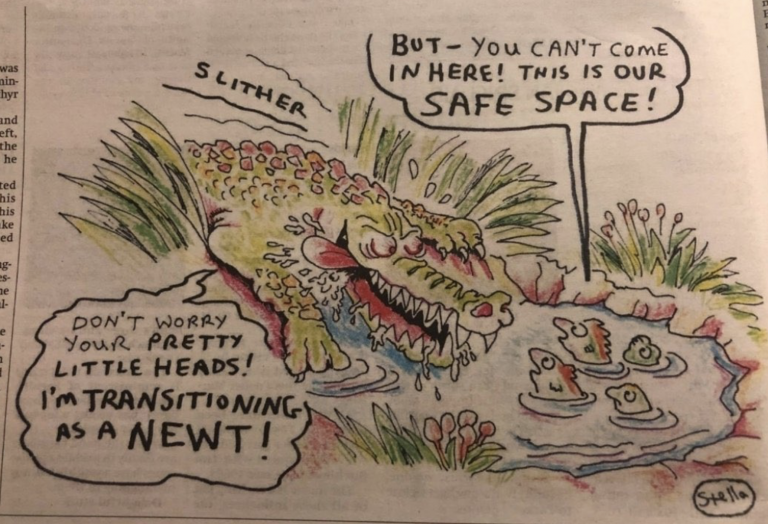
    The Morning Star has decided to prove once again that you don’t have to be right-wing to be hateful towards trans people. This is from the print edition:

    There’s a sour joke among trans people that anti-trans bigots have one joke, which is “I identify as / I’m transitioning to X”. But it isn’t usually portrayed in quite such a vicious manner as it is here.

    NW Durham constituency Labour Party:

    we can’t believe an allegedly socialist newspaper would publish something as vile as this.

    LGBTQ Bristol Labour:

    It heavily borrows from racist propaganda you see in a history book and hope never to see in real life. On a paper funded by unions. We condemn this completely.

    Guardian writer Owen Jones:

    This, in a supposedly leftwing newspaper, is absolutely twisted. The vicious, obsessive and unrelenting campaign against trans people is sadly far from confined to the right.

    This particular publication has been publishing virulently anti-trans stuff for several years now, but what’s different this time is it has apologised. From the website:

    The Morning Star apologises unreservedly for the publication last Tuesday of a cartoon which was offensive to trans people.

    The cartoon had not been authorised for publication and its appearance in the print edition represents a failure to follow our own procedures for approving submissions.

    Maybe it’s true and editorial standards at the Morning Star are so lax that cartoons can just leap into the pages without anybody knowing. But Occam’s razor suggests that what really happened here is that the publication simply didn’t expect a backlash from any cisgender people after several years of running articles saying pretty much the same thing as the cartoon.

    The myth that being trans is a lifestyle choice, that basic rights for trans people put other people in danger, is entirely invented. Here in the real world, being trans makes you a target. This was published this week too:

    BBC: A man has been jailed for setting fire to the home of a transgender woman after saying: “Anyone who is a tranny offends me”.

    Lee Harrison, 43, set light to the front door of her flat after trying to pour petrol through the letterbox.

    The woman’s flatmate, who was in at the time, said she “truly believed she was going to die”.

    Harrison, of Hallowmoor Road, Sheffield, was jailed for more than five years.

    Prosecutor Robert Sandford said the attack on 15 August was born out of a “hostility based around the fact [the victim] was in the process of transitioning from the male to female gender”.

    He said Harrison would call the victim “Steve” in the street and previously told her, “Anyone who is a tranny offends me; it’s a lifestyle choice.”

  • History lessons

    The former deputy editor of the New Statesman, now of The Atlantic, posted this to Twitter:

    There’s a lesson there, but it’s not the one Lewis thinks it is.

    The reason the GRA wasn’t turned into “culture war fuel” wasn’t anything to do with the Blair government. It was because we didn’t have people spending the best part of two years writing endless articles and constantly going on BBC programmes to talk about how it would redefine the word woman, expose children to predators, force children into surgery and all the other nonsense that’s been flying around for the last couple of years.

    That’s not to say people didn’t make those claims. They did. One of the most outspoken opponents was Norman Tebbit, who described gender reassignment surgery as a “practice of sexual mutilation” and tried to wreck the GRA in the House of Lords. Politicians raised concerns about redefining the very meaning of men and women, about trans women dominating women’s sport and about having trans women in female prisons. Tebbit even invoked the spectre of child killer Ian Huntley. Made-up stories about Huntley supposedly transitioning have been used to argue against GRA reform now. Politicians also claimed that trans people were merely suffering from “a serious psychological problem” and that the GRA would bring us into “a dark future of coerced totalitarian-style law making.”

    What’s different today is the media. While the same things were said about the GRA then as about GRA reform now, they weren’t amplified and repeated by the press again and again over a period of years. We didn’t have social media and its troll armies, or publications more interested in garnering web traffic than accurate reporting, or current affairs programmes that considered their mission to deliver “a shot of adrenaline” instead of present facts. That’s the lesson.

    The other point, that the Blair government deserves credit for its introduction, isn’t true either. The Blair government didn’t introduce the Gender Recognition Act because it wanted to. It did it because it had to, because it was breaking the law. In 2002, the European Court of Human rights ruled that refusing to change a trans person’s birth certificate was a breach of their rights under Article 8 and Article 12 of the European Convention on Human Rights. The government’s defeat in Goodwin v UK was a key reason for the introduction of the Act.

    Blair doesn’t deserve credit; trans people didn’t create or propagate this culture war.

    Incidentally, the Gender Recognition Act 2004 effectively undid the damage caused by an older court case, Corbett v Corbett, in 1971. That set back trans rights a great deal because a millionaire, Arthur Corbett, wanted to divorce his wife, April Ashley, without giving her any of his money. By arguing successfully that Ashley, a successful female model, was not and could never be a woman – that penetrative vaginal sex with her didn’t count because her vagina wasn’t there at birth – Corbett was able to get the marriage annulled. Before Corbett v Corbett trans people’s birth certificates were generally changed on the quiet; afterwards, trans people could be and were outed by people in positions of authority, often with awful consequences for their lives and careers.

  • I know I can never be that idealised girl

    There’s a superb piece in Vox by Emily Todd VanDerWerff about the costs of being a trans woman. I found myself nodding in agreement with a lot of it.

    I’ve done exactly this, albeit not quite so expensively: I’m more of a Boots No.7 person.

    The thing about self-acceptance is that when you’re just getting used to it, you become an easy mark. The first time I went to Sephora, I spent way more on makeup than I ever thought possible, because the salesperson who helped me made me feel so good about myself. From the second she learned my name, she called me Emily, even though I was in full guy mode. She used she/her pronouns. She told me I was pretty. I plunked down $250, and I would have spent well over $300 if she had managed to talk me into a $70 foundation. (My wife saved me on that one.)

    To be clear: None of this is the salesperson’s fault. None of it is my fault, either. This is just how society is designed to function, and to come out as trans later in life is to suddenly start careening downhill into a newer, truer gender, without some of the guardrails that snap into place when you grow up cis and figure out the ways society tries to exploit you on the grounds of gender.

    Something I think some of us wrestle with is the conflict between being proud of who we are and being unenthusiastic about getting our heads kicked in. On the one hand we know that we’re being suckered into the same bullshit standards of beauty that cisgender women have to battle against, but on the other we know that if we don’t, if we proudly stride around as ourselves and let stereotypical gender presentation be damned, we’re likely to get screamed at or worse.

    And, as VanDerWerff explains so beautifully, there’s an element of wanting to uphold those stereotypes because they’re still so new to us, because we’re chasing after something we could never have.

    Maybe I run so hard toward becoming that idealized girl because I know I can never be her, due to the circumstances of my birth. Maybe if I run hard enough, I’ll get there and suddenly wake up a suburban mother of two in Omaha, Nebraska. Maybe I wear so many dresses because I really love wearing dresses. Maybe I’m just overthinking it.

    This is one of the reasons I really hate the current anti-trans abuse that plagues social media. Reading this article, so many things were “yeah! I get that!” and “I hadn’t thought of it that way!” and the like; these are conversations I know I could have with other trans and non-binary people I’m connected to online but can’t because of the all-too-familiar and entirely reasonable fear of trolls. There is a small but obsessive contingent of people who monitor what trans people and our allies post online, circulating it to their equally obsessive followers (in many cases, to audiences much, much larger than our posts were published to) to malign, mock and in some cases encourage attacks on us. It would be foolish to give them any more ammunition.

    Here’s an example, albeit an extreme one. Yesterday, the BBC Scotland “The Social” channel – which has around 100,000 followers – re-shared a video it had made featuring a poem by Gray Crosbie. I know and love much of Gray’s work, and this poem was typically wise and interesting: it’s about the difficulties of getting a haircut when the barbers tell you you’re a girl and the salons say you’re a boy.

    Piers Morgan came across it and shared it disgustedly with his seven million, one hundred and fifty thousand, two hundred and twenty followers. Many of his followers sought out not just the BBC Social account but Gray’s personal Twitter account, which has 139 followers, and those people have spent the last two days posting abuse to it. Crosbie, who earlier this month posted about the negative effects on their mental health of social media, has been forced to lock the account to prevent any more abuse.

    It’s targeted harassment, but Morgan – who this week was crying crocodile tears over the death-by-media of Caroline Flack; many of the people posting abuse to Gray were posting “Be Kind” memes just days ago – is cunning enough to maintain plausible deniability. He didn’t specifically tell his millions of followers to go and attack someone. It’s just something that happened, and which has happened many times before, and which will happen many times again, which he pretends he has no control over, and for which he will never suffer any consequences.

    As Emily puts it in another context:

    the world is already cruel, and being trans only ramps up that cruelty… The border between my safety and something horrible is so tenuous, and societal norms dictate that I am the one who’s asked to enforce it

    As ever, the people who are really being silenced are the ones you aren’t reading in the papers or seeing on TV.

  • If this is the fast track, I’d hate to be on the slow one

    The BBC has discovered that many trans people are stuck on waiting lists for so long they have to buy their own medicine from overseas.

    The report, while accurate and worthwhile, also serves to demonstrate that the BBC clearly doesn’t have any trans people or experts on trans healthcare anywhere near the newsrooms it so happily fills with anti-trans activists. This is not a new story, and it’s definitely not a new problem. Long lists forcing people to self-medicate have been a huge problem in the trans community for very many years, and the ongoing trans healthcare crisis is a much bigger concern to us than any reform to our paperwork.

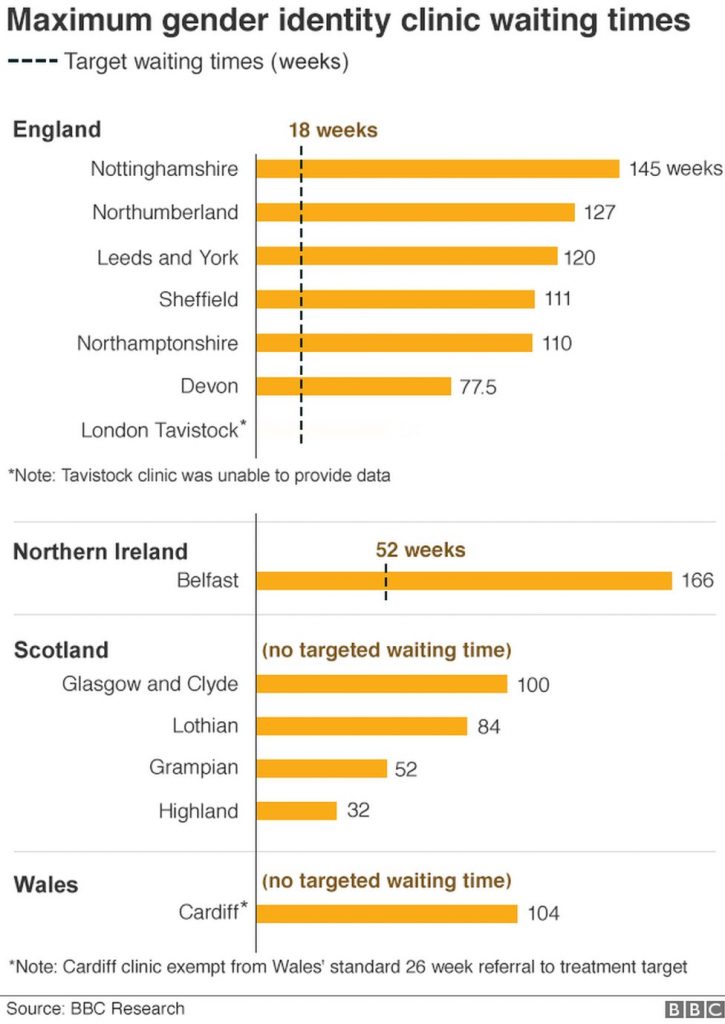
    Here’s the graph showing waiting times.

    These are not times between referral and treatment; these are times between referral and first appointment. To be given any medical treatment such as hormone therapy there are more assessments first. In my own case, they took a further seven months.

    It’s interesting to change the measurements here. Talking about timescales in weeks sounds like a short time, but the 100-week waiting list in Scotland means two years. In Northern Ireland it’s over three years.

    We’re talking here about medication that is proven to be safe, effective and in many cases life-saving; if these waiting lists for initial assessment were for any other group of people there would be outrage. But it’s us, so instead we have to endure endless bullshit in the papers about the supposed fast-tracking of trans people while the reality is the complete opposite. I fear that if there’s any outrage at all it won’t be at the broken system but at the people forced to go outside it.