Category: LGBTQ+

  • Hating for ratings

    How’s this for a TV show? We get a racist – a proper racist, ideally a knuckle-dragger from a really racist organisation such as the EDL or Britain First, someone who’s really loudly and proudly racist and spends loads of time being really racist to people on Twitter – and we pair him up with a nice middle-class Black woman. Then we get the two of them to sit down for a nice dinner and a chat and we film the whole thing.

    Good, right? It’s a social experiment!

    I haven’t even got to the best bit yet. It’s not just a chat. We give the racist guy a script of really racist things to say to the Black woman over dinner and we film her response. Maybe she’ll cry!  Maybe she’ll walk out! Maybe it’ll go viral!

    No? How about we pair a neo-nazi with a nice Jewish lady?

    Of course not. Trying to get a fight for ratings is disgusting, as we saw with the Jerry Springer and Jeremy Kyle shows. But that doesn’t mean TV production companies don’t keep trying to bring back the formula, which is essentially hating for ratings. For example, an Irish TV company is currently sending this to various trans women (and to other marginalised groups, such as members of the travelling community).
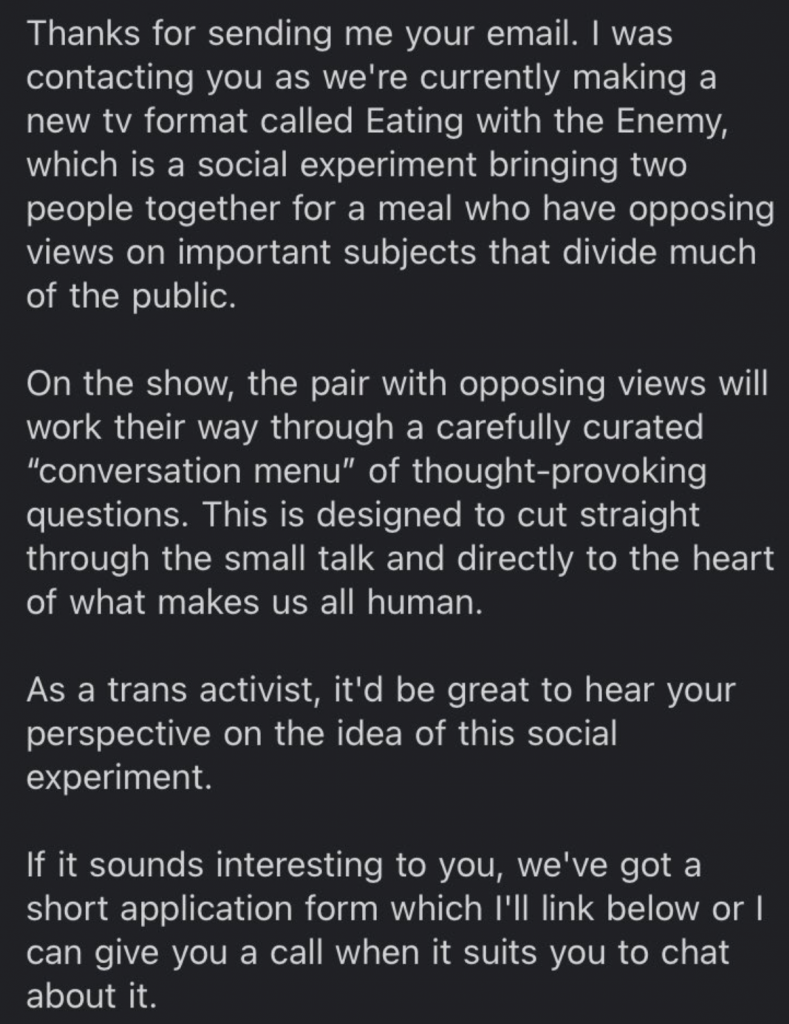
    As one commenter on Twitter translated: “We’re making a show where we have members of marginalised groups sit down with people who think they shouldn’t exist, for entertainment purposes. Also we’re suggesting that marginalised people are the enemy, in the title.”

    Earlier this year Evgeny Shtorn wrote about the importance of storytelling in regards to minority and marginalised people.

    Considering how powerful storytelling is, we cannot pretend that the infrastructure built around it by media and researchers is always ethical and respectful towards those who constitute those stories… journalists were rude to me, disrespectful and abusive. Using my words or ideas without quotes, giving erroneous interpretations and false promises. Trans and non-binary people, homeless people, other migrants, people of colour, people with disabilities and a lot of others who I shared my concerns with, told me that they often experienced similar treatment from journalists, but also from artists, researchers and other ‘supporters’. It is called ‘cognitive exploitation’, and this is exactly the opposite to the idea of the empowerment of the community through storytelling.

    …The problem is that after such an interaction most people retreat into their closet and don’t want to tell their stories anymore, despite those stories being so important to tell.

    There was an example of this in England the other day: trans person and poet Jay Hulme was invited on BBC TV to discuss the government’s response to GRA reform.

    I was going to be on the BBC today having a chat about the GRA – but I pulled out yesterday, having been informed that it’s BBC policy to have a cis woman invited to speak on any segment about trans ppl – I’m not going on TV to be yelled at by a transphobe from the Daily Mail.

    By “cis woman” the policy doesn’t mean a cisgender woman who’s supportive of trans people, even though such women are the majority (and were the majority in the GRA reform consultation too). It means the kind of woman trans commentator Shon Faye was expected to go on air with this week. Faye was one of several trans people invited on BBC Woman’s Hour to discuss gender recognition. At the last minute, the panel was expanded to include an anti-trans activist who has taken great delight in publicly misgendering her and who Faye says even shared a now-deleted defamatory petition implying she groomed children. Faye declined the invitation.

    I have some experience of this. I’ve refused to go on multiple programmes because the approach was clearly going to be gladiatorial, not editorial; other contributors were not people with concerns about specific bits of legalese but members of groups who peddle hatred on social media. Taking part is therefore a trap for marginalised people: if you don’t robustly challenge the other contributors they get to lie, lie and lie some more; if you do, and worse still if you also dare correct the presenter, you’re dismissed as unreasonable and aggressive. And even the most innocuous appearance will have bigots descending on your social media.

    It’s clear that the people commissioning and structuring these programmes are thinking about ratings, not the damage these narratives can do to marginalised groups. And they are doing damage. By presenting extreme views as mainstream, such as perpetuating the myth that the two sides of the trans debate are “trans activists vs feminists” rather than “most of the country vs a few well-connected bigots”, they’re fanning the flames of intolerance and positioning extreme views as if they’re mainstream. We’ve seen this before with the platforming of far-right views, of anti-vaxxers and of climate change denial.

    The problem yet again is that the people making these programmes have no skin in the game. Their human rights are not under attack. Their safety is not threatened by the rise in hate crimes. Their ability to participate in society is not something producers think should be up for debate. To them, it’s just another item. To marginalised and demonised minorities, it’s our lives.

  • Celebs speak out

    Minor celebrities: We must write an open letter to protest against online abuse of women!

    LGBT+ folks: Like the vicious abuse some of your co-signatories and many supporters of your multi-millionaire pal have spent years dishing out to trans women, to the mothers of trans children, to cisgender women who say they support trans rights and to cisgender women who work in rape crisis centres and other trans-inclusive organisations?

    Minor celebs: Not like that!

    PinkNews:

    More than 50 public figures and anti-trans campaigners signed the letter published in The Sunday Times, which condemns the “insidious, authoritarian and misogynistic” opposition to Rowling on social media.

    …the letter claims that Rowling “has consistently shown herself to be an honourable and compassionate person” – just days after the Harry Potter author promoted a website selling “f**k your pronouns” and “sorry about your d**k bro” badges mocking the trans community.

    One of the signatories has been banned from social media for a years-long campaign of hate speech against trans women and any cisgender women who dared disagree with him, a campaign that cost him his career and his marriage; others have been criticised for making transphobic statements that were at best tone-deaf and at worst actively malicious. One of the signatories previously accused a gay journalist who supports trans people of being a “sucker of Satan’s cock”.

    As Judith Butler said in her New Statesman interview the other day:

    if we are going to object to harassment and threats, as we surely should, we should also make sure we have a large picture of where that is happening, who is most profoundly affected, and whether it is tolerated by those who should be opposing it. It won’t do to say that threats against some people are tolerable but against others are intolerable.

  • Trans freedom fighters: a series

    The US edition of The Guardian continues to show how pathetic the UK edition’s coverage of trans people and trans-related issues has become. While the UK edition is still unsure about whether we actually deserve human rights, the US edition is running series telling stories like this one: ‘Our love is radical’: why trans activists lead the way in protest movements.

    Though their legacies have often been overlooked, trans Americans have been central to the country’s battles for justice, from racial equality to anti-fascism.

  • History reheated

    The Sun, 1984. Three decades later and it’s still singing the same song.

  • Right body, wrong configuration

    How often have you heard the phrase “born in the wrong body” about trans people? And how many times have you heard it said by trans people?

    Chances are the first number is much, much higher than the second. That’s because the BITWB trope is primarily used by cisgender people who are writing or talking about transgender people; the few trans people who do use it are typically people who have just come out, have just started making sense of things and are trying to explain something very big and complicated in as simple a way as possible.

    Mallory Moore has put together a good overview of this. As Moore points out, the vast majority of “trans people think you can be born in the wrong body” stuff online is written by anti-trans activists. Whenever I’ve seen it discussed by trans people, it’s to criticise the trope, not to perpetuate it. I don’t think I’ve encountered a single instance of the BITWB trope being used by anybody who’s come out as trans and begun any kind of transition.

    Moore quotes a poem by Elena Rose from 2007:

    I am not a woman trapped in a man’s body. This body is no man’s; it is mine, it is me, and there is no man in that equation. And I am not trapped in it. There are a million and one ways out of this body, and I have clung to it, tooth and claw, despite an endless line of people and institutions who would rather I vacate the premises, and have sometimes been willing to make me bleed to convince me they’re right.

    The trope does have a history, though. When trans healthcare suffered from even more gatekeeping than it does now, trans people knew exactly what was expected from them if they wanted access to any form of transition: if they didn’t turn up looking stereotypically feminine and telling the doc they were trapped in the wrong body, they wouldn’t get any treatment.

    It’s a story we were told to tell gatekeepers in order to qualify for essential treatment and a story early transitioners told the papers, setting a framework that journalists still use today.

    As Janet Mock put it:

    Trapped in the wrong body” is a convenient, lazy explanation but it fails to describe #trans people & our bodies every time… it makes our lives and struggles more palatable to the cis masses, but it is lazy media ‘reporting’.

    Update: The Mermaids charity has posted a blog asking trans and non-binary people whether they use the phrase; some used to and feel it isn’t right; others are perfectly fine with it. It’s an interesting piece. 

  • Some numbers

    18,400

    The number of one-click, template-based responses the UK’s main anti-trans group managed to get its supporters to send to the UK government’s gender recognition act consultation in a three-month period through constant social media activity, expensive full-page print adverts and the support of almost all the UK media.

    125,089 and counting

    Number of signatories in two days to a petition asking the UK government to deliver GRA reform, a petition that hasn’t had any press coverage or advertising support. That’s more people than buy the UK edition of The Guardian.

  • Murdoch papers in “bullshit” shocker

    I don’t want to go on too much about the UK government’s pathetic response to its gender recognition consultation, but I thought it was worth drawing attention to The Times and Sunday Times’ assertions that the consultation was “skewed” by an “avalanche” of responses by “trans rights groups” who twisted the consultation to say 70% of people were in favour of self-ID.

    Here’s a blog by the GRA consultation analysis team.

    We spent a long time with the data and employed a number of advanced analytical techniques to investigate the influence of potential campaigns on the consultation responses. However, we have seen little evidence that supports the view that the results were “skewed” by an “avalanche” of responses from trans rights groups. Furthermore, we are not sure where the reported figure of 70% in favour of self-identification has come from. This question was not directly asked in the consultation and this figure does not arise from our analysis.

    What they did find, however, was that one anti-trans group was responsible for nearly one-fifth of all responses – and unlike the majority of responses from other sources, particularly trans rights groups, these were identical posts created by a one-click online form “which had a pre-populated set of answers”.

    We would like to acknowledge the amount of care, attention and often depth of feeling that went into the submissions that we read, from people and organisations taking a range of positions. There were some long submissions – some over 5000 words -  in response to one individual question, and it was apparent that a large percentage of those who completed the consultation spent a long time writing their answers. We were struck by many of the accounts that people provided detailing their personal experiences or those of loved ones. It is sometimes easy to lose sight, in the arguments that surround GRA reform, that at the centre of this are real people living real and often difficult lives. Due to the need to be brief in order to write a succinct report and the confidentiality required for ethical reasons, the specific stories that were contained within many individual submissions cannot be published. However, reading them, as we have been able to as a team, paints a nuanced and complex picture of the lived experience of people working through these issues in their own lives and the lives of their loved ones.

  • Gender Trouble trouble

    Interviewing isn’t always easy: if you’re poorly prepared or if you’re trying to lead the subject down a road they don’t want to go down, you can easily find yourself getting your arse handed to you on a plate. It happened to me once with Terry Pratchett, a brilliant author who taught me a valuable lesson about the importance of preparation for even the most trivial interview.

    That was mortifying enough, so imagine how it must feel to be publicly owned by an interviewee when you’re interviewing a major figure for a popular current affairs magazine. That appears to be the case in this New Statesman interview with Judith Butler, in which the interviewer attempts to tell Butler what her own work is about. It’s the kind of interview that, as a writer, you read from behind your fingers.

    It’s also really interesting in what it says about coverage of gender:  Butler is a key figure in third wave feminism and her 1990 book Gender Trouble: Feminism and the Subversion of Identity is considered a key text in feminist and queer scholarship. She has a lot of interesting things to say and a body of work going back very many years, but the interviewer seems determined to force her into the JK Rowling vs Evil Trans Activists dialogue so beloved of so much of the UK and US press right now. And Butler is having none of it.

    Butler:

    Let us be clear that the debate here is not between feminists and trans activists… So one clear problem is the framing that acts as if the debate is between feminists and trans people. It is not.

    …It is a sad day when some feminists promote the anti-gender ideology position of the most reactionary forces in our society.

    Interviewer: But people have been nasty to JK Rowling on the internet!

    Butler:

    I confess to being perplexed by the fact that you point out the abuse levelled against JK Rowling, but you do not cite the abuse against trans people and their allies that happens online and in person.

    I disagree with JK Rowling’s view on trans people, but I do not think she should suffer harassment and threats. Let us also remember, though, the threats against trans people in places like Brazil, the harassment of trans people in the streets and on the job in places like Poland and Romania – or indeed right here in the US.

    So if we are going to object to harassment and threats, as we surely should, we should also make sure we have a large picture of where that is happening, who is most profoundly affected, and whether it is tolerated by those who should be opposing it. It won’t do to say that threats against some people are tolerable but against others are intolerable.

    As Max Morgan put it on Twitter:

    If I was this interviewer I would have told my editor that the dog ate the emails and they’d have to run something else.

  • Ding dong, GRA reform in England is dead

    The Westminster government has finally published its response to the public consultation on reform of the Gender Recognition Act. The short version: it’s going to be slightly cheaper to get a GRC and some of the forms will go online. There are no significant changes otherwise.

    This is for England and Wales; officially at least GRA reform is still possible in Scotland, so there will be no let-up in the hate campaigns against trans people. I suspect things will get even worse as they attempt to pressure the Scottish Government to follow the English example.

    It’s interesting to note that despite the supposed “swamping” of the consultation by trans “activists”, just 7,000 of the 102,800 responses – responses that were overwhelmingly in favour of reform by a much bigger margin than, say, the Brexit vote – were from trans people. Nearly 19,000 responses were one-click template-based submissions from a single anti-trans group. As ever, the discussion was primarily about us, without us.

    As you’d expect from a Government minister, there are some dodgy claims in Liz Truss’s statement.

    We have also come to understand that gender recognition reform, though supported in the consultation undertaken by the last government, is not the top priority for transgender people.

    Just because the government treats trans people even more hellishly in other parts of the system doesn’t mean legal gender recognition doesn’t need reformed.

    Thirty-eight per cent told us the process was too bureaucratic. So we will place the whole procedure online.

    Being able to upload deeply personal reports instead of posting them doesn’t make the process any less bureaucratic and it certainly doesn’t make it any less humiliating. The gatekeeping, the requirement to have medical reports and the paperwork you must provide to a faraway panel haven’t changed. Even the BMA says doctors shouldn’t be involved in this process.

    Trans people tell us that waiting lists at NHS gender clinics are too long. I agree, and I am deeply concerned at the distress it can cause. That is why we are opening at least three new gender clinics this year, which should see waiting lists cut by around 1,600 patients by 2022.

    This is nothing to do with the GRA consultation and Truss is claiming credit for decisions made by NHS England several years ago.

    It’s a sad state of affairs when “we’ll make the process slightly cheaper” counts as a victory. But ultimately nothing has changed but the price tag. There’s no change to the Equality Act or its guidance, and the role of a GRC has not been changed (it’s still irrelevant to what spaces we can access or where we can urinate). It’s not going to be any easier to get a GRC than it has been for the last sixteen years, so all of the antis’ “reasonable concerns” have been addressed. They can finally pack up and go home. Right?

    Maybe I’m cynical. Maybe now that the UK government has decided not to change anything, the groups created solely to fight against GRA reform will close their campaigns, disband their organisations and take the hundreds of thousands of pounds they’ve crowdfunded from dodgy donors and give that cash to organisations that help vulnerable women.

    Maybe.

    Or maybe, just maybe, GRA reform was only ever a fig leaf for their real motives.

  • “Do they really believe this garbage?”

    Journalist Jane Fae writes on Medium about the bogeymen and women the press likes to call “activists”.

    Just last week, for instance, Gillian Phillip kicked off in the Mail about the “violent, hate-filled language that has become chillingly familiar to anyone who has had the temerity to question the prevailing orthodoxy of the transgender activist brigade”. Meanwhile, over in the Times, James Kirkup contributed a piece that totally lived up to its headline: “Trans activists hate Rowling because she’s a woman”.

    Catherine Bennet was at it in the Observer this weekend too, arguing that anybody who criticised JK Rowling – a hugely significant cultural figure whose views are taken very seriously by very many people, and whose books were very important to many trans people  – but not the aforementioned Kirkup – an insignificant arse who’s made a career of having bad opinions for money – is a woman-hating misogynist.

    There’s no middle ground in any of this coverage. Any trans person with the slightest opinion on anything is portrayed as ISIS in makeup. Trans people aren’t allowed to talk about the vicious abuse they get simply for being trans, usually in the wake of yet another anti-trans blog post or column. Trans people as vulnerable? As victims? As too scared to leave the house because they’re expecting to see the transphobia from the papers reflected in other people’s eyes? That doesn’t fit the narrative. All trans people are violent, hate-filled activists. Never people.

    It’s the oldest trick in the book: portray the other as a monolithic bloc where the opinion or actions of the very worst extremes are presented as the opinions and actions of all. It’s known by many names, but the one I think suits it best is the Klan Fallacy: because one black person committed a crime, all black people are criminals and it’s okay to be a racist piece of shit.

    Why do they print this stuff? For starters, it allows commentators to put the boot into minorities without appearing to do so. Who us? Having a go at trans people? Or black people? Or any other sort of people? Nah. We’re just calling out the bad ones.

    The definition is infinitely flexible.

    If you want to demonise a whole group of people, you can absolutely go on Twitter and find some hothead. That hothead might not even be trans – the person behind the supposed bomb threat from trans activists, a story Fae writes about in the article, was a right-wing cisgender teenage gamer from the US trying to stir some shit against trans people – but that doesn’t matter. The columnist’s feelings don’t leave any room for facts.

    Trans activists: the “trans lobby”, cabal, ideology; these all furnish a target and an enemy to fight against. Much easier than owning to the fact that your own position is itself fundamentally ideological — often evangelical Christian, occasionally a reductive and back-to-the-stone-age feminism. Sexier, too than admitting that your primary goal is to resist minority demands for basic civil rights.