Category: LGBTQ+

  • A terrible thing that didn’t happen

    On Saturday, the Daily Mail published a made-up story about something that didn’t happen. I know that is hardly news, but neither was the story. It’s just yet another made-up piece trying to spread fear of trans people, the kind of thing that ends up being quoted by politicians who want to remove our healthcare and human rights.

    The article isn’t so much a red flag as a flag shop that only sells red flags and that just got a big stock delivery from the red flag distributor. According to Tory councillor Ruth Sampson, she was in the ladies toilet of a pub when she had a conversation with a trans woman (who “towered” over her) about the absence of paper towels to dry their hands.

    The key assertion in the story is that in the absence of towels, the woman told the councillor that “I’m going to wipe my hands on my penis.” This, according to the councillor, is definitely a thing that actually happened, and it therefore proves that trans women should be excluded from the ladies and all other facilities they are legally entitled to use. To undermine this, said councillor immediately wrote to anti-trans Tory equalities minister, Kemi Badenoch, rather than speak to the police, because that’s what you do, isn’t it?

    Unfortunately for the councillor, the trans woman concerned read the article too. And her side of the story is somewhat different. She had been attending a vigil in memory of a murdered trans girl, went to a pub afterwards, and in the bathroom conversation in question she said “oh, well I’ll just wipe my hands on my jeans then”, left, and thought nothing more of it.

    Which one do you think is most likely? That a trans woman, sad from a vigil and going about her everyday business, would decide to try and intimidate a random woman for no reason? Or that a young, grasping Tory councillor thought she’d try and raise her profile among her fellow Tories with a bit of the old transphobia that seems so popular among her elders?

    The article is a case study in subtle demonisation and defamation. She won’t face any consequences for adding to the anti-trans panic, and because the trans woman isn’t named the press regulations mean the Daily Mail won’t either. It’s all grist for the mill that wants to grind trans people into dust.



  • The Onion nails it again

    When The Onion strikes, it strikes hard.

    It Is Journalism’s Sacred Duty To Endanger The Lives Of As Many Trans People As Possible

    We just made Quentin up, and that’s okay. It doesn’t mean stories like his aren’t potentially happening everywhere, constantly. Good journalism is about finding those stories, even when they don’t exist. It’s about asking the tough questions and ignoring the answers you don’t like, then offering misleading evidence in service of preordained editorial conclusions.

  • RIP, Brianna

    This is a photo of Brianna Ghey, the 16-year-0ld girl who was stabbed to death at the weekend. She was trans, but the newspapers didn’t know that at first – and when they found out, the Times went back through its news story about her and removed every reference to her being a girl.

    As journalist Mic Wright points out, it’s notable that the reporting of this particular murder – of a young, pretty, photogenic, white teenage girl – has not been reported in the same way the murders of other pretty young white girls have been.

    It’s possible to believe — and I do — that there are two terrible and cruel things at work here: Newspapers are both obscuring the relevance of Brianna’s identity and discussing her being trans in the worst possible way by deadnaming her and making other insinuations.

    We don’t yet know why Brianna was killed; the police are currently investigating whether it was, as seems likely, a hate crime. Whatever the explanation, the response within the LGBT+ community is one of absolute heartbreak. We have been trying to warn about the rising tide of anti-trans hatred in the media and online, and how that hatred is manifesting itself in the streets: hate crimes have skyrocketed, particularly against trans people, and against trans women and girls in particular.

    We’re heartbroken not just because of the senseless loss of life. We’re heartbroken because for years, we have been telling you that this is the inevitable outcome of demonising, defaming and scaremongering about trans people. The so-called gender critical people pretending to be sad about her death are only sad because it’s bad optics for their movement. They’re crying crocodile tears, because this is exactly what they want: fewer trans people. Trans people are very familiar with people urging them to kill themselves, with people trying to prevent them from getting the healthcare that’s proven to reduce mental distress, with people urging others to take action to prevent them from existing safely in society.

    As Helen Joyce, writer of the utterly disgraceful Trans and one of the UK’s most prominent anti-trans activists has said, trans people – all trans people – are “a huge problem for a sane world” and we must reduce their numbers. It looks like she’s getting her wish.

  • “Forbidden knowledge”

    One of the many frustrating things about the current anti-trans moral panic is that supposedly reputable journalists are fuelling it with bad faith “just asking questions”, the answers to which are easy to find.

    This damning piece about the New York Times is just as appropriate to many other publications, including most of the UK press.

    “The ordinary liberal reader may be squeamish about this or that aspect of abortion, but they are fundamentally committed to the idea that abortion patients and their doctors are the ones best equipped to figure out what to do with a pregnancy. It is not the job of some outside party or institution—a controlling parent or spouse, a church, a Republican legislative majority, a major national newspaper—to step in and second-guess what they do with their bodies. 

    For trans care, this liberal theory of autonomy and decision-making is cast aside. The theoretical Times reader is ready to consume 15,000 words about the risks, controversies, and downsides of contemporary gender treatment because, at bottom, they are assumed to be dismayed by it all. An abortion patient is really pregnant, but trans youth—children who “say they’re transgender,” as the Atlantic put it back in 2018—maybe aren’t really trans, or wouldn’t be, if they had more time and better information.”

  • Honesty

    We’ve been trying to tell you for a long time that the goal of anti-trans activism and legislation is to eliminate trans people from society and to prevent trans people from transitioning. And one of the reasons we know that is because the anti-trans activists and legislations make it very clear that that’s their goal.

    In a new New York Times article, one of the key figures behind that activism and legislation admits it. Terry Schilling, leader of the American Principles Project (which has been working in tandem with the Alliance Defending Freedom, one of the key drivers of anti-trans cases in the UK) put it baldly:

    Mr. Schilling, of the American Principles Project, confirmed that his organization’s long-term goal was to eliminate transition care. The initial focus on children, he said, was a matter of “going where the consensus is.”

    One of the most frustrating things about this whole movement is that they’ve never made a secret of their aims or their strategy: it’s been publicly documented (by the anti-trans movement) since evangelicals’ conferences and strategy documents back in 2017. And there’s similar honesty in the Women’s Declaration, which has been signed by most of the high-profile anti-trans activists and groups in the UK: it describes legal recognition of trans women as “discrimination against women and girls” and demands its “elimination” in service provision and in law.

    As Mallory Moore points out, “The Women’s Declaration is unambiguously a document for the abolition of trans people’s civil rights… It was written by Maureen O’Hara, Sheila Jeffreys (who has openly described trans women as “parasites”, and regularly as perverts and various other epithets), and Heather Brunskell-Evans (who is a major backer of antisemitic theories about the funding behind Transgenderism).”

    When people show you who they are, believe them.

  • Twenty-eight

    I’m one of the contributors to a new book, Twenty-Eight, which looks at the impact of the hateful anti-LGBT legislation that lasted from the late 1980s until the early 2000s.

    It’s generally agreed that Section 28 was a terrible stain on our history, but what people tend to forget is that the majority supported it. As Scott Cuthbertson of LGBTI Scotland recalls:

    Not a single poll supported the repeal of Section 28. That’s because a millionaire and the media collaborated to create a moral panic. Now the vast majority of the public are horrified that they ever treated LGBT people that way.

    He notes that in 2000, the year Scotland repealed the law (England was a few years later), a poll for the Daily Mail found that 54% of respondents wanted to keep the legislation in place.

    Many of the pundits and publications that contributed to the moral panic over LGBT+ people then are doing the same now.

  • No rush

    Countering the constant flood of anti-trans bullshit is a Sisyphean task that many of us simply haven’t the time or energy to deal with, but a particularly egregious example is doing the rounds right now and it’s important to debunk it.

    The lie: the Scottish gender recognition reform bill was rushed through by the Scottish Government.

    The reality: as Nancy Kelley from Stonewall demonstrates, this is one of the most consulted on bills in Scottish Parliamentary history.

    • 5 years and 2 months of discussion and debate
    • 3 large scale consultations, amassing over 43,000 responses with a large majority in favour of reform
    • 67 hours of parliamentary debate and evidence gathering (during which anti-trans groups did not provide any evidence to substantiate their lurid claims)
    • 25 hours of parliamentary debate on proposed amendments at stage 3
    • A clear parliamentary majority in favour of reform at every stage of the bill

    As Kelley writes:

    This is one of the most consulted on bills in Scottish Government history. This is democracy and devolution in action. This is implementing a fundamental human right for trans people in Scotland. To consider triggering a constitutional crisis to block it is shocking.

  • It was never about sports

    This, by Erin Reed, is a good analysis of the Alliance Defending Freedom’s war on trans people and its use of a gullible/complicit media.

    A ban on gender affirming care is not the endgame here. With attacks on gay people rising through book bans and Don’t Say Gay or Trans bills, all LGBTQ+ rights are in the crosshairs. Terry Schilling of the American Principles Project makes that clear when he claims that the debate over gay marriage was a sham and that “essentially we went from Obergefell and gay marriage to now sex changes for gay minors, hormone treatments, and puberty blockers.”

    The ADF is a key driver of the anti-trans movement in the UK and in Scotland too, with its representatives given columns in the Scottish and national press without any explanation of who they are and what they represent; they typically provide witnesses in anti-trans legal cases too, such as the (now reversed) ban on puberty blockers in the UK.

    The anti-trans movement in the US is a Christian Right assault on LGBT+ people. And so is the UK one, although it tries to convince itself otherwise. Whether it’s Scottish Nationalists standing with the right-wing Christian fundamentalists, bored millionaires publicly supporting avowed anti-feminist Christian theocrats or self-proclaimed left-wing writers throwing themselves into the warm embrace of the Daily Mail, The Times and The Telegraph, anti-trans bigots in the UK are doing the work of the religious right.

    A key part of the Christian Right’s strategy is to frame trans people’s basic human rights as a “debate”, in much the same way creationists pushed the idea of “teaching the debate” as a way to get fundamentalist religious beliefs into classrooms. As Katelyn Burns writes in Xtra, that “debate” is no such thing: it’s a constant barrage of anti-trans propaganda. Whether due to malevolence or incompetence, supposedly liberal journalists are doing the devil’s work.


  • “How come you never thought it before?”

    There’s an article in today’s (Glasgow) Herald claiming that a ban on conversion therapy will “criminalise parents”, throw psychotherapists in prison and have you arrested if you question your child’s gender or sexuality.

    It’s nonsense, and it’s based almost entirely on baseless claims by the Christian Institute – the same Christian Institute that the same newspaper described as anti-LGBT “Christian Fundamentalists” in 2017 when it had yet to join the anti-trans culture war.

    As The Herald reported back then:

    The charity has previously campaigned against gambling, abortion, euthanasia and homosexuality, opposing same sex marriages and seeking to raise the age of consent. The charity once produced an organ-donor style plastic card that read: “In the event of my death, I do not want my children to be adopted by homosexuals”.

    None of that context is in today’s piece, despite being extremely relevant. It’s almost as if that’s a calculated editorial decision.

    This column, from the Belfast Media Group, is doing the rounds today although it was published last summer.

    if you are indeed one of those suddenly convinced that the trans issue is desperately worrying, ask yourself this question: How come you never thought it  before?

    Is it a coincidence that you suddenly started thinking and fretting about it at exactly the same time as the Tory press started to fixate upon it at a time when the Conservative Party is in dire trouble?

    You never cared about trans women in toilets, even though they’ve been there for decades and never did you any harm. You never cared about trans women athletes because they’ve been competing in the Olympics for 20 years. You’re only worried about them now because the right-leaning media is telling you to. Last time it was migrants. Time before that teachers. Time before that junior doctors. Time before that judges. Time before that people on benefits. Time before that gay people and HIV. Time before that… 

    When we do ban conversion therapy, like so many other countries have done and will do, it’ll become very clear that the fundamentalists lied. But don’t forget who passed them the mic to spread those lies.

  • There were no signs

    (Content warning: slurs)

    Many LGBT+ people who’ve come out have been told by friends or family, with some bafflement, that there “weren’t any signs” that they were gay or trans. And I think that’s really interesting, because I think there are two main reasons for that. The first is that the signs people expect are often based on stereotypes. And the second is because many people – not all LGBT+ people, but many of us – make damn sure we don’t reveal who we are if we haven’t come out.

    Let’s start with the stereotypes. When the only LGBT+ people portrayed in the media are from a particular mould – trans women but not trans men; straight trans women who fancy men but not gay trans women who love women; gay men who are hyper-camp but never gay men who are hyper-masculine, and so on – then many LGBT+ people simply don’t match the stereotypes people expect us to be. And in the case of trans women there’s the added confusion of drag. How could I have been trans when I didn’t spend my teens strutting down the high street dressed like RuPaul and destroying the locals with my savage drag queen wit?

    If those are the signs you’re looking for, then no. There were no signs.

    But there’s more to it than that, I think. It’s something Zoe Violet writes about in this poem for Tacoma West, “When you come out as trans and your mom says ‘there were no signs’”. Here’s an extract:

    But of course, there were no signs
    There were no signs because
    She was the city planner
    She was the civil engineer
    …She plastered you with circles and arrows
    Posted warnings and named all the places

    This isn’t exclusively a trans or LGBT+ thing, of course. As a parent I’m acutely aware that I’m the town planner and enforcer of my kids’ environment, and there are all kinds of ways in which I can make it clear what is and is not acceptable. And words are only a small part of it. What we do can undermine what we say: for example, a friend of mine was told through her early teens that no matter what she was going through, she could talk to her mum about it free from judgement or censure. And when she told her mum she’d started birth control before turning 16, her mum went ballistic. She didn’t confide in her mum ever again.

    It’s not usually that blatant, though. It’s something we tend to absorb by osmosis. It’s in how the people around us react to things, such as a boy wanting to wear nail polish or a girl who doesn’t want to do stereotypically girlish things. It’s in the jokes others tell and the sitcoms they laugh at, the churches the kids are taken to, the clothes allowed and the behaviours discouraged, the newspapers bought and the books left lying around, in the conversations kids overhear and in the phrases they learn (man up, be brave, boys don’t cry, good girls don’t, if you don’t stop crying I’ll give you something to cry about), in the friends on the approved list and the ones excluded from it.

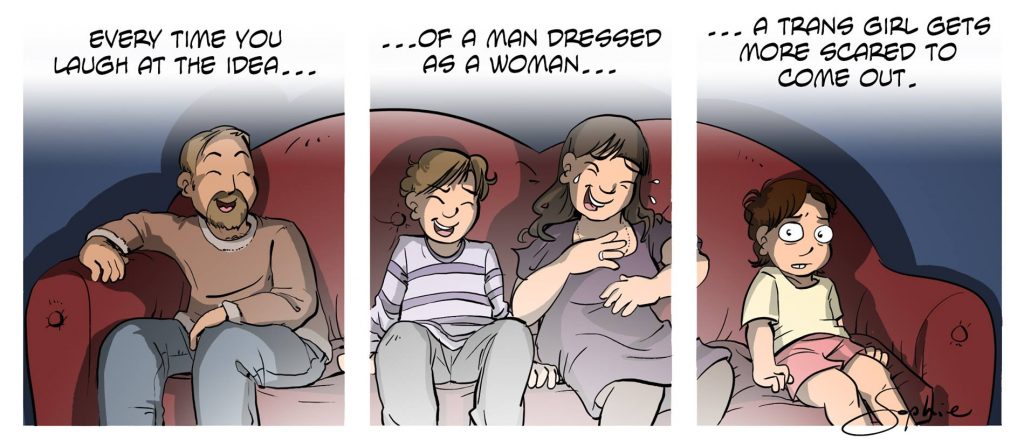
    As the cartoonist Sophie Labelle put it, every time you laugh at the idea of a man dressed as a woman, a trans girl gets more scared to come out.

    Cartoon by Sophie Labelle: every time you laugh at the idea of a man dressed as a woman a trans girl becomes more scared to come out

    And then there’s school. As Michael Franti of rap group The Disposable Heroes of Hiphoprisy wrote in The Language of Violence:

    The first day of school was always the hardest
    The first day of school, the hallways the darkest
    Like a gauntlet the voices haunted
    Walking in with his thin skin, lowered chin
    He knew the names that they would taunt him with
    Faggot, sissy, punk, queen, queer
    Although he’d never had sex in his 15 years

    Collectively these are the circles, arrows and posted warnings of Violet’s poem: they set out the territory we inhabit and tell us where the boundaries are. Some people become enforcers of those boundaries, and others become their victims. At school, LGBT+ people are much more likely to experience bullying; outside of it, they are much more likely to experience hate crimes, sexual assault and discrimination of all kinds. In our cities, LGBT+ people account for a disproportionate number of homeless people; they’re more likely than straight, cisgender teens to be made homeless by their parents or to be fleeing parental violence.

    You don’t need to have experienced these things directly to understand them. When every road and every junction is plastered with warnings, you know very well what might await you should you fail to follow the permitted path – or if you show any signs that you might be considering a different route.