Category: LGBTQ+

  • Words as weapons

    A new study from Germany adds more evidence that violent online speech leads to violent attacks in the streets. The Economist:

    A paper by Karsten Müller and Carlo Schwarz of the University of Warwick finds a strong association between right-wing, anti-refugee sentiment on German social-media sites and violent crimes against refugees.

    For every four anti-refugee posts on Facebook, there was one additional anti-refugee incident. According to the Economist, “This relationship appears to be driven by violent crimes such as arson and assault, and cannot be explained by local social-media usage or demography.”

    Correlation is not causation, I know. But we’re well aware of the power of propaganda and its association with violence. So it’s hardly surprising that the same connection is apparent in other forms of hateful speech. For example, if you plot the number of anti-trans articles in the UK press and the number of anti-trans hate crimes reported to the police in the same period, the curves are strikingly similar.

    This, by Joshua Foust back in 2019, is very relevant today.

    While I do think we still don’t understand the precise mechanism by which someone shifts from believing abhorrent ideas to acting on them, there is copious research demonstrating that abhorrent beliefs do lead to increases in ethnic violence. If a belief system is encouraging of violence and dehumanization then it has to be considered alongside the violent actors who say it inspires them.

    Foust begins by writing about Anders Breivik, whose manifesto famously referenced Daily Mail writer Melanie Phillips multiple times, but expands his article more widely:

    I think we need to take a few moments to understand how, as the debate over hate speech is manipulated in profoundly bad faith by right wing public intellectuals, the proliferation of hate speech is having a measurably bad effect on us as a society. And, realizing that, I’ll also discuss why placing faith in internet companies to fix the problem absolves everyone else of the need to act… we have to take responsibility for the sort of language we will tolerate, whether online or in more traditional media.
  • Red flags

    On Friday, 27-year-old Travis Ikeguchi murdered a 66-year-old mother of nine, Lauri Carleton, because he took exception to her shop’s Pride flag. According to US police he tore down the flag and hurled homophobic slurs before killing her in cold blood.

    Ikeguchi’s social media is still available to view, and it’s interesting to see how much he has in common with the leading lights of the UK anti-trans movement: he’s clearly a big fan of self-proclaimed theocratic fascist Matt Walsh, who JK Rowling recently praised on Twitter, and some of his posts share the same inflammatory rhetoric as the “groomer” posts by everybody’s favourite failed comedy writer. “We need to STOP COMPROMISING on this LGBT dictatorship” is fairly typical.

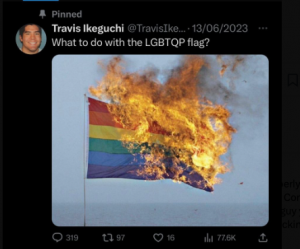
    Travis Ikeguchi's pinned Tweet from June 2023 showing a pride flag burning and describing it as the LGBTQP flag
    Travis Ikeguchi’s pinned Tweet from June 2023

    What’s also clear is that this killer was radicalised online, and that social networks didn’t do anything to stop it. On Twitter, Ikeguchi posted an image of a burning Pride flag with the caption “What do to with the LGBTQP flag?”. The addition of the letter P to denote paedophiles is a right-wing slur like the “groomer” slur, and burning or defaced Pride flags are a trademark of the “anti-woke” and so-called gender critical movements. When @medic_russell reported Ikeguchi’s post as hate speech, Twitter told him that “there were no violations of the Twitter rules in the content you reported”.

    That’s not a surprise. Travis Ikeguchi’s anti-Pride rhetoric is not significantly different from the anti-Pride rhetoric espoused by respected members of the so-called gender critical movement, so for example on his Twitter feed he reposted Jordan Peterson, who was sharing a baseless Daily Telegraph article about schoolchildren identifying as cats. Twitter generally doesn’t have a problem with abusive rhetoric around the Pride flag: for example, a tweet implying that trans women are violent men, demanding the removal of the “TQ” from the Pride flag and captioned “GET YOUR SHIT OFF OUR FLAG” apparently didn’t break the rules and was proudly shared by JK Rowling, not previously believed to be a member of the community “OUR FLAG” belongs to.

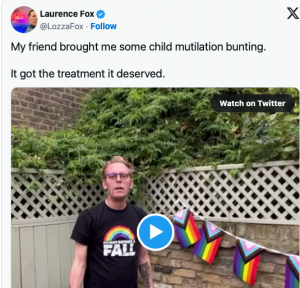
    Similarly when Helen Joyce posed with a pride flag from which the arrows representing trans people and people of colour had been cut out and trodden upon, Twitter didn’t think that was against the rules either. When minor actor turned anti-woke arse Lawrence Fox burned Pride flags in his back garden, flags he called “child mutilation bunting” before adding that “[Pride] isn’t pride. It’s just a celebration of the mutilation of children”, Twitter felt that was just fine. The post is still up.

    Anti-trans tweet reposted by JK Rowling in March 2023
    Author Helen Joyce poses proudly with a vandalised pride flag in 2022
    Photo shared by Helen Joyce on Twitter in 2022
    Actor turned culture war goon Laurence Fox burns pride flags in his back garden
    Laurence Fox on Twitter, June 2023

    Violent imagery and violent rhetoric begets violence. And while we don’t have the US gun culture that led in part to Lauri Carleton’s death, we do have the violent homophobia and transphobia that helped radicalise her murderer. And that leads to violence here too. Just last week two men were stabbed outside a London gay bar in what appears to be a hate crime; we’re awaiting the trial of the murderers of teenage trans girl Brianna Ghey, whose death also appears to be a hate crime. In March a gay man was beaten by a gang of youths in Bournemouth because he was holding hands with his husband;  in July a Birmingham estate agent was jailed for a similar attack in which he attacked a gay couple with a glass bottle and a metal pipe.

    There’s not a single day that passes where my news feed doesn’t contain stories of hate crimes perpetrated against members of the LGBTQ+ community, usually by straight men, usually because they have convinced themselves – or more likely, been convinced by others – that LGBTQ+ people are evil, perverted and dangerous. The people who push this rhetoric are not typically the ones who act on it. But they have blood on their hands just the same.

  • “Oh, you know the ones…”

    Graham Linehan, the comedy writer who sacrificed his marriage and his career so he could hurl abuse at trans people and their allies on the internet all day, has been all over the press in recent days. But the only piece worth reading is this one, by Caitlin Logan in The National.

    Some of the explanations for the ­cancellation offered in mainstream news publications include: “concern about Mr Linehan’s views on transgender issues”; his “views on sex and gender”; and his “gender critical beliefs”. This just in: wolf banned from cottage for “Little Red ­Riding Hood critical beliefs”.

    I’m reminded of Andrew Lawrence’s joke about the conservative who claims they’ve been cancelled for their “conservative views”.

    Con: I have been censored for my conservative views!
    Me: Holy shit! You were censored for wanting lower taxes?
    Con: LOL no… no, not those views
    Me: So… deregulation?
    Con: Haha! No, not those views either
    Me: So, which views, exactly?
    Con: Oh, you know the ones

  • A rook-y mistake

    I thought the panic about trans women in sport had reached its nadir when they banned us from badminton, but I was wrong: this week, trans women were banned from the famously physical endurance sport of… chess.

    I’m not making this up.

    The reason elite international chess has some gendered categories is for positive discrimination; there’s a huge drop-off of girl chess players around the age of 13, and there’s a lot of evidence that where boys are steered towards the game, girls are steered away from it. It’s not a biological issue but a social one. The gendered categories are designed to boost inclusion of people who are not cisgender men, which of course is a category that should include trans women.

    It’s interesting to note that while yet again there are no actual cases of trans women being a problem in this sport, there are currently multiple allegations against straight cisgender male chess players, including grand masters, with credible claims detailing misogyny, sexism and sexual assault of women players.

    What’s particularly galling about this is that the self-proclaimed “feminists” who support trans exclusion are all over this with claims that yes, trans women should be excluded, not because of physical strength this time but because of course, women’s brains are inferior to men’s. If you’re born in a female body you get a little lady brain, they argue, and that means you need your own special lady-brain category in chess so that the big strong clever men don’t win with their big science brains and make you go boo-hoo.

    I despair, but the little bit of me that’s still optimistic hopes that this will finally make people appreciate the bigotry behind trans sporting bans: the science has not changed but there has been a seemingly daily parade of sports lining up to ban trans women. That’s particularly true in England, which seems second only to Russia in its race to exclude trans women from everything. It does make you wonder what conversations are going on behind the scenes between the sporting bodies and Sport England, the government agency that funds so many of them.

    Update, 21 August:

    Some interesting developments here: the English, German, French and US chess governing bodies have rejected the policy set out by FIDE, the International Chess Federation; the German Chess Federation (FSB) issued a strongly worded statement making it clear that they believe the policy is discriminatory, probably illegal and utterly unwelcome.

    The president of FIDE is Arkady Dvorkovich, former deputy prime minister of Russia and a friend of Vladimir Putin. This isn’t the first time he’s been accused of using FIDE to advance Putin’s political aims; earlier this year the European Chess Union’s vice-president accused FIDE of running a “soft power game” that was being “directed by the Kremlin”.

    It’s clear that FIDE is at odds with most national chess governing bodies. And that makes the so-called feminists loudly supporting its policy look even more repellent as they stand proudly against chess players and with Vladimir Putin. But then, there’s a precedent here: in 2022, Putin praised JK Rowling and claimed that Russia was a victim of cancel culture. So he’d fit right in at a UK anti-trans event.

  • Tory in “lying” shocker

    I’m trying not to pay too much attention to the Tories’ culture war bullshit, of which a thinly disguised bathroom ban appears to be the current unlawful idea, but it’s always worth pointing out when ministers tell very obvious lies in support of their bigotry. Like this one, written in yesterday’s Telegraph by equalities minister and Satan’s little helper Kemi Badenoch:

    A decade ago, there was no need to clarify who could use which toilet.

    That’s a lie, and Badenoch knows it. The Equality Act was passed without alarm 13 years ago and clarifies exactly that. And the supposed woke push for gender-neutral toilets in schools that she rails against in the article was actively encouraged by, er, the Conservative government back in 2007 via the Department for Education. Here’s a BBC article about it.

    Here’s a more correct version of Badenoch’s line:

    A decade ago, far-right politicians and the press weren’t waging a war on trans women.

  • “We’ve been TERFing and it’s so much fun”

    In my book, I write briefly about a significant subset of the anti-gender movement: the “bored straight white women who spend too much time on social media and have taken up bullying as a hobby, claiming to be ‘the granddaughters of the witches you couldn’t burn’ and trying to incite stochastic terrorism against inconvenient women like me.”

    There was a good example of just that on social media over the weekend, as two bored and presumably straight white women shared a video of their excitement over their two-person protest outside an English Costa Coffee shop. Costa is the current boycott target of the UK bigot brigade because at a Pride event over a year ago, it hired a trans artist to paint an inclusive picture that featured a trans man. To bigots, this is a bat signal.

    What’s notable about the video isn’t the hypocrisy of people who claim “TERF is a slur” happily saying they’ve been “out TERFing”, although that’s there. It’s the visible joy. There’s no pretence of “reasonable concerns” here, no desire to protect anyone from anything. It’s that to these women, being visibly and vocally hateful towards a minority is like a trip to the garden centre: a fun thing to do at the weekend; a jolly good day out.

  • To know me is to love me

    One of the things I write about in my book is that transphobia largely relies on people not knowing, or not thinking they know, any trans people. I make a very good joke about it that you’ll need to buy the book to read. And the same point is made in this report from LGBT Nation, which talks about polling that demonstrates intergroup contact theory. The short version is that if you know trans people, you’re much more likely to oppose hateful anti-trans legislation.

    This is why they want to ban books about or by us, and why they want to erase us from public life. Because as the cliché goes, to know us is to love us.

    Transphobia is classic fascism: we are the out-group against whom the in-group is mobilised, the outsiders the insiders are told to hate and fear. And to maintain that, you need to maintain the fiction that we are a dangerous, sinister “other”. Knowing us, hearing our stories, seeing us do ordinary things… that’s something to be prevented at all costs.

    This week’s right-wing shitefest (or at least, the loudest one so far; I’m writing this on Tuesday) is over the inclusion of Hari Nef (above), a very beautiful trans actress, in the Barbie movie. Her transness isn’t referenced in the movie at all, and there’s no indication as to whether her character – which, it’s important to note, is a plastic doll – is cis or trans. These giant babies are throwing tantrums purely because a trans woman has a job.

    It’s very telling that in the photos many of these ludicrous attention-seeking bigots are sharing in their outrage, they frequently point to a completely different, cisgender, actress as they cry “we can always tell!” So far I’ve seen almost all of the film’s cast identified as trans women or trans men, including the very famous and very cisgender actors Margot Robbie and Ryan Gosling.

  • What need is this meeting?

    This article, by Doc Impossible, talks about something I think we often shy away from: the role of kink in trans people’s self-discovery. As the Doc writes, many people have asked the question: it’s just a fetish, right?

    This hopeful, terrified question that bears so, so much weight. Hopeful because, to the person asking the question, if it is just a fetish, it can stay in the bedroom, just be this weird, small part of you that nobody else needs to know about, that never needs to be acknowledged, that doesn’t need to have any power over you or your life.

    As the Doc explains, most people have a kink of some kind: one in two are into BDSM, one in seven have a foot fetish and so on. And many trans feminine people who haven’t worked out that they’re trans yet believe that they too have a kink. And maybe they do! But maybe it’s more than that.

    Indulging a kink is vastly safer and more private than coming out and transitioning. So, to a subconscious mind that’s trying to keep you safe and alive, it’d make an awful lot of sense to sort of lunge toward kink when it works to sublimate that need.

    The Doc suggests asking another question: what need is this meeting? Or to put it another way, what needs are kinks sublimating?

    As the woman I was talking to eventually discovered for herself, it was never about the sex. She didn’t want to live the kind of life that she had once fantasized about, not in reality. It was just a way for her to reach out and touch that part of herself before she was ready to face it consciously, to project herself into a body and a life and a joy that was a lot closer to who she was inside.

  • Pride in the city

    There were some beautiful scenes in London yesterday when an estimated 22,000 people marched for Trans Pride. That number is absolutely astonishing: the crowd easily filled Trafalgar Square, and I saw lots of Pride veterans posting that the first London Prides – which were attended by people from the entire LGBT+ community, not just the trans and non-binary contingent – were much smaller.

    I wrote about Pride and its importance for the closeted and newly out in my book:

    When you’ve spent decades being ashamed of who you are there is something profoundly liberating and energising about standing among thousands of people just like you for the very first time.

    And this particular Pride was an interesting contrast to the more commercial Pride event with its various corporations pridewashing their brands: where London Pride wants to be a highly profitable party, Trans Pride was a protest. A beautiful, joyful protest, but a protest nonetheless: a protest against the politicians who want to reduce our rights, and the newspapers that play the tune they dance to. And the sheer scale of that protest makes it very clear that despite the best efforts of the worst people, we are here and we aren’t going anywhere.

    It’s interesting to compare the images from yesterday with the images from any of the anti-trans rallies held around the country, rallies where despite having the full-throated support of the media and bussing in people from all over the country the numbers are always laughably small.

    The bigots may be loud and some of them may have friends in the media. But as Trans Pride demonstrated, there are many more of us, and we have many more friends.

    The anti-trans goons are the real-world equivalent of the people who buy blue tick accounts on Twitter to ensure that while they have nothing of value to say, people are forced to hear it anyway. Or maybe a better comparison is the man with the mic I saw on my way to Glasgow Pride:

    I was amused rather than appalled by the bible guy preaching eternal damnation through a megaphone as I clumped past him, his face as clenched as the fist holding his microphone. 5,000 marchers, 50,000 supporters, Irish popsters B*Witched and Scotland’s First Minister Nicola Sturgeon were getting ready to show that he was on the wrong side of history.

    Then again, perhaps not – because unlike the preacher, these people prefer to shout their slurs from the safety of their sitting rooms. It’s a lot easier to shout at crowds when you know the crowds can’t shout back.

  • Expecting the expected

    With Twitter doing its best impression of the Titan submersible, the race is on to find the next big social network. Previous contender Mastodon missed its opportunity the last time there was a Twitter exodus (I saw it described today as puritan, inward-looking and Protestant, which I think is very accurate), so the current favourite is Bluesky – which was partly funded by Twitter, and has Twitter co-founder and terrible arse Jack Dorsey on its board. Facebook is expected to launch its own contender, Threads, tomorrow.

    I think Threads will get the big numbers. Not because it’s necessarily the best service, but for multiple reasons. The first is scale: Meta, Facebook’s owner, can handle massive user numbers. The second is familiarity: it looks and works like Instagram. But the third and arguably most important reason is because Meta knows what to do about nazis.

    I’ve not been online as long as some, but I’ve still been online for nearly thirty years now. And every single social platform I’ve used, from Usenet and CompuServe through forums and Web 2.0 and social media and more, has faced the same problem: sooner or later, significant numbers of people, including but not limited to nazis, will try and abuse it and weaponise it against marginalised people. The question is never whether it’ll happen; just when it’ll happen and how.

    There’s a question every technology product should ask, and that is: how can this be abused? And despite thirty-odd years of social media online, all too often the question is not considered until the abuse is already well under way.

    Bluesky and Mastodon and the various others haven’t been through this yet to any significant degree, and whenever I try to get clarity on how exactly Bluesky will protect marginalised people the answer appears to be a vague collection of optimism and vibes – which is entirely in keeping with a Jack Dorsey product – or a promise that if Bluesky isn’t doing its job right, you can go to another service that uses the same protocol. But at the moment, there are no other services that use the same protocol.

    Inevitably, the bad people are now starting to move across. Some of the worst anti-trans bigots are there now, along with some of the worst of the far right, because owning Twitter is no fun: bigots need people to abuse and to orchestrate pile-ons against, which is why bigots aren’t happy to stay on their own bigot-centred social networks such as Gab, Parler and increasingly, Twitter. And the only solution that Bluesky appears to offer is blocking, which Twitter also has and which didn’t stop Twitter becoming unusable for marginalised people.

    I have no great love for Meta, Facebook’s parent company. And I fear Mark Zuckerberg is part of the right-wing techbro mob that’s doing so much damage to democracy right now. But in the short term at least, I know that Facebook and Instagram have a reasonable set of tools to protect their users from abusers on those platforms, and so Threads will have too. I know “don’t make it too easy for nazis” is an astonishingly low bar to clear, but as far as I can see right now only Threads looks like it’ll clear it.