I retweeted a post by Common Space editor Angela Haggerty last night. If you’re not familiar with the social network Twitter, retweeting is when you copy somebody’s message so that the people who follow you on Twitter can see it.
As part of a thread on Twitter’s toxic abuse problem, Haggerty wrote:
Social media abuse is probably doing more long term harm to young women/girls, and they don’t have a voice in media. Some of the stories I’ve heard are frightening and I don’t think I could have coped with it as a teen. As adults we have a huge responsibility to fight this.
This isn’t remotely surprising to anybody who’s been paying attention. Social media can be toxic, and it can be especially toxic for young women – even more so if those women are from any minority group.
So naturally a complete stranger charged into my Twitter mentions to post widely-debunked Men’s Rights Activist nonsense: women are really the villains, men get more online abuse, lesbians are wife-beaters and so on.
I’ll spare you the ins and outs of my replies – executive summary: there’s tons of data that shows the significant difference in what men and women experience online; men are more likely to be told to piss off or called a cockwomble while women are more likely to be threatened with sexual violence – and present an anecdote instead.
I’ve been using social media since 1994*. I’ve been a journalist since 1998. And I didn’t come out online as trans until 2017.
That means I was a guy on social media for 23 years and a male journalist with publicly available social media and email for 19 years.
During that period, lots of people called me names and told me to fuck off. Some people made a hobby of it.
But the total amount of actual abuse I experienced in total over 19 years is less than many women experience in one day.
The short version: one company surreptitiously and unethically gathered data on 1/3 of US Facebook users and used it to precision-target them with political messages on behalf of the Trump campaign.
The algorithm at the heart of the Facebook data breach sounds almost too dystopian to be real. It trawls through the most apparently trivial, throwaway postings –the “likes†users dole out as they browse the site – to gather sensitive personal information about sexual orientation, race, gender, even intelligence and childhood trauma.
A few dozen “likes†can give a strong prediction of which party a user will vote for, reveal their gender and whether their partner is likely to be a man or woman, provide powerful clues about whether their parents stayed together throughout their childhood and predict their vulnerability to substance abuse. And it can do all this without an need for delving into personal messages, posts, status updates, photos or all the other information Facebook holds.
YouTube has recently come under fire for recommending videos promoting the conspiracy theory that the outspoken survivors of the school shooting in Parkland, Fla., are “crisis actors†masquerading as victims. Jonathan Albright, a researcher at Columbia, recently “seeded†a YouTube account with a search for “crisis actor†and found that following the “up next†recommendations led to a network of some 9,000 videos promoting that and related conspiracy theories, including the claim that the 2012 school shooting in Newtown, Conn., was a hoax.
What we are witnessing is the computational exploitation of a natural human desire
We like conspiracies. We want to know the news THEY don’t want us to see, the products THEY tried to ban, the secrets THEY don’t want us to know. And such bullshit has been around for centuries.
What’s different is that previously, the bullshit wasn’t mainstream. The much-derided media “gatekeepers” ensured that this shit didn’t spread beyond very small groups of people. Extreme and unhinged voices were largely unable to get a platform.
Now, we don’t have gatekeepers. For younger people YouTube and Facebook are their BBC and CNN, and there’s often an assumption that if it’s on these sites it must be okay. And it’s not okay. It’s far from okay.
Extremist content isn’t just being uploaded; it’s staying up. Good luck reporting actual Nazis to Twitter, or actual Nazi propaganda to Facebook, or bigotry and hate speech on any social network.
Free speech über alles. Fuck the consequences.
The “if it’s outrageous it’s contagious” approach prioritises the worst of us. It has turned social media into a very dangerous weapon.
We’ll be reaping the whirlwind for a long time to come.
Show a neural network enough examples of faces from two celebrities and it’ll develop its own mental model of what they look like, capable of generating new faces with specific expressions.
Ask it to generate a set of expressions on one face that are mapped onto a second face, and you have the beginnings of a convincing, automatically generated, utterly fake video. And so, naturally, the internet created a lot of porn.
I haven’t seen the porn – I have no interest in seeing videos created without people’s consent – but I have seen what the technology can do in the hands of ethical people.
Beyond just pure fun, I can only imagine how people will start turning this tech into business ideas. Fashion will be huge (what would I look like with this kind of hair, this kind of dress…), fitness could be interesting (do I look good with muscles, will I really look better skinny), travel (this is you standing on a beach is going to be quite convincing). It’ll bring advertising to a whole new level. No need to imagine what if, they’ll tell you what your “better†life will look like! And it’ll be hard to get that picture out of your head…
This technology is in its infancy, but it’s getting smarter by the day. And the potential ramifications for everything from revenge porn to political propaganda are enormous and disturbing.
Back to The Guardian:
It’s grim. But it’s not going to go away. The technology is publicly available, extensively documented, and the subject of research around the globe. This is our world now. As Lucas warned MPs: “Please don’t spend too much time looking in the mirror at what Russia did to us; look through the windscreen at what’s coming down the road. That’s much more dangerous.â€
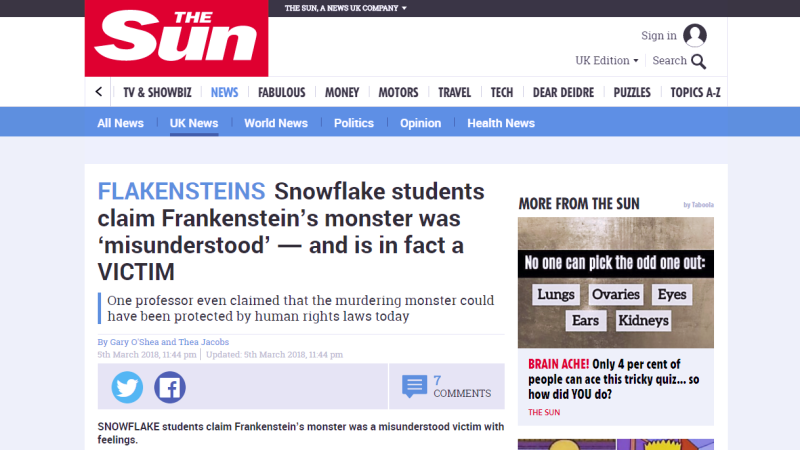
Good news for anybody stuck in 1818: The Sun and The Times have both shared the incredible revelation that according to “snowflake students”, the monster in Mary Shelley’s Frankenstein; or, The Modern Prometheus should be pitied.
Here’s The Sun:
Next the snowflakes will be telling us that The Metamorphosis wasn’t really about cockroaches and that Jonathan Swift didn’t really want us to eat children.
This is incredibly dangerous, and she’s not the only MP using such language. And of course certain newspapers run headlines about “enemies of the people”.
These aren’t words that anybody should use when violent nationalism is resurgent.
YouTube viewers who started searching for information on “crisis actors†— people who supposedly play roles as mass shooting survivors to push gun control — could soon find themselves tumbling down a rabbit hole of conspiracies about the the Sept. 11, 2001 attacks, the JFK assassination and Pizzagate, the hoax about a supposed child molestation ring run by Democratic Party luminaries out of a Washington pizzeria.
“It’s a conspiracy ecosystem,†said Albright, research director at Columbia University’s Tow Center for Digital Journalism. “It’s growing, not only in size but in depth.â€
Exactly the same thing happens on Facebook.
The problem is “trending” content, the stuff you’re recommended by Facebook and YouTube’s algorithms, which then leads to other things.
For both YouTube (the world’s main provider of videos) and Facebook (the dominant vector of fake news), solving this problem would actually be easy: kill Trending Topics, which has a terrible track record. But neither tech giant will do that, because that’s where the advertising money is.
That money is mainstreaming extreme views. Some of the people who subscribe to the “crisis actor” bullshit are violent bigots; therefore if you view some crisis actor bullshit you’re likely to see other content relevant to violent bigots. It’s not long before you’re in very disturbing territory.
As the columnist Christopher Mims notes:
Facebook is a unique enabler of extremism, full stop. “If it’s outrageous, it’s contagious†is literally the bedrock, fundamental modus operandi of its engagement-optimizing algorithms.
I recently cancelled my long-standing subscription to The Times and Sunday Times because I was getting fed up with its selective reporting.
As any writer knows, you can change a story by choosing what to include and what not to include – so if you leave out important details you can create a misleading impression.
I can’t comment on subjects I don’t know about, but when the Times/ST reports on trans-related subjects it does that all the time.
Police were called when a tutor refused to address a transgender pupil by the correct pronoun, it emerged yesterday. Officers became involved because the behaviour counted as a hate crime, it was alleged.
The article quotes Susie Green of the charity Mermaids:
“Recently we had to get the police involved because a young student was being regularly misgendered by his tutor. The tutor dismissed it until he was informed that it counted as a hate crime. The matter has now been resolved by the police.â€
And that’s pretty much it. I’m quite sure many people would read that and think “Police? For God’s sake, what an overreaction.”
Susie Green, CEO of Mermaids, a charity which supports transgender children and their families, told how the teacher had laughed in the child’s face and said “if you don’t want to be called a girl then don’t look like oneâ€.
She said that the teacher and school’s management ignored three months of pleas from the transgender child and their parents and dismissed their requests, until she was informed by police that her actions constituted a hate crime.
…She said that the child was so distressed by the teacher’s actions that their mental health suffered, and they took two weeks off school with anxiety and depression.
The pupil’s parents contacted Mermaids, and with their help, escalated the matter to the Equalities and Human Rights Commission and the police.
Ms Green said: “We spoke to a member of the police force, who contacted the CPS and clarified the position. The CPS said it was a hate crime.†[Emphasis mine]
Reading that, it’s a completely different story: here we have a teacher who deliberately flouts the Equality Act 2010, who deliberately bullies a child for three months and who only stopped when they were informed that they could be prosecuted.
In this version I’d suggest that the reaction is likely to be “Police? Quite right. What an arsehole.”
The majority of people aren’t trans and don’t have trans kids, of course, so whether The Times has some kind of anti-trans agenda may not seem relevant to them. But if the paper is willing to mislead its readers about something as easily checked as this, what else is it misleading you about?
The BBC reports that a new study, published in The Lancet, finds that anti-depressants really do work.
The study, which analysed data from 522 trials involving 116,477 people, found 21 common anti-depressants were all more effective at reducing symptoms of acute depression than dummy pills.
It’s timely given the massive and largely uncritical publicity recently given to admitted plagiarist Johann Hari, whose book Pull Your Socks Up You Miserable Bastards (I’m paraphrasing) argues that everything we – that is you, me and the medical establishment – know about depression is wrong.
Dean Burnett’s critique is worth your time; it’s a rare bit of common sense in a sea of credulous coverage. He debunks many of Hari’s key claims, such as the idea that anti-depressants are the only treatment offered for depression or that nobody but Hari has considered the link between life events and depression.
I’d always assumed the role of life events was widely accepted, and has been for decades. In psychiatry/medicine/psychology, this is often known as the Biopsychosocial model, and any decent professional will be very aware of it. Far from being a revelation of Hari’s, it was mooted back in the 70s, and has been part of standard teaching for at least 20 years.
Anti-depressants work. They work differently for different people, and some people respond differently to different antidepressants. Others develop a tolerance or intolerance. Regimes may need changed, or doses adjusted. Some people experience side-effects, or don’t get the outcomes they expect. But that’s medicine for you.
What anti-depressants don’t do is magically make everything okay, and nobody sensible claims that they do.
They’re medicine, not magic. If part of your depression is because your life is shit in every conceivable way, a course of Sertraline (or whatever drug) isn’t going to change that.
Think of it this way. Forget what you know about depression and just imagine being followed around all day by
WHACK
a man who
WHACK
for no reason
WHACK
keeps punching you
WHACK
in the face.
WHACK
It’ll take more than
WHACK
Nurofen to stop
WHACK
him from doing that
WHACK
but it’s impossible
WHACK
to think about what
WHACK
you need to
WHACK
do to make him
WHACK
stop when you’ve
WHACK
got a constant
WHACK
headache.
Anti-depressants don’t stop life from punching you in the face, but they can help you feel less punch-drunk. They can give you the clarity to see where the punches are coming from and to maybe dodge the next one, and the one after that.
I was on anti-depressants for a couple of years. I don’t need them any more. The drugs didn’t cure me, but they gave me the space I needed to see what had to change.
I went to a comedy show last night, and the comedian didn’t make any jokes about trans people. I knew he wouldn’t – the comic, Jimeoin, doesn’t do that kind of joke – so I felt safe enough to go as me.
By “as me†I mean as Carrie, rather than in disguise. I should probably describe what that means in case you’re imagining some kind of Cupid Stunt or Lily Savage creature. When I’m out as me, I generally try to imitate what ordinary fortysomething women wear and dial it back a notch. Think of it like a golf handicap: because I’m trans (not to mention taller and heavier than most women) I stand out much more, so I need to be a little more sober in my presentation.
So for example last night I was in jeans, casual boot/shoes, a top and a cardigan. That’s about as dramatic as I get. Makeup-wise I go for the “hide my horrible skin†approach rather than smoky eyes and ruby lips; on top of my head the hair is simple, just short of shoulder length and undramatically blonde.
That doesn’t mean I don’t stand out, though. Last night’s show was in the new auditorium of the Glasgow Royal Concert Hall. The bar area is notable for being incredibly brightly lit, incredibly spacious and incredibly short of anywhere for people to sit. The few seats around the edges and every bit of wall space were already occupied, so my pre-gig G&T was sipped while standing in the middle of the room.
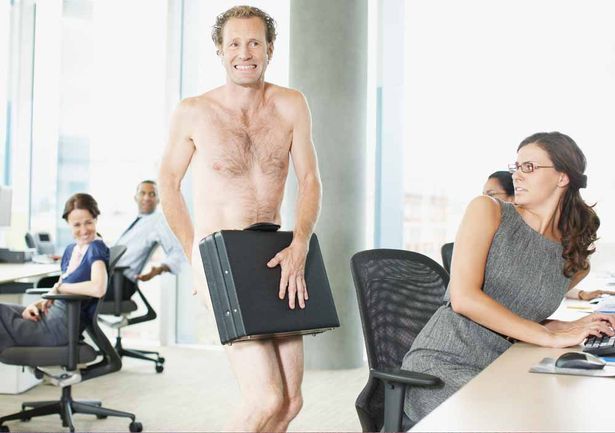
You know that dream where you’re doing something in front of an audience – in the school assembly hall, maybe, or at a big work conference – and for no good reason you have to do it in your underwear?
That’s my social life.
Everybody looks. Everybody. Some do it subtly. Most don’t. And they look in different ways. Younger women generally do the “oh, trans†look and get on with whatever they were doing. Older ones often double-take and then get on with whatever they’re doing or give you a really hard stare before getting on with whatever they’re doing. The oldest women couldn’t care less; they’ve seen it all before.
Men are different. Some look at you with open disgust. Some stare so hard you fear they’re actually going to dent your skull with sheer stare power. Some look at you in a threatening way, making it clear that they know they’re making you uncomfortable and that’s the point. And a few – bookish types, usually – give you the “oh, trans†look.
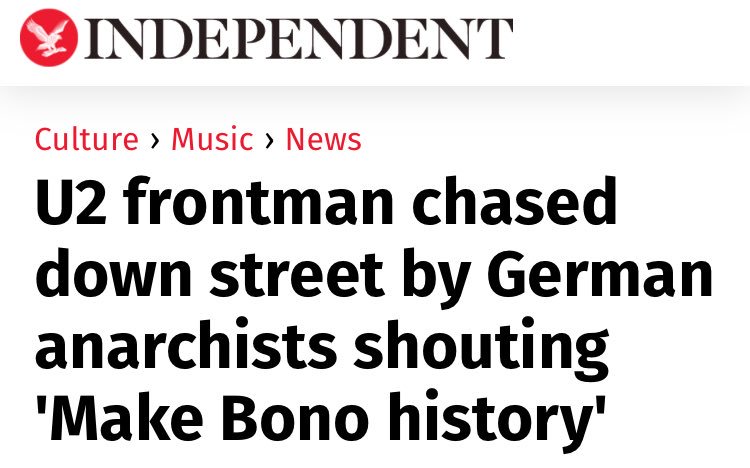
It’s an odd thing to experience when you don’t want to stand out. Bono from U2 famously and stupidly said that being famous meant he knew what it felt like to be a girl; but to be trans in a brightly lit public room gives you a pretty good idea what it might be like to be Bono.
You’d need a heart of stone not to laugh.
You say it best when you say nothing at all
I can’t say I particularly enjoy it, but it’s part of the territory. As is misgendering, which is when you’re called sir when you’re presenting as madam or madam when you’re presenting as sir.
Misgendering is a common tactic of anti-trans trolls, who delight in saying “you’re a MAN!†to trans women in the apparent belief that they’ve never been yelled at before. It’s background noise on the internet but when it happens from strangers in real life it’s surprisingly powerful.
I’m under no illusions that I pass as a cis woman. I’m 6’3†in my favourite casual shoes and I have a voice that makes Barry White seem awfully squeaky. But I’m still taken aback when, as last night, I hand over my concert ticket and the woman tells me where my seat is and calls me “sirâ€.
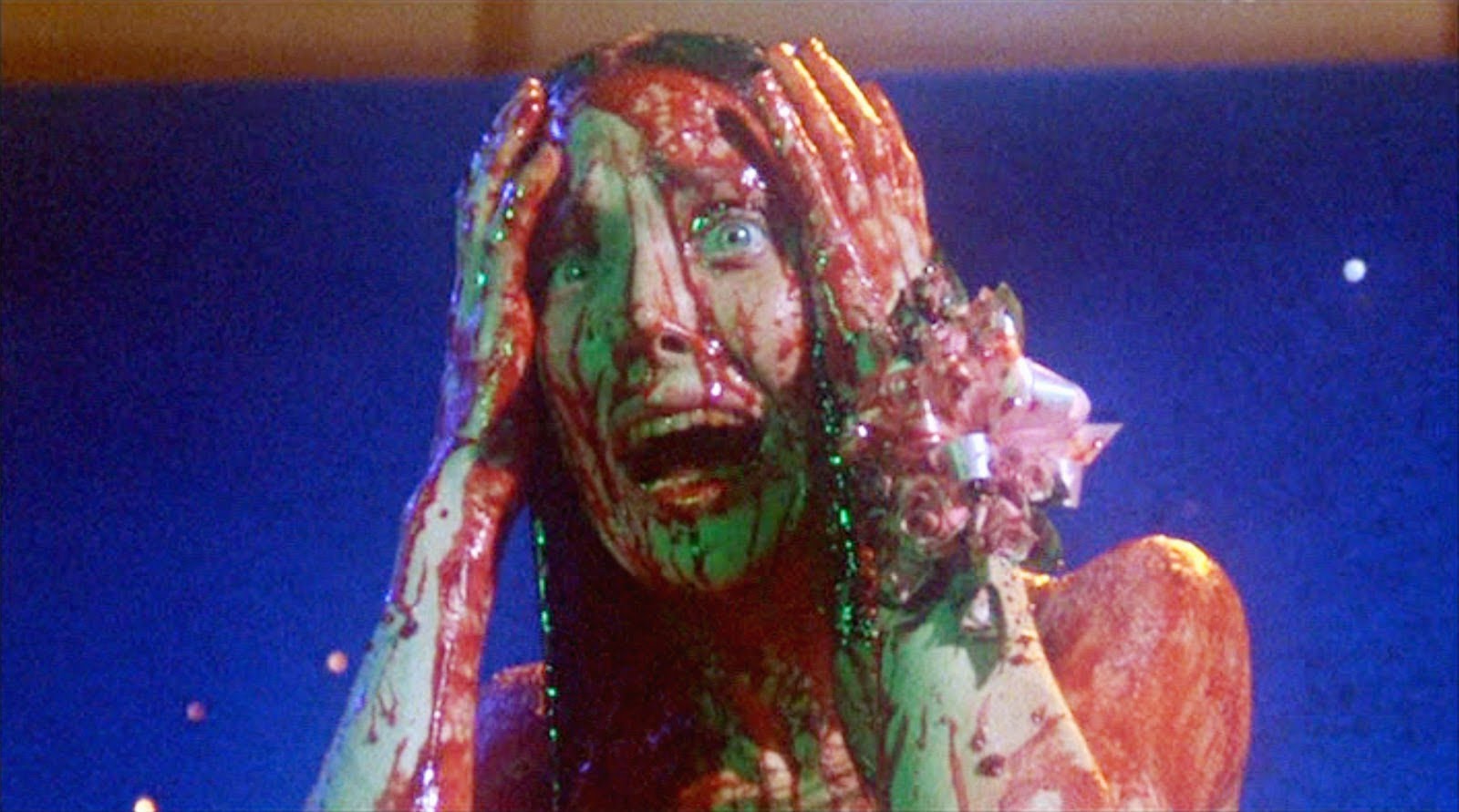
It’s hardly the bucket of blood in the film Carrie, I know. But it still knocks the wind out of your sails: it’s a reminder that the two lots of shaving, the agonising over what to wear, the carefully applied makeup, the three-times-attempted nail polish, the expensive wig and all the rest of it was completely and utterly pointless. You’re a heifer in heels, a dude in drag.
I’m not offended or outraged or overreacting, just thinking out loud in a blog post, but it strikes me that this is a matter of simple sensitivity.
I try not to use words or phrases that might make other people feel awkward – for example by assuming that they’re straight, or that they’re not religious, or that they share my political views – and if somebody in front of you is clearly presenting in a female way then surely common sense suggests that they might not want to be called “sirâ€. In such cases, surely it’s better not to use any term than to accidentally use the wrong one.
No offence
Getting it wrong, intentionally or otherwise, is what’s known as a micro-aggression. It’s a term feminists and trans people have borrowed from people of colour: Columbia professor Derald Sue used the phrase to describe “brief and commonplace daily verbal, behavioural, or environmental indignities, whether intentional or unintentional, that communicate hostile, derogatory, or negative racial slights and insults toward people of colour.â€
When a commenter notes that a working class black man is articulate when the same wouldn’t be said about a white graduate, that’s a micro-aggression. If someone says an African woman’s name is too difficult to pronounce, that’s a micro-aggression. If you use the word normal as an antonym of gay, that’s a micro-aggression. If you tell a woman that you want to see the manager because you assume she isn’t the manager, that’s a micro-aggression. If you misgender a trans person, that’s a micro-aggression.
Individually, micro-aggressions don’t do much. But they’re like drops of water. It’s what they do cumulatively that matters. It wasn’t the individual drops that drove victims of Chinese water torture insane. It was that the drops just kept on coming.
Asking people to consider the words they use often results in people railing against “snowflakesâ€, especially in the columns of right-wing newspapers. Apparently asking people to be respectful to other people is a step too far. It’s political correctness gone mad.
As another comedian, Stewart Lee, said a long time ago:
The kind of people that say “political correctness gone mad” are usually using that phrase as a kind of cover action to attack minorities or people that they disagree with… [they’re] like those people who turn around and go, “you know who the most oppressed minorities in Britain are? White, middle-class men.” You’re a bunch of idiots.
Everybody makes assumptions, including me, and the language we use often reveals those assumptions: we may be unconsciously making assumptions based on people’s race, class, sex, gender, accent or any one of a myriad other things. Questioning those assumptions doesn’t cost us anything, and might just help make the world a slightly better place. None of us is perfect, but we can try to be a little bit better.
And as for political correctness gone mad… you really shouldn’t use the word mad either.