Category: Hell in a handcart

We’re all doomed

  • A slackening grip on reality

    There’s an interesting and disturbing long read by Alex Hern in The Guardian: The story of Facebook, QAnon and the world’s slackening grip on reality. It talks about how Facebook in particular encourages conspiracy theories.

    The social network has always prided itself on connecting people, and when the ability to socialise in person, or even leave the house, was curtailed, Facebook was there to pick up the slack.

    But those same services have also enabled the creation of what one professional factchecker calls a “perfect storm for misinformation”. And with real-life interaction suppressed to counter the spread of the virus, it’s easier than ever for people to fall deep down a rabbit hole of deception, where the endpoint may not simply be a decline in vaccination rates or the election of an unpleasant president, but the end of consensus reality as we know it. What happens when your basic understanding of the world is no longer the same as your neighbour’s?

    The focus on this piece is QAnon, but there are strong parallels with another largely social media-driven movement, anti-trans activism – so much so that I’ve seen a number of people describe such obsessive activism as “QAnon for middle-class women”. Like QAnon its adherents claims there is a sinister conspiracy to target children; like QAnon they are often anti-semitic, alleging that the sinister conspiracy is funded by Jewish people generally and George Soros specifically; like QAnon they believe that there is a secret cabal of people who control the media and politics; like QAnon they include celebrities talking shit to large audiences.

    “The industries that many celebrities work in – film, music, sport – were among the hardest hit by shutdowns. So even more than most of us, they suddenly found themselves with nothing to do but sit on Twitter,” Phillips says. “Not all of them did a Taylor Swift, spending the time recording an album. Some of them started sharing wild rumours to millions of followers instead.” This, then, is how we end up with Ian Brown, the former frontman of the Stone Roses, declaring that conspiracy theorist is “a term invented by the lame stream media to discredit those who can smell and see through the government/media lies and propaganda”.

    And like QAnon, it’s bullshit that can only be perpetuated by denying reality and surrounding yourself with fellow conspiracists.

    It’s not easy to overturn someone’s sense of reality, but even harder to restore it once it has been lost.

    What frightens me most about this – and there are lots of things that frighten me about it – is that we know these conspiracies lead to real-world acts.
  • Too little, too late

    Media companies are finally doing what they should have been doing years ago. In the last few days Twitter has put most of Donald Trump’s incendiary tweets behind barriers that point out that the content of the tweets isn’t true. YouTube has kicked off former Trump strategist Steve Bannon after he called for public figures to be beheaded. And multiple broadcasters cut away from Donald Trump’s live-streamed rambling “remarks” last night on the grounds that he was lying through his teeth and potentially inciting violence.

    It would have been good if they’d done this five years ago. But they didn’t. Given the choice of doing the right thing or platforming the far-right thing, they did the latter.

    I hope the ad revenues were worth it.


  • If Trump goes

    I’m writing this before the US election result is called; right now it looks like a narrow win for Joe Biden.

    I hope so, although I fear the aftermath amid the warlike rhetoric coming from Trumpists right now. And I worry about the longer term too. Despite everything he’s done and everything we know about him, Trump nearly got elected again: a huge proportion of the US electorate saw kids in cages, election rigging, racism, anti-LGBT+ discrimination, blatant corruption, criminal activity and the avoidable deaths of more than 200,000 people and thought “yep, I’d like four more years of that.”

    If Trump goes, that sentiment remains. Think of him as a trial balloon for the next, much more dangerous Republican president.

  • Barefoot and pregnant

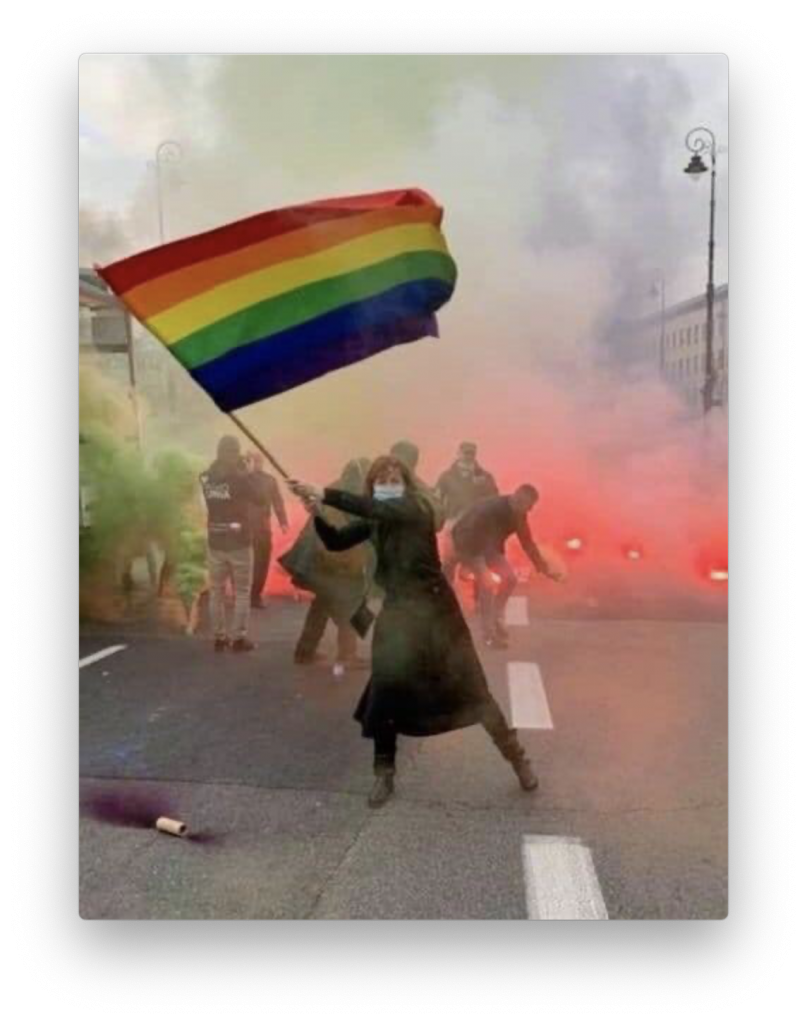
    This powerful photo is from Poland, where women and LGBT+ people are protesting truly awful anti-abortion legislation. The government was elected partly because of its anti-LGBT+, “family values” stance; as is always the case, “family values” also means restricting women’s rights in order to keep them barefoot and pregnant.

    Here’s another family values politician, the US Republican Senator Lindsey Graham, speaking this week.

    I want every young woman to know there’s a place for you in America if you are pro-life, if you embrace your religion, and you follow traditional family structure. That you can go anywhere, young lady.

    As in Poland, the family values here are of the barefoot and pregnant variety.

    Cas Mudde, writing in the New Statesman:

    Most far-right politicians take a traditional view of gender that sees women first and foremost as mothers, discouraging them from working outside of the household. The idea that women are “virgin-mothers” points to a kind of benevolent sexism where women are vulnerable and dependent upon (and deserving of) protection from strong men. Such politicians view gender ideology as a threat to the fundamentally different and “natural” roles that men and women play in society.

    Women’s reproductive and sexual freedom, gay/bi/pan women and trans women are at odds with that worldview.

    the global far right converges on one thing: they all denounce contemporary feminism and “gender ideology”, and see women, first and foremost, as the “womb of the nation”. Consequently, far-right men believe it is their right (and even duty) to control and police their women. After all, as the Hungarian Speaker of Parliament recently said, “individuals’ decisions on having children are public matters.”

  • Lockdown and mental health

    Like many people I’ve been struggling this year. Lockdown and COVID restrictions have been hellish for many people’s mental health.

    The promise of lockdown was that it was a necessary evil: we did it to save the NHS and to buy time to create an effective contact tracing system. That time was squandered, and England is about to go into lockdown again.

    This, by Owen Jones for The Guardian, is very good.

    This is purgatory, a barren parody of real life. We’re living in monochrome, an existence bedevilled by tedium, stripped of spontaneity, robbed of little joys but defined by ever greater stresses. This relentless assault on our wellbeing will only intensify: those left fearing for their imperilled jobs in a nation with a shredded safety net in place of a welfare state; the young being deprived of their best days; the old, denied the dignity and support they deserve in their later years; the millions who were already struggling with their mental health even before the old world collapsed; those imprisoned with domestic abusers, or LGBTQ people locked away with bigoted relatives.

    This is a conversation we need to have. As things stand, talk of the mental impact of the world’s greatest crisis for three quarters of a century has been monopolised by corona deniers and anti-lockdown agitators.

    Being sad and lonely is clearly lesser than being dead, or causing the deaths of other people. But nevertheless the damage to people’s mental health is much more important and will cause much more misery than the damage to corporations’ profits. To date the UK government has been much more concerned with the latter.

    the deprivation of our liberty was not supposed to be an endless cycle of outbreaks and national lockdowns; it was to prevent the NHS being overwhelmed so it could continue to function, to stop needless deaths and to buy time to establish a functioning test and trace system. Its failure means our mental wellbeing has been needlessly tossed on a bonfire – not because of partying youngsters but because of a government that relied on shambolic private contractors and sought to put the economy ahead of human life, with terrible consequences for both.

    I’ve written before that while our COVID death toll is already in the tens of thousands, others are in the low single digits: Vietnam, which has a long land border with and extensive travel to and from China, has had just 35 deaths. Vietnam took COVID seriously. Here, we bribed people to go to Wetherspoons.

  • They’re here

    TIME magazine:

    Twenty-eight U.S. Christian right groups have spent millions of dollars pursuing conservative agendas that threaten LGBTQ and women’s rights in Europe, a new investigation by British news website openDemocracy found Tuesday.

  • “I’ve seen some mention of lizard people?”

    This is a great, and terrifying, piece of journalism: The 31-Day Campaign Against QAnon. It’s about what happened when a “nice guy” ran for Congress against a right-wing extremist.

    There was a time when Kevin Van Ausdal had not yet been called a “loser” and “a disgrace” and hustled out of Georgia. He had not yet punched a wall, or been labeled a “communist,” or a person “who’d probably cry like a baby if you put a gun in his face.” He did not yet know who was going to be the Republican nominee for Congress in his conservative district in northwestern Georgia: the well-known local neurosurgeon, or the woman he knew vaguely as a person who had openly promoted conspiracies including something about a cabal of Satan-worshipping pedophiles.

  • Weakness

    If you’ve been wondering why the far right is so keen on anti-masking and so against any measures to combat COVID other than letting the virus rip through the most vulnerable, the answer is simple: a core tenet of fascism is about casting out the weak.

    On the internet there’s a famous trope called Godwin’s law, which says that in any online argument sooner or later somebody will be compared to the Nazis or Hitler. But as Godwin himself has said, the law only applies to false comparisons. When you’re talking about actual neo-Nazism, Godwin said:

    By all means, compare these shitheads to the Nazis. Again and again. I’m with you.

    And right now, the shitheads are everywhere.

    It’s frightening to see ideologies that once belonged solely to the far right appearing in mainstream discourse, as sides in a “debate”. It’s as if we’ve persuaded ourselves that fascism only manifests itself in Hugo Boss uniforms and shiny boots, rather than in smart suits, carefully chosen soundbites and Facebook groups.

    Here’s political analyst Natascha Strobl on the far right’s belief that COVID should be left to eliminate the weakest members of society, an ideology that’s becoming worryingly echoed by sectors of the mainstream press too.

    And it is precisely here that we witness one of the most central elements of fascist ideology: the weak and all its synonyms. A decadent, soft, unmanly, hysterical, panicky, timid, effeminate society is the problem… men aren’t men anymore, but nervous, urban, overly intellectualized and (here it comes) sickly weaklings. The idea of sick as weak is important.
    … Protagonists now proclaim with great pathos that should they be befallen by the virus, they will look death calmly in the eye. Self-heroization against a virus (which doesn’t care at all).
    And what is demanded as a globally social strategy is to let things go their usual way, both in order not to ruin the economy and because the lockdown is a fearful and thus unmanly strategy, and the measure are the strong, not the weak.

    The idea that some people are weak and not deserving of saving – that their weakness is harming the strong and damaging the economy – has a chilling precedent. The first victims of the Nazis were the “unfit”, the “unworthy of living”: the disabled, the mentally ill, the chronically sick. Nazi propaganda posters told the public that disabled people were a drain on the economy, and that the money spent on them was “your money too”.

    One of the programmes responsible for killing hundreds of thousands of disabled people was called Aktion T4, aka T4. Speaking at the unveiling of a memorial to its victims, German culture minister Monika Grütters told the crowd that the memorial “confronts us today with the harrowing Nazi ideology of presuming life can be measured by ‘usefulness.’”

  • Competence and cronyism

    The UK, which is very far away from China, has a population of around 66 million people and has officially recorded 635,000 cases of COVID-19 and 43,000 deaths.

    Vietnam, which has a long land border with China, has a population of 95 million people. It has recorded 1,113 cases and 35 deaths.

    The difference isn’t some special Asian COVID-resistant DNA, as some of the more unhinged right-wing commentators have suggested, or the Vietnamese government suppressing the real scale of the virus; doctors on the ground say the figures match their experiences. It’s that Asia has learnt lessons from previous pandemics and applied them competently.

    To take just one example, in Vietnam temperature checks were introduced in Hanoi airport in January before human to human transmission had even been confirmed. In the UK, we started trialling temperature checks for Heathrow arrivals in late May, two months after we went into lockdown. Vietnam began contact tracing and quarantining in January. As The Guardian reports, the UK track and trace system wasn’t announced until late May and it still isn’t working.

    the government’s Sage scientific advisers have concluded NHS test and trace is not working.

    Too few people are getting tested, results are coming back too slowly and not enough people are sticking to the instructions to isolate, they say.

    The system “is having a marginal impact on transmission”, as a result, and unless it grows as fast as the epidemic that impact will only wane.

    One of the reasons it isn’t working is that the government decided to outsource everything to private firms instead of using existing public health services. The Guardian again:

    The percentage of people reached and asked to provide details of recent close contacts [by the national test and trace system] hit its lowest level since June at the end of September, with performance worsening steadily over the month. It means about 25% of contacts are not reached at all.

    Our World In Data has a fascinating and comprehensive explanation of how and why Vietnam responded to COVID. Not everything could have been replicated elsewhere, but in its conclusion the report says that many lessons are applicable to other countries: investing in public health infrastructure, taking early action to curb community spread, having a thorough contact tracing system, quarantining based on possible exposure rather than symptoms, and clear, consistent and serious public communication.

    When Vietnam did lockdown and contact tracing, it did it properly. Here, the time lockdown was supposed to buy us wasn’t spent on building an effective track and trace system; it was spent enriching the Government’s mates and giving lucrative contracts to cronies. That’s already killed thousands of people, and it looks likely to kill very many more.

  • Intended consequences

    The anti-trans mob and their evangelical Christian pals are behind a judicial review that could have chilling effects on young women’s access to contraception. That’s not a potential unintended consequence. It’s the whole point.

    Stonewall’s Nancy Kelley, writing in the i Paper:

    If [we] chip away at the idea that children and young people are not fit to know what’s best for them, we open the door towards eroding Gillick Competency. ‘Gillick’ was a case in 1985 which established that young people under the age of 16 can consent to their own medical treatment, without the need for parental knowledge or permission.

    Gillick is a cornerstone of children and young people’s rights and helps ensure young people can access the healthcare service they may need, including abortion, contraception or sexual health services.

    So, this case isn’t just about healthcare for trans young people, it’s about a much wider issue: whether we believe children and young people have a right to treat their bodies as their own.

    The lawyers representing the people bringing the case say it would push Gillick to ‘breaking point‘. This would give a green light to those who want to use this an opportunity to roll back the healthcare rights of not just LGBT young people, but all young people.

    Getting rid of Gillick is a key goal of the religious right, who do not want any teenagers to have access to contraception or sexual health services. The anti-trans women hoping the verdict goes against the NHS are either willing accomplices or deeply, deeply stupid.