Category: Health

Scare stories and newspaper nonsense

  • Death by numbers

    On Twitter, Dan Barker has posted an interesting thread showing how terrible reporting becomes conspiracy theory nonsense.

    It begins with The Telegraph. Its science editor reported that lockdown could cause as many as 200,000 preventable deaths, and the headline was clear:

    The same claim was then posted by other news outlets citing the Telegraph. For example, Metro’s headline was “Coronavirus lockdown could cause ‘200,000 extra deaths’”.

    Remember, most people who share news stories on social media don’t read beyond the headline.

    This is important, because as Baker demonstrates, people are taking the headline and using it in anti-lockdown posts such as this one.
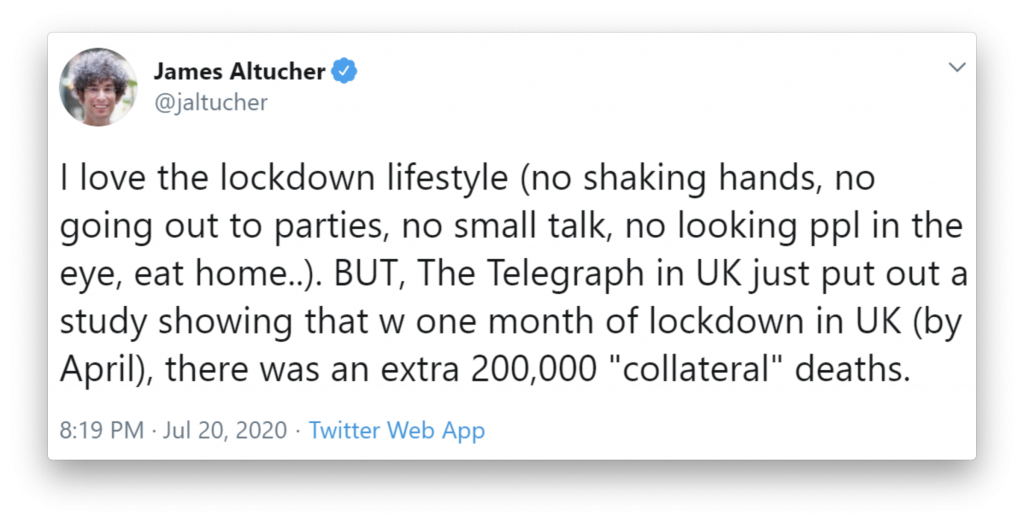
    First of all, that’s not what the article says. It is not a report about actual deaths. It’s a report about predictions of possible deaths in a very specific scenario.

    And secondly, the Telegraph has framed the story in what appears to be a deliberately misleading way.

    As Barker points out, the report this story is based on isn’t just about lockdown. The figures it quotes are from predictions based on “protecting the NHS” – that is, cancelling other healthcare to prioritise COVID-19 cases.

    The report asked the question: what would happen if prioritising COVID cases meant cancelling 75% of elective treatments, such as cancer treatments and other life-saving surgeries?

    That’s where the 200,000 figure comes from. It’s a worst-case scenario that says up to 25,000 people might die because their treatments were delayed; in the medium to long term, such delays could kill up to 185,000 more.

    So in this scenario, if we protect the NHS from being overwhelmed and have to do so for a long time it might – might – cost over 200,000 lives.

    And if we don’t?

    We’ll kill a million and a half.

    It’s there in the report, and in the Telegraph article, which notes that:

    …nearly 500,000 people would have died from coronavirus if the virus had been allowed to run through the population unchecked. And there would have been more than a million non-COVID deaths resulting from missed treatment if the health service had been overwhelmed in dealing with the pandemic.

    So protecting the NHS would kill 1.3 million fewer people than doing nothing.

    And yet this report is being used to fuel anti-lockdown sentiment when a second coronavirus spike in England, and the need for at least local lockdowns, is highly likely.

    Barker:

    In other words: The report implies lockdown could save hundreds of thousands of lives – the opposite of the headline.

    Newspapers are very keen to blame social media for spreading conspiracy theories, but many of those theories originate from newspapers and their online offshoots. Some of the most enthusiastic conspiracists are well known media figures: for example, one of the people currently pushing the “lockdown will kill 200,000 people” narrative is Toby Young.

    Many of the worst conspiracy theories circulating online originated in print.

    Here’s Marianna Spring from the BBC, who got chatting to two young men outside Topshop this week.

    Also an anecdote – while I was recording this on Oxford Street, two guys in their twenties started talking to me.

    Without me even explaining what the report was about they told me they wouldn’t be getting a coronavirus vaccine because it was a plot to microchip everyone.

    The roots of that conspiracy theory are in the anti-MMR vaccine scare, which predated Facebook and Twitter: it spread not on social media, but in the pages of the Daily Mail, The Sun, The Daily Express, the Daily Telegraph and The Spectator. The anti-vaxx movement it spawned is already responsible for thousands of preventable deaths; as it evolves into COVID vaccine denial it could kill thousands more.

  • Forever delayed

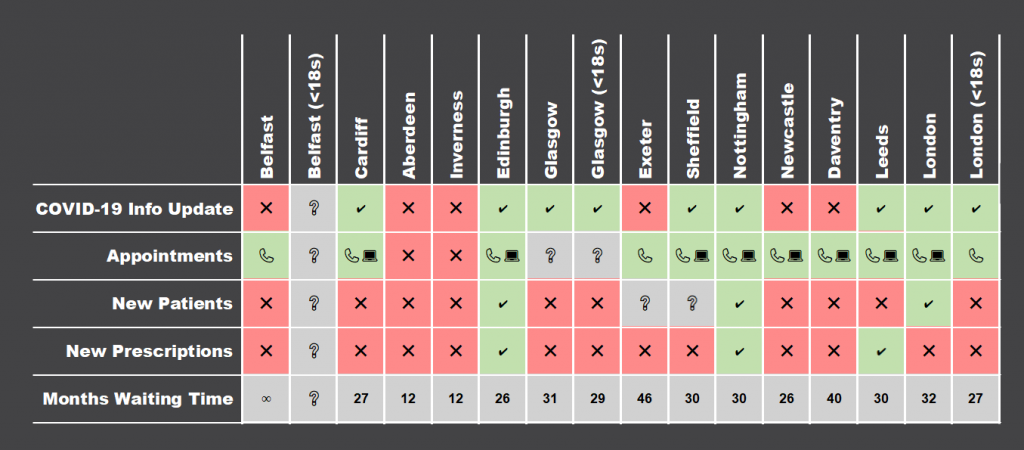
    Trans Health UK has posted an update on the few services gender clinics are currently providing. It’s summarised in this image:

    Look at that bottom row: that’s the current waiting time for a first appointment. Not a prescription or a referral to anything; just a first assessment. The trend was obvious long before COVID-19 came along: trans healthcare is in crisis.

    In Exeter the wait is currently four years; in Belfast the waiting list has grown so long it isn’t accepting any new patients.

    This is the reality of supposed “fast-tracking”, of people being “rushed” through the system. It’s years of waiting for a first appointment, then waiting list after waiting list for any kind of treatment.

    Here’s an example from my own experience. This was when the waiting times for my local gender clinic were 1/3 what they are now.

    Waiting time for initial assessment: 11 months
    Waiting time for second assessment: 4 months
    Waiting time for assessment for counselling: 2 months
    Waiting time for first counselling session: 10 months

    That’s three years for a first counselling appointment – and that first waiting period of 11 months is now 31 months, so God knows how long trans people have to wait for counselling now. I’ve been told that the waiting times for surgery are currently measured not in months but in millennia.

    In a better world this would be a scandal. But in this one, people actively campaign to make trans people’s healthcare even harder to access.

  • How about we try to stop people from dying?

    Yesterday, there were thousands of posts on Twitter by anti-trans activists claiming that only women get cervical cancer.

    It was a deliberate attack on trans men and non-binary people; the hashtag began after a trans man posted on Twitter about his cervical cancer diagnosis and a bunch of awful people started abusing him.

    Think about that for a moment. Somebody has received possibly the worst news of their life, and thousands of people pile on to say in effect, “fuck you! You’re not a man! Only women get cervical cancer!”

    Trans men and non-binary people are not women. However, if they have not had surgical intervention, their bodies will do the same thing women’s bodies do. And that means they are at risk of, and can die from, the same cancers as women.

    Part of the pile-on was also aimed at trans women. It’s pretty twisted to wear susceptibility to cancer as a badge of honour – “haha! You can’t die in the same way we can!” – and it’s only partially true. Trans women don’t get cervical cancer if they haven’t had gender reassignment surgery. But if they have, they can develop similar carcinomas. Trans women who have undergone hormonal transition should also be screened for breast cancer.

    The inclusive language that transphobes hate so much – people who menstruate, people with cervixes, people who can get pregnant and so on – does not exclude cisgender women. But it does include trans men and non-binary people, and that’s important. One of the reasons it’s important is because many trans people are not included in essential screening. Here’s Public Health England.

    If you are a trans man aged 25 to 64 who has registered with a GP as male, you won’t be invited for cervical screening.

    This is why organisations specifically try to include trans men in screening awareness programmes. If they don’t ask to be screened, they won’t be invited for screening.

    There’s no reason why the system can’t record lived/legal gender and whether someone’s trans as separate categories; there are significant biological differences between trans men and cisgender men, and between trans women and cisgender women. Long-term hormone treatment also means there are significant differences between trans women and cisgender men, and between transgender men and cisgender women.

    That complexity is currently reduced to a single item: M/F?

    I’ve had some experience of this too. Long before I officially transitioned, my GP’s surgery said they wanted to change my gender marker on the NHS computer to female. The practice manager explained that if the marker wasn’t changed, the labs would continue to reject my blood samples because they had female-typical estrogen levels. As far as the labs were concerned, high estrogen proved that my samples had been mixed up with somebody else’s.

    For me, changing my gender marker meant I started getting reminders to come for cervical cancer screening (you can contact your GP to opt out of those communications) and I won’t get reminders about prostate cancer screening when I’m older, so I need to be aware of that (although the hormones I take massively reduce my risk). For trans men, it means the reverse – and that’s a potential problem, because some trans men have an elevated risk of the very cancers they won’t be invited to screen for.

    The general bullshit that LGBT+ people experience often means higher levels of potentially risky behaviour – smoking, drinking to excess and so on. But the biggest risk is that the terrible experiences trans people often endure when they try to access healthcare can prevent them from taking part in preventive screening, or from seeking help until the very last moment. With cancer, early detection is everything.

    Here’s the US National LGBT Cancer Network.

    For trans men, ovarian cancer poses an extra challenge, due not only increased risk factors and decreased access to healthcare but also to the increased levels of discrimination faced by the trans community.

    One of the most famous examples of that is discrimination is Robert Eads, a trans man who was advised not to have gender reassignment surgeries because he was too old. He later died of ovarian cancer after twelve different doctors refused to treat him – not because he was a medical challenge, but because they didn’t want word getting out that they’d treated a trans man.

    What those doctors did is what the Twitter mob did yesterday: they decided that their personal feelings about trans people were more important than saving someone’s life.

  • “Only the wealthy get to survive the pandemic unscathed”

    Deb Perelman has written an interesting piece in the New York Times about working parents in the time of COVID-19.

    Why am I, a food blogger best known for such hits as the All-Butter Really Flaky Pie Dough and The ‘I Want Chocolate Cake’ Cake, sounding the alarm on this? I think it’s because when you’re home schooling all day, and not performing the work you were hired to do until the wee hours of the morning, and do it on repeat for 106 days (not that anyone is counting), you might be a bit too fried to funnel your rage effectively.

    …The consensus is that everyone agrees this is a catastrophe, but we are too bone-tired to raise our voices above a groan, let alone scream through a megaphone. Every single person confesses burnout, despair, feeling like they are losing their minds, knowing in their guts that this is untenable.

    Of course there is an element of privilege here: there are many people who, long before COVID, were forced to work very long hours and sometimes multiple jobs just to scratch a living (and in America, get healthcare). They didn’t get to write about it in the NYT.

    But that doesn’t mean Perelman doesn’t have a point. The response to COVID-19 means that in many parts of the world, many workers are now expected to do their jobs in the same hours from home. In addition to their full-time job they’re also expected to look after and teach their children, which is also a full-time job. And when politicians talk about re-opening the economy, those parents clearly aren’t being taken into consideration.

    I’ve heard from parents who have the luck of a grandparent who can swoop in, or the deep pockets for a full-time nanny or a private tutor for their child when schools are closed. That all sounds enviable, but it would be absurd to let policy be guided by people with cushioning. If you have the privilege to opt out of the work force and wish to, enjoy it. But don’t wield it as a stick to poke others with because far more people are being forced to “opt out” this year and will never professionally or financially recover.

    I resent articles that view the struggle of working parents this year as an emotional concern. We are not burned out because life is hard this year. We are burned out because we are being rolled over by the wheels of an economy that has bafflingly declared working parents inessential.

    I’m one of the privileged ones (although I’m ineligible for the financial support the government ensures furloughed workers and some self-employed people get to keep the wolf from the door, so I’m not that privileged). I was already a home worker, I don’t have to work specific hours and because I co-parent I still have a few days when I can work in silence without also having to amuse or educate my children. But the effect on my productivity and availability has still been catastrophic: while I cannot be available for half of the usual working week, the people who employ me expect me to be. Trust me, it’s hard to write an accurate piece about something complicated, let alone broadcast live to the nation, when your six-year-old is bored senseless and loudly demanding entertainment.

    Muddling through is doable for a short time. I’ve done it for four months, albeit four months that have wiped out all my savings. But what if the new normal is nothing like the old normal? What happens if your employer expects you to be back full-time but your kids’ school is only taking them part time? Given the horrendous cost of commercial childcare, the only solution for some couples will be for one of them to go part-time, assuming the employer allows it, or to quit. Most of the people expected to go part-time or quit will be women.

    And of course, things are even more difficult for single parents.

    Even those who found a short-term solution because they had the luxury to hit the pause button on their projects and careers this spring to manage the effects of the pandemic — predicated on the assumption that the fall would bring a return to school and child care — may now have no choice but to leave the work force. A friend just applied for a job and tells me she cannot even imagine how she would be able to take it if her children aren’t truly back in school. There’s an idea that people can walk away from careers and just pick them up where they left off, even though we know that women who drop out of the work force to take care of children often have trouble getting back in.

    This isn’t really about COVID. It’s about a sudden economic shock making existing fault lines deeper, amplifying the existing inequalities so that they affect a wider group of people. It’s about the hypocrisy of a largely male political class who have the resources to pay for high quality childcare, education and healthcare for their own families but deny it to everybody else. Childcare, education and health are not costs to be avoided; they’re investments in – and insurance for – the future.

  • Good news, bad news

    The UK government’s plans to roll back trans rights suffered a setback this week when tens of thousands of cisgender women emailed the Prime Minister to say “not in my name”. I don’t believe for a moment that the plans have been dropped – as today’s Guardian notes, Dominic Cummings was focus-grouping trans rights in the Autumn as a topic the conservatives can use to attack Labour – but it was a welcome reminder that anti-trans voices do not speak for most women.

    As was this, in the LA Times: it’s very typical of the US response to JK Rowling’s blog post.

    Poke a prejudice, almost any prejudice, and pretty quickly the conversation goes straight down the toilet. Those opposed to civil rights, LGBTQ rights and the Equal Rights Amendment all have historically boiled their bigotry down to some wild-eyed fear about what equality in any form will mean to the state of our public restrooms. Black people peeing with white people, men with women, straight people with gays people, trans with cis — oh, the horror, the horror.

    As I’ve written before, the difference between the mainstream US media and the mainstream UK media is dramatic. Last night BBC’s Newsnight – which previously gave extensive coverage to an anti-trans piece in the BMJ without revealing that the article it was covering was written by the journalists who were covering it – once again decided to scaremonger about trans teens’ healthcare by getting the same journalists to essentially tell the same story again.

    There was lots of scary music and lurid claims from conveniently anonymous sources, but no time to explain how the system currently works. Coincidentally, knowing how the system actually works is at odds with scary tales of children being railroaded at high speed into irreversible treatment.

    The parent of a trans kid detailed the process in the I Paper last year, when waiting lists were shorter – they were 20 months for a first appointment then; it’s now 27 months and climbing.

    Once you are seen for the first time, there follows a lengthy assessment process, involving a minimum of six appointments with two psychologists who assess and challenge the child over a period of at least six months, often stretching to years in limbo. Each appointment is a lost day of education and work, with long journeys to London, a second Gids centre in Leeds, or a handful of satellite clinics.

    If this long assessment period is ever concluded, “hormone blockers” may be prescribed. These are designed to pause puberty, which allows the young person time to reflect on their gender. The medication is well understood, considered reversible, and has been used safely for nearly 30 years for transgender young people and considerably longer for treating early onset puberty.

    Given the timing, it seems rather suspicious that Newsnight chose this of all weeks to reheat the same innuendo from what looks very much like a mendacious campaign. But it appears to have had the desired effect, with endless commenters on Newsnight’s social media comparing trans healthcare providers to Dr Mengele, claiming that this is a scandal akin to Thalidomide and describing an NHS facility as a “child abuse clinic”.

    You may recall similar rhetoric being used before people started bombing abortion clinics or taking assault rifles to pizza parlours in the belief that Hilary Clinton was skinning babies in the basement.

  • Four horsemen

    NYT:

    The four large countries where coronavirus cases have recently been increasing fastest are Brazil, the United States, Russia and Britain. And they have something in common.

    They are all run by populist male leaders who cast themselves as anti-elite and anti-establishment.

  • “The perfect virus for our times”

    Ian Betteridge writes about COVID-19:

    Never has a culture been less prepared for a pandemic, and never has a virus had a better chance to become endemic in a population. COVID almost seems tailor made to capitalise on every single weakness in our culture, from expert denial and anti-vaccine madness to our lack of experience of pandemic to the way our economy is structured.

  • The writers who want your granny to die

    Peter Geoghegan and Mary Fitzgerald in The Guardian on the “lockdown sceptics“:

    It is no surprise that so many professional contrarians are paid-up lockdown sceptics. They are products of our distorted media ecosystem, which invariably privileges heat over light. For them, the only thing worse than being talked about is not being talked about – even if what you are talking about amounts to social Darwinism.

    But the lockdown opponents are not just media “personalities”… How long before a British parliamentarian goes full “plandemic” and wonders aloud if Covid-19 is all a conspiracy?

  • Cherries, condoms and coronavirus

    During the AIDS epidemic, some people who didn’t want to wear condoms claimed that it wasn’t because they were selfishly putting other people at risk; it was that the virus was so small that it could pass through microscopic gaps in the material condoms were made from, so there was no point in people wearing them.

    During the coronavirus pandemic, some people who don’t want to wear masks are claiming that it’s not because they’re selfishly putting other people at risk; it’s that the virus is so small that it can pass through gaps in even the fabric of medical-grade masks, so there is no point in people wearing them.

    Both groups of people were wrong, because viruses don’t travel by themselves; they need a host. In the case of AIDS it was bodily fluids; with coronavirus it’s droplets. And in both cases, the hosts are much, much bigger than the virus – so condoms prevent the spread of AIDS and masks reduce the spread of coronavirus.

    This is technically known as the fallacy of incomplete evidence, although we know it as cherry picking. It’s when you carefully choose evidence that appears to support your position and ignore or discount anything that contradicts it. You’ll find it in climate change denial and creationism, anti-trans activism and racism and pseudoscience of all kinds, and it’s been with us for millennia.

    Or at least, all the evidence I choose to believe says it has been.

  • Ill communications

    When you’re trying to keep people at home over what’s likely to be a hot and sunny bank holiday weekend, it’s hard to imagine a worse headline than this.

    It’s from today’s Daily Mail (in England; the Scottish edition has Nicola Sturgeon saying the lockdown can’t be lifted yet). The Mail of all papers should be wary about headlines with “Hurrah” in them.

    The Mail is one of several tabloid newspapers who are promising an end to lockdown starting Monday and publishing it on their front pages the day after the UK death toll became the highest in Europe. There are officially more than 30,000 people dead; the real number is believed to exceed 50,000.

    Let’s see what the papers have to hurrah about.

    Has the UK reached its own testing target? Nope: the much-promised 100,000 tests per day hasn’t been achieved at all. The government attempted to pretend otherwise by counting 40,000 tests posted but not received; that worked for one day, but the daily number is back down to 80-something-thousand.

    Do front-line NHS workers have adequate PPE? Nope. The much-lauded order of PPE from Turkey is being sent back today because it doesn’t meet NHS standards.

    Do we have enough testers and trackers in place to know where the virus is and where to target resources? Nope.

    Do we have a trace, track and isolate system in place? Nope.

    The official stats are online. We are currently recording over 6,000 new cases a day.

    All of these things together mean that the lockdown shouldn’t and won’t be lifted on Monday in England; we may see some very minor changes, such as stopping the cops from shouting at sunbathers, but it isn’t safe to change things yet.

    That’s not what the papers are suggesting, though, and as a result we’re going to have a weekend of people flouting the lockdown because hey, it’s going to be lifted on Monday anyway.

    Apparently the government are deeply concerned about this; what I thought was a deliberate leak to distract tabloids from the death toll is reportedly an unsanctioned leak that’s been blown out of all proportion to produce front pages like this:

    If it’s true that this isn’t what the government wanted, it’s clearly a case of reaping what you’ve been sowing: this is what happens when you don’t communicate clearly with a country, when you share policy and plans not with Parliament but with your pet newspapers, when your government cares more about PR than PPE.