Category: Bullshit

Pernicious nonsense and other irritants

  • Some accident

    [Content note: slurs]

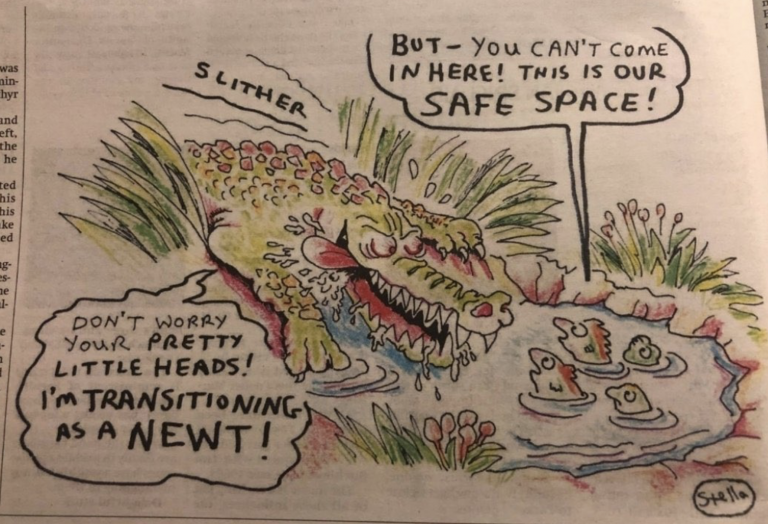
    The Morning Star has decided to prove once again that you don’t have to be right-wing to be hateful towards trans people. This is from the print edition:

    There’s a sour joke among trans people that anti-trans bigots have one joke, which is “I identify as / I’m transitioning to X”. But it isn’t usually portrayed in quite such a vicious manner as it is here.

    NW Durham constituency Labour Party:

    we can’t believe an allegedly socialist newspaper would publish something as vile as this.

    LGBTQ Bristol Labour:

    It heavily borrows from racist propaganda you see in a history book and hope never to see in real life. On a paper funded by unions. We condemn this completely.

    Guardian writer Owen Jones:

    This, in a supposedly leftwing newspaper, is absolutely twisted. The vicious, obsessive and unrelenting campaign against trans people is sadly far from confined to the right.

    This particular publication has been publishing virulently anti-trans stuff for several years now, but what’s different this time is it has apologised. From the website:

    The Morning Star apologises unreservedly for the publication last Tuesday of a cartoon which was offensive to trans people.

    The cartoon had not been authorised for publication and its appearance in the print edition represents a failure to follow our own procedures for approving submissions.

    Maybe it’s true and editorial standards at the Morning Star are so lax that cartoons can just leap into the pages without anybody knowing. But Occam’s razor suggests that what really happened here is that the publication simply didn’t expect a backlash from any cisgender people after several years of running articles saying pretty much the same thing as the cartoon.

    The myth that being trans is a lifestyle choice, that basic rights for trans people put other people in danger, is entirely invented. Here in the real world, being trans makes you a target. This was published this week too:

    BBC: A man has been jailed for setting fire to the home of a transgender woman after saying: “Anyone who is a tranny offends me”.

    Lee Harrison, 43, set light to the front door of her flat after trying to pour petrol through the letterbox.

    The woman’s flatmate, who was in at the time, said she “truly believed she was going to die”.

    Harrison, of Hallowmoor Road, Sheffield, was jailed for more than five years.

    Prosecutor Robert Sandford said the attack on 15 August was born out of a “hostility based around the fact [the victim] was in the process of transitioning from the male to female gender”.

    He said Harrison would call the victim “Steve” in the street and previously told her, “Anyone who is a tranny offends me; it’s a lifestyle choice.”

  • History lessons

    The former deputy editor of the New Statesman, now of The Atlantic, posted this to Twitter:

    There’s a lesson there, but it’s not the one Lewis thinks it is.

    The reason the GRA wasn’t turned into “culture war fuel” wasn’t anything to do with the Blair government. It was because we didn’t have people spending the best part of two years writing endless articles and constantly going on BBC programmes to talk about how it would redefine the word woman, expose children to predators, force children into surgery and all the other nonsense that’s been flying around for the last couple of years.

    That’s not to say people didn’t make those claims. They did. One of the most outspoken opponents was Norman Tebbit, who described gender reassignment surgery as a “practice of sexual mutilation” and tried to wreck the GRA in the House of Lords. Politicians raised concerns about redefining the very meaning of men and women, about trans women dominating women’s sport and about having trans women in female prisons. Tebbit even invoked the spectre of child killer Ian Huntley. Made-up stories about Huntley supposedly transitioning have been used to argue against GRA reform now. Politicians also claimed that trans people were merely suffering from “a serious psychological problem” and that the GRA would bring us into “a dark future of coerced totalitarian-style law making.”

    What’s different today is the media. While the same things were said about the GRA then as about GRA reform now, they weren’t amplified and repeated by the press again and again over a period of years. We didn’t have social media and its troll armies, or publications more interested in garnering web traffic than accurate reporting, or current affairs programmes that considered their mission to deliver “a shot of adrenaline” instead of present facts. That’s the lesson.

    The other point, that the Blair government deserves credit for its introduction, isn’t true either. The Blair government didn’t introduce the Gender Recognition Act because it wanted to. It did it because it had to, because it was breaking the law. In 2002, the European Court of Human rights ruled that refusing to change a trans person’s birth certificate was a breach of their rights under Article 8 and Article 12 of the European Convention on Human Rights. The government’s defeat in Goodwin v UK was a key reason for the introduction of the Act.

    Blair doesn’t deserve credit; trans people didn’t create or propagate this culture war.

    Incidentally, the Gender Recognition Act 2004 effectively undid the damage caused by an older court case, Corbett v Corbett, in 1971. That set back trans rights a great deal because a millionaire, Arthur Corbett, wanted to divorce his wife, April Ashley, without giving her any of his money. By arguing successfully that Ashley, a successful female model, was not and could never be a woman – that penetrative vaginal sex with her didn’t count because her vagina wasn’t there at birth – Corbett was able to get the marriage annulled. Before Corbett v Corbett trans people’s birth certificates were generally changed on the quiet; afterwards, trans people could be and were outed by people in positions of authority, often with awful consequences for their lives and careers.

  • “Take a long hard look at your bullshit shock jokes”

    [Content note: suicide]

    Last night I stepped off a stage and ended up in 1971.

    My brother and I were the featured act at an open mic night I’ve played at many times before, a mix of musicians and comedians. It’s fun, although inevitably you have to put up with the odd person whose pub pals have told him he’s hilarious and who really isn’t. Last night’s example of that was the old man who got up on stage after our (fantastic, if I say so myself) performance.

    I’ve seen him before. He’s a peddler of seventies-variety “take my wife, please” jokes with a whiff of misogyny to them. Last night the whiff became a stench. His new material is about lap dancing, his horror of women who groom their pubic hair, and in a piece he’s clearly very proud of, a horrible nightmare in which a beautiful woman turns out to be “a ladyboy”.

    He isn’t the only stand-up to decide trans jokes are where it’s at. Last night, popular US stand-up Dan Telfer wrote on Twitter:

    I am so fucking sick of transphobic jokes at stand-up open mics. It is absolutely everywhere and comedians who pretend it‘s not are in denial. There is nothing awkward or yucky to joke about here, cis folks. Take a long hard look at your bullshit shock jokes, for fucking serious.

    it clearly touched a nerve: the post has been liked by 31.4 thousand people so far. Lots of comedians are doing the same stale jokes like it’s 1971.

    Nobody’s saying you can’t make trans jokes. I did last night, on the very same stage between songs, and got some big laughs. But if your punchline is “Ugh! Trans!” then you’re a hack.

    Last night’s hack didn’t have any new spin to offer, no hilarious take: his joke was that he had a dream, there was a sexy woman in it, she was trans. The expectation was that the room would share his disgust, but it didn’t and he died on his arse. Judging by the daggers he was looking at me later, he blamed me for that.

    Good. I usually hate seeing comics die on stage, no matter how bad they are, but this was thoroughly deserved. I had to sit ten feet away – our table was at the very front – from a man who hoped to mine laughs from sharing his horror of bodies like mine. Imagine how it feels to sit through that, to feel every pair of eyes in the room turn to look at you as it becomes clear what the punchline is going to be. Those feelings linger long after the hack has come off stage.

    “Ugh, trans” isn’t a punchline. It’s a punch down. The idea of trans people deceiving straight men is so commonly used as an excuse for violence and sexual violence against us that there’s a name for it: the trans panic defence. The idea that trans people are disgusting, horrific, worthy of nothing but contempt – a trope that is still very common, especially in comedy – keeps many of us in the closet and continues to harm us when we’re out of it. If the world keeps telling you you’re a monster, it’s hard not to believe it.

    When I got home from the gig last night, I read a long blog post by another Scottish trans woman, Becca, roughly the same age as me. “After six years of being on hormones and presenting completely female, I am still getting misgendered far too frequently and as the years have gone by, the sheer hopelessness of it all has finally sunk in,” she wrote. “I would honestly rather be dead than seen as a ‘man in a dress’.”

    It was a scheduled post, timed to go live hours after it has been written. By the time it was published, Becca had stepped in front of a train.

  • The right to swing arms

    There were two trans-related court verdicts yesterday, although only one of them has received significant coverage.

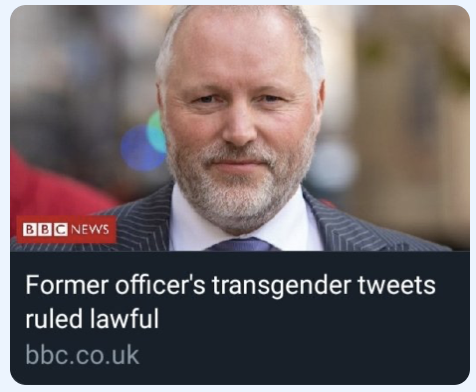
    In the one you’ve probably read about, Harry Miller had a partial victory in his case against Humberside Police, who turned up at his work to quiz him about his anti-trans tweets.

    The verdict chimes with what most people (cis and trans) I’ve seen discuss the case think: the police were too heavy-handed in dealing with someone who’s deeply unpleasant – as one learned commentator put it yesterday, “most people who test the limits of free speech are going to be wankers, but Harry Miller is really pushing it” – but who wasn’t committing a crime.

    Fans of irony were amused by the post-verdict photo shoot where Miller was photographed with various odious supporters calling themselves free speech defenders. One of those supporters loves free speech so much that has spent the last week threatening to sue various people on Twitter for calling him names. A few days ago he threatened one legendary feminist with a defamation suit because she told him to “fuck off”.

    What the verdict didn’t do was say it’s legal to abuse people on the internet, although that’s how many people have chosen to interpret it. What chance have we got when even the BBC can’t report it properly?

    No they weren’t. The case wasn’t about the lawfulness of the “opaque, profane and unsophisticated” posts; it was about whether police correctly followed guidelines. 

    Which leads us to the second case, which hasn’t attracted as much coverage (apart from a really nasty piece of victim-blaming by the Daily Mail; in one section, now removed, it accused the victim of “brandishing her GRC” as if a gender recognition certificate were some kind of weapon rather than a bit of official paperwork).

    In the second case, Kate Scottow was found guilty of “persistently making use of a public communications network” by setting up multiple social media accounts to attack, defame and harass one person.

    As her victim, Stephanie Hayden, said in a statement:

    The media-led obsession and campaign of hate is encouraging people like Katherine Scottow to think they can target transgender people online with impunity.

    And it continues to do so.

    The law’s pretty clear on all of this. It’s perfectly legal to have racist, misogynist, homophobic, anti-semitic or transphobic views, but it’s not legal to harass, abuse or assault people because of those views.

    Unfortunately a lot of the reporting hasn’t quite grasped that, and journalist Jane Fae was quick to notice. As she writes on Twitter in a thread that’s well worth your time:

    two different cases, two verdicts. In the first, dealing with the process of recording a hate incident, a court took issue with how the police had done it. In the second, hateful harassment was treated as a crime.

    …This was crying out for analysis that juxtaposed the two cases. But most coverage,starting with the @bbcnews focussed on the hate incident case and just ignored the scottow one

    As Fae notes, press reports claiming that the judge in the Miller case said it was legal to be nasty to trans people simply aren’t true. The case was about police procedures, not the content of messages. And the Scottow case was about a deliberate and sustained campaign of harassment, not the beliefs behind it.

    It’s perfectly legal to believe even the most horrible things. It’s not legal to act on those beliefs if doing so harms other people. That’s hardly a new concept. As US politician John B Finch said in 1882: “your right to swing your arm leaves off where my right not to have my nose struck begins.”

  • Deception

    The reaction to 57-year-old TV presenter Philip Schofield coming out as gay has been interesting. Interesting because it’s been a very different and much more positive reaction than the reaction to Jameela Jamil coming out as queer the day before, which says a lot about the racism, misogyny and intolerance queer women of colour have to endure.

    And it’s interesting because despite the relative positivity there’s nevertheless been a really nasty outbreak of homophobia among some commentators and on social media.
    Max Morgan puts it very well:

    The main issue I want to address is the repeated portrayal of Schofield (and ergo other men who come out after years of marriage to a woman) as a liar and a deceiver, as someone who used his wife to cover his dirty little secret before ditching her when it was expedient for him to do so. I’m obviously not privy to the inner workings of the Schofields’ marriage, but I do know that in a great many cases this grubby insinuation couldn’t be further from the truth.
    …For me, and so many others, the closet wasn’t a place where I said, “I’m gay, but I’m going to hide it in here,” it was a place in which I fought tooth and nail, at great psychological cost, to convince myself I wasn’t gay at all. I knew I liked boys when I was about 6 or 7. And I knew very shortly after that that a boy who likes other boys was the very worst thing you could possibly be. So I convinced myself I wasn’t that.

    I’m older than Morgan and younger than Schofield, but we all grew up during a time when just to admit that LGBT+ people existed could cost people their jobs, when vicious homophobia was in the daily papers, when people like us were only ever portrayed as sick, perverted, predatory.

    LGBT people who grew up in the 70s, 80s and 90s did so at a time where every aspect of the public discourse was awash with a particularly nasty and virulent brand of homophobia. The press, the media, even the government – fuck, especially the government – displayed an unflinching commitment to hammering home the message that being gay was wrong, shameful, disgusting.

    We were perverts. We were predators. We were mentally ill. We were spreaders of disease. We were paedophiles, hell bent on corrupting children for our own nefarious ends. We were incapable of fidelity, or of love. We were a powerful lobby, to be feared and mistrusted. We were poofs, faggots and queers, dykes, rug-munchers and trannies. We were less than human and fair game for whatever violence came our way.

    So many of us did exactly what the advocates of lethal conversion therapy want people like us to do: we tried with all our might not to be gay, or trans, or whichever part of the rainbow we are. We fought to try and make ourselves “normal”, to deny what our own brains and bodies were trying to tell us, to refuse to see any signs that we were who we were trying so hard not to be. Many of us managed to keep that fight going for decades.

    I didn’t marry to deceive. I married because I was in love, and because I thought that love had cured me of my sadness. I genuinely believed that I could be Mr Right, and for a while I was.

    Morgan:

    I took those vows because I loved my wife, and that remains the case to this day. I would never knowingly have misled her, or undertaken any conscious act that would have hurt her in any way. Sure, there was a deception taking place, but it was a tangled and intricate web of self-deception, from which it would take me a further 13 years to extricate myself.

    And the more people depend on you, the more awful the consequences of untangling that web.

    I’m currently reading Stuck In The Middle With You, by Jennifer Finney Boylan – like me, a trans woman who came out after years of marriage and after becoming a parent. She writes:

    I still believed, on some fundamental level, that love would cure me. That if only I were loved deeply by someone else, I would be content to stay a man… Of course, nobody really gets cured by love, but transsexuals are hardly the only people who believe romance will lead them outside of themselves. You can’t fault a person for hoping that love will make her into someone else, someone better. The world is full of false hopes, many of them dumber than the hope of being transformed by love.

    But of course, understanding any of this requires compassion and empathy, something sorely lacking among the tedious contrarians and twitter trolls.

    It’s no coincidence that many of the people condemning Schofield for his supposed “deception” are the same people calling Jameela Jamil a fake, a liar who‘s pretending to be queer in order to get “woke points”. As ever, the pejorative use of “woke” is the battle cry of the intolerant and privileged.

    Many of them are also so-called “gender critical” activists who claim teenage trans kids aren’t old enough to know who they are (in many cases advocating dangerous and discredited conversion therapy, which converts many perfectly healthy LGBT kids into damaged or even dead ones) while telling trans women of my age that if we had really been suffering we’d have come out in our teens.

    The truth is that it doesn’t matter to these people if we come out in our teens when we’re single, in our thirties when we’re in a relationship, or in married middle age. They don’t want us to come out at all. Not today, not tomorrow, not ever.

  • “Hot takes and salacious hate-reads”

    There’s an interesting piece in The Guardian by Andrew Marantz about trolls, technology companies and how both have helped to fuel the resurgence of the far right. He argues that part of the rise is because journalism and traditional media was spectacularly unequipped to deal with it: the desire to remain neutral that’s appropriate for writing about tariffs and treaties can be exploited by “a racist movement full of creeps and liars”. You see a similar dynamic in bigotry, climate change denial, anti-vaccination and so on where extremist views are presented as one perfectly valid side of an equally balanced argument.

    Neutrality has never been a universal good, even in the simplest of times. In unusual times – say, when the press has been drafted, without its consent or comprehension, into a dirty culture war – neutrality might not always be possible. Some questions aren’t really questions at all. Should Muslim Americans be treated as real Americans? Should women be welcome in the workplace? To treat these as legitimate topics of debate is to be not neutral, but complicit. Sometimes, even for a journalist, there is no such thing as not picking a side.

  • Adult kids say the funniest things

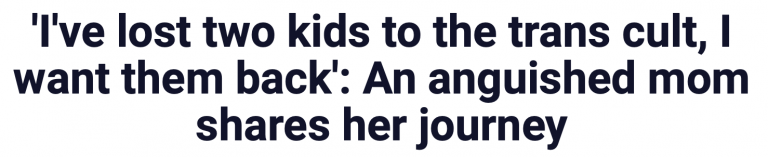
    I’ve written before about dubious “the sinister trans cult stole my children” articles: all too often they turn out to demonstrate that some parents find it easier to blame sinister, shadowy forces than their own shortcomings when their grown-up children cut all contact. But I’ve rarely seen an example as downright awful as this one.

    This is from The Christian Post last year, and it’s being widely circulated again by anti-trans types. I’m not linking to it because it’s just hateful and packed with some really, really unpleasant stuff.

    The “kids” are in their twenties and thirties. The “anguished mom” is “tormented Lynn Meagher”.

    Meagher lost contact with her son for nearly a decade after he came out as transgender. She reconnected with him in 2013, which was a struggle because she didn’t feel she could call him “she” or a woman, and use his preferred female name while remaining true to her beliefs — particularly that sex cannot be changed and no amount of cosmetic surgery can alter biology.

    “I did the best I could to have a relationship with him where I just loved him for himself, and was hoping that we could just disagree on what we disagreed with and love each other anyway,” Meagher said.

    Got that? I just want to love you for who you are, except for the “who you are” stuff. Incidentally, did you count the deliberate misgenderings in those two paragraphs? I make it eight.

    The thing about grown-up children is that they can speak for themselves. Here’s Meagher’s daughter, posting in November in a discussion about the article.

    She didn’t lose me to a cult. She lost me to her racism (she’s a Proud Boy). She lost me to her abuse (she threw me against the wall so I would stop crying). She lost me to her transphobia (she collected signatures for the anti-trans bathroom petition). She lost me to her greed (she stole survivors’ benefits the federal gov’t gave me to buy herself fur coats and a car). She lost me to her cruelty…

    The Proud Boys are a US far-right group. If they’re not actually neo-Nazis, they’re incredibly good friends with many people who are.

    Just in case you had any doubts about this woman’s eligibility for the Mother of The Year award, here’s a message from her son, responding to an article critical of his mother.

    thank you thank you thank you for addressing her, her hateful rhetoric, and the article she wrote (which was originally uploaded with mine and my siblings full names, and was found when a friend of mine had searched my name for my top surgery fundraiser, basically outing me as trans to future employers. it makes my situation more manageable to know that people see through her BS, even without knowing about the emotional/religious abuse and physical violence she inflicted on all of her children and husband for years. thank you.

    The article notes that our anguished mom has made lots of new friends, not just from far-right groups but also some of the leading lights of the UK anti-trans movement. They gave her “lots of hugs.” Which sounds like more love than she ever gave her children.

  • What doesn’t hit print

    I linked to a Roy Greenslade piece the other day about the way UK newspapers invented a so-called immigration crisis. In it he wrote:

    If you want to understand the populist media’s underlying agenda then you have to look not only at what gets published, but what doesn’t.

    Here’s a great example of that. Every single time an anti-trans pressure group or disgruntled axe-grinder makes unsubstantiated claims about the supposed dangers and alleged overprescription of puberty blockers, it gets printed in the Daily Mail, The Sunday Times and other print publications.

    Last week, a massive, reputable study with a huge sample size reported that puberty blockers are safe, reversible and in many cases life-saving. They have proven positive effects on teens’ mental health.

    Not a single UK newspaper has mentioned it.

  • “We are living in Bigot Christmas”

    Ellie Mae O’Hagan writes about the “anti-woke backlash”. She argues that in the 1990s and 2000s socially liberal values became the “new normal”, with even the Conservative party becoming nicer and introducing legislation such as equal marriage. It seemed unimaginable at the time, but that consensus is unravelling very quickly.

    …as the tide of 90s social liberalism has ebbed, it has also revealed another group of people (primarily older, white homeowners and pensioners) who had never bought into the consensus in the first place, and are aggressively hostile to its newer, more radical iteration.

    We all know a member of this demographic: alienated by the modern world and displeased by change, they are fond of complaining that “You can’t say anything any more!” – even as their opinions are widely reproduced in the nation’s print media.

    And the nation’s print media are happy to pander to them, not least because they’re the demographic that still buys the nation’s print media and that advertisers most want to reach.

    Having spent so long feeling silenced by the liberal consensus, people in this group have been given a new lease of life by the right’s new insurgents. Not only were they correct all along; they were actually victims, zealously persecuted by an oversensitive and censorious society. It is this righteous indignation that lends their antipathy to wokeness a defiant and almost celebratory quality. As a friend of mine puts it, we are living in “bigot Christmas”.

    As O’Hagan points out, if this group’s claims of persecution were really true the country and the world would look very different. But just because something isn’t true doesn’t mean people don’t believe it.

    O’Hagan’s piece isn’t an attack on those people. It’s a warning to the rest of us, because the so-called anti-woke are often “parroting arguments that are largely advanced by the far right”. And they’re winning.

    Progressives need to wise up to the fact that they are losing this argument and decide what they are going to do in response. If they don’t, they may soon find that the future they always assumed was theirs is being made without them.

  • “Who is this all for?”

    Yomi Adegoke writes about the increasing use of polarised, gladiatorial “debates” to try and get social media attention.

    The BBC has said it will no longer have climate change deniers in debate with climate change activists, as it’s a “false balance”. Yet the topic of racism is handled in the same way a TV programme might treat the topic of extraterrestrials; punctuated with a large question mark.

    Lecturers, authors and professors for whom this is their life’s work and personal experience, are pit against talking-heads whose qualifications to discuss racism appear to be the fact that they’re white, pissed off, and more often than not, perpetrators of the very racism they’re discussing.

    It’s not just race. I can very much relate to this:

    as the conversation surrounding race in the UK becomes more toxic, I’ve received more requests to partake in this type of debate on TV more than ever. And like several other black journalists I know, I have been immediately sceptical about the motivation behind this newfound eagerness to debate topics the media has historically sidelined.

    The UK media had absolutely no interest in trans people until 2017. We’ve had so-called self-ID in law since the 1970s and in practice since the 1940s. The original Gender Recognition Act, which enables us to change our birth certificates and HMRC details, passed without fuss in 2004. The Equality Act, which gives us protection from discrimination and legislates about access to single-sex spaces, has been law for a decade.

    And yet again and again we’re seeing trans people and allies being put up against people who are the gender equivalents of anti-vaxxers or climate change deniers: denying science, demonstrating profound ignorance of the law, claiming that the medical establishment is part of a conspiracy and that trans people are some kind of sinister lobby hell-bent on destroying civilisation and stealing your children. Repeatedly platforming them is either due to incompetence – there’s a distinct lack of fact-checking around these so-called debates, with complete fabrications often being aired unchallenged – cynical traffic-chasing or malice.

    There are not always two sides to a story; differing positions do not always have equal weight. To pretend otherwise in the hope of generating social media traffic is despicable and dangerous.