Author: Carrie

  • 2020 is the most… what?

    Here’s an interesting thought, which someone (I’ve lost the link, sorry) posted on social media earlier.

    What if 2020 isn’t the most awful year we’ve experienced, but the most important?

    That’s not to say it isn’t awful. Of course it is. But history is full of awful times that, with the benefit of hindsight, turned out to be hugely important. They weren’t just periods of awfulness; they were periods of transition. Sometimes very painful transition, but transition nevertheless.

    What if 2020 is one of them?

  • “the hardest thing to do is admitting that others may have it worse”

    Katelyn Burns, writing for Vox: The LGBTQ civil rights fight is far from over.

    Often, the common perception of LGBTQ people’s lives in the US is filtered through the experiences of white, upper-middle-class, cisgender lesbian and gay people [who] live in coastal cities and happen to have access to large media platforms. Kirchick’s piece is filled with the common gripes of white, cis, gay men, citing protests of Pride parades by Black Lives Matter activists, questioning the inclusion of asexual people under the LGBTQ banner, and displaying general disregard for the needs of trans people.

    I have no doubt that some cisgender gay and lesbian white people, with their local nondiscrimination protections and their ability to marry their partners, have had all their needs met by the achievements of the gay rights movement. But calls for the end of LGBTQ activism ring hollow to those of us who still hold marginalized identities within the community.

  • Oppression as a marketing opportunity

    You’ve seen pinkwashing, when firms who don’t particularly care about LGBT+ people pretend to care about LGBT+ people so they can sell stuff during Pride month. You’ve seen greenwashing, when firms who don’t particularly care about the environment pretend to care about the environment so they can sell stuff to people who do. And now, there’s whitewashing, where firms who don’t particularly care about Black people pretend to care about Black people because it looks good on social media.

    There is far too much of this kind of thing, expertly parodied by Chris Franklin:

  • Get a big discount on my bundled books

    How’s that for a headline?

    The British Computer Society commissioned me to write some books about effective writing, and this month they’re offering them as the Writing In IT Bundle with a whopping great discount. They even made a video!

    These books are designed to be practical and useful: you’ll discover how to optimise your words for maximum impact, which terrible traps to avoid and how to make your expertise and enthusiasm even more infectious.

    There’s 50% off the bundle until the 30th of June 2020: just order from the BCS shop and quote the discount code BCSJUNE.

  • Four horsemen

    NYT:

    The four large countries where coronavirus cases have recently been increasing fastest are Brazil, the United States, Russia and Britain. And they have something in common.

    They are all run by populist male leaders who cast themselves as anti-elite and anti-establishment.

  • It couldn’t happen here

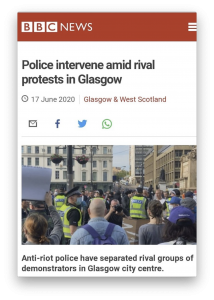
    Like everyone, I’ve been watching the US police brutality with horror. US racism is hardly new, but this – these vicious attacks on peaceful protestors, and the deliberate targeting of press photographers and cameramen and women – feels like the culmination of so many recent trends: the deliberate infiltration of the police by white supremacists, the militarisation of police forces, the mainstreaming of far-right views and the characterisation of the media as the enemy.

    I’ve also seen a lot of British people posting on social media that they’re glad they live here because it isn’t a racist country. You’ll never guess what colour those people are.

    The UK may not seem to be racist if you’re white, but of course it is and it has been for a very long time. It’s just not as visible as it is in the US. But this is the country of Grenfell and Windrush, of the hostile environment and Go Home vans, of Nigel Farage and racist newspapers and a Prime Minister who’s long traded in racist stereotypes. It’s a country where 1/3 of the deaths in police custody are Black or members of other ethnic minorities, where more BAME people than white people die from COVID-19 and where the report into those deaths is suppressed for fear it may “stoke racial tensions”. And of course, this is the country of Empire, an empire many of us choose to see through rose-tinted spectacles. We certainly don’t teach our children the murderous reality.

    Some people would say that that’s England, not Scotland, as if Scotland is somehow better. The attitude was expressed perfectly over the weekend on social media, where I saw some apparently educated Scots claiming that Scotland’s participation in the slave trade was forced on it by the English. But it wasn’t. We were enthusiastic participants, and many Scots built their fortune on Black people’s blood. Many Glasgow streets are named after the slave trade crops, and many of Glasgow’s mansions were built with slave trade money.

    You can’t learn lessons from history if you refuse to learn history in the first place. And you can’t make a better nation if you don’t understand where your nation needs to be better.

    Scotland is not special and we are certainly not immune from racism. The author and playwright James Kelman wrote about this thirty years ago in his piece, Attack On These People Not Racist, Says British State. It’s about Britain as a whole but describes racist violence in Scotland and racist coverage by the Scottish press.

    we all know that racist abuse and violation, including murder, are the experience of the various non-European communities from John O’Groats to Land’s End.

    …The general public rarely gets to know about everyday racism except where it occurs in front of their nose.

    Last year, more than 80 artists, academics, lawyers and activists signed an open letter warning that attitudes towards race and racism in Scotland are rolling backwards:

    Solutions cannot be reached without discussing how racism operates as a social and institutional structure, fuelled by protections and advantages people perceived as white have received over time and in the present day.

    If you don’t see racism here, that doesn’t mean it isn’t happening. It means it isn’t happening to you.

  • Brands in “empty PR bullshit” shocker

    This image is from L’Oreal, one of many brands keen to associate itself with the Black Lives Matter movement. The company posted on Twitter to say that it “stands in solidarity with the Black community, and against injustice of any kind.”

    Three years ago, L’Oreal made it clear to Black model Munroe Bergdorf that speaking out against racism was not worth it: they fired her from an ad campaign because some white people complained about her anti-racist posts on social media.

  • “The perfect virus for our times”

    Ian Betteridge writes about COVID-19:

    Never has a culture been less prepared for a pandemic, and never has a virus had a better chance to become endemic in a population. COVID almost seems tailor made to capitalise on every single weakness in our culture, from expert denial and anti-vaccine madness to our lack of experience of pandemic to the way our economy is structured.

  • It’s getting harder to be average

    When I was at school, I was excellent. I didn’t find anything particularly difficult, and I breezed through exams without having to study for them. I assumed that when I left school, the world of work would be much the same and I would be hugely rewarded for doing sod-all.

    Spoiler: nope.

    One of the things about growing up – unless you’re lucky enough to benefit from inherited wealth and/or nepotism – is that you soon learn that you are not the genius you thought you were. It turns out that the world is full of people who are not just as clever or as talented as you, but who also work much harder than you do.

    That leaves you with two options. One, find ways to compete. Or two, have an almighty shit-fit about how it’s soooooo unfair that others are allowed into your treehouse. Previously the highly privileged railed against “PC gone maaaaaaad”; now it’s about “wokeness”. But it’s always a toddler tantrum.

    Laura Waddell in the Scotsman, itself no stranger to publishing such tantrums, writes about two kinds of contrarians: the career ones who manufacture controversy cynically to pay their bills, and the people who mistake loss of privilege for conspiracy.

    The second camp is rooted in insecurity about one’s own position in the professional world, and a sense of being left behind as it changes. This can be seen in the desire to suck up to a stale model of power, the white male change-maker who held court when the controversialist’s career was on the up. Mocking others is an ingratiation attempt, showing they’re in the same camp, fighting newcomers who dare think they deserve a place at the table. But it is always easier to trick oneself into believing advancement of others has resulted in one’s personal persecution, than come to terms with being average among the competition.

    White people aren’t necessarily better writers than people of colour. Men are not necessarily better musicians than women. Straight people are not necessarily better CEOs than gay people. But for a very long time, mediocre people have had better opportunities than others purely because of their skin colour. their gender or their sexual orientation because they and people like them promoted the people who were exactly like them – and limited the opportunities for people who were not.

    Waddell:

    The problem is not the existence of others – it’s just not being good enough. The world is just a little less likely to reward them for it.