Author: Carrie

  • Sometimes you surprise yourself

    Although I’m a musician, I haven’t performed in public for 15 years.

    It’s not about lack of opportunity; even if you aren’t in a band there are plenty of open mic nights around if you want to grab an instrument and play. It’s mainly because of crippling stage fright, something I used to address with that musician’s crutch, alcohol. The longer I went without performing the more frightening the prospect became.

    Last night, I played a short gig.

    It wasn’t just my first time performing in 15 years. It was my first since coming out, my first as a visibly trans woman, my first time standing in front of strangers under lights in a dress.

    I had an icy blast of fear during the day, but it wasn’t as bad as it used to be. Back then I’d be unable to concentrate all day, often nauseous and unable to eat because of the ice cold in the pit of my stomach. It would fade a bit once I was actually on stage, but the fight or flight response means that the most memorable gigs I ever played, I barely remember at all.

    But last night I wasn’t scared, just full of nervous excitement. I wasn’t full of booze, either. Just two medicinal whiskys for a cold that was threatening to take my voice away. I’d intended to take beta blockers, but I decided not to. I simply wasn’t as scared as I used to be.

    While the gig itself was in sad circumstances and one of the songs bassist Kenny and I played is terribly sad, I loved every second of it. It helped that the room was a positive one, there like us to remember a friend. But even in less friendly environments there is a buzz you get from playing live, from connecting with strangers through songs you wrote in isolation, from opening your heart in a strange room at high volume. That all came rushing back last night.

    Sometimes you don’t realise you’re missing something until you experience it again. Sometimes fear keeps you from the things you love, the things that give you life. For me, music is one of those things.

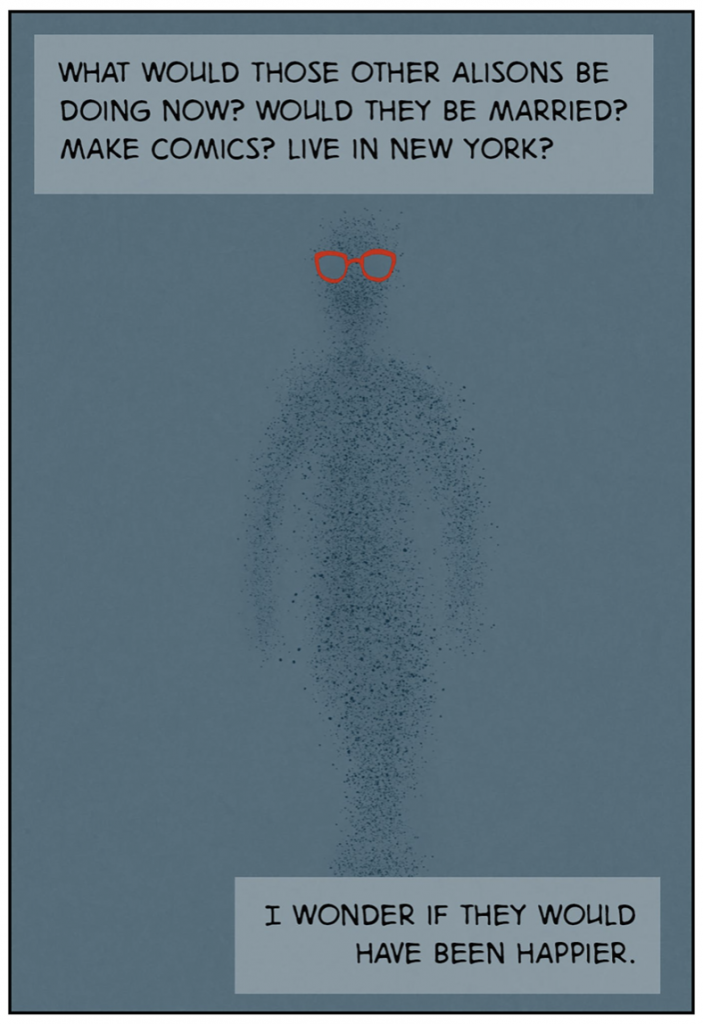
  • “Grieving for all those Alisons who never were”

    This, by artist Alison Wilgus, is wonderful and terribly sad at the same time. It’s a comic about “mourning the versions of ourselves that will never exist.”

    There’s a narrative you hear a lot about people who come out: they always knew. And that’s true for many, but not all. Some of us take a terribly long time to realise who we are, partly because it’s not always so obvious and mainly because we actively fight against it. And that means when we do finally put it all together and finally become ourselves, we do so late in life.

    That’s hard. It’s hard practically – coming out often means throwing a hand grenade into a life you’ve spent many years constructing, causing all kinds of devastation, and of course there are physical aspects too: it’s a lot harder to transition if you’re old, overweight and baggy than when you’re young and slim with great skin.

    But it’s harder emotionally. You find yourself looking backwards with a mix of sadness and sometimes anger, mourning the you you never were. It’s hard not to focus on what Wilgus describes as “the opportunities I’m never going to get back. The doors that feel like they’re closed to me.” There will always be huge gaps in your experience because you wasted so many years trying to live the wrong life.


  • “Basic facts have not been apparent in much of the media coverage”

    Writing in Bella Caledonia, Caitlin Logan describes the current backlash against trans people as evidence of widespread media failure.

    In Scotland, the conversation on trans rights started out as distinctly civil in comparison to our counterparts in England. Women’s organisations stood alongside LGBT campaigners in explaining why trans people can and should be included in their joint efforts for a more equal, safer and socially just Scotland. MSPs from across the political spectrum were photographed with ‘Equal Recognition’ campaign signs, demonstrating their support for reforms which seemed a fairly simple extension of progress which had already taken place with limited fanfare.

    It was as the public – media-driven – debate in England intensified that the Scottish media began to follow suit.

    … the news media has always been driven by competition to be the “most interesting”, but I fear that its decline in the digital age has spawned a whole new impetus to shock, to incite debate, and even to anger.

    …We are now witnessing, on multiple different issues, the political and personal consequences of a media strategy centred more on generating heat than shedding light, coupled with a disregard for clarifying whether the controversial opinions it platforms are even based in fact.

    It’s hard to express just how draining this poison is. Writer and activist Julia Serano is as sick of it as the rest of us are.

    We are now living through the biggest anti-#trans backlash since the 1970s. it’s been going on since at least 2016. it’s not just Republicans or evangelicals – it’s coming from numerous fronts. & most cis people seem entirely oblivious to it…

    …anyway, my point is, these cis people – often people very close to me – seem surprised that lots of people are still very much anti-trans. because they (the haters) have all since learned to couch their bigotry via buzz words about “biological sex” & “women’s safety” and “the science is still out on that” & so on.

    Logan:

    The media is not merely a mirror, reflecting society back at itself – it is part of society, and to ignore its own power in shaping the social and political dynamics it reports on is a dereliction of duty which can no longer stand.

  • Twitter: our rules don’t apply to white guys

    As Twitter continues to ignore calls to ban nazis from its platform, a leak provides one explanation: fear of collateral damage. Twitter fears that if it were to ban white supremacist hate speech, that might mean banning some US republican politicians. Politicians such as, er, the President of the United States.

    That fear only appears to apply if the collateral damage affects white people. According to Vice, reporting the claims of a disgruntled employee:

    When a platform aggressively enforces against ISIS content, for instance, it can also flag innocent accounts as well, such as Arabic language broadcasters. Society, in general, accepts the benefit of banning ISIS for inconveniencing some others, he said.

    In other words, it’s okay to have collateral damage if it affects brown people.

    Twitter denies it all, of course. But Twitter is awfully slow to act on hate speech when it’s perpetrated by white guys. Founder Jack Dorsey followed a number of alt-right demagogues on the service and won’t even say if he’d have a problem with Trump posting tweets calling for the murder of journalists. Vanity Fair:

    Dorsey has typically been evasive when questioned about banning white supremacists, only saying, “we’d certainly talk about it,” when asked point-blank if Trump asking his followers to murder journalists would warrant a ban.

    Twitter has become a megaphone for hatred: white supremacy in particular, but bigotry of all kinds. And it does appear to operate a double standard where members of minorities can be abused in horrendous ways and then kicked off the service if they dare to answer back.

    Last year, the actor Seth Rogen had a months-long conversation via Twitter direct messages with Dorsey about the problem of nazis and other white supremacists on the service. His conclusion:

    I’ve been DMing with @jack about his bizarre need to verify white supremacists on his platform for the last 8 months or so, and after all the exchanges, I’ve reached a conclusion: the dude simply does not seem to give a fuck.

  • The anti-vax movement is lethal

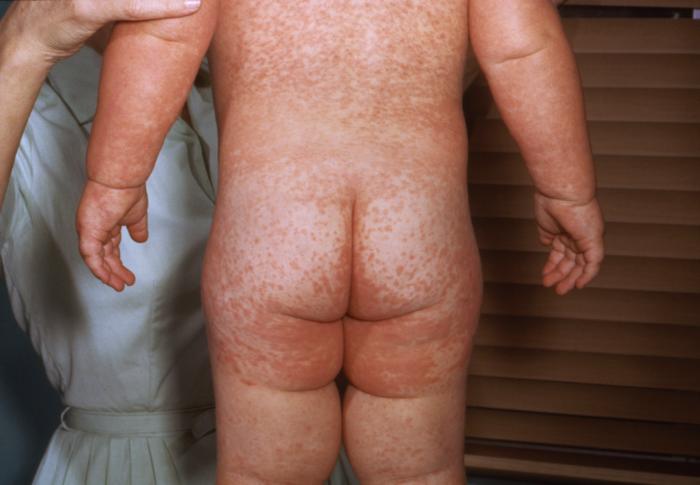
    Newspaper and internet scaremongering is so commonplace now that we’re numb to it, but we shouldn’t be. Some of this misinformation kills. The mainstreaming of anti-vaccination lunacy by newspapers such as the Daily Mail and later, idiots on social media, has seen vaccination levels drop and infection levels soar.

    In the UK, more than half a million children weren’t vaccinated between 2010 and 2017. Cases in England have quadrupled in the last year as vaccination levels have fallen. The WHO target is 95% vaccination of children, but in England it has fallen to 87.5%. We lose herd immunity at around 90%.

    Measles kills. It recently killed 1,000 children in Madagascar in a horrific example of how quickly it can spread. The cause was lack of vaccination: nearly 40% of the population are unvaccinated. Before we introduced vaccination in the 1960s, Measles killed 2.6 million people a year.

    In some parts of the world such as Madagascar the problem is down to lack of access to medicine. But in the affluent west, it’s because of first world problems such as complacency and believing bullshit on the internet and in newspapers.

    This is not a debate; there are not two sides to this story. Measles is a lethal and entirely preventable disease, and if you don’t get your children vaccinated you’re risking other children’s lives.

  • “Sweaty with rage”

    I haven’t linked to a good literary kicking for a while, so here’s Anna Leszkiewicz giving Bret Easton Ellis both barrels in The Guardian.

    There are too many good bits to quote them all, but these are some highlights:

    like a recently dumped partner ranting about their ex for 90 minutes before adding that they don’t care.

    a resentful, bitter man still caught up in the heat of arguments, years after everyone else has left the restaurant.

    a nonsensical, vapid book, written by a man so furiously obsessed with his right to speak that he forgets to say anything at all.

    Wonderful.

  • Why I block

    Yesterday, the anti-trans group For Women Scotland accused publisher Laura Waddell of running a “misogynist blocklist” to prevent Twitter users from reading and replying to her posts. Like other claims the group makes – this is the same organisation that accused a cat of sectarianism a few weeks back – it wasn’t true. Like many people on Twitter, Waddell manually blocks individual accounts when she can no longer be arsed with their bullshit. Their account was one of them after previous interactions on the social network.

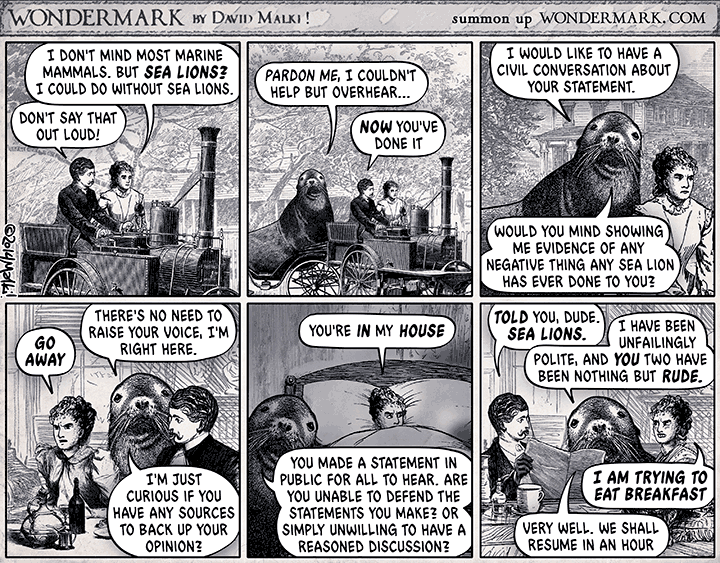
    Blocking people can be crucial on Twitter. If you don’t do it, your feed can quickly fill with awful people trying to ruin your day. I block thousands of people, bigots and trolls of all stripes, using an automated list of known offenders – racist abusers, anti-trans bigots, sea lions (people who pretend to be arguing in good faith but just waste enormous amounts of time) and so on.

    Sea lions are among the worst, because they’re the midges of social media: individually insignificant but hugely annoying in groups. Here’s a good cartoon about them.
    I’m sure some perfectly nice people are also blocked by accident but I have neither the time nor the inclination to manually go through a list of thousands of people. Unfortunately accidental blocks are the collateral damage caused by bigots and trolls’ online abuse. If Twitter actually enforced its own rules against abuse, hate speech and harassment there’d be no need for a block feature at all.

    Yesterday the Equality Network posted a tweet about gender recognition and was quickly piled on by the anti-trans crowd. As the organisation posted today:

    We firmly believe that the proposed reform of the Gender Recognition Act can be done without affecting the rights of women or others, and we are happy to see that genuinely discussed and to engage. However some of the responses to our tweet [yesterday] illustrate a different agenda…

    The important word here is “genuinely”. Many of the people who pile on trans people and trans allies online are not looking for a genuine discussion; they are coming with a script of pre-decided talking points and have absolutely no interest in the answers. They aren’t coming for a debate. They believe they are waging a war.

    This graphic has been doing the rounds on Twitter lately. It’s the “I don’t hate minority X, but…” bingo card, designed to show the patterns that appear again and again and again online. “I don’t hate black/trans/gay people, but we need to protect our children from predators”. “Asian/Trans/women are just too easily offended.” “Black/trans/gay people are erasing us”. “I believe in equality but this lot have gone too far”.
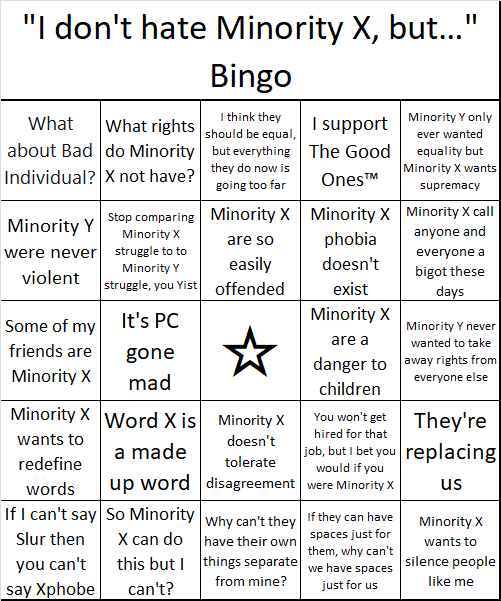
    Bear in mind that these aren’t just the odd tweet. People from minority groups and their allies can be on the receiving end of dozens, sometimes hundreds of messages all saying the same thing: I AM RIGHT AND YOU ARE WRONG DEBATE ME NOW COWARD.

    What’s a girl to do?
    To take the current example over gender recognition reform, many people are completely wrong about the law. They conflate the Gender Recognition Act with the Equality Act, are unaware of the context within human rights legislation, have no understanding of what self-ID actually means, are unaware of the medical, scientific and legal status of trans people and so on.

    Some people believe things that aren’t true because they’ve been misled by bad actors. They think trans children are given surgery (they aren’t), that they’re fast-tracked and forced to identify as trans (nope), that puberty blockers are new, experimental drugs (nope) or that children are prescribed cross-sex hormones (nope again).

    If they are willing to discuss these things, to look at the evidence, then of course you can have a worthwhile debate. But if they’re just going to shout “fake news”, accuse trans women of being predatory, violent men and call you a handmaiden of the patriarchy (or worse) because someone on the internet told them to, they’re a complete waste of your time, energy and oxygen. You cannot have a legitimate, constructive or useful debate with somebody who is acting in bad faith.

    Some people on the internet are stupid. Some are wicked. Some are both. You have no obligation to put up with their bullshit.

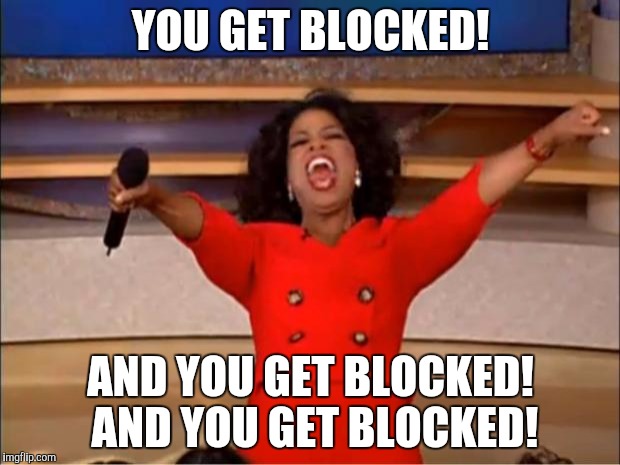
    Unless you’re operating it on behalf of an organisation, your Twitter feed (or any other social media presence) is yours, and you decide what you want in it. Think of it as a table in a pub: you’re there talking to your pals. If a bunch of people were to come over and loudly demand you debate them right here, right now, you’d tell them to fuck off. And that’s pretty much what blocking does. It doesn’t censor people. It just stops them from being able to annoy you.

    In the case of trans issues, if someone refuses to accept that trans people are not mentally ill, they are no different from flat-earthers. If they refuse to accept that biology is more complicated than they learned in primary school, they are no different from climate change deniers. If they claim that protecting trans people from discrimination will erase women, they are no different from the racists who peddle the “white genocide” conspiracy theory. If they claim trans people are being funded by George Soros, they are no different from any other anti-semite.

    These people may deserve your pity, but they do not deserve your attention.
  • Young woman, know your place

    Greta Thunberg, the young woman at the centre of the current climate change protests, has been vilified by the usual suspects on social media.

    Brendan O’Neill of Spiked, reliably wrong about everything all the time and editor of a magazine funded at least in part by the climate change-denying Koch brothers, mocked her voice (she has Aspergers and is speaking a second language).

    Toby Young retweeted an article accusing her of privilege (he’s the son of a baron, a man whose academic career was saved by a phone call from his father and whose media career seems to be built entirely on connections because, God knows, it wasn’t built on writing talent).

    Douglas Carswell, a political lightweight, attacked her as the “Child messiah” head of a cult.

    What’s notable about the attacks is that the vast majority of them are not about what she said; they’re about who she is: a young, articulate woman.

    Jane McCallion, writer and editor:

    The reaction of the likes of Toby Young and others on the right in particular to Greta Thunberg reminds me of how the same general group of people reacted to Malala Yousafazi. Young politically active women whom they see as uppity and in need of being put in their place.

    Through any attempt to take down a young woman or girl who is making herself heard on an important issue there runs a deep vein of misogyny that shouldn’t be underestimated or overlooked.

    The reaction underlines something that’s a real problem in the UK media and political establishments: they’re dominated by the voices of mediocre, reactionary men. They’re not clutching their pearls because she says something they disagree with; they’re doing it because she has the temerity to say anything at all.

  • Sell your kids for clicks

    There’s a deeply worrying article in The Guardian about the rise of child labour on the internet.

    Making videos of your kids might not seem like work, but it is: as one interviewee puts it, “it’s not play if you’re making money”. Child performers are subject to laws designed to protect them from exploitation not just by employers but by their parents. Online, those laws are being evaded or avoided.

    Money made online by children, and that money can be significant, goes directly to their parents, because children can’t have social media accounts on the likes of YouTube or Facebook.

    We’re easily seduced by technology, and that seduction often blinds us to the distinctly old-fashioned things that technology enables: union-busting, unethical practices and “disruption” not just of industries but of the laws designed to protect individuals from rapacious employers and greedy parents alike. YouTube may be relatively new, but children being exploited by the people behind the cameras is not.


  • A night for Billy, Glasgow, 27 April

    I’m taking part in a special event to remember my friend Billy Samson on Saturday night (27 April). It’s at The Old Hairdresser’s in Glasgow and will feature many of Billy’s musical friends, me (and my glamorous assistant Kenny, bass player in our band) included. Entry’s free but we’ll be shaking buckets for the Help Musicians UK charity on the night, so please come and bring lots of pound coins.

    Apologies, the venue isn’t accessible for wheelchair users.