Category: LGBTQ+

  • This hateful, murderous ignorance

    The thing about bigots is that often, they have no idea what they’re talking about. Sometimes that’s because they’re stupid. But all too often it’s wilful stupidity, where the information is widely and easily available but they either don’t look for it or refuse to believe it.

    Here’s an example from this morning. Over on Mumsnet, aka Prosecco Stormfront, the anti-trans lot are appalled at the idea of trans women being able to change the gender marker on their passports without having to present medical evidence, report to a panel and so on.

    The thing they’re concerned about has been law for 49 years.

    Not only that, but the law simply codified something that’s been happening since at least 1942.

    If you weren’t wilfully stupid that might give you pause: after all, if self-ID were so dangerous and open to abuse we’d presumably have seen a flood of passport-changing predators over the last 77 years; the fact that there hasn’t been a single case demonstrates how ridiculous that argument is. But nobody’s going to change their mind here. All they’ll do is ignore the evidence and demand the law be changed to accommodate their bigotry.

    They’re not interested in facts, or in evidence. They’re wilfully, maliciously, proudly ignorant.

    Their far-right friends show just how dangerous wilful stupidity can be. In Ohio, right-wing forced-birthers have introduced a bill that would force doctors to carry out medical procedures that aren’t physically possible at significant risk to pregnant women’s health.

    I’m not making this up. The bill, Ohio HB413, says that if a doctor doesn’t want to face charges of murder for letting an embryo die, they must try to reimplant an ectopic pregnancy – something that isn’t medically possible.

    A doctor will face criminal charges unless they:

    Takes all possible steps to preserve the life of the unborn child, while preserving the life of the woman. Such steps include, if applicable, attempting to re-implant an ectopic pregnancy into the woman’s uterus.”

    There are no documented cases of this ever being done successfully. The likelihood of success is zero. The risk of killing the woman is significant.

    But these so-called pro-lifers aren’t interested in the health of the woman. They already advocate “watchful waiting”, which means refusing treatment to a woman until she miscarries – despite the very real and significant risk that she may die of a haemorrhage if her ectopic pregnancy isn’t treated.

    That’s where wilful stupidity leads you.

    Women’s reproductive healthcare is not some dark art or some secret. The evidence around ectopic pregnancy, its dangers and how to minimise those dangers is solid and easy to access.

    But these murderous yahoos don’t want evidence. They don’t want facts. They want doctors to do what they’re damn well told because they know better than so-called experts with their “facts” and their “science” and their “not killing women”.

    As Grazia Daily put it:

    This is what happens when people who know nothing about women’s bodies make laws about women’s bodies.

  • A dangerous obsession

    Let’s compare two numbers.

    In a typical year, the UK Gender Recognition Panel will grant around 320 gender recognition certificates to trans people.

    Over the last year, the UK press printed more than 6,000 articles about trans people, most of them negative, many of them scaremongering about the imagined dangers of letting trans people get those certificates in slightly less expensive, time-consuming and humiliating ways.

    As the analysis notes, much of the coverage is carefully worded: there’s been a shift from obvious abuse to “reasonable concerns”, although the message and the negativity remains the same.

    As of last summer, the UK government had issued a total of 4,910 GRCs over a period of fourteen years. The UK press printed that many anti-trans articles in less than one.

    If the trend continues, the UK press will soon be printing more pieces scaremongering about trans people than there are actual trans people.

  • When parental pride doesn’t extend to LGBT+ children

    According to a new YouGov poll, a quarter of UK adults would not feel proud of their child if their child came out as LGBT+.

    The poll is full of saddening figures, of which this is the saddest: 11% would feel uncomfortable living at home with a gay, lesbian, bisexual or transgender child.

    That perhaps helps explain why there are so many LGBT+ kids among the homeless: 24% of homeless people aged 16-25 are LGBT+, and 77% of them say that familial rejection was the main factor in them becoming homeless. Lack of parental acceptance is also a crucial factor in the rates of self-harm and suicide in the LGBT+ community.

    I cannot comprehend how a parent would rather see their child self-harm, live on the street or take their own life than accept their child for who they are.

  • When things feel slow

    When you’re going through tough times or big changes, it can be hard to see the bigger picture. You may be in a better place than you were in the past, you may be ending things that have had a negative effect on you, but you don’t necessarily feel like bouncing around in a joyful bubble.

    It’s often quite the opposite: if you’re still in the trenches you can feel tired and demotivated because you’ve been dealing with this shit for far too long and it just feels like it’ll never end.

    That’s why I think it’s really important to notice and mark milestones, no matter how trivial. They demonstrate what you don’t necessarily believe, that you really are moving forwards.

    Here’s one such example. Just over two years ago – and it feels much, much longer than two years ago –  I stood outside my local pub, shaking. I was about to go inside as me for the very first time.

    Last night, I co-hosted the same pub’s quiz night while wearing a really nice dress.

    Sometimes you need to look in the rear view mirror to see how far you’ve come.

  • “A fatberg in the river of Scottish public conversation.”

    I don’t normally link to The Scotsman, but I’m a big admirer of its columnist Laura Waddell. Today, she’s writing about the so-called debate over trans rights.

    For the sake of trans people, for women, and for the state of our public discourse, enough of the bad faith actions. The Women’s Pledges which have recently sprung up to sit vulture-like on SNP, Labour and Lib Dem fringes are not party affiliated and further single-issue interests under the guise of speaking for all women; the trans-exclusionary alliances with Facebook pages run by young American men attached to Trump, anti-choice, and other pages designed to stoke political fallout from culture wars; the politicians who use the deeply irresponsible, imflammatory, and dishonest phrase ‘war on women’ about the policy consultation and who’ve let the idea they are leading the charge go to their heads.

    Enough of those who direct online mobs to harass trans-inclusive Scottish women’s charities, shelters, libraries, and bookshops, weakening public faith in these important feminist organisations who’ve work with determination and grit over the decades for everything they have. Most of this doesn’t even pertain to the proposed policy which has attracted like a magnet a collected debris of homophobia, misogyny, men who’ve never taken an interest in women’s rights in their puff, conspiracy theorists and party agitators, condensed like a fatberg in the river of Scottish public conversation.

  • Study: you can’t turn your kids trans

    Newsweek reports on the largest ever study of trans kids, which found that – surprise! – you can’t turn your kids trans even if you try really really really hard.

    This is not surprising to those of us who spent most of our lives trying not to be trans.

    [being] responsive to a child’s expression and needs is not going to ‘make them transgender’; enabling a child to choose freely toys, clothes, hairstyle, a name and pronoun, or even to present in the experienced gender outside the domestic environment does not ’cause’ children to become transgender or later transsexual adults.

    I’m sure the Daily Mail, The Sunday Times, The Spectator and The Telegraph will give this study the same prominence they give to the anti-trans ramblings of idiots, activists and extremists.

  • This is why trans people self-medicate

    Sometimes Murdoch-owned news outlets manage to do something amazing: they publish something about trans people that isn’t untrue, isn’t malicious and doesn’t show us in a terrible light. In the same week The Sun is banging on about predators in changing rooms, The Australian is calling us dangerous extremists and The Sunday Times is no doubt accusing us of child sacrifice again, Sky News asked and answered a simple question: why do so many trans people self-medicate?

    Self-medication is when you go on the internet and source hormones: estrogen for trans women, testosterone for trans men (incidentally, it’s much more difficult for trans men because testosterone’s use as a performance-enhancing drug means it’s a controlled substance). Like many people I self-medicated before moving to an (almost identical) NHS-approved regime.

    Why do we do it? Because if we don’t, we have to wait years and not all of us can do that.

    Sky asked the GICs how long people have to wait for an initial appointment. These are the results.
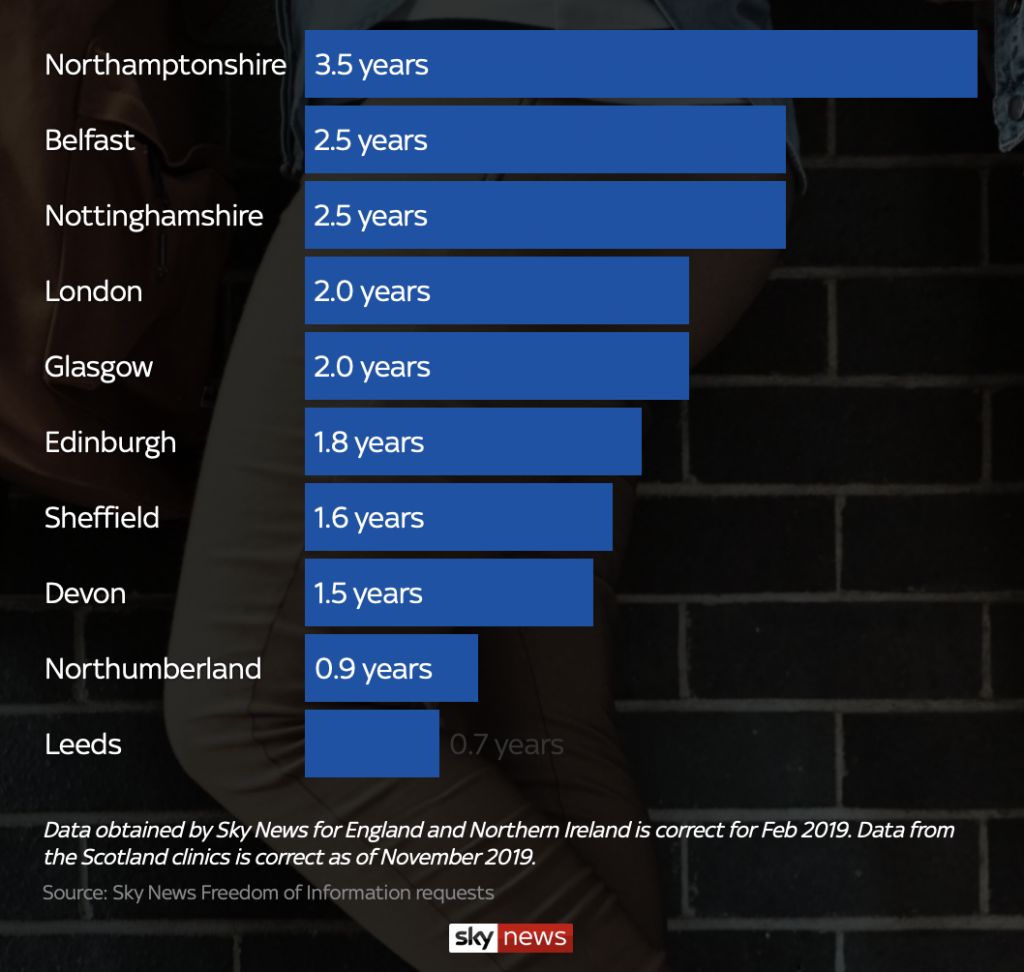
    This graph shows the average waiting times for a first appointment with gender clinics (GICs) in the UK. Awful, isn’t it? And the reality is even worse, because the clinics have clearly provided figures that show them in a comparatively positive light. For example, Belfast isn’t accepting any new patients; Wales didn’t have a clinic at all until two months ago.

    As trans health expert Dr Ruth Pearce notes on Twitter, the GIC’s figures aren’t accurate. For example in Leeds the figures (0.7 years – the number isn’t on the graph here for some tedious technical reason) appear to refer to pre-appointment screenings; the wait after that for an initial appointment is three years.

    Another Twitter poster, MichaelT, goes into detail. Leeds’ own website reports a 30 month wait for a first appointment. He also notes that while Devon claims an 18 month wait it’s currently keeping people on hold who were referred 40 months ago and who do not have any current indication of when anybody will see them. That’s over three years. The Northumberland figures are wrong too. They told Sky 0.9 years, but their website says 26 months.

    The waiting times Sky has published are not the waiting times to get hormones. These are the waiting times for an initial assessment, which is followed by a second assessment, which is followed by a decision on hormones.

    For me, the gap between initial referral and being prescribed hormones was three years. For others it’s even longer.

    In Newcastle, the waiting list for the first appointment is two years; you’ll then wait up to two years for your second appointment. In Northumberland it’s 30 months for an initial appointment then at least 30 months more before a hormone clinic appointment, a total of five years.

    As MichaelT says:

    The GICs know perfectly well that in the context of questions about the impact of waiting times on patients, the relevant time period, certainly at all adult English services is 2.5 years plus.

    But they’re not talking to trans people. They’re talking to the wider public, so this is really PR.

    They know patients know this. They know the trans community knows this. So in giving this kind of nonsense to media enquiries, they’re actively speaking to cis people, not trans people.

    The Sky piece is pushing back against the “fast track” nonsense, which is good. But (many) GICs still prioritise trying to make themselves look good over accurately representing the situation for the patients they’re supposed to serve.

    Here’s a pretty realistic description of the process by writer Ed Davies in response to a “hilarious” tabloid prediction that Prince Harry would have a “sex change” and become Harriet by 2027. The short version: if you’re being referred in 2019, 2027 is incredibly optimistic.

    Many, many people experience obstacles that aren’t accounted for here — from being held back until they “fix” their mental health after crises caused by these very wait times, to being “lost in the system” repeatedly, to being discharged for spurious reasons. People of colour, gender nonconforming trans people, trans lesbians, trans men perceived as confused lesbians, those too young to be believed at their word about their experiences, transfeminine people, those from other countries and cultures, disabled people, autistic people… many groups tend to struggle more than “average”, too.

    Self-medication can be dangerous, but so can doing nothing: some people die on waiting lists. As Edinburgh GP Jo Gardiner told the BBC earlier this year, trans patients:

    …often don’t have the same support as other patients. Family and relationships break down when they transition so it can be quite distressing for them.

    Some patients are very isolated and alone and at high risk for things like suicide.

    These problems are not unique to trans healthcare; they’re the symptoms of ongoing lack of investment into the NHS by successive governments. But because trans healthcare is such a niche area, it’s suffered particularly badly: the gender clinic I use is desperately understaffed, with even simple admin tasks like typing letters taking three months.

    But there are two things that make the current trans healthcare crisis particularly galling.

    The first is that the government and the NHS were told that it was going to happen and did nothing; the Gender Identity Research Society, GIRES, provided the Home Office with extensive data in 2009 demonstrating the increasing demand for gender clinic services – particularly among younger patients who are coming of age in a world where trans existences are subject to less shame and stigma than in previous generations.

    As the report noted:

    The only safe assumption for commissioners and providers is that the present growth rate in the incidence of new people requiring medical and other care is likely to continue, which is usually the basis on which service provision is planned. At a growth rate of 15 % per annum compound, the number of new cases will approximately double every 5 years.

    …the mounting requirement for services has serious implications for resources, especially for specialised adult surgery and adolescent endocrinology.

    The report predicted pretty much everything the press is scaremongering about now: an increase in referrals from people assigned female at birth (it’s been a 50/50 balance in Europe for many years, but in the UK there were more trans women than trans men accessing services); the growth in adolescent referrals; the increasing number of people transitioning as the world becomes (slightly) more accepting.

    That was ten years ago.

    And the second thing that’s happened is of course the press, which continually lies about the supposed fast-tracking of trans people and which has made the issue politically toxic: fixing the trans healthcare crisis may be necessary, but which politician is going to risk the wrath of The Sun, The Daily Mail, The Times and The Spectator, who will frame it as evil trans cult members stealing resources from kids with cancer?

    So we self-medicate, and the people who come after us will self-medicate, and we’ll continue to do so for as long as the UK system fails to meet its own waiting list targets, let alone internationally agreed standards of best practice. The system isn’t fit for purpose – it’s overly medicalised, far too complicated and desperately underfunded – but right now it’s the only system we have.

    Trans people know that self-medication is dangerous, and that in some cases it’s illegal. But sometimes doing nothing is even worse.


  • I can’t tell you that I like you

    Have you ever wanted to swipe right on a dating app, or tell someone who makes your heart beat faster that you like them, but stopped yourself because you’re too scared of being rejected – not because of how you look, act or think but because of what you are? I have, and I think quite a few other trans people have too.

    This tweet, by YouTuber Mia Mulder, struck a chord with me and many others: it’s been liked more than 3,500 times.

    Any other trans women out there feel scared of expressing any form of attraction ever, even to actual current partners, for fear of seeming predatory or seem “male aggressive” to the point of absurdity?

    My answer, like many other trans women’s answers, was “all the time.”

    Here’s the writer and playwright Harry Josephine.

    yeah sex is good but have u tried being a transfem n thus so fundamentally alienated from your desires n so relentlessly problematised in all social space that instead you just stay at home and read a book???

    If you think a trans woman likes you, you may be right. But she may be far too scared to tell you. I certainly am.

    Here’s why.

    I’m under no illusions about who I am: I’m a giant, excitable puppy in a dress, an overweight, middle-aged trans woman who likes women and who hates her body.

    But I’m scared that you see something very different. Someone who’s a deceiver. Delusional. Mentally ill. A mutilated man. A pervert. A predator. A fetishist. A fraud. A wolf in sheep’s clothing. A fox in the hen house.

    I could go on.

    I worry you’ll think that because that’s what we’ve been told since childhood, and because you’re still being told it today in the newspapers you read and the social networks you use. Again and again very vocal and often vicious people, many of them with high profile media jobs and/or thousands of social media followers, tell us that trans women cannot be trusted. They tell us that trans women are predatory, damaged, dangerous men full of male entitlement and male aggression, that we go through what we go through purely so we can prey on vulnerable women. The decades of mocking and shaming our appearance weren’t enough. They want you to be scared of us too.

    So we’re scared of you.

    And if we’re not scared of you, we’re scared of the people you know. I worry that even if you don’t think that I’m a fake, a fraud, a fetishist, your friends or your colleagues or your family members will.

    So I don’t swipe right. I don’t tell you that I like you. I stay home and read a book.

    I don’t swipe right or tell you that I like you because I believe that if I do you’ll be horrified, that you’ll think I’m just being predatory. And if I’m wrong about that, if you’re not horrified when we match in an app, you’ll be horrified when  you hear my voice or see what I really look like compared to my carefully chosen, better-makeup-than-usual selfies. And if you’re not horrified then, you’ll be horrified when you see me without my makeup, or when the question of what bits I do or do not have comes up. And if you’re not horrified by that and we see each other again, your friends, your family or the people who just see us talking in a restaurant will make it clear just how horrified they are on your behalf.

    Better not to swipe right in the first place.

    Don’t worry, I’m fine. This isn’t a cry for help. But on this, the last day of trans awareness week, I wanted to write about this because it’s something I don’t think many cisgender people are aware of – probably because we don’t like to admit to any kind of weakness in case bigots try to weaponise it against us. But you’d have to be pretty tough to survive decades of being mocked and shamed and demonised without internalising any of it. I’m neither pretty nor tough.

    This will change. It’s already changing. Young people’s attitudes are completely different than my generation’s were; the bigots are on the wrong side of history, which is one of the reasons they’ve become so vicious. But while I’m happy to see progress, I’m sad that it came late for me. The lake is being drained of poison, but I spent forty years swimming in it.

  • Money for Mermaids

    Mermaids, the charity for trans kids and their families, is trying to raise money to better help people. The video above does a really good job of demonstrating just how toxic things are at the moment: I thought I was pretty much desensitised to the constant barrage of anti-trans articles, but it turns out I’m not – to see the onslaught on-screen is still horrifying, especially when it only represents a tiny, tiny proportion of the newspaper scaremongering and online abuse.

    The Mermaids crowdfunder is here. I don’t agree with everything they’re raising money for – I think their planned billboards, which they hope will raise positive awareness of trans kids, are going to be completely ineffective; when you’re up against the overwhelming majority of the UK media and much of the political class too, having a couple of billboards is like taking a pea-shooter to a nuclear war – but they’re also raising money to fund more helpline volunteers and improve the information on their website, practical steps that will genuinely help people.

    And while they’re hopelessly outgunned, the point they’re making with their #IfIHadAVoice campaign is an important one. What’s missing from the so-called debate about trans kids is the voices of the children and of their families (and the medical professionals who are active in this field), all of which are drowned out by ill-informed, self-proclaimed experts. For example, the right-wing press’s favourite  “expert” on trans kids is a former religious cult member whose expertise is in sculpture, not medicine; their go-to anti-trans transsexual “Dr” isn’t a medical doctor but a physics teacher; many of the voices given airtime are simply bigots.

    Mermaids:

    the amount of negative coverage of transgender kids over the last 8 years has grown massively. The press and a small group of anti-trans campaigners have decided to make transgender children – and the few organisations supporting them – the target of deliberate misrepresentation.

    While transgender children and their families feel increasingly afraid to speak out, some of the country’s most influential speakers are content to speak about them, speak for them and speak over them.

  • “The biggest threat to single-sex services is insufficient funding from the Government”

    I hadn’t seen this before: a Q&A on gender recognition by the Fawcett Society, a leading feminist charity campaigning for women’s rights. It strikes me as nuanced and fair-minded, so for example:

    The tone of the debate in some quarters, and on extremes of both sides, has been a problem. Amplified by social media, a small minority whom we believe do not represent the views of most people have gone far outside legitimate debate and strayed into violence, or aggressive, intimidating, or dehumanising language. We believe there is no place for that in this discussion.

    Events appear to have overtaken this bit:

    It is notable that in Scotland, where there has been an ongoing dialogue for some time between women’s and trans organisations, that mutual understanding and respect is stronger and there is a common agenda. We think this is valuable and needed in the rest of the country too.

    That was written in February, but while it’s an accurate description of women’s groups and single-sex services it sadly doesn’t apply to the majority of Scots media and the most vocal parts of social media. Our newspapers and current affairs magazines are relentlessly one-sided; they frequently go “far outside legitimate debate” and do nothing about comments pages full of aggressive, intimidating and dehumanising language.