This, by author Mia Violet, is very true. It’s a shame that the first section should be in any way controversial: being trans is hard in a world that treats trans people so badly.
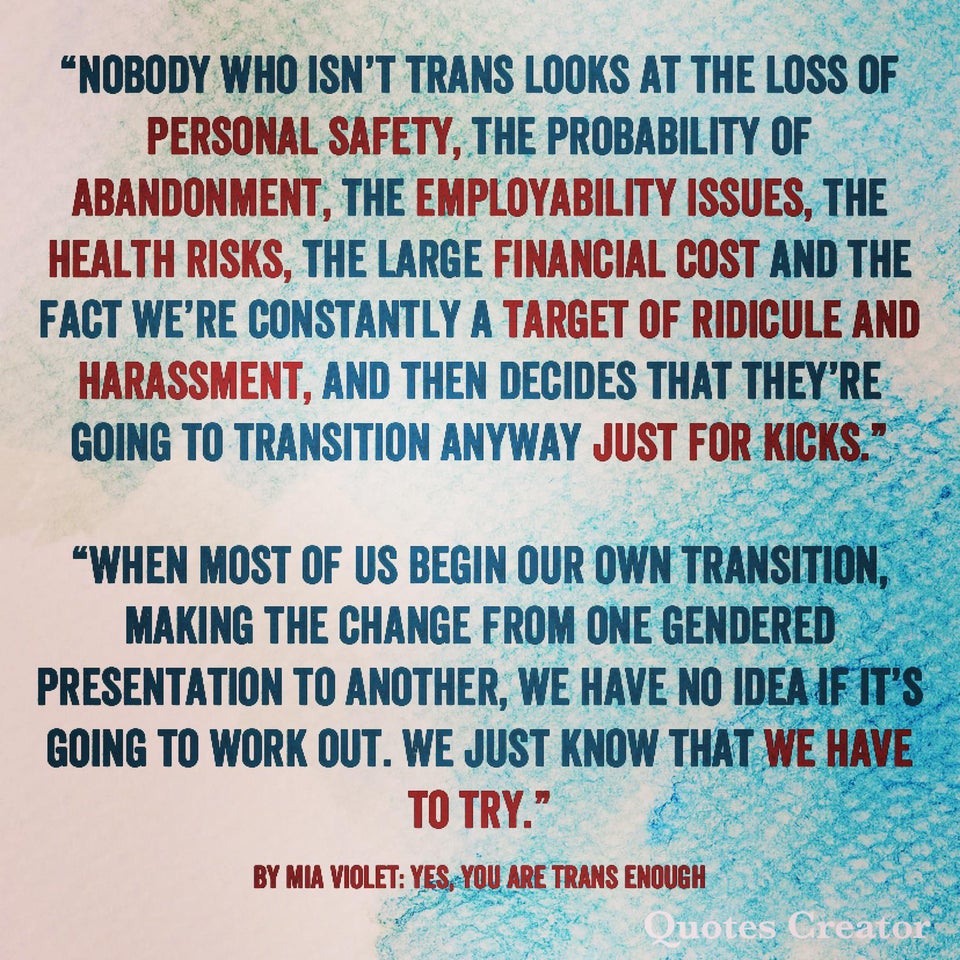
This, by author Mia Violet, is very true. It’s a shame that the first section should be in any way controversial: being trans is hard in a world that treats trans people so badly.
Every now and again, someone on the internet will read a few articles about something, decide they’re an expert on the subject and start arguing with others. At its most entertaining, they pick fights with actual experts without realising who they’re talking to and get their arse handed to them on a plate.
Sadly it’s not always funny. This is where the anti-vaccination, anti-mask and anti-5G conspiracy theories come from: they’re spread by people who believe that they have stumbled upon a Great Truth, a truth that of course They Don’t Want You To Know, and they surround themselves with people who celebrate rather than challenge their ignorance.
The phenomenon isn’t limited to people with Twitter handles like BigDave23632111. It affects celebrities, journalists and other public figures too: there are few people more zealous, and in some cases dangerous, than the person with an audience who has become an instant expert with Things To Say.
All too often, what they want to say is the same old shit.
It happens so frequently with trans-related subjects that Julia Serano, biologist and writer, wrote an article to save her having to plough through the same long-debunked bullshit again and again. She wrote it four years ago and it’s just as relevant now.Â
This is not an abstract debate.
Other people’s vocal ignorance about trans people has a direct effect on trans people’s lives. For example, Janice Raymond, an ex-nun who argued that trans people should be “morally mandated out of existence” in the 1970s (a belief that’s sadly still common in so-called gender critical circles), was partly responsible for the removal of healthcare from trans people in the US.
Much of the current wave of anti-trans activism is focused on restricting the healthcare and basic human rights of trans people, and some of it threatens violence against us. Just this morning I watched a video of a US demonstration, ostensibly about supporting the police, where the protesters switched chants from “all lives matter” to “kill transgenders”, a frightening echo of what’s commonplace in Eastern Europe and Russia.
Here in the UK, it’s the fifth anniversary of the UK government’s Transgender Equality Inquiry. In those five years, the “debate” about trans people – a debate almost entirely conducted by cisgender people talking to other cisgender people about trans people – has ensured that not one of its recommendations has been implemented. Meanwhile the crisis in trans healthcare continues to worsen and hate crimes against trans people have increased considerably.
Serano:
as transgender people have become more visible and have garnered increasing media scrutiny, trans-unaware politicians, pundits, and journalists have suddenly swooped in to weigh in on these important issues — issues that (conveniently) they themselves are not personally invested in. Some of these people have very clear anti-trans agendas. Others are (perhaps well-meaning) interlopers who believe that by simply reading a few research papers and interviewing a few people here and there, they can acquire an “objective understanding†about this complex subject that spans a half-century of history. And sadly, they often center their op-eds and think-pieces on an especially vulnerable segment of our community: transgender children.
As Serano points out, there is a common thread to much of this: the idea that somehow cisgender people can be “transed”: that is, turned transsexual, as if being transsexual is something we do for shits and giggles or decide on a whim.
The decision to transition does not happen in a vacuum. It occurs in the presence of systemic societal transphobia. Every transgender person is highly aware of how pervasive this double standard is (as we face it every day). And every transsexual who transitions does so in spite of systemic transphobia. This is a testament to how intense gender dysphoria can be, or (to put it in less pathologizing language) how deeply rooted our gender identities are: We’d rather live with the stigma of transphobia than be forced to live in our birth-assigned gender.
As Serano writes, there’s also a (sometimes deliberate) confusion between being transsexual and being transgender.
Transgender is a big tent. It includes non-binary people, gender non-conforming people and transsexual people. The transsexual people are the ones who may undergo some form of social and/or medical transition. But often, articles and discussions about transgender people assume that all of them will undergo hormone treatment and gender reassignment surgery. That simply isn’t true.
Much of the “debate” around trans people is based on ignorance and on bad faith. As Serano describes it, articles and discussions usually fall into one of two categories:Â the trans-antagonistic position, which comes from a belief that trans people are “delusional, wayward and/or misled”, and the trans-suspicious position, which mistakes the increased visibility of trans people for a “trend” where people who aren’t really trans pretend to be.
There’s no point in spending any time on the first position, because it’s simple bigotry. But the second is more insidious, because on the face of it it sounds reasonable: you don’t hate trans people; you just have reasonable concerns.
Serano:
the argument that some people are easily swayed or misled into transitioning can only be made if one intentionally denies, discounts, or downplays the existence of societal transphobia, gender dysphoria, and the legitimacy of trans people’s gender identities. In other words, this line of reasoning is condescending and steeped in transphobia.
The notion that some people who transition are not “really trans†presumes that cisgender and transgender are immutable, essentialist categories — this is absolutely not the case… Even if transitioning doesn’t pan out for these individuals for some reason, it does not mean that they were “really cisgender†all along; it simply means that transitioning was not the right path for them personally.
…If the trans-suspicious position were true (i.e., that cis people are needlessly being pushed toward trans identities and transitioning), then the clear implication of these op-eds and think-pieces is that access to gender transition (and possibly even the acceptance of, or information about, transgender identities) should be restricted to some degree.
…these op-eds and think-pieces are invariably written by cisgender authors who (as outsiders to all this) look upon this situation and reflexively come to the conclusion: “Oh no, some cisgender people are choosing or being misled into a transgender lifestyle!†But I would as ask: Why is this even a problem? I mean, so long as these supposed “cisgender-people-turned-transgender†are happy with their life choices and their post-transition lives, why should anyone even care? Frankly, I believe that this concern stems directly from the transphobic assumption that cisgender bodies are valid and valuable, whereas trans people’s are invalid and defective. It is this assumption that leads these authors to view these supposed “cisgender-people-turned-transgender†as an inherently undesirable outcome, even if these individuals wind up being happy in the end. After all, they have taken their precious and perfect cisgender bodies, and transformed them into defective transsexual ones. This helps to explain why the implicit premise of these pieces (i.e., that gender transition should be restricted in order to protect cis people) resonates with so many readers: Denying trans people access to healthcare and living happy lives seems like a small price to pay if it saves even a few cisgender people from making such a horrible mistake with their bodies.
As Serano writes, there is no evidence that cisgender people are being “turned trans”: the fact that a few people who transition decide it isn’t the right thing for them (whether that’s temporarily or permanently) does not change the fact that for the overwhelming majority of trans people who transition, transition is a positive and sometimes life-saving process with an incredibly low regret rate.
The dynamic here is quite similar to the “ex-gay†phenomenon. Conservative forces who insist that homosexuality is a “treatable disease†or merely an “alternative lifestyle†love to tout the existence of “ex-gaysâ€
The article goes into a lot of detail about the various questions asked about trans people and trans children in particular. The highlight in the quoted text is from the original article: it’s a section that’s been highlighted by other readers.
The theme of [many] pieces is that something must be done to stop these cisgender-kids-being-turned-transgender, and the implicit solution is to curtail/limit/end childhood gender transition. Yet, in these pieces there is absolutely no consideration of how this might impact trans children who might benefit from gender transition. In fact, such oversights can lead to obvious hypocrisy. For example, authors often raise fears that some children (i.e., ones who are “really cisgender†in their minds) may be pushed into the “wrong†puberty, and thus may have to undergo expensive medical procedures to correct those bodily changes. But this precisely describes what a trans child would face if they were not allowed to transition until adulthood. If the former example concerns you, but the latter one doesn’t, then that’s a clear sign that you value cis bodies and lives over trans ones.
In her conclusion, Serano writes:
…what is really driving this debate is a difference of opinion with regards to what constitutes a “good outcome.†Trans activists and advocates like myself generally think that a good outcome is a happy child, regardless of whether they transition or not, or whether they grow up to be transsexual, non-binary, gender non-conforming, lesbian, gay, bisexual, etcetera. Trans-antagonistic and trans-suspicious people (who constantly cite “80% desistanceâ€) seem to think that a good outcome is a cisgender child, and they seem to be willing to make transphobic arguments and subject transgender and gender non-conforming children to clinically ordained transphobia (i.e., gender-reparative therapies) in order to achieve that end goal.
There’s no doubt that life is harder for trans people than it is for cisgender people; anyone who believes otherwise is coming from a position of ignorance or dogma. But there’s no inherent reason why it should be. To be blunt, the problem isn’t us. It’s you.
Being a transgender person is not especially difficult in and of itself. But the one thing that does make transgender and gender non-conforming lives difficult and harrowing is transphobia.
The sad truth is that the people who are most vocal about trans people have nothing to say about, and no interest in, the health, happiness or safety of trans people. To them, trans lives are simply less valuable than cisgender ones.
Caitlin Logan in The National writes about how the US Christian Right ended up with uncritical coverage in Scottish newspapers.
Somewhat unsurprisingly to anyone who has been paying attention to public debates over apparently controversial legislation in Scotland over the past two decades, Free To Disagree is a campaign led by The Christian Institute.
The Newcastle-based institute was one of two Christian organisations behind the Be Reasonable campaign against the “smacking ban†which passed in the Scottish Parliament last year. It played a significant role in halting the proposed Named Person scheme which would have given each child in Scotland a single point of contact to safeguard their welfare. And it has thrown its weight behind numerous campaigns and legal challenges across the UK against same-sex civil parternships, marriage and adoption, as well as abortion and assisted dying.
…That ADF International should now crop up in the debate over Scotland’s hate crime laws is, therefore, as predictable as it is ominous. It is also no surprise that it appears to be working in lockstep with The Christian Institute, given that the former describes the latter as its “allied organisationâ€, and the two previously worked together on a legal challenge on behalf of a registrar who refused to officiate same-sex civil partnerships.
…Part of being organised, of course, means being astute communicators, and these organisations are getting better at this all the time; using respectable, legalistic language to make themselves more palatable, all while pouring money into socially regressive causes that would see the rights of women and minorities stripped away. This is why the ADF International columns presented the Hate Crime Bill as a threat to open debate among feminists; this was a cynical ploy to muddy the waters, while eluding the organisation’s own agenda entirely.
…free speech means very little when organisations or individuals can spend hundreds of thousands of pounds to scare politicians out of backing legislation they don’t like. Whether the basis for their hostility is religious belief or financial interest, the end result is the same: democracy is demeaned and the voices of those without means are drowned out.
How did we get from the one place to the other? How did we go from the “beautiful fantasy world†to this exhibition of fear and dehumanization? Was she always like this? Why is she doing this? People who always detested the books can give fans a satisfied “I told you she sucked,†but this is far too simple. Rowling’s fiction is complex, thoughtful, deeply beloved. That has to be reconciled with any explanation of her ignorance on gender.
…Before all the online transphobia, Rowling herself was adored, in part because she seemed an example of a “meritocracy†actually functioning: a talented woman producing something actually good and then getting rightly acclaimed for it. Fans wanted to love J.K. Rowling. They did love J.K. Rowling.
This is a critical part of why so many of her readers feel so betrayed to see Rowling devolve into a Twitter personality who regularly says offensive things about transgender people. To have invented all of this… and then to become that? How disappointing. How sad. How typical. How distinctly non-magical.
One of the key points made in this piece is that Rowling is acting from a position of ignorance: she doesn’t engage with the arguments, but simply dismisses them.
Rowling’s essay is maddening, in part because, a lot like “intellectual dark web†criticism of feminist and anti-racist politics (see, e.g, Steven Pinker), it pretends to be Reasonable and Empathetic but is nothing of the kind, distorting the opposing arguments and failing to actually engage with the other side’s writing or thinking. It is, as Dominique Sisley writes for Huck, “dogmatism dressed up as rationalism,†misrepresenting facts, making unsubstantiated claims, presenting unrepresentative anecdotes as data, and spreading pernicious myths
…Rowling does something here that people often do when telling a story about the Social Justice Mob shutting down dissenting opinion, which is that she assumes that the critics must have been wrong without actually investigating what their criticisms were.
…Rowling, then, is ignorant. She couldn’t be bothered to read an introductory blog post, let alone actually research the subject. Here she is explaining that while she has been begged repeatedly to actually talk to (and listen to) the people she’s talking about, she has made no serious effort to do so.
…Trans writers have carefully explained why what Rowling said is objectionable. In addition to Montgomerie’s piece, Zinnia Jones published a three-part series citing tons of peer-reviewed scientific literature. Do I think Rowling will read Jones’ careful explanation of how Rowling is misrepresenting statistics in order to present a picture of some giant national trend of children becoming transgender? Do I think she will bother to investigate the abuse that trans writers receive (here’s journalist Siobhan O’Leary on what she gets in just 24 hours) so that Rowling can fix her misperception that the online trans community is uniquely hostile? No, I think she is going to conclude that the existence of disagreement with her essay means that she must be telling Unspeakable Truths that No One Dares To Say.
The thing about transphobia is that in the same way many people who think or do racist things do not believe they are racist, many people who think or do transphobic things do not believe they are transphobic. Transphobic people are hateful, like the Westboro Baptist Church. They’re not people like you or like me.
Except, of course, they are.
People often do not notice their transphobia. They do not notice that they are applying different standards to trans people than they do to cis people.
…A big part of racism, like transphobia, is the refusal to see certain people as human to the same degree you see yourself as human. They are talked about, but not listened to. I’ve written over and over and over for the last few years about the staggering fact that when critics of “social justice†and “identity politics†write about these things, they don’t seem to take the time to read a single book by the people about whom they have such strong opinions.
It’s a really good article. You should probably read it before Rowling’s lawyers move in.
Yesterday, the Scottish Daily Mail ran a front page story damning Scotland’s proposed new anti-hate crime legislation.
The source of the story is Lois McLatchie, who the Daily Mail says “works with the UN Human Rights Council”.
That’s a very clever way of implying she’s part of the Council. She isn’t; in fact, she is part of an organisation that represents pretty much everything the UN HRC stands against. McLatchie lobbies the UN Human Rights Council, because she’s the legal analyst for ADF International.
ADF International is an anti-abortion, anti-LGBT hate group.
Founded by some 30 leaders of the Christian Right, the Alliance Defending Freedom is a legal advocacy and training group that has supported the recriminalization of sexual acts between consenting LGBTQ adults in the U.S. and criminalization abroad; has defended state-sanctioned sterilization of trans people abroad; has contended that LGBTQ people are more likely to engage in pedophilia; and claims that a “homosexual agenda” will destroy Christianity and society.
ADF also works to develop “religious liberty” legislation and case law that will allow the denial of goods and services to LGBTQ people on the basis of religion. Since the election of President Trump, ADF has become one of the most influential groups informing the administration’s attack on LGBTQ rights.
It’s hardly surprising that the ADF is against any legislation that might suppress its ability to spread hate. And it’s also unsurprising that the Daily Mail would happily jump into bed with the Christian Right yet again: its anti-trans campaigning frequently platforms evangelical groups from the lunatic fringe, and might well fall foul of any anti-hate speech legislation. But giving the front page to the ADF is a new, chilling low.
The US Christian Right operates globally, pouring its considerable resources into overt and covert campaigning against women’s rights and LGBT people’s rights. It’s connected to the violent anti-LGBT movements in Eastern Europe. It tried to influence the Irish referendum on women’s reproductive freedom. It’s trying to influence, and appears to be funding moves against, a whole swathe of legislation in the UK and in Scotland. And it’s increasingly indistinguishable from the far right.
The Daily Mail, once again, is dining with the Devil.
I wrote the other day about how if you’re in a customer-facing role, you’re expected to call male customers “sir” and female customers “madam”. This, from a travel industry talk last year by Billy Kolber, discusses the gendering and inclusivity of the hospitality industry.
When travel destinations and brands say they’re LGBTQ+ friendly, what they really mean is they’re very comfortable serving the rich, white gay men who have been visiting them for the past decade. Most have no idea who the T, Q or all the people represented by the + are, let alone how to welcome us respectfully and personally.
…Our industry is one of the most heavily gendered, with ideas about hospitality and respect that date back to the Victorian era. Virtually everything we know about travel is built on a paradigm of the heterosexual couple, mostly white, mostly American, British or German, traveling around the world.
We hold doors and pull out chairs for women, and hand wine lists to men. We market spas to women and adventure to men. For years, hotels have given couples two pairs of slippers – one big and one small.
This unnecessary gendering happens in all kinds of industries, and it’s not just relevant to LGBT+ people.
Here’s an example from this week: a new study found that during lockdown, more than one-third of women using the Zoom videoconferencing app for work have been told to wear more makeup and have their hair done for video calls; 27% had been asked to dress “in a more sexy or provocative way” because it’s important “to look nicer for the team” or to be more “pleasing to a client”.
How many men do you think were asked to dress more provocatively to be more pleasing to the client?
Kolber:
To be champions of equity and inclusion, we must make our own professional spaces and engagements equitable and inclusive. They must be desexualized. A gender-less future isn’t one where we don’t have gender, it’s one where gender doesn’t impact access or respect.
Journalist Jane Fae has written a heartfelt article to the people who seem to hate trans people so much.
It is a letter to friends I once had “that side of the wallâ€. Women, mostly, with whom I broke bread, and shared my house. Women with whom I campaigned, long and hard, against male violence. Against rape. Against social exclusion.
You knew me once. You knew who I am, how I am: in truth you still do. You know, should know, I am not the monster depicted by the gender police. How are you not ashamed to be where you are now?
…I do not understand why you are working with some of the most regressive elements in society, who hate not just trans people, but women and LGB folks too. I do not, in the name of all that is commonsense, understand why you would support court actions whose endgame will be the reduction in rights for all minorities, yourselves included.
I do not understand how you can support monsters, masquerading as global statesmen, in furtherance of your anti-trans agenda. I saw you when you praised Trump for owning the trans: saw you, too, when you got into bed with anti-abortion groups and violent neo-fascists in Ireland to own the trans.
And I saw you this very week, when your writings gave succour to Russia, the same day their police were beating up LGBT folks and feminists. To own the trans.
Over the past few weeks, some very wealthy writers have been very vocal about the importance of free speech. People should be free to voice their honestly held opinions, they say, no matter how offensive or hurtful those opinions may be.
This week, the same writers have sent their lawyers after multiple people and publications whose honestly held opinions are that the wealthy writers are transphobic.
Those opinions are honestly held. But they are not held by people who are wealthy. And that means the people they criticise can, and do, use the threat of financial ruin to silence them.
An Ontario pastor who came out to her congregation as a transgender woman last month has been fired after the congregation voted to remove her.
Ex-Absu Guitarist Details Being Fired From Band After Coming Out as Transgender
Transgender man files discrimination suit after Maryland hospital cancels hysterectomy… the center canceled the procedure because it “conflicted with the hospital’s Catholic religious beliefs”.
The Trump Administration is planning to tell homeless shelters how to identify and subsequently deny access to transgender women, including warning shelter workers to look for “facial hair†and “the presence of an Adam’s apple.â€
Another week, another wise and witty column from Jenny Boylan. I won’t spoil the opener because it really made me laugh and I think it will really make you laugh too.
But the column isn’t just about a funny misunderstanding. It’s about having a disability, about consideration for others, about being different.
I’ve spent too much of my life worrying about looking funny, about not fitting in, both as a partially deaf person living in a world dominated by the hearing and as an L.G.B.T.Q. woman living in a world dominated by straight and cis people. I’m tired of living in a world in which hearing people never think about the rest of us. I’m tired of living in a world in which transgender people constantly have to explain and justify the facts of our existence. I’m tired of living in a world in which, for some white people, the simple statement that Black lives matter is somehow considered radical.