Category: LGBTQ+

  • The system is cruel

    Every twelve weeks, I feel like shit. It coincides with the injection cycle for one of my medications, which stops my body from making testosterone; in the week or so before each injection I feel sluggish and stupid and short-tempered and sad.

    I don’t know if it’s connected or a coincidence, if it’s a genuine physical thing or psychosomatic, because from what I’ve read of the medication, once I’ve been on it for a year or so – and I’ve been on it for longer than that – my testosterone levels shouldn’t rise significantly towards the end of each 12-week cycle. But I keep a diary and the dates match; more so this month because I couldn’t get a 12-week appointment so I’ll be getting my top-up today, at the 13-week mark. I definitely feel even more sluggish, even more stupid, even more short-tempered and even more sad than normal.

    Despite all that, I woke up in a brilliant mood yesterday – and then I got some more good news. I was offered a last-minute appointment with my gender clinic (GIC) doctor.

    I was due to see her three months ago, but all trans healthcare basically stopped in Spring this year because of coronavirus. In the meantime I’ve had to do my own endocrinology to ensure a prescription change hasn’t messed up my hormone levels: my practice nurse did the blood test, send the bloods to the labs and I then compared the results with the desired levels. My prescription seems to be okay, but the gender clinic doesn’t know that yet.

    It’s not just monitoring. There are some very important healthcare things I need to speak to my GIC doctor about, so when I got a call asking if I could do a telephone appointment at 10.15am I said yes.

    It wasn’t ideal, because I was due to go on air at the BBC at 10.45. But it was a really important call, so I told the team that I might not be off the call in time to go on air; my friend and colleague Louise was happy to cover for me.

    So I quickly collated all the things I wanted to discuss with the doc – blood test results, weight loss details, a few other bits and bobs – and I waited for her call.

    And waited.

    And waited.

    And waited.

    At 10.30, I called the clinic to see if there was a problem. We’ll call you right back.

    They didn’t call me right back.

    I finally got a call one minute before I was due to go on air, but it wasn’t my doctor. It turns out that there had been a mistake, the doctor hadn’t been available after all, I can talk to her in October. By this time it was too late to go on the radio, so of course I’m not going to get paid for my non-appearance.

    The bungled appointment cost me money and wasted time, but it also really upset me. Most of my interactions with the gender clinic (GIC) have left me crying with frustration, and this was no exception: getting the appointment made me feel that after months of waiting, I could finally put some important wheels in motion. It’s much worse to be promised an appointment and not get it than not to have an appointment at all. As we all know, it’s the hope that kills you.

    If the October appointment goes ahead it will be nearly a year since I’ve been able to discuss my healthcare; longer still since I’ve been able to do it with somebody competent*. That’s a long time to be in limbo.

    This is normal. The COVID stuff is making it worse, but the system is cruel. Here’s Heather Paterson, CEO of SAYiTSheffield:

    A person I know has just received [a] surgery referral letter, still with indeterminate waiting time, 6 years after their initial GRC referral. Which was some time after mental health referral. Which was after a wait from GP referral. Which was after years of building up to come out, tell anyone or approach services.

    They have been actively fighting a system for over a decade that has thrown hurdles in their way at every step, and over the past few years been navigated while having to see anti-trans stories in the press EVERY DAY and groups actively organising to try and take their rights to live their life taken away.

    I am so happy for them that they have managed to survive this process so far and can finally see a glimmer of light at the end of the tunnel, and so filled with rage for those who couldn’t make it that far.

    So if you think people are transitioning on a whim, that they are coming out and in surgery weeks/months later, think again.

    I’m amazed so many people actually survive this lengthy, quite frankly barbaric system.

    * My prescription change was to undo a serious mistake made by my previous gender clinic doctor, about whom I ended up filing a formal complaint and a request to be reassigned.

  • The softer side of rapacious capitalism

    I’ve written once or twice about choosing not to spend money with firms who platform bigots or who donate to bigots’ charities. So here’s a refreshing alternative to that: in the UK, over 130 major companies have come together in a show of support for trans people.

    Their message is simple and should be uncontroversial: “We value trans people as our employees, customers and colleagues.” But that’s enough for anti-trans Twitter to boycott them, once again demonstrating that when they say they don’t hate trans people or wish them ill, they’re lying through their bigoted little teeth.

    It’s good to see such a wide range of household names: Microsoft, the British Army, universities and councils, multinationals of various kinds and a few broadcasters too. Some big names are conspicuous by their absence – so there’s NBC but not the BBC, Sky but not Channel 4, the Financial Times but not The Times or its stablemates. Funny that.

    I have mixed feelings about these kind of things. Of course it’s always good to see such large organisations state publicly that they value trans people; it’s yet more evidence that the bigots are on the wrong side of history and I think it’s an important message for their employees and potential new hires.

    But at the same time, some of the companies here may have great inclusion and diversity policies while still being the sort of organisations that should be first against the wall when the revolution comes.

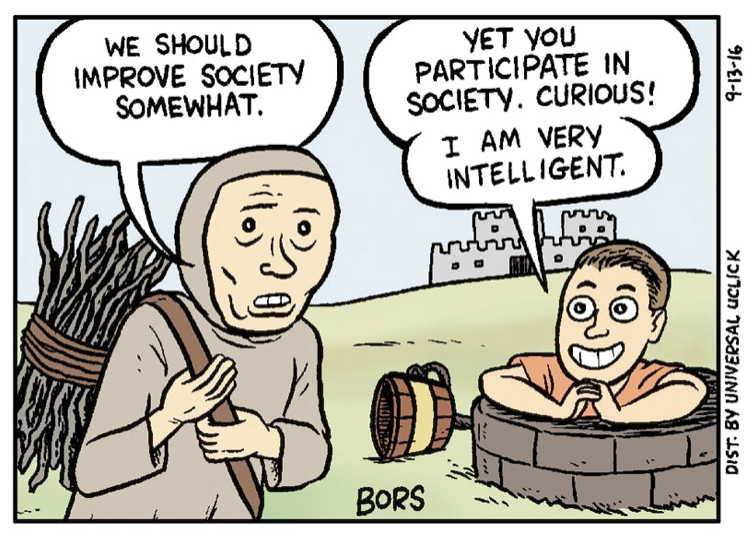
    These feelings aren’t mutually exclusive, although I’m sure Mr Gotcha will be along in a minute:

    Image: a man says "we should improve society somewhat". Another man bursts out of a well to say "Yet you participate in society. Curious! I am very intelligent"
    https://thenib.com/mister-gotcha/
  • The dark money behind “concerned parents”

    I’ve written before about the links between the Religious Right and supposedly grass-roots pressure groups with “reasonable concerns” about inclusive education, trans kids and so on. Writing in Byline Times, Sian Norris details some of those links.

    Groups such as Parent Power, Authentic RSE, 40 Days, and the School Gate Campaign provide a Trojan horse for beliefs around ‘family rights’ and so-called ‘gender ideology’ – a term used by the far and religious right to discredit the fight for reproductive and sexual rights. Their attacks on RSE help to mainstream a narrative attacking women’s and LGBTIQ rights.

    You don’t need to dig too deep to find the connections between these groups and the usual anti-abortion, anti-LGBT+ organisations. Sometimes they share the same offices, or the same lawyers, or the same key people.

    …by using a Trojan horse of parental freedom and moral panic, the UK’s religious right has created a network of astroturf groups that provide cover for a far-right ‘family rights’ agenda.

    None of this is particularly hidden. You can find the links between, say, a supposedly pro-gay but definitely anti-trans lobby group and the US Heritage Foundation on a founder’s Facebook page. Until very recently the Hands Across The Aisle website, a US evangelical project, proudly listed the UK anti-trans groups and writers it had brought together with US evangelical groups. Anti-abortion, anti-inclusive education and anti-trans groups share resources and legal counsel. The use of crowdfunding, where donors’ identities can be kept a secret, has put half a million pounds into supposedly grass-roots UK anti-trans groups in the last two years, and many of those crowdfunders were promoted overseas by US religious groups. Supposedly grass-roots groups with no apparent source of income suddenly find themselves able to pay for multiple full-page newspaper adverts. And so on.

    This is happening in plain sight, and yet whenever well-funded, well-connected lobby groups representing the Christian Right or its interests go on TV or radio they are described as “concerned parents” or “family campaigners”, the children the use to front their legal test cases just ordinary kids rather than pawns in a culture war. If the people in media giving these groups an uncritical platform aren’t aware of who they really are, they’re incompetent. And if they are aware, they’re complicit.

  • You’re wrong about Stonewall

    I never thought I’d find myself listening to a documentary about syphilis in 1930s America, but that was before I discovered You’re Wrong About. It’s a podcast that challenges the prevailing narrative about significant people and significant events, and the documentary in question is about something I hadn’t heard of before: the Tuskegee Syphilis Study, something that started with good intentions but which degenerated into something really awful. The first episode (it’s a two-parter) is utterly compelling and like all the episodes I’ve heard so far, based on exhaustive research and interviews with key experts.

    I came to the podcast because of its episode about the demonisation of the musician Courtney Love, who I’m fascinated by. Love is the widow of Nirvana frontman Kurt Cobain and a successful rock star in her own right (the Live Through This Album is as good as anything Nirvana ever did). She was treated horrifically when he was alive and worse after his death. Even if you’re not interested in music or knowledgeable about Courtney and Kurt, her story is a pretty savage indictment of misogyny in the music business, in music fandom and in the entertainment media.

    What I liked about the podcast’s take on it was its refusal to take a simplistic view. While it successfully debunked the demonisation of Love, it didn’t attempt to paint her as an angel either. She is a complicated, flawed, human being who’s made a lot of mistakes and who’s experienced some truly terrible events. The podcast argues that it’s possible to understand and empathise with someone without necessarily liking them or wanting to be their best friend.

    The episode was great, so I listened to more. I think my favourite so far is You’re Wrong About… The Stonewall Uprising, which tells a familiar story – the Stonewall riot, often seen as the Big Bang of the LGBT+ rights movement – in a very thorough way. Some of the people we think were there were not there, some of the things we think happened didn’t, and the story doesn’t fit into the neat little boxes people would like it to.

    One of the things that the episode is particularly good on is the erasure of the people who were actually involved: disproportionately drag queens, trans women of colour, sex workers and street punks. But the statues memorialising it, and much of the media portraying the legend of it, focus on white cisgender people.

    If you’re looking for a metaphor for how the gay rights movement excluded (and in some cases continues to exclude) huge swathes of the LGBT+ community, that one’s hard to beat.

    If you’re looking for something interesting to get your ears around, there’s more about You’re Wrong About here.

  • Your doctor, your teacher, your ambulance driver

    The UK edition of The Guardian hasn’t exactly covered itself in glory with its coverage of trans-related issues – this week marks a year since it last commissioned any UK-based trans writer on the topic despite running many, many pieces by anti-trans writers in the same period. So this, a feature about trans key workers in COVID, is a pleasant surprise.

    With the coronavirus pandemic as a backdrop to the event [Trans Pride London], we spoke to five trans key workers about their experiences over the past six months.

    It’s an interesting read about five interesting people.

    Update:

    Writer and researcher Robin Craig suggests on Twitter that articles whose basic message is “trans people have jobs, are maybe not freaks” are deeply patronising. It’s a fair point. I don’t think that was the writer’s intention and I think that humanising trans people instead of demonising them is of course an improvement for a paper that’s been very guilty of the latter. But in context it does feel awfully close to “hey, maybe we shouldn’t be nasty to all the trans people! One or two of them might be useful!”. Your worth as a human being is not dependent on having a job that’s useful to others.

  • A short rant containing several swear words

    Like most bloggers, I write in character: the character is a version of me, but it’s not the me that’s sometimes too sad to get out of bed or so angry I could twat somebody in the face with a shovel. So forgive me if I break character for a moment.

    I am so, so tired of every new day bringing a fresh edition of The Sinister Silencing Wokerati Thought Police Trans Mafia Demand X It’s Political Correctness Gone Maaaaaaaad culture war bullshit.

    I wish that the people who so loudly claim to have been silenced actually were, because the noise they make is deafening. Every single day trans and non-binary people are vocally blamed for some pointless non-story that’s got fuck-all to do with us and that none of us give the slightest fraction of a shit about.

    I don’t care if you write “woman” or “womxn”, what the dictionary definition of female is, or any of the other pointless, manufactured nonsense that we get blamed for in this idiotic outrage economy. I’ve never met any other trans or non-binary people who give a shit about these things either, because the reality for many of us is that we have so much real-world shit to deal with that there simply isn’t any room in our brains for inconsequential bullshit.

    But inconsequential bullshit is the only thing people want us to talk about.

    Trans journalists are never invited on air to talk about healthcare, homelessness, hate crimes or any of the other horrors that disproportionately affect our community. They’re only allowed on to play fixed roles in a pantomime, the story set by whatever has been trending on Twitter, the questions framed in much the same way as “when did you stop beating your wife?”

    And that’s if they’re given airtime at all. Most of the time you’ll hear cisgender people talking to other cisgender people about what they claim trans and non-binary people think and want (or as they put it, what activists are demanding). They talk about us without us.

    If people actually asked what we cared about, we’d happily tell them. We’d tell them about being made to wait years to get basic healthcare, or for some of us being refused it altogether. We’d tell them about being unable to go for a piss without fearing for our safety. We’d tell them about what it feels like when most of the press repeatedly tells most of the country that we’re dangerous, deluded deviants. We’d tell them that sometimes the weight of this means that some of us are so scared or so sad we can’t leave our homes.

    Maybe, and it’s a very big maybe, maybe one day that will all be solved and we’ll finally have the luxury of caring about what particular spelling of a word is used by an organisation we don’t deal with in materials we’ll never read. But I doubt it.

    In the meantime, the agenda of The Sinister Silencing Wokerati Thought Police Trans Mafia is the same as it’s always been: for the love of God, leave us alone.

  • I would go out tonight, but I haven’t got a pelvis

    One of the key tenets of anti-trans activism is that you cannot deny biological reality. Many of the people who say this have a very shaky grasp of human biology.

    I don’t even mean their knowledge of endocrinology, cytogenics or other sciencey stuff that demonstrates humans are much more varied than you might have learnt when you were 11. I mean their knowledge of basic things, such as where tits come from or what hormones are in your body.

    For example, I’ve seen very many examples of anti-trans people flatly denying that trans women can grow breasts, which is news to the useless lumps of fat currently sitting on my chest. I’ve also seen many examples of women claiming that cisgender women don’t have testosterone (they do), or that hormonally or surgically transitioned trans women’s testosterone levels are many times higher than those of cisgender women.

    For pre-menopausal cisgender women, normal testosterone levels are between 0.3 and 2.4 nanomoles per litre, aka nmol/l (if you’re interested, cisgender men’s T levels vary from around 8 nmol/l to 35 nmol/l).

    Trans girls who are prescribed the most common GnRH agonists, medication that suppresses testosterone, will have levels of less than 1.0 nanomoles. Trans women like me who have regular GnRH injections, or trans women who have had some form of gender confirmation surgery will normally have testosterone levels of 1.7 nmol/l or lower. 

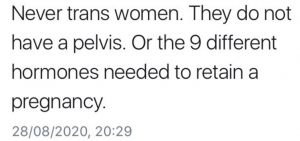
    But this one is particularly special. It’s from a discussion about the possibility that one day trans women might be able to bear children, and it includes this bombshell.

    That’s right. Trans women don’t have pelvises. No wonder anti-trans activists find us so easy to spot: because our femurs have nothing to anchor to, we don’t walk like other humans. We undulate our way through the streets, wincing in discomfort. We’d take a break by sitting down but of course, you can’t really do that when you don’t have a pelvis.

    It’s fun to mock, but as ever there’s a serious point here. There’s significant overlap between people who believe trans people don’t have pelvises or that cisgender women don’t have testosterone and people who think Bill Gates is using 5G CIA Wi-Fi to spread coronavirus and microchip their children. Whether they’re anti-vax, anti-mask or anti-trans (and many are all three), they’re science deniers.

  • The rights we are denied

    A popular anti-trans “gotcha” is to ask, “what rights don’t trans people have?” The question is never asked in good faith, so trans people generally ignore it: it’s the same assholes with the same bullshit all over again shouting “debate me, cowards!” But by not answering it, it enables the bad faith poster to claim that we didn’t respond because we can’t answer.

    So let’s answer it. Bear in mind this is a blog post, not a piece of research, so there will be tons of things I’ve missed out.

    The rights we have vary from country to country, and many of them are detailed in this annual study. Here’s a more accessible summary of some of the key issues by Katie Montgomerie.

    For example in some countries trans people cannot have legal gender recognition without forced sterilisation, a breach of their human rights. Technically that isn’t the case in the UK, but the Gender Recognition Panel’s focus on surgical and hormonal transition – both of which lead to sterilisation – means that in effect, it’s much the same here. Our legal gender recognition also requires a mental health diagnosis even though being trans is not a mental health problem.

    In the UK, it’s still legal to force trans and non-binary teens into dangerous and damaging conversion therapy to try and “cure” them.

    There are other rights. We do not have the same right to healthcare as you do: NHS waiting lists shouldn’t exceed 18 weeks, but for trans people they are at least two years and in some cases more than four years long. Seven percent of trans people have been refused health care altogether because they are LGBT.

    We do not have the same right to safe workspaces as you do. One in eight British trans people has been assaulted at work by a co-worker or customer. Half of trans people hide or disguise their gender identity at work because they fear discrimination.

    We do not have the same rights to live free from discrimination and violence. Two in five trans people and three in ten non-binary people have experienced hate crimes because of their gender identity. For younger people the numbers are even higher. Half of us are scared to use public toilets for fear of abuse or assault. 44% of us avoid certain streets because we don’t feel safe.

    We do not have the same rights to marry as other people do. Without legal gender recognition we cannot marry in our correct gender.

    And crucially, there are rights we supposedly have on paper but do not have in reality. It’s illegal to discriminate against people because of their gender identity but one in three employers say they wouldn’t consider hiring a trans person. 25% of trans people have been discriminated against in housing. 29% of social services users have experienced discrimination. 34% of young trans people have experienced discrimination in social places such as restaurants or bars. One in seven trans students has considered dropping out of university because of their experiences of harassment and discrimination.

    Finally, there are the rights we have and that others want to take from us. Here in the UK those rights include the rights set out in the Equality Act. In the US, those rights include the right to basic and even emergency healthcare.

    “What rights don’t trans people have” is the bigot equivalent of “what have the Romans ever done for us”. But it’s a lot less amusing.

  • Trans healthcare has been privatised

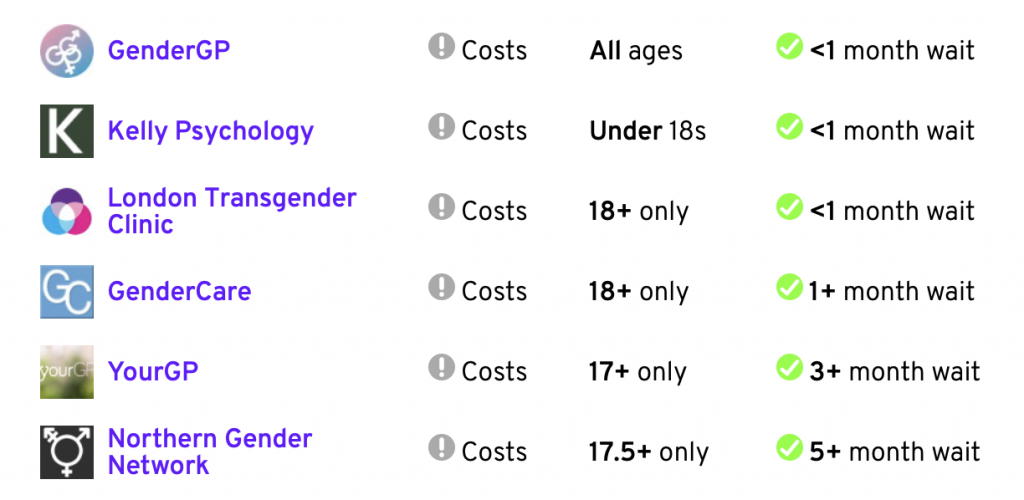
    Genderkit has collated the latest waiting list information for UK trans healthcare and it’s the grimmest read yet: there isn’t a single gender clinic for adults that has a waiting list of less than two years, and those waiting lists are growing ever longer.

    This image is telling: the only clinics without years-long waiting lists are the ones in the private sector.I’ve experience of this; I was a private patient with GenderGP while languishing on an NHS waiting list.

    What’s effectively happened here is that trans healthcare has been privatised. If you can’t afford to pay privately for your healthcare you can expect to wait many years before getting a first assessment and months or years more for any kind of treatment.

  • The ego has landed

    I’ve always considered myself to be terribly shy. That probably seems weird given that for most of my adult life I’ve been the singer in bands, but performing in front of people was always something I felt forced to do, not something I wanted to do. That’s because I had terrible stage fright, stage fright that sometimes made me physically sick hours before setting off for a venue.

    I had the same stage fright in radio studios even after years of doing shows. A different studio or a different presenter would bring the icy-stomach terror right back, as would the slightest hint of a camera: I’m fairly comfortable in front of a microphone but I’m incredibly camera shy.

    Not any more.

    In the last couple of weeks I’ve been the subject of a professional photo shoot, performed in front of cameras for two live-streamed concerts, played some solo songs for a radio session and made a complete fool of myself in front of multiple cameras as my band was filmed for a live video.

    It’s been brilliant.

    I don’t think I’ve ever had so much fun.

    That’s quite odd, I think. You’d think that as a trans person who really hates their body and how they look the last thing I’d want is to be filmed or photographed. And if I’m honest, I’m not mad keen on seeing the results of the filming or the photography. But I am very much enjoying being filmed and being photographed while I wave my guitar around like I used to wave a badminton racket in my bedroom while pretending I was playing Top of The Pops. It’s as if I’ve spent years pretending to be a recluse like Enya when I was Bono all along.

    I think a big part of this is that since coming out, I’ve stopped caring what other people think. That’s partly a survival mechanism – if I worried about what other people might think of me, I’d never leave the flat – but it’s also profoundly liberating. Instead of stage fright I have nervous, puppyish excitement; instead of trying to act cool I’m quite happy to make a complete arse of myself.

    And I think that’s a very visible demonstration of where my head’s at right now. I’m more confident than I was, more comfortable in my own skin, less fearful and less apologetic.

    In one of the songs we filmed yesterday, “I could never be your girl”, I sing this. And I mean it.

    I belong right here, I’m a woman on a mission
    I’m not looking for approval 
    and I don’t need your permission