Category: LGBTQ+

  • Profits of doom

    This graph is astonishing, if unsurprising: the UK press is publishing an average of 38 articles about trans people per day, most of them negative.
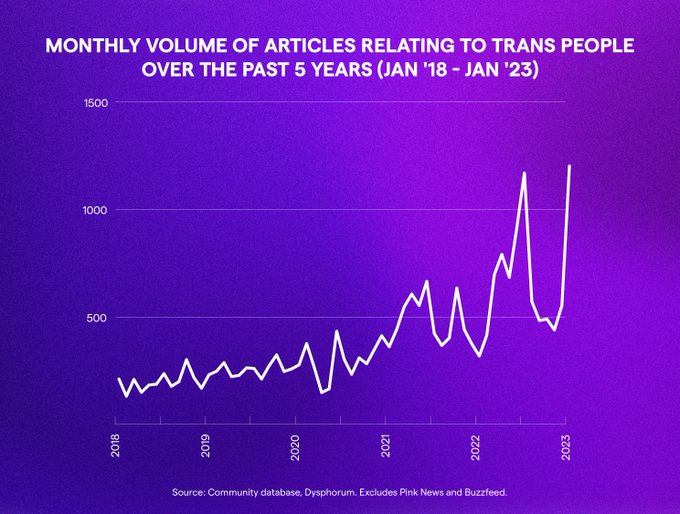
    Graph showing relentless rise of transphobic articles

    Writing in advertising industry site Outvertising, Marty Davies makes it clear that brands, via advertising, are funding this – and that online advertising incentivises it.

    “We’re finding ourselves funding a forever intensifying, never-ending campaign of hate against the trans community. The World Association of News Publishers assessed that over 50% of news publisher revenue comes from advertising. The ‘gender critical’ journalists are pumping out execution after execution of this hate campaign and are paid generously from our hands. This campaign is setting the news agenda and leading our whole media and politics to become infected by its poison.

    It’s important for us also to consider the role of our social platforms and broadcasters in this ecosystem. They also have questions to answer. TV and Radio broadcasters are platforming ‘gender critical’ voices unchallenged – framing anti-trans narrative as ‘legitimate concerns’. Sensationalist stories act like kindling for conversation across social platforms, allowing hateful views to burn like wildfire and become reinforced in algorithmic bubbles. Hate speech is commonplace and sanctions from platforms on users are slow if forthcoming at all. This commentary then provides content to be platformed and amplified by the media vying for attention to then sell on to us advertisers.”

  • Say their names

    While the press continue to pretend that people who aren’t trans are being rushed into irreversible medical treatment, trans people continue to die from inadequate healthcare and disgracefully long waiting lists.

    The coroner’s report into the suicide of 21-year-old Northern Irish trans woman Sophie Williams, a report released this week, found that multiple failings by the NHS contributed to her death. This is from her family’s solicitor:

    “Two days before her death Sophie was informed by the Tavistock GIC that the four years that she had spent waiting for a first appointment at Belfast’s equivalent GIC service would not be recognised by the Tavistock, news that was devastating to Sophie. Sophie died on 20 May 2021 having taken an overdose of prescription medication.”

    This week would have been the 21st birthday of another young British trans woman, Alice Litman. She too took her own life after languishing for years on a waiting list. According to The Good Law Project:

    “Alice’s family believes her death was partly a result of not getting the care she needed, because she was transgender… at the time of her death, Alice had been on an NHS waitlist for nearly 3 years. Alice’s family feel that this long wait may have been too much for her to bear.”

    If Alice and Sophie weren’t trans, their deaths would be national scandals – as would the murder of 16-year-old Brianna Ghey just weeks ago. But it’s very clear that to much of our media and many politicians, trans lives simply don’t matter.

  • Number crunching

    “Average use of the word ‘trans’ in UK media stories about Brianna Ghey: 0.5

    Average use of the word ‘trans’ in UK media stories about Isla Bryson: 16,427.1

    The first is a victim of a terrible crime, likely targeted for being trans; the latter a perpetrator of a terrible crime, in which her trans status has no bearing.”

    Andrew Carter

  • Poisoned pens

    Jude Doyle knocks it out of the park yet again with an incisive analysis of the increasingly poisonous New York Times:

    “Transphobia has been an unacknowledged norm of “objective” journalism for a very long time. It’s been an unacknowledged cultural norm for much longer. Yet it is still transphobia—still bigotry, still lethal—no matter how unconscious it may be. In 2023, when trans people are at the red-hot centre of a culture war and trans healthcare is being attacked in dozens of state legislatures across the nation, it is not a form of ignorance that any journalist can afford.”

    The superb If Books Could Kill podcast has just published an episode about the same thing, and comes to very similar conclusions about the polite bigotry of the paper of record.

    You could write a very similar article or episode about the UK.

    As Doyle also writes – and this is something that’s widely known among trans people who pay attention to the media, but still utterly shocking to see when it’s stated so baldly – “It’s a tough topic, media transphobia. It’s complex. It’s nuanced. You can almost forget that top editor Ian Katz — formerly the deputy editor of the Guardian, then the editor of BBC’s Newsnight, now head of programming for Channel 4 — was, until quite recently, married to Justine Roberts, co-founder of TERF forum Mumsnet, and that they were together for twenty-five years.”

    The links between Mumsnet, the so-called Gender Critical movement and their cheerleaders in the press and broadcast media would make a great Private Eye piece. Or at least it would if Private Eye weren’t part of the same incestuous bubble of bigotry.

  • A terrible thing that didn’t happen

    On Saturday, the Daily Mail published a made-up story about something that didn’t happen. I know that is hardly news, but neither was the story. It’s just yet another made-up piece trying to spread fear of trans people, the kind of thing that ends up being quoted by politicians who want to remove our healthcare and human rights.

    The article isn’t so much a red flag as a flag shop that only sells red flags and that just got a big stock delivery from the red flag distributor. According to Tory councillor Ruth Sampson, she was in the ladies toilet of a pub when she had a conversation with a trans woman (who “towered” over her) about the absence of paper towels to dry their hands.

    The key assertion in the story is that in the absence of towels, the woman told the councillor that “I’m going to wipe my hands on my penis.” This, according to the councillor, is definitely a thing that actually happened, and it therefore proves that trans women should be excluded from the ladies and all other facilities they are legally entitled to use. To undermine this, said councillor immediately wrote to anti-trans Tory equalities minister, Kemi Badenoch, rather than speak to the police, because that’s what you do, isn’t it?

    Unfortunately for the councillor, the trans woman concerned read the article too. And her side of the story is somewhat different. She had been attending a vigil in memory of a murdered trans girl, went to a pub afterwards, and in the bathroom conversation in question she said “oh, well I’ll just wipe my hands on my jeans then”, left, and thought nothing more of it.

    Which one do you think is most likely? That a trans woman, sad from a vigil and going about her everyday business, would decide to try and intimidate a random woman for no reason? Or that a young, grasping Tory councillor thought she’d try and raise her profile among her fellow Tories with a bit of the old transphobia that seems so popular among her elders?

    The article is a case study in subtle demonisation and defamation. She won’t face any consequences for adding to the anti-trans panic, and because the trans woman isn’t named the press regulations mean the Daily Mail won’t either. It’s all grist for the mill that wants to grind trans people into dust.


  • The Onion nails it again

    When The Onion strikes, it strikes hard.

    It Is Journalism’s Sacred Duty To Endanger The Lives Of As Many Trans People As Possible

    We just made Quentin up, and that’s okay. It doesn’t mean stories like his aren’t potentially happening everywhere, constantly. Good journalism is about finding those stories, even when they don’t exist. It’s about asking the tough questions and ignoring the answers you don’t like, then offering misleading evidence in service of preordained editorial conclusions.

  • RIP, Brianna

    This is a photo of Brianna Ghey, the 16-year-0ld girl who was stabbed to death at the weekend. She was trans, but the newspapers didn’t know that at first – and when they found out, the Times went back through its news story about her and removed every reference to her being a girl.

    As journalist Mic Wright points out, it’s notable that the reporting of this particular murder – of a young, pretty, photogenic, white teenage girl – has not been reported in the same way the murders of other pretty young white girls have been.

    It’s possible to believe — and I do — that there are two terrible and cruel things at work here: Newspapers are both obscuring the relevance of Brianna’s identity and discussing her being trans in the worst possible way by deadnaming her and making other insinuations.

    We don’t yet know why Brianna was killed; the police are currently investigating whether it was, as seems likely, a hate crime. Whatever the explanation, the response within the LGBT+ community is one of absolute heartbreak. We have been trying to warn about the rising tide of anti-trans hatred in the media and online, and how that hatred is manifesting itself in the streets: hate crimes have skyrocketed, particularly against trans people, and against trans women and girls in particular.

    We’re heartbroken not just because of the senseless loss of life. We’re heartbroken because for years, we have been telling you that this is the inevitable outcome of demonising, defaming and scaremongering about trans people. The so-called gender critical people pretending to be sad about her death are only sad because it’s bad optics for their movement. They’re crying crocodile tears, because this is exactly what they want: fewer trans people. Trans people are very familiar with people urging them to kill themselves, with people trying to prevent them from getting the healthcare that’s proven to reduce mental distress, with people urging others to take action to prevent them from existing safely in society.

    As Helen Joyce, writer of the utterly disgraceful Trans and one of the UK’s most prominent anti-trans activists has said, trans people – all trans people – are “a huge problem for a sane world” and we must reduce their numbers. It looks like she’s getting her wish.

  • “Forbidden knowledge”

    One of the many frustrating things about the current anti-trans moral panic is that supposedly reputable journalists are fuelling it with bad faith “just asking questions”, the answers to which are easy to find.

    This damning piece about the New York Times is just as appropriate to many other publications, including most of the UK press.

    “The ordinary liberal reader may be squeamish about this or that aspect of abortion, but they are fundamentally committed to the idea that abortion patients and their doctors are the ones best equipped to figure out what to do with a pregnancy. It is not the job of some outside party or institution—a controlling parent or spouse, a church, a Republican legislative majority, a major national newspaper—to step in and second-guess what they do with their bodies. 

    For trans care, this liberal theory of autonomy and decision-making is cast aside. The theoretical Times reader is ready to consume 15,000 words about the risks, controversies, and downsides of contemporary gender treatment because, at bottom, they are assumed to be dismayed by it all. An abortion patient is really pregnant, but trans youth—children who “say they’re transgender,” as the Atlantic put it back in 2018—maybe aren’t really trans, or wouldn’t be, if they had more time and better information.”

  • Honesty

    We’ve been trying to tell you for a long time that the goal of anti-trans activism and legislation is to eliminate trans people from society and to prevent trans people from transitioning. And one of the reasons we know that is because the anti-trans activists and legislations make it very clear that that’s their goal.

    In a new New York Times article, one of the key figures behind that activism and legislation admits it. Terry Schilling, leader of the American Principles Project (which has been working in tandem with the Alliance Defending Freedom, one of the key drivers of anti-trans cases in the UK) put it baldly:

    Mr. Schilling, of the American Principles Project, confirmed that his organization’s long-term goal was to eliminate transition care. The initial focus on children, he said, was a matter of “going where the consensus is.”

    One of the most frustrating things about this whole movement is that they’ve never made a secret of their aims or their strategy: it’s been publicly documented (by the anti-trans movement) since evangelicals’ conferences and strategy documents back in 2017. And there’s similar honesty in the Women’s Declaration, which has been signed by most of the high-profile anti-trans activists and groups in the UK: it describes legal recognition of trans women as “discrimination against women and girls” and demands its “elimination” in service provision and in law.

    As Mallory Moore points out, “The Women’s Declaration is unambiguously a document for the abolition of trans people’s civil rights… It was written by Maureen O’Hara, Sheila Jeffreys (who has openly described trans women as “parasites”, and regularly as perverts and various other epithets), and Heather Brunskell-Evans (who is a major backer of antisemitic theories about the funding behind Transgenderism).”

    When people show you who they are, believe them.

  • Twenty-eight

    I’m one of the contributors to a new book, Twenty-Eight, which looks at the impact of the hateful anti-LGBT legislation that lasted from the late 1980s until the early 2000s.

    It’s generally agreed that Section 28 was a terrible stain on our history, but what people tend to forget is that the majority supported it. As Scott Cuthbertson of LGBTI Scotland recalls:

    Not a single poll supported the repeal of Section 28. That’s because a millionaire and the media collaborated to create a moral panic. Now the vast majority of the public are horrified that they ever treated LGBT people that way.

    He notes that in 2000, the year Scotland repealed the law (England was a few years later), a poll for the Daily Mail found that 54% of respondents wanted to keep the legislation in place.

    Many of the pundits and publications that contributed to the moral panic over LGBT+ people then are doing the same now.